
Facebook Safe Usage Product Warnings

I recently watched the new documentary, "The Social Dilemma." which has inspired me to cut my usage of Facebook. Rather than simply scold myself to cut FB usage, I decided to create more detailed guidance for myself (and anyone else who finds this useful):

Facebook Safe-Usage Product Warnings

A. Use FB no more than 10 minutes per day (extra time allowed for posting content I create and for exchanging private messages). Set a timer. This limited use will function like the rule many people use for potato chips: Put a handful into a small bowl instead of gobbling them out from the full bag.

B. Before any FB session, remind myself that FB is a valuable and useful platform with serious hidden dangers. Thus, using FB is like using a dangerous consumer product where the manufacturer failed to attach necessary usage warnings.

C. Remind myself that FB has been meticulously designed as a highly-sophisticated manipulation engine. In the short run, FB is addictive. In the long run, FB encourages us to think like teams instead of as individuals and this it is ripping our communities apart.

D. Only use FB intentionally, never out of boredom, out of habit or thoughtlessly. Don’t use FB unless I’m using it consciously. Avoid using FB when I’m tired or fatigued, because these are times when I am especially prone to go down the FB rabbit hole.

E. Before using FB, always ask myself whether there is a better use of my time, such as directly reaching out to a friend or choosing my own next thought process.

F. Do not access FB from my phone.

G. Keep all FB notifications turned off, except for private messages.

H. Use FB for several defined purposes only. If I stray from these purposes, turn FB off.

1. Checking out what is up with people I know well. 2. Interacting with thoughtful people. 3. Reading and sharing interesting, inspiring and light-hearted posts. 4. Connecting with special-interest FB Groups that I have consciously chosen to join. 5. Keeping an eye on FB Events that I might want to attend. 6. Sharing my photography and articles I’ve written at Dangerous Intersection. 7. Sharing well-written articles that I have found outside of FB.

I. Whenever on FB, I should strive to use the same tone and degree of kindness that I use when communicating with someone in person.

J. My FB friends will mostly be feeding me a steady diet of articles that reenforce my existing opinions. Therefore, I need to remind myself to always look beyond FB to seek out diverse sources of information, including news sources that are not in my comfort zone.

K. Repeatedly remind myself that FB’s algorithms delude users into believing that those with differing opinions are idiots who we are entitled to treat rudely.

L. Whenever I sense that I am caught in a cycle of doom-scrolling, I should shut off FB.

M. Always vet articles for accuracy before sharing anything on FB.

N. Remind everyone I meet to watch the important new documentary: The Social Dilemma.
Continue ReadingFacebook Safe Usage Product Warnings

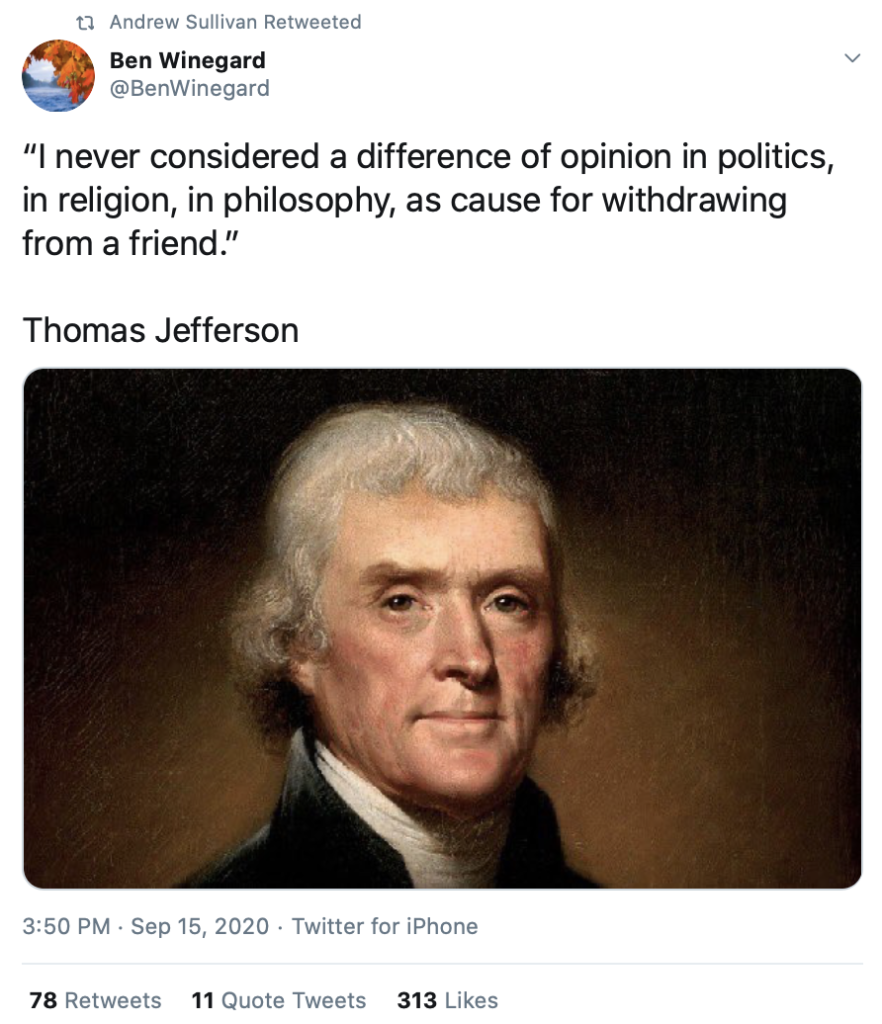
Purity Tests, Friendship and Thomas Jefferson

I see the opposite of Jefferson's wise approach commonly being celebrated on FB.

A few months ago, I was booted from a decades-long friendship by a woman who insisted, out of the blue, that I needed to acknowledge the unparalleled wisdom of the Roman Catholic Church. Ideological purity tests everywhere I look these days. This is exactly what Terror Management Theory predicts when death is in the air, when mortality is "salient."

Continue ReadingPurity Tests, Friendship and Thomas Jefferson

Babygate: Where People Allow Skin Color to Interfere with Basic Human Kindness

Have you heard about "Babygate"? The crux of the problem is that a white man affectionately held a Black friend's Black baby on his lap, at the friends's request during a meeting of the NYC Community Education Council. Members of the Council complained, indicating that this was "harmful" and that it "hurts people." The formal written accusation contained the following:

The letter characterized the lap incident as harmful: “Imagine the insult and emotional injury any thinking person, especially a person of color, suffered when they witnessed this scene and heard that comment,” it stated, calling them “shocking, disgusting, offensive, and racially incendiary.” It demanded that Wrocklage resign, claiming that allowing such incidents to continue without consequences “will only further empower the perpetuation of similar racist behaviors.

When the man who held the baby was called out, he challenged the accusers to state why this was racist. The accusers could not explain why this was racist. They told him that he needed to read Robin DiAngelo. This incident illustrates how crazed we are getting. "Anti-racist" ideology is has successfully turned innocent human kindness into a bad thing.

This recent incident and its aftermath were described in detail, then analyzed by Conor Friedersdorf of The Atlantic in an article titled "Anti-racist Arguments Are Tearing People Apart: What a viral story reveals about contemporary leftist discourse." An excerpt:

Folks who have different ideas about how to combat racism should engage one another. They might even attempt a reciprocal book exchange, in which everyone works to understand how others see the world. A more inclusive anti-racist canon would include Bayard Rustin, Albert Murray, Henry Louis Gates, Zadie Smith, Thomas Sowell, Shelby Steele, Danielle Allen, Randall Kennedy, Stephen Carter, John McWhorter, Glenn Loury, Barbara and Karen Fields, Thomas Chatterton Williams, Adolph Reed, Kmele Foster, Coleman Hughes, and others.

As long as sharp disagreements persist about what causes racial inequality and how best to remedy it, deliberations rooted in the specific costs and benefits of discrete policies will provide a better foundation for actual progress than meta-arguments about what “anti-racism” demands.

Continue ReadingBabygate: Where People Allow Skin Color to Interfere with Basic Human Kindness

Life in a Woke Upscale Progressive Private School

How are things going in one upscale private progressive school in NY for the children of a Jewish woman and her Black husband?  This is an excerpt from "My Kids and Their Elite Education in Racism: How Rye Country Day School reflects the madness of our times," by Naomi Schaefer Riley:

I fear that the message currently emanating from teachers and administrators and politicians and pundits will harm [ ] relationships. The new anti-racism, with its endless cycles of victimization and demands for reparations—as opposed to the model of teaching people to aspire to colorblindness and providing everyone with equal opportunity—requires all of us (and children in particular) to see race all the time. This new model will turn what would otherwise be ordinary, healthy relationships—friendships, even—into dramas with racially defined roles for all the characters.

The good people of my community and others around the country are told that no matter how welcoming they are, how well they treat others, there is nothing they can do to make up for systemic racism. Will they begin to fret over every interaction, fearing that they could say or do the wrong thing? . . .

I worry that the message is already trickling down. Advice columns in recent years have featured parents asking whether it’s okay for them to adopt children of another race, or whether people can ever truly understand someone of another race enough to marry that person, or whether it wouldn’t be easier for same-sex couples to use the white partner’s egg so as not to have the insurmountable task of handling a black child. Could white supremacists of 50 years ago have dared to dream of such attitudes among people who call themselves liberals?

Continue ReadingLife in a Woke Upscale Progressive Private School

Jonathan Haidt Discusses Two Versions of Identity Politics: “Common Enemy Politics” and “Common Humanity”

I've followed Social Psychologist Jonathan Haidt closely for many years (as you can see by searching for his name at DI). He is the author of several excellent books, including The Happiness Hypothesis, The Righteous Mind: Why Good People Are Divided by Politics and Religion and The Coddling of the American Mind. Haidt's thought process crosscuts the prevailing two wings of political thought in the United States. In this extended interview with Joe Rogan, Haidt dissects many topics, including identity politics. He urges that this phrase encompasses two separate approaches, "Common Enemy Politics" and "Common Humanity."

Haidt also distinguishes between two prevalent types of conversations, two types of "games" being played that often make conversations frustrating. Many of us insist upon playing the "truth seeking game," while others play a game that assumes a Manichean battle where A) no one gains except at the expense of someone else, B) where people are not seen as individuals but a members of groups, and C) you can tell who someone is merely by their appearance. Much of the fruitless dialogue on social media and elsewhere makes a lot more sense once we realize that these two approaches have virtually nothing in common--they serve entirely different purposes. Just because we exchange words does not mean we are, in any meaningful way, communicating.

I'm strongly in agreement with Haidt's analysis.

Haid's distinction parallels David Sloan Wilson's distinction between science-oriented "factual realism" and group-survival-oriented "practical realism."

In addition to embedding the video of the interview, I invested some time to create a transcript of several sections of this interview, from about Min. 33 - 55. I have cleaned up the wording to omit throat-clearings and false starts, but I have worked hard to be true to the substance of the conversation.

--

Haidt – Rogan Interview

33:18 JH: You have to look at different games being played. Yale was a place that taught me to think in lots of different ways and it was constantly blowing my mind when I took my first economics course. It was like wow, here's a new pair of spectacles that I can put on and suddenly I see all these prices and supply. I never learned to think that way, where I learned about Freud in psychology or sociology. A good education is one that lets you look at our complicated world through multiple perspectives. That makes you smart. That's what a liberal arts education should do. But what I see increasingly happening, especially at elite schools, is the dominance of a single story, and that single story is life is a battle between good people and evil people, or rather good groups and evil groups, and it's a zero-sum game. So if the bad groups have more, it's because they took it from the good groups, so the point of everything is to fight the bad groups. Bring them down create equality and this is a terrible way to think in a free society. That might have worked you know in biblical days when you got the Moabites killing the Jebusites or whatever, but you know we live in an era in which we've discovered that that the pie can be grown a million-fold. So to teach students to see society as a zero-sum competition between groups is primitive and destructive.

34:22 JR: In your book, you actually identify the moment where these micro aggressions made their appearance and they were initially a racist thing.

JH: Yeah. The idea of a micro aggression really becomes popular in a 2007 article by Derald Wing Sue at Teachers College. He talks about this concept of microaggressions. There are two things that are good about the concept, that are useful. One is that explicit racism has clearly gone down--by any measure explicit racism is plummeted in American across the West—but there could still be subtle or veiled a racism.

37:27 JR It's ultimately for everyone's sake, I mean, even for the sake of the people that are embroiled in all this controversy and chaos. It would be fantastic across the board if there was no more sexism, there was no more racism, there was no more any of these things. It would be wonderful. Then we could just start treating humans as just humans. Like this is just who you are you're just a person. No one cares. What a wonderful world we would live in if this was no longer an issue at all.

JH: Beautifully put.

JR: How does that get through?

38:01 JH: We were getting there, okay? That's what the twentieth century was. We were shaped by the late 20th century. The late 20th century was a time in America in which, you know, earlier on there was all kinds of prejudice. I mean, when I was born, just right before you were born, it was legal to say you can't eat here because you're Black and so that changed in 1964-65. But it used to be that we had legal differentiations by race and then those were knocked down. But we still had social [discrimination] and it used to be that if you were gay that was something humiliating. It had to be hidden. If you look at where we were in 1960 or ’63, when I was born and then you look at where we got by 2000, the progress is fantastic on every front, so that's all I mean when I say we were moving in that direction.

Continue ReadingJonathan Haidt Discusses Two Versions of Identity Politics: “Common Enemy Politics” and “Common Humanity”