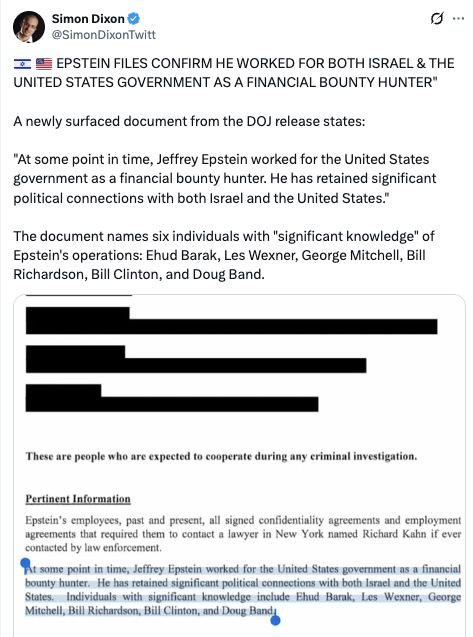
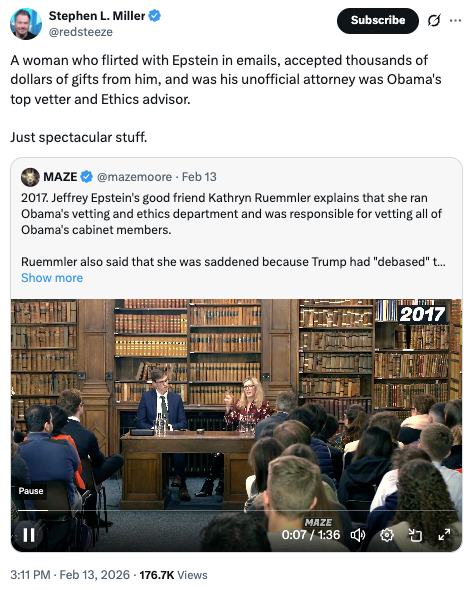
We are being kept in the dark. We elect what is really a pretend government. The majority of the people calling the shots lurk in the shadows. We've always known that big donors and corporations have an outsize influence on our politicians, but it's much worse than we suspected. It's now clear that at least hundreds of rich and powerful people worked with Jeffrey Epstein on behalf of the US security state and the Israeli government. This has been true through many administrations, as evidenced by recently released documents connecting Jeffrey Epstein's power and money to the Clintons and to Obama's WH Attorney Kathryn Ruemmler. It involves many of the DNC's most powerful funders: Reid Hoffman, Glenn Dubin, Tom Pritzker, Leslie Wexner and Bill Gates. as well as some of Trump's highest-placed people, including Howard Lutnck, Steve Bannon, William Barr and Alan Dershowitz. It involves many hundreds of documented incidents where your voice as a citizen has been nullified. You did not vote for this corrupt and degenerate plutocracy. Nor will you ever be given the opportunity to get rid of it by any sort of vote. The people who have really been in charge don't care about you or me. They laugh at our Constitution.
And have you ever noticed how there are so many news media narratives that run counter to common sense? Those narratives are being driven by corrupt power and money.
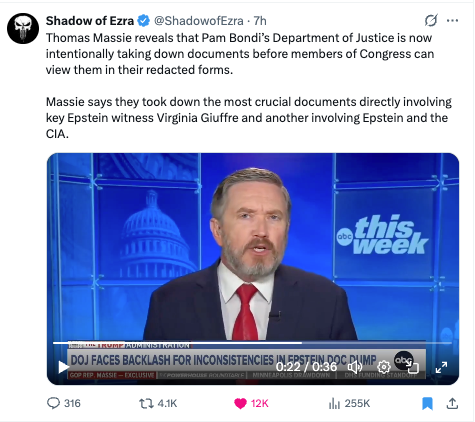
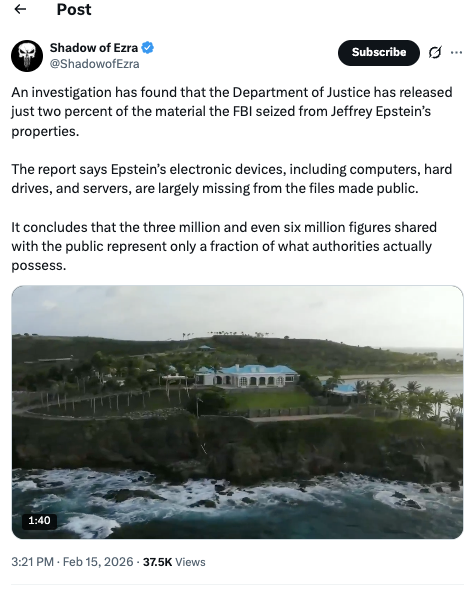
I never thought I'd say this, but the U.S. government is more than corrupt. Our country has been completely occupied by unelected people (many of them operating through NGOs) who make many of the biggest decisions, including in the areas of domestic policy, public health, finance and foreign policy. In the area of foreign policy, we already knew this from years of US obeisance to the Israeli government's political arm, AIPAC, especially evidenced by our willingness to pour unlimited $ into wars at the direction of Israel. All of this has become distressingly more clear based on the recently released Epstein files. It is equally clear that we haven't yet seen the vast majority of the Epstein documentation. Most of Epstein's data has been meticulously and obediently redacted or withheld from U.S. Citizens by unknown people on behalf of their unknown bosses. See the post/video below (by Shadow of Ezra) for more on that.
An investigation has found that the Department of Justice has released just two percent of the material the FBI seized from Jeffrey Epstein’s properties.
The report says Epstein’s electronic devices, including computers, hard drives, and servers, are largely missing from the files made public.
It concludes that the three million and even six million figures shared with the public represent only a fraction of what authorities actually possess.
You might think that what I have written sounds crazy. I would agree with you that this sounds completely crazy. If you are brave and courageous, however, visit X, search for "Epstein" and start reading the who's who list of all the rich and famous people who have been exercising their political muscle in the shadows. The more you read, the more you will appreciate the courage of a handful of our elected representatives who know that we the citizens have a right to know what has been going on. Thank you to Thomas Massie, Ro Khanna, Lauren Boebert, Marjorie Taylor Greene, and Nancy Mace, who led or supported the bipartisan discharge petition and legislation to compel the Justice Department to disclose the Epstein files.