If only I could conjure up a sprawling, complex, monied and politically-interconnected system of prophylactic gaslighting in order to protect me from any criticism at all for my own egregious misconduct. I don't have those resources.
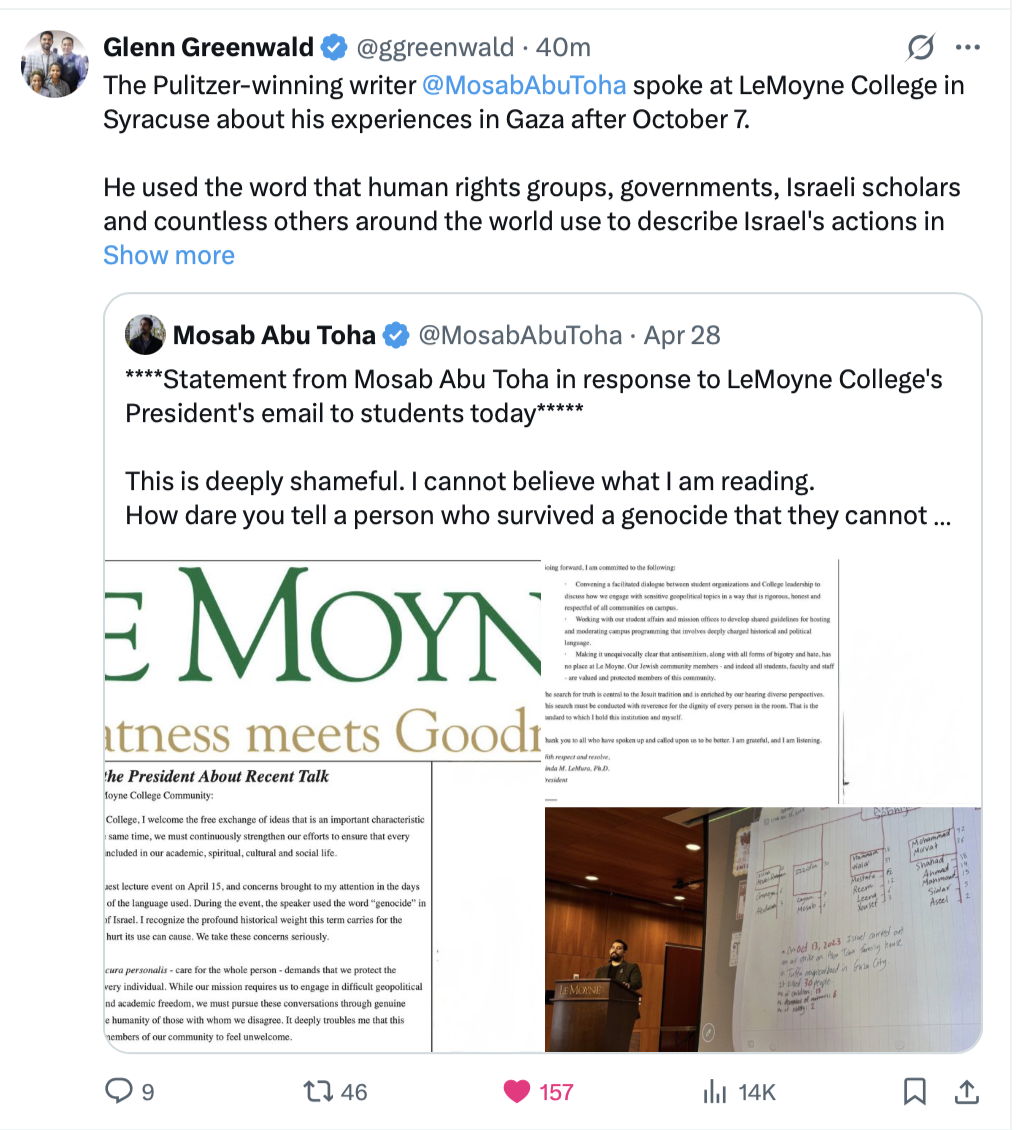
I would need a very powerful social and economic system, indeed, to sell "logic" as idiotic as this: Whenever you criticize me for despicable things I actually did, you are criticizing my puppy, the Apple tree in my backyard and my second grade music teacher. That sad state of affair is where we currently are, as Glenn Greenwald describes.
Truly, it would take an immensely powerful political/economic force to sell that level of bullshit on a nationwide basis. It would take the kind of overwhelming power capable purchasing CBS and TikTok, as well as purchasing hundreds of members of Congress through AIPAC. With that kind of power and money and reach, we now see that one could even incentivize (or frighten) a college president to implore to her college students that 2 + 2 = 5.
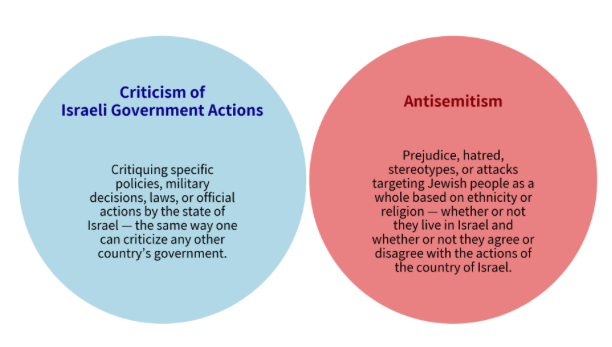
What we are seeing in these modern times is that sufficient money and power can dispense with the simple logic and clear meaning of this Venn diagram:
They hide the dead to help the "fight for freedom." Most corporate news organizations have been cheerleaders for the wars waged by the party in power. They curate the experience for you to spare you the trouble of thinking. Think of Afghanistan. And see here. Raw photography would end almost every war, so that's why you are not permitted to see the photos, especially photos of up-close suffering, maiming of civilians and death, in the corporate media. Not in Iraq, Afghanistan, Gaza, Syria, Lebanon, Iran or anywhere else that the US fights for "freedom." Robert Fisk, Robert Fisk (1946–2020) was a highly regarded British journalist and author:
I always remember when Madeleine Albright announced that Israel was under siege. For a brief moment, I asked myself, if there were Palestinian tanks in Haifa. How do we reach a stage where we so distort reality that we actually have a lethal effect on the conflict itself? The worst example of this, I'm sorry to say, is television, the way in which, unless an Iraqi is obliging enough in a war to die romantically beside the road in silhouette with all his arms still attached, you do not see the dead for viewers of television, not in the Arab world, I might add that in the West we do not see the dead, and thus our leaders, all of whom at the moment have ZERO experience of real war--the journalists do, but not our leaders in the West--they are able to present, to the public, war as a bloodless sand pit. War as something primarily to do with victory and defeat rather than death, which is exactly what is about on a large scale. War represents the total failure of the human spirit.
And I had a perfect example of this in 2003 I was in Baghdad. I was trying to get down to Basra. I got halfway, and then I was so frightened I could hardly write. And were so many bombs dropping from my own Air Force, among others, that I turned back to Baghdad. But Al Jazeera were in Basra, and they got back the same day to Baghdad with their video film, and I sat with them in their little tent. You probably realized that in a war, many of the big agencies pool their material, especially the television companies. So it was being sent through the satellite to Reuters in London, whose job was to edit the film. So of course, this was film of a civilian hospital. There were some soldiers brought in wounded and dead, but most of the pictures were of dead and wounded, women and children. They had been killed and wounded by British artillery fire in Basra. The British were besieging Basra while the Americans took the highway to claim Baghdad. And what was particularly revealing was, as they showed the film, I listened to the remarks coming back from London. You know, there were terrible scenes. It was one of a child holding its intestines and a woman with part of her hand missing. And there were screams and cries and lots of blood on the film. And the voice from London said, "You know, we can't really show this. You can't show this to people at tea time." And by this moment, I had my notebook out for The Independent, my newspaper. THIS was going to be tonight's story. So [Al Jazeera] said, "Please, please. Please, we risked our life for this. Just let us put out a little bit more of the film. Maybe you can use it." And of course, there were more pictures of blood and wounded children and dead children. And then the voice came back and said, "This is obscene. We can't put obscene pictures like this on Western television." They pleaded again by now, of course. My pen was skidding over the pages. These were great quotes, because this is what was wrong. And then the voice came back for the third and final time. "We can't show these pictures because we must respect the dead." Now you get the point. We didn't respect them when they were alive. We didn't respect them when we blew them to bits. But when they're dead, by God, we have to respect them.
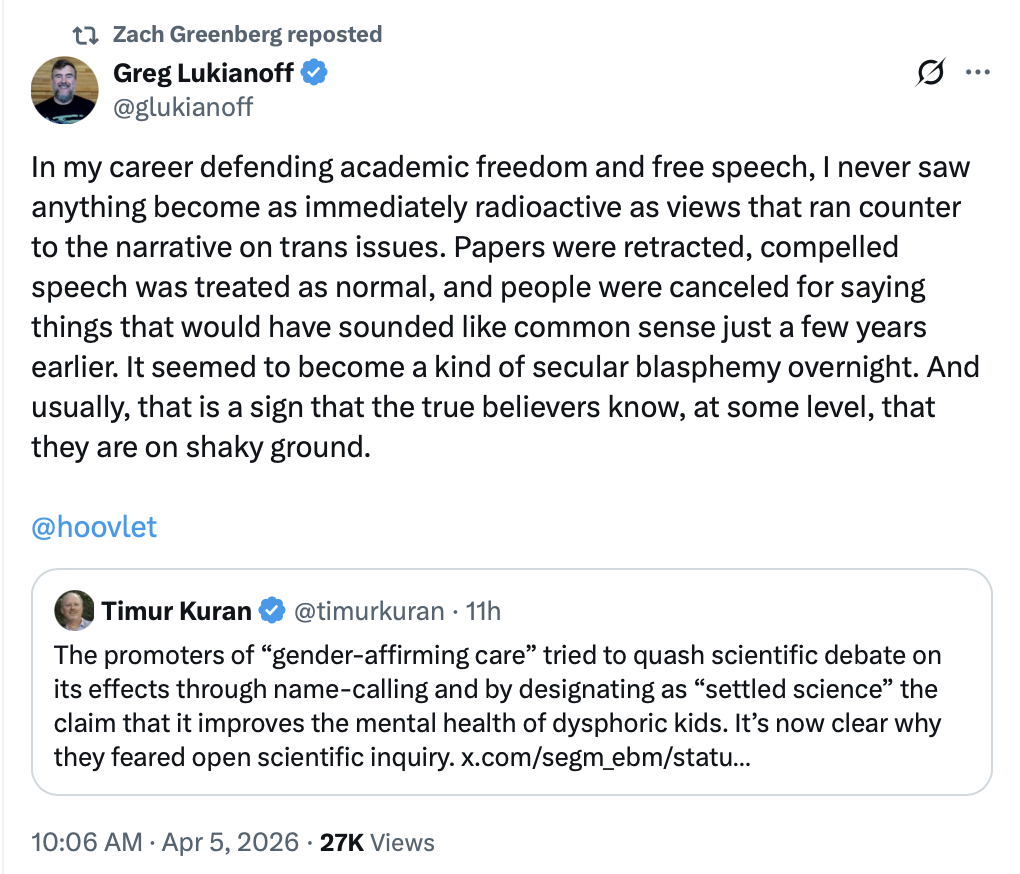
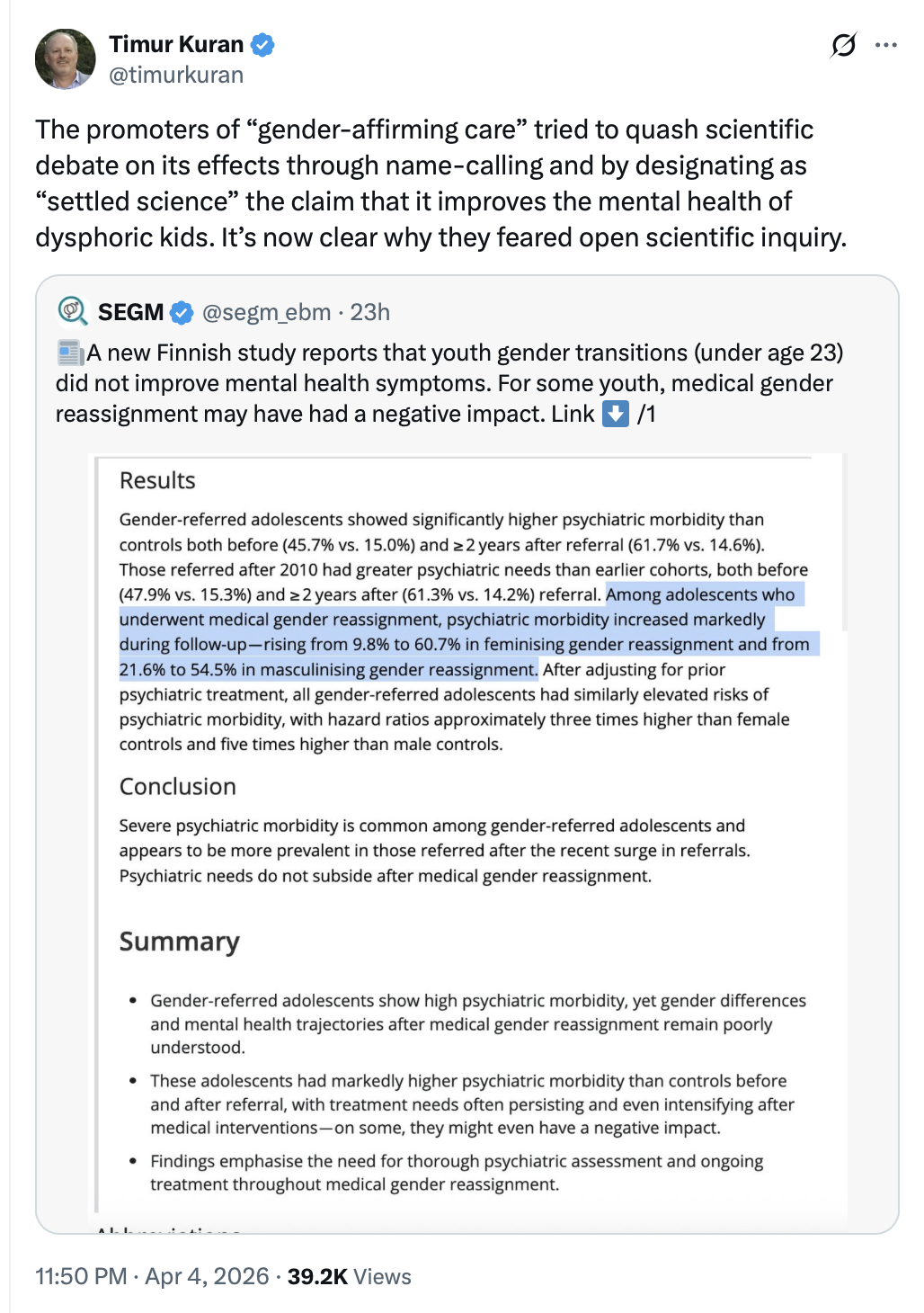
The you remember the inorganic wave of brand new "obvious" things we were all supposed to believe and say about transgender topics? I agree with Greg Lukianoff that it was surreal. I spoke up with questions and concerns that were repeatedly blasted with religious fervor. But here we are now, and it's clear that the transgender religious movement distorted everything around it, including our First Amendment rights. One big moment to upright the ship was the Cass Report. Another was the mass closing of transgender clinics. And now a new Finnish study.
[You can see many many posts on this topic (I published more than 150 articles at this site) here:
Greg Lukianoff:
In my career defending academic freedom and free speech, I never saw anything become as immediately radioactive as views that ran counter to the narrative on trans issues. Papers were retracted, compelled speech was treated as normal, and people were canceled for saying things that would have sounded like common sense just a few years earlier. It seemed to become a kind of secular blasphemy overnight. And usually, that is a sign that the true believers know, at some level, that they are on shaky ground.
Translation Tip: Whenever a politician or corporate media tells you “X,” translate it to this: Super-rich people who lurk in the shadows demanded that we tell you “X” and we usually obey them even if “X” is false or there is no evidence of “X.”
The recent Epstein document drop proves that we know only 1% of what is really going on in DC. I'm posting another tiny bit of evidence below. I could have posted hundreds of other items, but this one popped up today. We are subjected to hundreds of carefully designed nudges and psyops every day.
We can safely predict that almost none of these high-profile Epstein criminals will be prosecuted, whether they are democrats or republicans. And the corporate media will help most of them patch up their reputations when this blows over. You see, rich and powerful American people live under an entirely different set of laws than you and me.
What more do you need to convince you that we, the citizens of the US, are being systematically mis-informed? How about the many major conspiracy theories that have been proven true? How about the fact that your government and your "news media" got virtually everything wrong about COVID? That years-long comically false COVID reporting was not accidental. The journalists didn't simply get unlucky. They got everything wrong by refusing to do basic journalism in the middle of COVID. They don't care about getting the facts right because the job of the corporate media is primarily not to tell us what's going on. Unless they absolutely have to, which is when they temporarily become limited hangouts. Corporate Journalism is designed to convince us that we know what we don't really know, that we should give homage to every newly concocted false-consensus and that we should not question authority figures and "experts."
There is no way that the thousands of stories of Epstein stories of perversion and corruption were accidentally missed by the corporate media for more than ten years. This is more proof that the federal government is not YOUR government, as you were taught in grade school. In this world, your job as a citizen is to fall in line and obey. That includes supporting every new war. And most people will happily obey because because they can't stand being criticized, even when they are right. They would rather be liked than assert their rights and duties as citizens. Nothing will change because owners of this country (as George Carlin described them) own all of the sense-making institutions, and this increasingly includes the entire Internet.
We understandably love many things about the Internet, but powerful people see it primarily as a means to control our minds, because they have an unquenchable thirst for power and they don't give a shit about personal autonomy (or anything else in the Constitution). The EU's government-financed propaganda-censorship tidal wave is about to hit the US, which will bring back Biden-era internet censorship/propaganda with a vengeance. The silver lining for the sheep is that this will likely solve the problem of dissidents like me asking obvious questions that annoy many people. Congratulations. You are living in a double-feature: "The Truman Show" and "The Emperor's New Clothes."
Hello, I invite you to subscribe to Dangerous Intersection by entering your email below. You will have the option to receive emails notifying you of new posts once per week or more often.