Depends Who Said It
Fun little street experiment. Statements about Iran are bad because Trump said them. But actually, Hillary Clinton and Kamala Harris said them. Ooops. Too late to retract the venom.


Fun little street experiment. Statements about Iran are bad because Trump said them. But actually, Hillary Clinton and Kamala Harris said them. Ooops. Too late to retract the venom.
Excellent summary of 20 cognitive biases by psychologist Steve Stewart-Williams. His Intro:
The human mind is a remarkable piece of biological engineering. It’s capable of an astonishing range of feats like inventing calculus, composing rock operas, and putting spacecraft on other planets. But it’s also capable of an equally astonishing range of predictable reasoning errors. Psychologists call these cognitive biases, and they’re as common as the common cold.
In this post, I’ll outline 20 major biases that distort our judgments about evidence, ourselves, and the world. Once you learn about them, you’ll start seeing them everywhere: in politics, in the news, on social media - and occasionally even in your own thinking. (Mostly, though, in other people’s.)
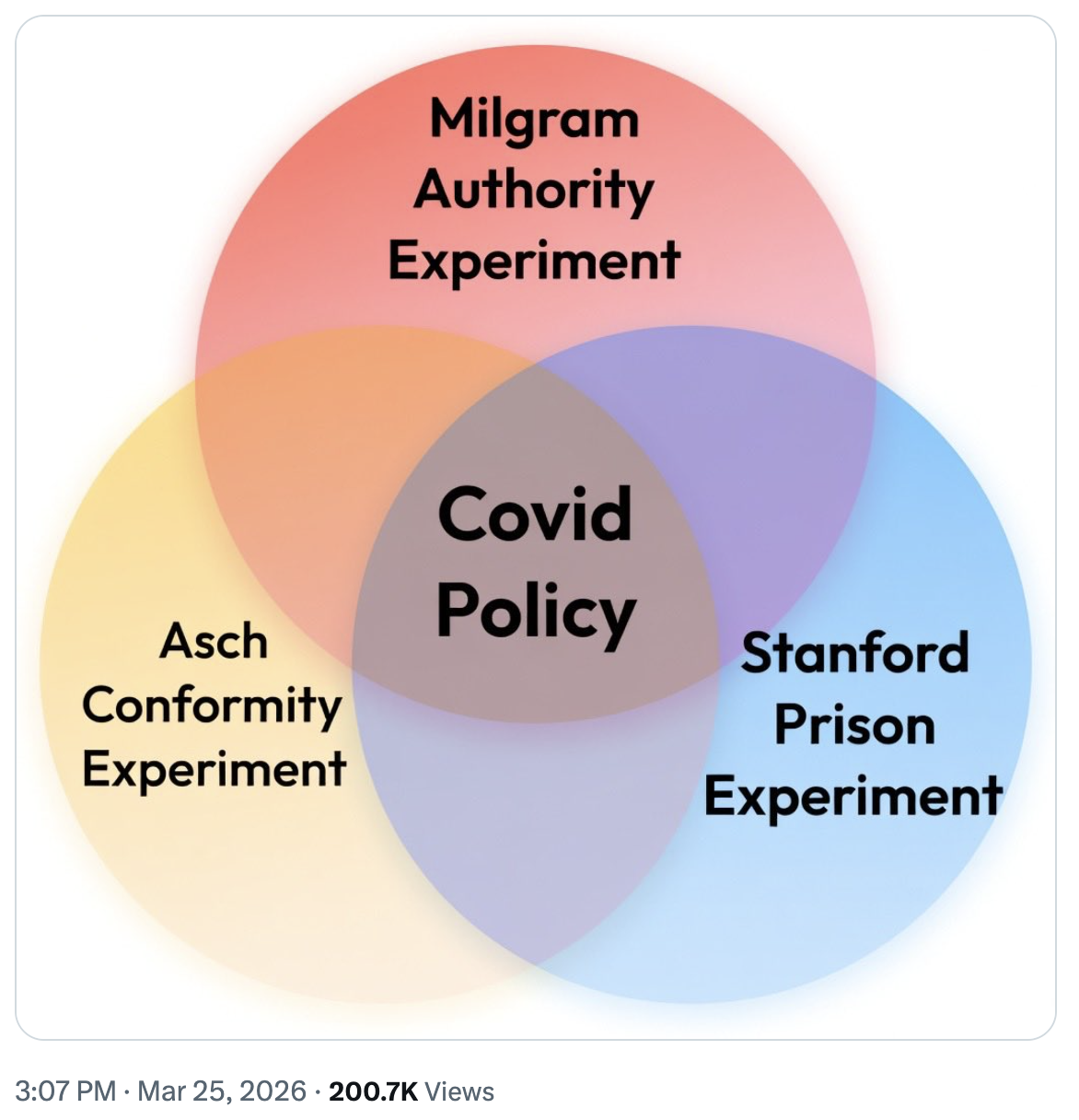
Three of the most disturbing psychological experiments in modern history placed in a Venn diagram with COVID policy sitting precisely at their intersection.Carmody's analysis on X is spot on:
Most people know the Milgram experiment. Ordinary people administering what they believed were lethal electric shocks to strangers because an authority figure in a white coat told them to continue. We wrote about this. COVID replicated it at planetary scale, the doctors, the neighbours, the employers, the family members who enforced mandates with a zeal that had nothing to do with science and everything to do with institutional obedience.But the other two are equally important and far less discussed.
The Asch Conformity Experiment demonstrated something even more fundamental. Solomon Asch showed in the 1950s that a significant majority of people will deny the evidence of their own eyes will give an answer they know to be factually wrong, simply because everyone else in the room is giving that answer. Not because they were threatened. Not because they were paid. Because the social pressure of the group was sufficient to override direct sensory experience.
This is what masking a healthy population, cancelling Christmas, and demanding that people treat their neighbours as biological threats actually accomplished. It was not about any of those things specifically. It was about training an entire population to override their own perception and defer to the group consensus, however absurd that consensus became.
And then the Stanford Prison Experiment.
Philip Zimbardo’s 1971 study abandoned early because it spiralled so rapidly out of control, showed that ordinary people assigned roles of authority over other ordinary people will, within days, begin to abuse that authority in ways they would have found unthinkable before the role was assigned. The guards became cruel not because they were cruel people but because the structure gave them permission and the institution backed them up.
We watched this happen in real time.
The COVID marshals. The border agents turning families away. The hospital administrators barring visitors from dying patients. The teachers reporting parents. The neighbours calling police on children playing in parks. The HR departments gleefully processing terminations for the unvaccinated. Ordinary people, handed a role and a uniform of institutional approval, discovering capacities for cruelty that their pre-2020 selves would not have recognised.
I think Wes Yang is correct. Persons unknown decided that they would perform a 180° turn on this issue and many others, including immigration.
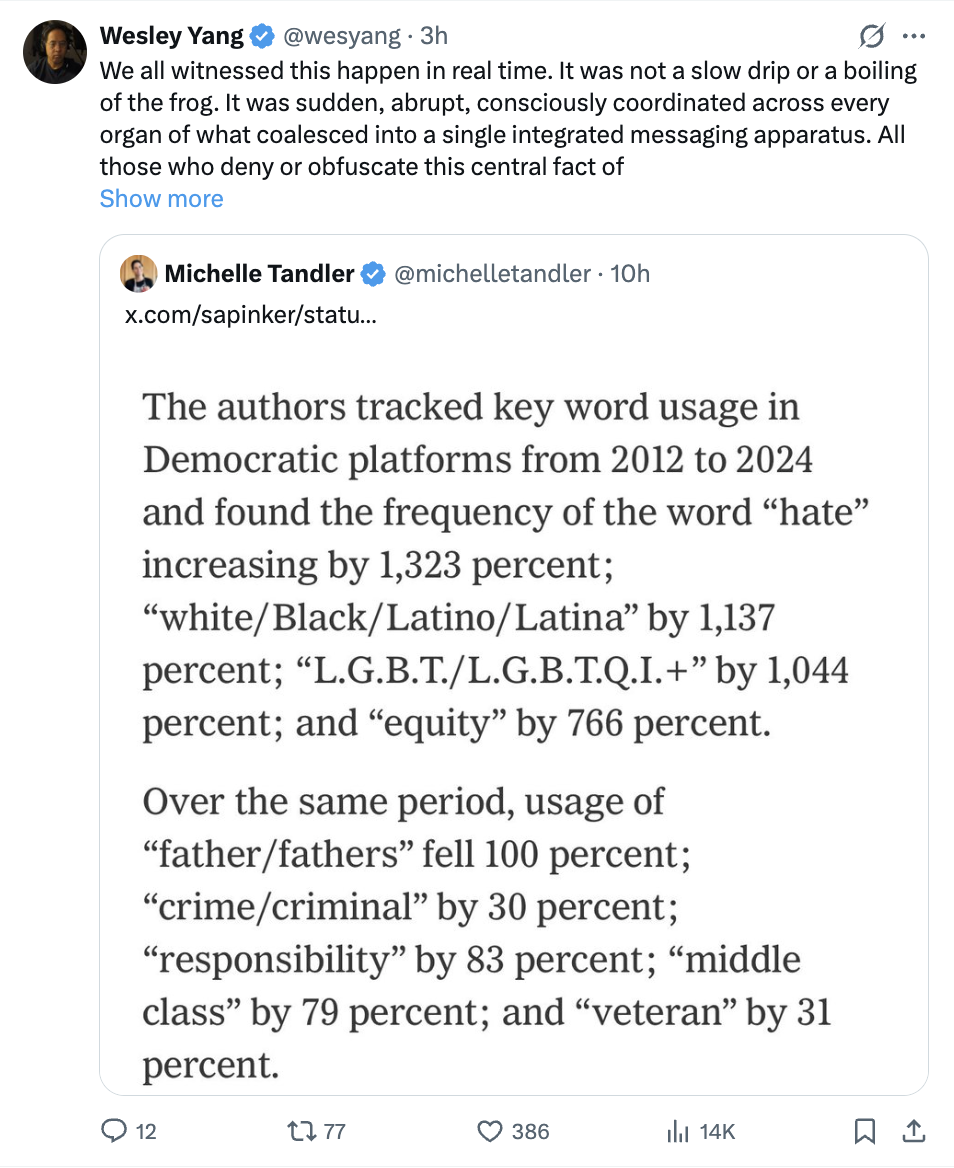
We all witnessed this happen in real time. It was not a slow drip or a boiling of the frog. It was sudden, abrupt, consciously coordinated across every organ of what coalesced into a single integrated messaging apparatus. All those who deny or obfuscate this central fact of American public life are engaged in conscious deceit.
This post leads to an opinion piece in the NYT, "‘I Wouldn’t Say the Democrats Are in Good Shape’". Here's an excerpt:
In October, the group behind the centrist Democratic WelcomePAC issued “Deciding to Win,” an analysis of “election results, hundreds of public polls and academic papers, dozens of case studies, and surveys of more than 500,000 voters” that found that “since 2012, highly educated staffers, donors, advocacy groups, pundits and elected officials have reshaped the Democratic Party’s agenda, decreasing our party’s focus on the economic issues that are the top concerns of the American people.”The authors tracked key word usage in Democratic platforms from 2012 to 2024 and found the frequency of the word “hate” increasing by 1,323 percent; “white/Black/Latino/Latina” by 1,137 percent; “L.G.B.T./L.G.B.T.Q.I.+” by 1,044 percent; and “equity” by 766 percent.
Over the same period, usage of “father/fathers” fell 100 percent; “crime/criminal” by 30 percent; “responsibility” by 83 percent; “middle class” by 79 percent; and “veteran” by 31 percent.
Finally, in November, Politico’s Elena Schneider reported the findings of a 21-state research project funded by Democracy Matters involving polling, dozens of focus groups and message testing.
“Working-class voters see Democrats as ‘woke, weak and out of touch’ and six in 10 have a negative view of the party,” she wrote . . .
Jowan Mahmod discusses the paradox of multi-culturalism in his article: "The Multiculturalism Paradox: How identity-affirming policies fuel the competitive group dynamics that weaken national cohesion."
[T]he core creed of multiculturalism: noble intentions and moral rhetoric paired with total disregard for real-world outcome . . . . Multiculturalism promotes the celebration of difference on the assumption that strengthening one’s group identity naturally produces greater openness toward, and acceptance of, others. Few ideas have been more widely embraced—and more poorly understood—than this. . . Ultimately, tolerance does not grow out of abstract ideals. It grows from loosening the grip of collective identity and seeing others not as representatives of a category but as individuals. Societies must ensure that people of all backgrounds can develop a strong sense of personal identity. This is not merely desirable but essential for any nation that hopes to remain both diverse and cohesive. Prejudice is rooted in group belonging and in the basic psychology of us-and-them. When institutions encourage people to define themselves primarily through group identity, they inevitably reinforce the very us-and-them thinking that fuels prejudice and division.A functioning multicultural society is not one that obsessively manages groups and their identities, but one that enables individuals to move beyond them and form connections based on shared human and civic values. Only then can we approach the kind of multicultural society we claim to aspire to, and that can be achieved only by loosening, not tightening, the hold of group identity.