
Hide the Photos of the Maimed and the Dead, so the War Looks Sterile, Glorious and Successful.

They hide the dead to help the "fight for freedom." Most corporate news organizations have been cheerleaders for the wars waged by the party in power.  They curate the experience for you to spare you the trouble of thinking.  Think of Afghanistan. And see here.  Raw photography would end almost every war, so that's why you are not permitted to see the photos, especially photos of up-close suffering, maiming of civilians and death, in the corporate media. Not in Iraq, Afghanistan, Gaza, Syria, Lebanon, Iran or anywhere else that the US fights for "freedom." Robert Fisk, Robert Fisk (1946–2020) was a highly regarded British journalist and author:

I always remember when Madeleine Albright announced that Israel was under siege. For a brief moment, I asked myself, if there were Palestinian tanks in Haifa. How do we reach a stage where we so distort reality that we actually have a lethal effect on the conflict itself? The worst example of this, I'm sorry to say, is television, the way in which, unless an Iraqi is obliging enough in a war to die romantically beside the road in silhouette with all his arms still attached, you do not see the dead for viewers of television, not in the Arab world, I might add that in the West we do not see the dead, and thus our leaders, all of whom at the moment have ZERO experience of real war--the journalists do, but not our leaders in the West--they are able to present, to the public, war as a bloodless sand pit. War as something primarily to do with victory and defeat rather than death, which is exactly what is about on a large scale. War represents the total failure of the human spirit.
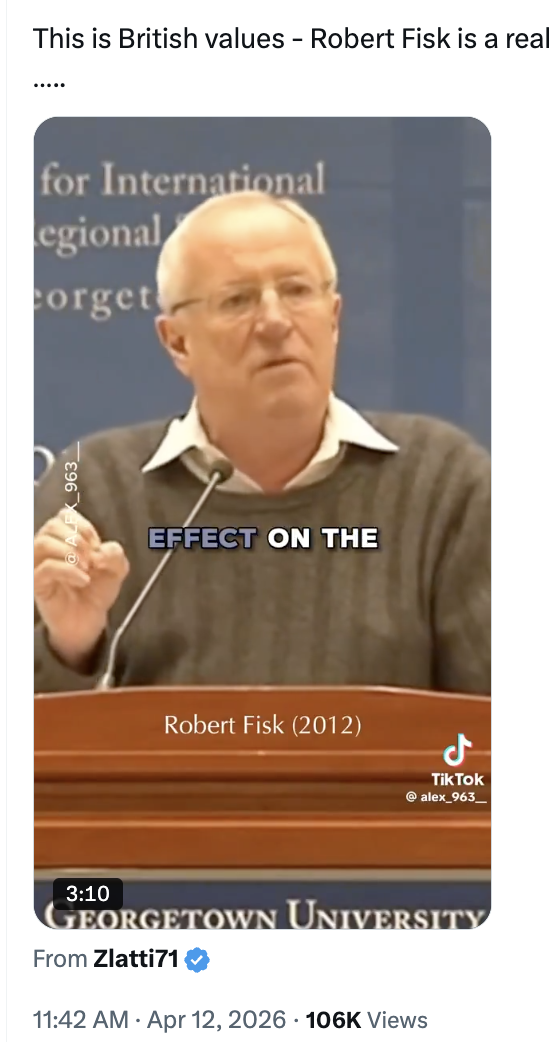
And I had a perfect example of this in 2003 I was in Baghdad. I was trying to get down to Basra. I got halfway, and then I was so frightened I could hardly write. And were so many bombs dropping from my own Air Force, among others, that I turned back to Baghdad. But Al Jazeera were in Basra, and they got back the same day to Baghdad with their video film, and I sat with them in their little tent. You probably realized that in a war, many of the big agencies pool their material, especially the television companies. So it was being sent through the satellite to Reuters in London, whose job was to edit the film. So of course, this was film of a civilian hospital. There were some soldiers brought in wounded and dead, but most of the pictures were of dead and wounded, women and children. They had been killed and wounded by British artillery fire in Basra. The British were besieging Basra while the Americans took the highway to claim Baghdad. And what was particularly revealing was, as they showed the film, I listened to the remarks coming back from London. You know, there were terrible scenes. It was one of a child holding its intestines and a woman with part of her hand missing. And there were screams and cries and lots of blood on the film. And the voice from London said, "You know, we can't really show this. You can't show this to people at tea time." And by this moment, I had my notebook out for The Independent, my newspaper. THIS was going to be tonight's story. So [Al Jazeera] said, "Please, please. Please, we risked our life for this. Just let us put out a little bit more of the film. Maybe you can use it." And of course, there were more pictures of blood and wounded children and dead children. And then the voice came back and said, "This is obscene. We can't put obscene pictures like this on Western television." They pleaded again by now, of course. My pen was skidding over the pages. These were great quotes, because this is what was wrong. And then the voice came back for the third and final time. "We can't show these pictures because we must respect the dead." Now you get the point. We didn't respect them when they were alive. We didn't respect them when we blew them to bits. But when they're dead, by God, we have to respect them.
Continue ReadingHide the Photos of the Maimed and the Dead, so the War Looks Sterile, Glorious and Successful.

Before You Complain About Anything . . .

Quote by David Sinclair, longevity researcher at Harvard:

Statistically, you should not exist:

– Life-friendly universe: 1/10⁶⁰

– Earth + moon: 1/10⁹

– Multicellular life: 1/10⁴

– Intelligence & civilization: 1/10⁹

– Your genome: 1/70 trillion

You’ve already won the lottery 10 times in a row. Ignore small people & enjoy!

Continue ReadingBefore You Complain About Anything . . .

Hate Speech is an Authoritarian Religious Concept

"Hate Speech" is a claim that some topics/claims are off-limits, that someone ELSE gets to decide what's off-limit and that you are irredeemably "bad" if you try to apply facts, logic and persuasion. Yes, "hate speech" is the modern secular authoritarian version of "blasphemy" or "sacrilege."

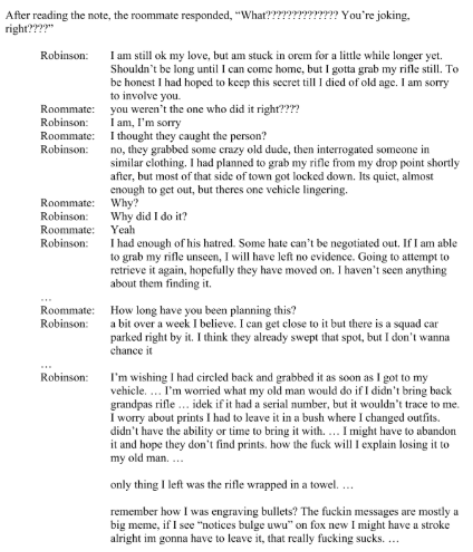
I was provoked to write the above after reading the thoughtful post below by Greg Lukianoff, who was provoked by reading this text messages between Tyler Robinson, the accused Charlie Kirk assassin, and his roommate and romantic partner, per prosecutors:

Lukianoff:

This is going to be a Rorschach test for a lot of people. What I see when I look at this is the harm of a quasi-mystical idea of “hate” as a spectral, even demonic, force. It’s a superstition that allows you to turn off your critical faculties, ignore anything that might contradict a sacred belief on a particular topic or about a particular individual — as in this case — and act with impunity.

It has always been a profoundly anti-intellectual idea, developed by those who saw intellectuals as mere tools for often extremely simplistic partisan ends to allow them to win arguments by brute force rather than logic and proof.

It has spread into the rest of society and across the globe in a way that allows taboo to defeat reason and skepticism almost every time.

I hope it’s an idea — like “speech is violence” — that we can relegate to the dustbin of history. If you believe the world is divided into a simplistic binary of “good people” and those infected with hate, then maybe the post-Enlightenment world is not for you.

And for those of us who believe that human morality and nature is more complex and less flattering than the sacred warriors in this battle, it's time to remember that Enlightenment values are not easy. But they are absolutely worth fighting for because the world without them is a place that lets you excuse the most monstrous behavior and never lose your sense of moral superiority.

That's the trap of the binary.

Continue ReadingHate Speech is an Authoritarian Religious Concept

X Explodes With Evidence that Numerous UK Girls Have been Raped by Pakistani Gangs. US Legacy News is Silent.

X is rapidly filling with credible posts providing evidence that numerous UK girls, at least 1,500, have been raped by Pakistani gangs over the years, yet the police have been covering this up and, in fact, criminally prosecuting UK citizens who try to express concerns about these rapes on social media.  Tommy Robinson's courageous reporting has been critical to bringing the issue of these UK rapes to the fore, yet Tommy is currently in UK prison for the crime of reporting on this issue.

Could the number of victims really be closer to 250,000 girls?

Consider Samantha Smith's allegations:

Bill Ackman weighs in:

Tommy Robinson's documentary, "Silenced," can be viewed here. It is gripping and horrifying. Tommy has made a very strong case and yet he sits in prison for exposing societal dysfunction and corruption:

[More . . . ]

Continue ReadingX Explodes With Evidence that Numerous UK Girls Have been Raped by Pakistani Gangs. US Legacy News is Silent.

Coleman Hughes Contemplates the End of Life

Coleman Hughes has written a personal account of the excruciating death of his mother. What follows is an excerpt from "My Mom—and the Case for Assisted Death: My dying mother chose to end terrible suffering. I want others to have that choice, too."

Instead of a slippery slope, what has emerged over the past three decades are two distinct policies: one restricted to people on their deathbed and exemplified by Oregon, Australia, and New Zealand; and the other open to anyone who is “suffering” and exemplified by the Benelux nations and Canada, without any slippage between the two. It is not a coincidence that all the horror stories come from the latter. The lesson for the rest of the world is not to throw out assisted dying altogether, but to copy the policy that works, and avoid the policy that doesn’t.

Aside from the major objections, critics have leveled many practical objections: Do doctors always know when someone has six months to live? Are fatal drugs always painless? What if relatives pressure someone to commit suicide? I may go through these one by one some other time, but here I will simply say this: Once you understand how much suffering is on the other side of this moral equation—that is, once you understand just how bad “bad deaths” are—then you must view these practical objections as problems to be addressed, rather than as reasons to jettison the whole policy.

It is commonly said that a huge percentage of our healthcare spending comes in the last year of life. But the far more important corollary is rarely said: In many cases, a huge portion—perhaps a majority—of our lifetime suffering comes not just in the last year, but in the last few months. Assisted dying therefore represents an opportunity to prevent an immense amount of needless suffering in the world. If my mother’s story can help even one person come around to this view, then I can say that she did not suffer completely in vain.

I think of these issues every so often. And I often think back to my college days when I volunteered as a counselor and trainer for Suicide Prevention in St. Louis. After doing my best for several years I left. I had had several cases where I did my best to encourage people to live another day, but where I privately wondered whether that was the kind of advice I would want were I in a situation that was truly (not merely apparently) hopeless. I'm referring to people who were terminally ill, jobless, in constant pain, who had no longer had family or friends to look out for them. People who had worked hard for months to find reasons to keep on living but no longer could. People for whom the things that once brought them great joy were no longer interesting to them.

I hope that humane people will step up to help me in my moment of need, people who have the courage to show mercy rather than to obsess about the "rules."

Continue ReadingColeman Hughes Contemplates the End of Life