Hide the Photos of the Maimed and the Dead, so the War Looks Sterile, Glorious and Successful.

They hide the dead to help the "fight for freedom." Most corporate news organizations have been cheerleaders for the wars waged by the party in power.  They curate the experience for you to spare you the trouble of thinking.  Think of Afghanistan. And see here.  Raw photography would end almost every war, so that's why you are not permitted to see the photos, especially photos of up-close suffering, maiming of civilians and death, in the corporate media. Not in Iraq, Afghanistan, Gaza, Syria, Lebanon, Iran or anywhere else that the US fights for "freedom." Robert Fisk, Robert Fisk (1946–2020) was a highly regarded British journalist and author:

I always remember when Madeleine Albright announced that Israel was under siege. For a brief moment, I asked myself, if there were Palestinian tanks in Haifa. How do we reach a stage where we so distort reality that we actually have a lethal effect on the conflict itself? The worst example of this, I'm sorry to say, is television, the way in which, unless an Iraqi is obliging enough in a war to die romantically beside the road in silhouette with all his arms still attached, you do not see the dead for viewers of television, not in the Arab world, I might add that in the West we do not see the dead, and thus our leaders, all of whom at the moment have ZERO experience of real war--the journalists do, but not our leaders in the West--they are able to present, to the public, war as a bloodless sand pit. War as something primarily to do with victory and defeat rather than death, which is exactly what is about on a large scale. War represents the total failure of the human spirit.

And I had a perfect example of this in 2003 I was in Baghdad. I was trying to get down to Basra. I got halfway, and then I was so frightened I could hardly write. And were so many bombs dropping from my own Air Force, among others, that I turned back to Baghdad. But Al Jazeera were in Basra, and they got back the same day to Baghdad with their video film, and I sat with them in their little tent. You probably realized that in a war, many of the big agencies pool their material, especially the television companies. So it was being sent through the satellite to Reuters in London, whose job was to edit the film. So of course, this was film of a civilian hospital. There were some soldiers brought in wounded and dead, but most of the pictures were of dead and wounded, women and children. They had been killed and wounded by British artillery fire in Basra. The British were besieging Basra while the Americans took the highway to claim Baghdad. And what was particularly revealing was, as they showed the film, I listened to the remarks coming back from London. You know, there were terrible scenes. It was one of a child holding its intestines and a woman with part of her hand missing. And there were screams and cries and lots of blood on the film. And the voice from London said, "You know, we can't really show this. You can't show this to people at tea time." And by this moment, I had my notebook out for The Independent, my newspaper. THIS was going to be tonight's story. So [Al Jazeera] said, "Please, please. Please, we risked our life for this. Just let us put out a little bit more of the film. Maybe you can use it." And of course, there were more pictures of blood and wounded children and dead children. And then the voice came back and said, "This is obscene. We can't put obscene pictures like this on Western television." They pleaded again by now, of course. My pen was skidding over the pages. These were great quotes, because this is what was wrong. And then the voice came back for the third and final time. "We can't show these pictures because we must respect the dead." Now you get the point. We didn't respect them when they were alive. We didn't respect them when we blew them to bits. But when they're dead, by God, we have to respect them.

Continue ReadingHide the Photos of the Maimed and the Dead, so the War Looks Sterile, Glorious and Successful.

US Corporate Media’s indifference to Netanyahu’s Support of Hamas

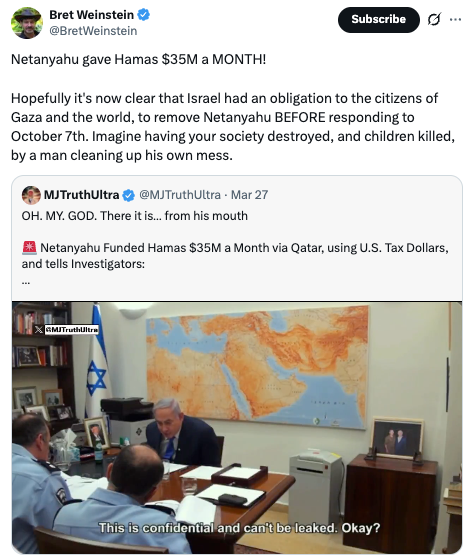
Again, things aren't what they were reported to be by the US corporate media. This video clip is from the 2024 documentary The Bibi Files (directed by Alexis Bloom, produced by Alex Gibney), which uses leaked Israeli police interrogation footage from 2016–2018. I asked Grok to double-check the translations of the letter to Qatar and the verbal statements of Netanyahu. Here's the important point: According to major U.S. corporate media outlets (such as The New York Times, CNN, NPR, and others), Israel's policy of approving and facilitating Qatari cash transfers to Gaza (under Hamas control) was not prominently explained to the American public in the immediate aftermath of the October 7, 2023 attacks. Instead, the focus was overwhelmingly on the Hamas attacks themselves, the scale of the violence, Israel's response, and initial hostage negotiations. AM.png" alt="" width="474" height="560" />

Netanyahu's statement (in the video) translated: AM.png" alt="" width="474" height="560" />

Netanyahu (in Hebrew, with English subtitles/narration in the documentary):“This is confidential and can’t be leaked, okay? We have neighbors here, sworn enemies. I’m constantly passing them messages. I confuse them, mislead them, lie to them, and then hit them over their heads.

Continue ReadingUS Corporate Media’s indifference to Netanyahu’s Support of Hamas

More on the Nord Stream Pipeline

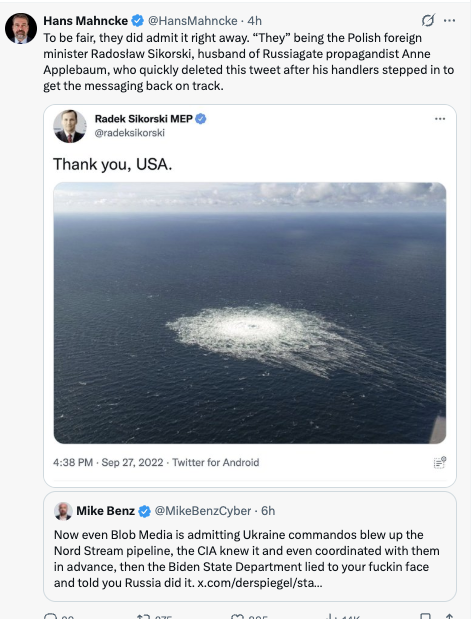
Mike Benz: "Now even Blob Media is admitting Ukraine commandos blew up the Nord Stream pipeline, the CIA knew it and even coordinated with them in advance, then the Biden State Department lied to your fuckin face and told you Russia did it."

Here's the background.  Here and here:

Continue ReadingMore on the Nord Stream Pipeline

Emily Kopp Named Editor of Racket News

Emily Kopp, yet another reject from legacy news, has been named the new Editor of Racket News. This is excellent news. Below she spells out the principles of good journalism. You can make a strong case that the OPPOSITE of each of these principles are the modern foundation for corporate news. Emily opening statement as Editor:

It was once fashionable for corporate media to prescribe what to think and for Big Tech to clamp down on free speech and debate. These days it’s in vogue to embrace a relativist attitude toward truth. No journalist can promise truth, a slippery metaphysical thing that’s especially elusive in the first moments of a crisis. The only thing we can promise is to try for it.

That’s why we’re bringing old school journalistic standards to the new school, wide-open Overton Window. If we do our jobs well, we’ll provide occasional relief from the cacophony.

Racket already had a few internal rules barring advertisers, hidden investors, and silent edits, and general guidelines about a few other things.

We’re hanging on to those, adding a few more, and preserving all of them on our website for accountability. Here they are:

No advertisers, sponsors, or hidden investors. Our content is our own.

No partisan restraints. While we support certain overarching principles, we won’t mold reporting to serve a political party or ideological project.

No predetermined narratives. Complexity should be embraced rather than soothingly papered over. We worry about being wrong, not about being unpopular.

No reflexive dismissal of even outlandish sounding theories prior to examination. However we reserve the right to dismiss (even ridicule) the outlandish theories that do not bear scrutiny.

No recycled content. We will always strive to do original reporting. Every story on Racket will have at least one phone call behind it.

Not politesse about taboos if it gets in the way of facts. But the transgression of taboos is also not something to be gratuitously courted for easy shock value.

No trepidation in the face of personal attacks and intimidation. Neither Matt nor I are stranger to these tactics.

No sacrifices on the altar of access journalism. Access to powerful people in government can facilitate reporting. But ultimately, they are bureaucrats who work for us. We’re not afraid to lose friends for an important story.

No coy sourcing. Anonymous sources may be used, but not as a matter of course. We’ll strive to connect readers to primary sources, archived as much as possible. Procuring original documents is to be a central focus.

No axes to grind. We’ll try to be right and admit when we’re wrong. Corrections are announced and left published.

Finally, the audience should always be the imagined boss. Yes, it’s our job to give you bad news sometimes. But writing with readers in mind is good practice.

Welcome to the new Racket News.

Continue ReadingEmily Kopp Named Editor of Racket News

Limited Hangout Week re Epstein “Disclosures”

If the phrase "limited hangout" is not yet part of your vocabulary, it's time to add it to your repertoire. Grok offers this definition:

A limited hangout is a strategy, often used in espionage, politics, or public relations, where a partial truth or selected information is disclosed to the public or investigators to prevent the discovery of more damaging or sensitive facts, effectively acting as a form of damage control when a full cover-up is no longer viable. The term originates from CIA jargon, as described by former official Victor Marchetti, who explained it as admitting "some of the truth when tight lips have slipped" but withholding the key details to mislead further inquiry.

Here is the only thing you can do to make sure you are not a victim of limited hangouts: Repeatedly ask: "What else have you not yet told me?" Ask this repeatedly, especially when dealing with people, government officials and corporate news outlets you have previously trusted. Consider these recent examples:

DOJ under Pam Bondi redacted a photo of Benjamin Netanyahu with Jeffrey Epstein from the files.

Redactions are admittedly an imperfect way of engaging in limited hangouts, but they work well enough often enough, given the limitations of human attention and memory.

DNC mega-donor Reid Hoffman was mentioned 2,600 times in the Epstein files. David Sachs: "The NYT story on Epstein & Silicon Valley has paragraphs on Elon, Peter Thiel … Reid Hoffman barely gets mentioned despite having the deepest Epstein relationship and having lied about it."

New York Times forgot to mention that one of its own reporters worked closely with Epstein well after Epstein was a known child sex trafficker. And see here.

The DOJ briefly uploaded — then removed — an 86-page document titled “Investigation into Potential Jeffrey Epstein Co-Conspirators.”

Amidst all the chaos, Rep Thomas Massie emerges: with some common sense:

Rep. Thomas Massie says he’s ready to use the nuclear option if the DOJ refuses to un-redact the names of Epstein’s clients. He warns he will simply start reading Epstein’s client names publicly if Pam Bondi’s Department of Justice does not release them. “If the victims want to give them to me, I’ve expressed that I’m willing to do that.” See also here.

Continue ReadingLimited Hangout Week re Epstein “Disclosures”