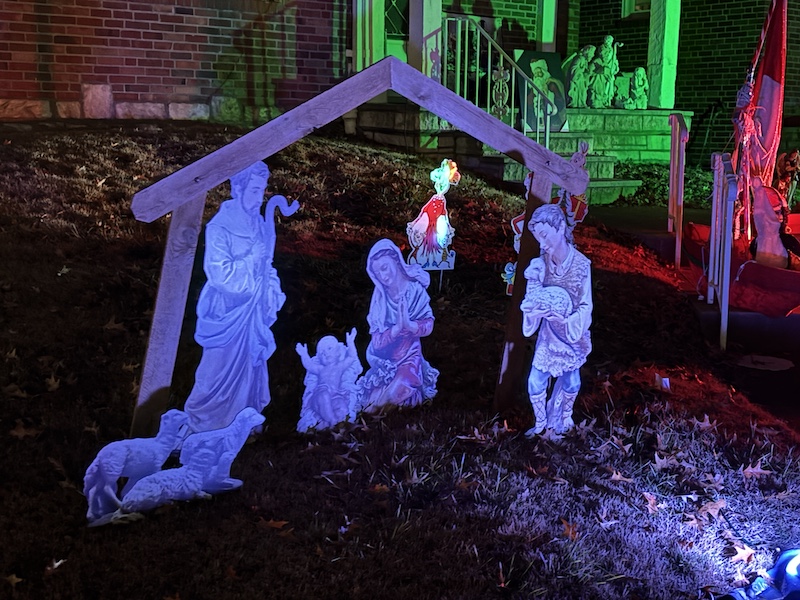
To what extent is Christmas about Jesus? On evening of Dec 18, I conducted a survey of Christmas lights in south St. Louis. I walked through neighborhoods to photograph residential Christmas displays. I walked through several neighborhoods (in the vicinity Ted Drews, for those of you from St. Louis).

I photographed every front yard that had a person or a thing on the front yard, excluding houses that merely had Christmas lights without figures. I also excluded houses with only Christmas tree images and those displaying only angels. I wanted to know the percentage of homes that displayed Jesus or the Nativity Scene. If a house displayed Jesus plus other figures, I counted it as a house that displayed an image of Jesus. I'm fully aware that this was not a scientific survey. There are likely many religious people who choose (for many reasons) to refrain from displaying images of Jesus in their Christmas front yard displays.
Out of 164 Christmas displays I photographed, only 13 (8%) displays a representation of Jesus.
At the end of this article I’ve listed many of the other personalities and objects you’ll find on neighborhood lawns to celebrate Christmas. In addition to Santas and reindeer, these figures include Harry Potter, penguins, unicorns, pigs wearing sunglasses and the Grinch.

Why would I do this survey? I was not trying to point out America’s loss of religiosity. I’m an atheist. My position is to each to his or her own. Feel free to follow a religion or no religion as long as you celebrate the right of all other people to celebrate their own religion (or no religion).

My purpose was inspired by the following passage by Thomas Sowell, from Knowledge and Decisions (1980):

Perhaps the most important feature of the first half of Knowledge and Decisions is simply its analysis of decision-making processes and institutions in terms of the characteristics and consequences of those processes themselves—irrespective of their goals. As noted in Chapter 6, this approach rejects the common practice of “characterizing processes by their hoped-for results rather than their actual mechanics.” “Profit-making” businesses, “public interest” law firms, and “drug prevention” programs are just some of the many things commonly defined by their hoped-for results, rather than by the characteristics of die decision-making processes involved and the incentives created by those processes. So called “profit-making” businesses, for example, often fail to make a profit and most of them become extinct within a decade after being founded. In Knowledge and Decisions the owners of such businesses are defined not as profit makers but as residual claimants to the firm’s income—that is, to what is left over after employees, suppliers, and others have been paid. Put this way, it is dear from the outset that what is left over may be positive, negative, or zero. There is no more reason to expect "drug prevention” programs to prevent drug usage or “public interest” law firms to serve the public interest than to expect that most “profit-making” enterprises will in fact make profits. Whether any of these organizations do or do not live up to their expectations or claims is a question of empirical evidence. Pending the presentation of such evidence, such organizations can be analyzed in terms of what they actually do, not what they hope or claim to achieve.
Is Christmas about Jesus? Somewhat, but evidence abounds suggesting that Christmas is, mostly, for most Americans, about other things, including an orgy of consumerism. A Martian anthropologist who objectively studied Christmas behavior, including America’s choices in Christmas lights, would probably agree with me. Yes, Jesus is discussed in churches, but where are figurines of Jesus in grocery stores and hardware stores? Is Jesus discussed to any meaningful degree at family dinner tables? How often do people spontaneously discuss Jesus at cocktail parties?
Christmas, as a national institution, is mostly not about Jesus. It’s mostly about other things. It is my belief that it has become more and more about things since my childhood (I was born in the mid-1950s) and it has been a slow imperceptible drift. Jesus is the frog in the pot.

But the institution of Christmas is merely one example of many such drifting institutions. It appears to me that most American Institutions have been hollowed out over the years. They no longer do what they claim to do. Hence, the caveat offered by Thomas Sowell.
Wikipedia, which claims to offer a “neutral” point of view, is one of these hollowed-out institutions. And see here.

Also note this about Wikipedia's annual budget:

Consider also the FDA, which is almost completely captured by pharmaceutical money. Consider the Department of “Defense,” which has waged numerous wars of discretion for decades, all of these wars supported by corporate media marching in lockstep.

And speaking of the corporate “news” media, it is clear that one can expect mostly to be misguided and propagandized by these institutions, not well-informed. Here are more than 300 examples of that.

Is a school functioning as a school? You need to dig in deep to figure it out. Don't just read the word school on the building and assume that children are being educated inside.
In conclusion, I refer back to the wise words of Thomas Sowell. Don’t ever assume that an institution actually does what it claims to do. I’m from Missouri, the “Show Me” state and I recommend that we all take on this attitude.
I decided to do my Christmas light survey because it was easy: people reveal in lights what is on their mind about the reason for the season. It’s much more difficult to tell what is really going on with most other institutions. Whenever institutions make claims that they are doing good things for society, demand that they open up and show you. Sunshine is the best disinfectant.
Merry Christmas to all, whatever that might mean to you!