

1,225 Dead People and Pfizer
Naomi Wolf has just published The Pfizer Papers, a book focused on misconduct of Pfizer during the COVID crisis. She wanted to know the extent to which Pfizer's COVID vax killed people.
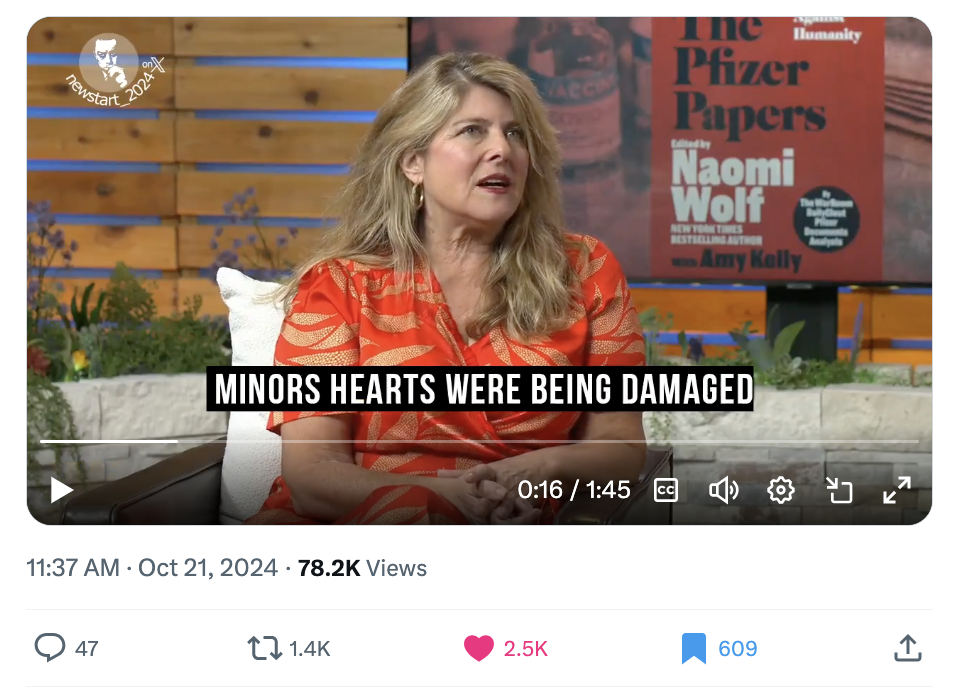
Wolf also appeared on the above podcast. Excerpt:
Pfizer knew within three months that 1,225 people died. That's how many deaths there are in just three months of rollout. Pfizer knew by April of 2021 that minors' hearts were being damaged by the injection. They had warnings from the Israeli Health Ministry and also from a pediatric group.
And rather than coming forward and telling all of us this is going to damage the hearts of minors, our lawyers FOIA'd email chains that go up to Dr. Fauci, Dr. Walensky, POTUS, and 15 White House staffers. In the email, you see it going all the way. So the president can't say— The template goes to POTUS. Right. OK. A little deniability there, but the template goes to POTUS.
But certainly there are 15 White House staffers on the email chain, right? Being told, hello, we have a problem here. Worse. They were told that, but then there was this freak out, and I recognize it from having been an advisor to a presidential campaign, a freak out conference where they're planning how to lie to the American people, and they're creating a script.
The script is 17 pages, completely redacted. But you remember what happened in April and May of 2021. They came forward and said, oh, you know, pericarditis, myocarditis in young men and teenagers, it's transient, it's mild, it's rare that they knew that they were lying.
That's what they came out with. That was their approach. Correct. Like, we'll kind of admit it, but we'll just say it's really nothing to worry about. And then they followed that with an all summer long propaganda campaign using influencers and TikTok personalities to get young people and teenagers to get injected.
Cut all Government-Funding to Kneecap the Censors
The five-minute answer is civil society organizations [must] prepare for public knowledge and education a comprehensive list of every single censorship program, every single censorship grant, every single censorship contract, every single censorship Task Force, every single censorship initiative at the US Department of Defense, the US Department of State, US Agency for International Development, the Department of Homeland Security, the FBI, DHS, HHS, FDA, CDC, FEMA, CISA. You basically have a comprehensive executive order that bars all federal funding, all procurements, all grants, all contracts. And you basically kneecap the entire censorship industry through cutting the funding, because these people don't work for free. This is a censorship war. It's carried out by a censorship army. The censorship army is composed of censorship mercenaries, and those censorship mercenaries need government money to do their work.

The Democratic Party “Left Us”
Tulsi Gabbard, RFK, Jr. and Elon Musk were all solidly behind the Democratic Party until the party became corrupt, abandoning the U.S. Constitution and the Rule of Law.
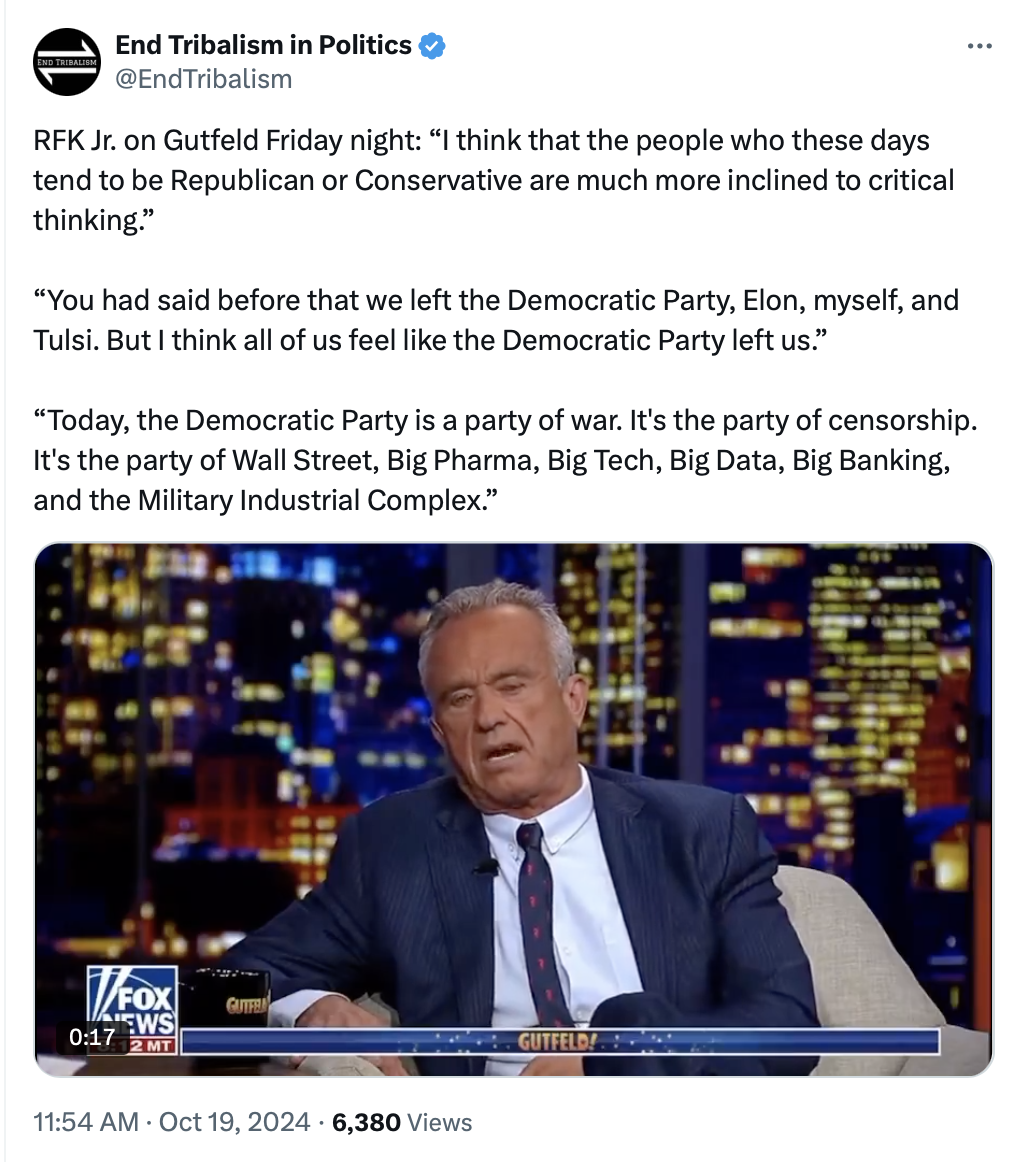
RFK Jr. on Gutfeld Friday night: “I think that the people who these days tend to be Republican or Conservative are much more inclined to critical thinking.” “You had said before that we left the Democratic Party, Elon, myself, and Tulsi. But I think all of us feel like the Democratic Party left us.” “Today, the Democratic Party is a party of war. It's the party of censorship. It's the party of Wall Street, Big Pharma, Big Tech, Big Data, Big Banking, and the Military Industrial Complex.”
Andrew Sullivan announced his support for Kamala Harris. He has recently expressed that he is reconsidering based on this administrations embrace of gender ideology:
We now discover, from insurance claims, that at least 14,000 minors have been transed either chemically or surgically in the last five years. At a minimum...It is despicable to take a child who has never gone through puberty and remove from them any possibility of orgasm for life — before they can possibly know what an orgasm feels like. Evil. Bowers admits it’s no different than FGM in its effect. With FGM, much of the pressure to mutilate a child comes from the parents’ religion. The difference between Iran — where they trans young gays and lesbians en masse — and America, is that in one, the parents’ religion is fundamentalist Islam, and in America, it’s wokeness.
And that wokeness overwhelmingly targets gay kids. In Britain they became the vast majority of the children sent for sex reassignment, before it was banned outside a clinical trial. And we know that these “doctors” have no way of objectively knowing whether a child is actually trans or gay or depressed or autistic — and yet they also oppose any broad mental health assessment of a child, if that child has simply declared himself or herself the opposite sex...
But the discovery from a lawsuit against the State of Alabama over its ban on the medical sex reassignment of children has left me reeling. It shows a staggering level of bad faith from the transqueer lobby, and, also, from Rachel Levine — the Assistant Secretary for Health at HHS. Read the amicus brief here. Everything in this piece is based on it . . .
I remember very well how all my gender insecurities as a gay kid vanished after puberty. So I urge any gay man or lesbian who, as a child or teen, was barred from this basic human right to be brave and start the lawsuits. It’s the only way. No gay men or lesbians will come to your aid. Kamala Harris and the gay groups sure won’t. “LGBTQIA+” billionaires will sacrifice any number of gay kids if it means not being called “transphobic” at a dinner party.
I look around what was once my community and see such incredible cowardice and indoctrination that it makes me despair at what we have become. A movement that began as a crusade for sexual liberation is now sterilizing gay and trans children and removing their capacity for orgasm forever. A movement that began with defending gay men and lesbians is now sacrificing a generation of gay kids at the behest of trans extremists and critical gender theory.
Forgive me for the passion. But this amicus brief set my head and heart aflame. What has happened — what is still happening — is the worst attack on gay kids since Anita Bryant.
But this time, the danger is coming from inside the house.
About Anne Applebaum
Anne Applebaum just wrote a big hit piece on Elon Musk in the Atlantic. Who is she? Mike Benz reports:

- 1
- 2
- 3
- 4
- …
- 1,977
- Go to the next page