20 Human Cognitive Biases Explained by Steve Stewart Williams

Excellent summary of 20 cognitive biases by psychologist Steve Stewart-Williams.  His Intro:

The human mind is a remarkable piece of biological engineering. It’s capable of an astonishing range of feats like inventing calculus, composing rock operas, and putting spacecraft on other planets. But it’s also capable of an equally astonishing range of predictable reasoning errors. Psychologists call these cognitive biases, and they’re as common as the common cold.

In this post, I’ll outline 20 major biases that distort our judgments about evidence, ourselves, and the world. Once you learn about them, you’ll start seeing them everywhere: in politics, in the news, on social media - and occasionally even in your own thinking. (Mostly, though, in other people’s.)

Continue Reading20 Human Cognitive Biases Explained by Steve Stewart Williams

US Public Health COVID Policies Exploited Three Classic Human Frailties

Kenny Carmody:

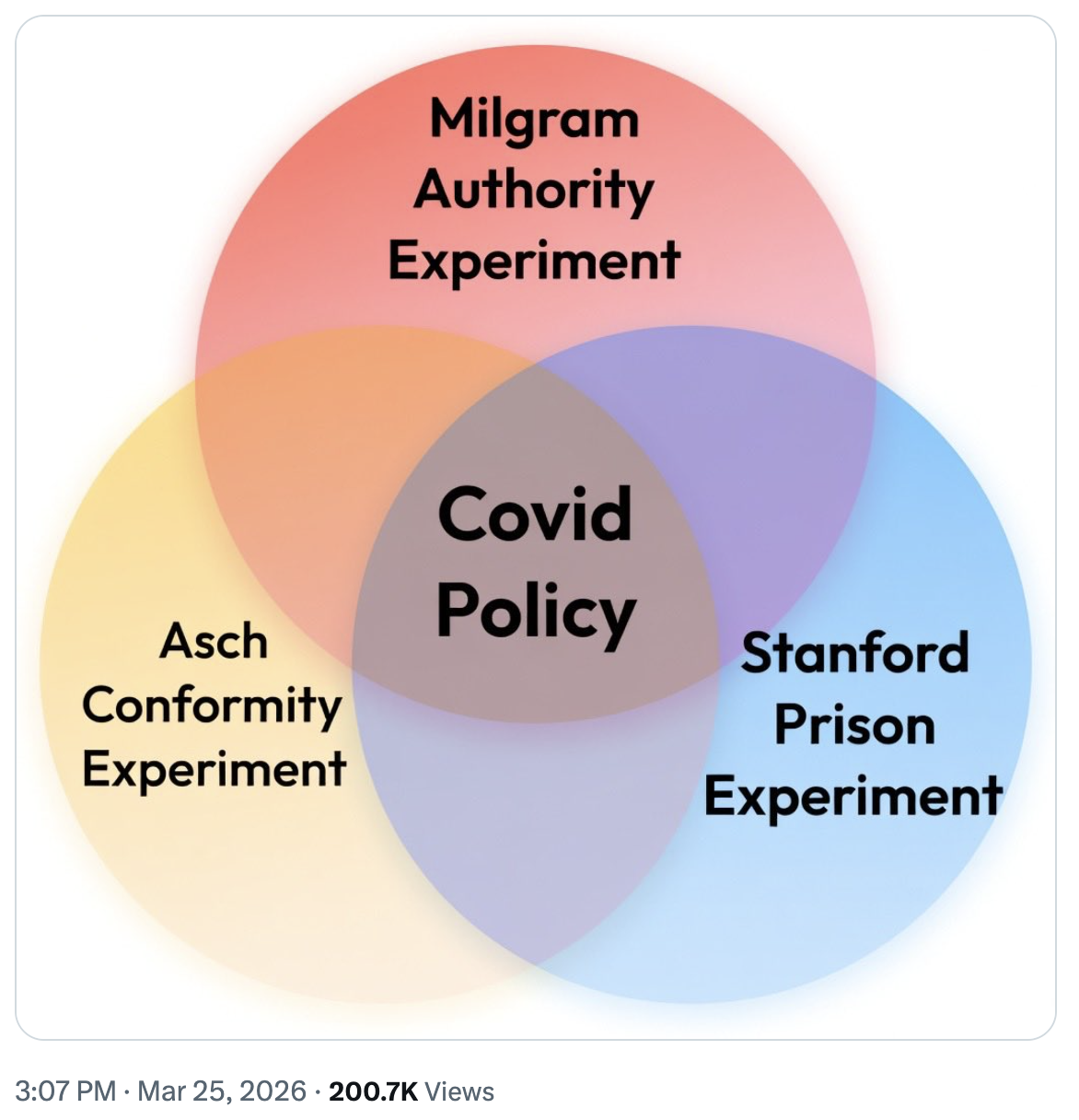
Three of the most disturbing psychological experiments in modern history placed in a Venn diagram with COVID policy sitting precisely at their intersection.
Carmody's analysis on X is spot on:

Most people know the Milgram experiment. Ordinary people administering what they believed were lethal electric shocks to strangers because an authority figure in a white coat told them to continue. We wrote about this. COVID replicated it at planetary scale, the doctors, the neighbours, the employers, the family members who enforced mandates with a zeal that had nothing to do with science and everything to do with institutional obedience.

But the other two are equally important and far less discussed.

The Asch Conformity Experiment demonstrated something even more fundamental. Solomon Asch showed in the 1950s that a significant majority of people will deny the evidence of their own eyes will give an answer they know to be factually wrong, simply because everyone else in the room is giving that answer. Not because they were threatened. Not because they were paid. Because the social pressure of the group was sufficient to override direct sensory experience.

This is what masking a healthy population, cancelling Christmas, and demanding that people treat their neighbours as biological threats actually accomplished. It was not about any of those things specifically. It was about training an entire population to override their own perception and defer to the group consensus, however absurd that consensus became.

And then the Stanford Prison Experiment.

Philip Zimbardo’s 1971 study abandoned early because it spiralled so rapidly out of control, showed that ordinary people assigned roles of authority over other ordinary people will, within days, begin to abuse that authority in ways they would have found unthinkable before the role was assigned. The guards became cruel not because they were cruel people but because the structure gave them permission and the institution backed them up.

We watched this happen in real time.

The COVID marshals. The border agents turning families away. The hospital administrators barring visitors from dying patients. The teachers reporting parents. The neighbours calling police on children playing in parks. The HR departments gleefully processing terminations for the unvaccinated. Ordinary people, handed a role and a uniform of institutional approval, discovering capacities for cruelty that their pre-2020 selves would not have recognised.

Continue ReadingUS Public Health COVID Policies Exploited Three Classic Human Frailties

Remembering the Good Old Days When Evidence Mattered

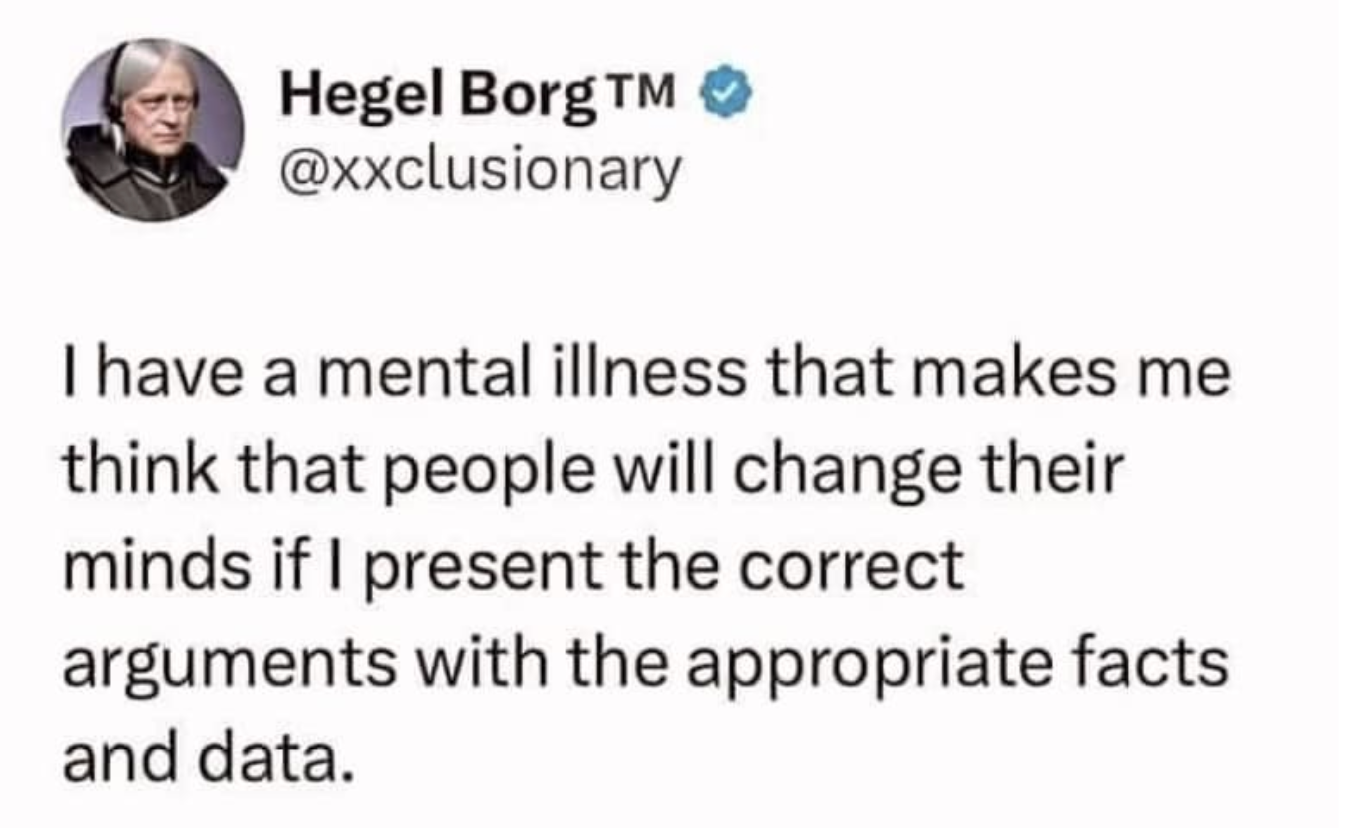
"I have a mental illness that makes me think that people will change their minds if i present the correct arguments with the appropriate facts and data."

And to make things even worse, consider the Boomerang Effect. I turn to Grok:

The boomerang effect (also known as the backfire effect in some psychological literature). Is a persuasion paradox where presenting strong evidence or arguments to debunk a false belief doesn't sway people; instead, it often reinforces their original misconception, making them dig in even deeper. This happens because the challenge feels like a threat to their identity, worldview, or autonomy, triggering defensive reasoning—think of it as the brain "boomeranging" the message right back at you with amplified conviction.Classic examples include political debates (e.g., fact-checking a conspiracy theory that only rallies believers more) or health campaigns (e.g., anti-smoking ads that ironically boost smoking among defiant teens). Studies show it spikes when the persuasion feels too forceful, emotional, or condescending, as people resist perceived control. To counter it, softer approaches like asking open questions or building rapport work better than direct confrontation.It's a frustrating reminder that facts alone don't always win—emotions and ego often steal the show.

Continue ReadingRemembering the Good Old Days When Evidence Mattered

Social Contagion and Kayfabe: When 2 + 2 = 5

Fascinated by the ubiquitous occurrences of social contagion, where seemingly intelligent people start saying things that don't add up. I've documented hundreds of these things at this website, many of which are illustrated under the category of "Media Narratives."

Recently, a friend of mine gave me an old example that is rather strange and stunning, the case of Florence Foster Jenkins, and exceedingly bad singer who was enthusiastically praised in the 1920s through the 1940s. I'll quote a few passages about her from Wikipedia:
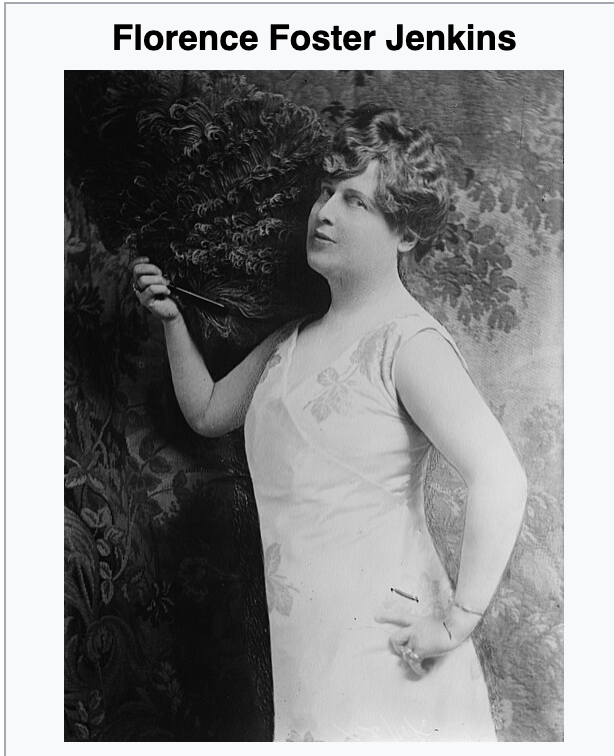
Florence Foster Jenkins (born Narcissa Florence Foster;[a] July 19, 1868 – November 26, 1944) was an American socialite and amateur coloratura soprano who became known, and mocked, for her flamboyant performance costumes and notably poor singing ability. Stephen Pile ranked her "the world's worst opera singer ... No one, before or since, has succeeded in liberating themselves quite so completely from the shackles of musical notation."[1]

Despite – or perhaps because of – her technical incompetence, she became a prominent musical camp cult-figure in New York City during the 1920s, 1930s, and 1940s. Cole Porter, Gian Carlo Menotti, Lily Pons, Sir Thomas Beecham, and other celebrities were counted among her fans.[2][3] Enrico Caruso reportedly "regarded her with affection and respect".[4]

The poet William Meredith wrote that a Jenkins recital "was never exactly an aesthetic experience, or only to the degree that an early Christian among the lions provided aesthetic experience; it was chiefly immolatory, and Madame Jenkins was always eaten, in the end."

Perhaps this is not exactly social contagion. Maybe it's better described as Kayfabe, the classic example being pro wrestling, but it seems to have widespread application in our dysfunctionally performative modern culture. Kayfabe [pronounced Kay-Fabe] is described by Grok as follows:

Kayfabe is a term originating from professional wrestling, referring to the practice of presenting staged events, characters, storylines, and rivalries as genuine or "real" to maintain the illusion for audiences.

It's essentially a form of suspension of disbelief, where wrestlers (and sometimes promoters) stay in character both in and out of the ring to preserve the fiction of the sport.

The word itself is believed to derive from carny slang (carnival worker lingo), possibly a Pig Latin variation of "be fake" or "fake," though its exact etymology is debated and dates back to the early 20th century in wrestling circles.

History and Usage in WrestlingIn the early days of pro wrestling, kayfabe was strictly enforced to protect the industry's secrets. Wrestlers would avoid being seen together in public if their characters were rivals, and they'd even use separate travel arrangements or fake injuries to sell storylines.

Breaking kayfabe—revealing the scripted nature of events, going off-script, or acknowledging the fakery—could result in fines, suspensions, or blacklisting. For example, in the 1980s and '90s, figures like Hulk Hogan or The Undertaker maintained their personas rigorously outside the arena.Over time, with the rise of the internet and "dirt sheets" (insider newsletters), kayfabe has become harder to uphold. The 1999 documentary Beyond the Mat and WWE's own "reality era" in the 2010s blurred lines further, leading to more meta-storylines where wrestlers reference real-life events.

Today, it's more flexible, but elements persist—like wrestlers "working" the crowd or media with in-character interviews.Broader Cultural MeaningBeyond wrestling, kayfabe has entered wider slang to describe any situation where people collectively pretend something scripted or artificial is authentic, such as in politics, reality TV, or corporate culture. For instance, it might apply to politicians maintaining a public facade despite behind-the-scenes deals.

It's about a tacit agreement to ignore the "fourth wall" for the sake of the performance.

Continue ReadingSocial Contagion and Kayfabe: When 2 + 2 = 5

Binding and Blinding

Jonathan Haidt: "Morality binds and blinds. It binds us into ideological teams that fight each other as though the fate of the world depended on our side winning each battle. It blinds us to the fact that each team is composed of good people who have something important to say."

I would add this: Being a member of a team causes one's IQ to plummet regarding topics relevant to one's team. Don't join anyone else's team. Be your own team, so that you have no stake in any particular outcome.

Continue ReadingBinding and Blinding