20 Human Cognitive Biases Explained by Steve Stewart Williams

Excellent summary of 20 cognitive biases by psychologist Steve Stewart-Williams.  His Intro:

The human mind is a remarkable piece of biological engineering. It’s capable of an astonishing range of feats like inventing calculus, composing rock operas, and putting spacecraft on other planets. But it’s also capable of an equally astonishing range of predictable reasoning errors. Psychologists call these cognitive biases, and they’re as common as the common cold.

In this post, I’ll outline 20 major biases that distort our judgments about evidence, ourselves, and the world. Once you learn about them, you’ll start seeing them everywhere: in politics, in the news, on social media - and occasionally even in your own thinking. (Mostly, though, in other people’s.)

Continue Reading20 Human Cognitive Biases Explained by Steve Stewart Williams

Therapy that Cannot Stand the Pain

In talking with some acquaintances and viewing videos of people who are clearly struggling to cope, I'm often distracted by their use of language that abstracts away from human-to-human conflict. Their focus has been repackaged into sterilized abstruse terminology. It's as though the emotions and suffering have been packed away into the basement and they are trapped upstairs in a nonstop web of psychological chatter that is facilitated by their therapists.

Freya India points out the increasingly common problem of therapy buzzwords in a communication to Ayishat Akanbi, a writer:

I’m very skeptical of therapy-speak, unconvinced it even helps us open up. More often I think it actually closes down our ability to have honest conversations.

But you got to the heart of what bothers me about it, the insincerity. If someone tells me about their “fearful-avoidant” attachment style or how they are learning to “hold space” for others, I find it hard to feel anything. But if they tell me about their hurt and heartbreak, or how they are trying to be less selfish, I’m listening. We are talking human to human now.

As you write, “We’re encouraged to describe even ordinary interpersonal conflict in the language of pathology and melodramatic categories. So we start treating every slight like persecution because exaggeration is the only way to make pain legible.”

But I’ve been wondering lately if two things are happening at once. On one hand, we have this therapeutic group-speak, this exaggeration of suffering. But on the other hand, I think we are also losing the ability to talk about actual pain.

The writer Samuel Kronen, in a piece about chronic illness, put it like this: “There still appears to be a lot of unrewarded suffering in the world and our culture can seem pretty cruel and callous toward the vulnerable…If anything, I think our screen-addled, instantly-gratifying, digitally-intoxicated culture actually makes people less sensitive and conscious of suffering in certain ways, contributing to a more casual cruelty.”

I think he’s right. We might pathologise ordinary feelings and exaggerate small slights, but we also seem unwilling to accept genuine suffering. We can’t seem to cope with it. It’s hard, for example, to have a sincere conversation about something like family breakdown. I hear so many young women talking about their attachment styles, about “reparenting” themselves and healing their inner child, but not so much about the pain of divorce. I think this is why, as a culture, we have ended up with so much therapeutic advice and so little wisdom. Because we aren’t speaking about our problems in any recognisably human way. Maybe we are trying to make things easier on ourselves. If you phrase your problem as “anxious attachment”, you need a therapist. If you phrase it as your parents’ divorce, you need a difficult conversation with your dad.

As I read India's email to Akanbi, I was reminded of a book I read in college: The Myth of Mental Illness (1961), by Thomas Szasz. I think Szasz overstated his case in his book, but he did draw necessary attention to whether metaphoric terms like "mental illness" been literalized to unduly justify psychiatry's authority, turning common problems of living into impenetrable diagnoses, often harming individuals by stripping them of agency and responsibility for their actions.

Continue ReadingTherapy that Cannot Stand the Pain

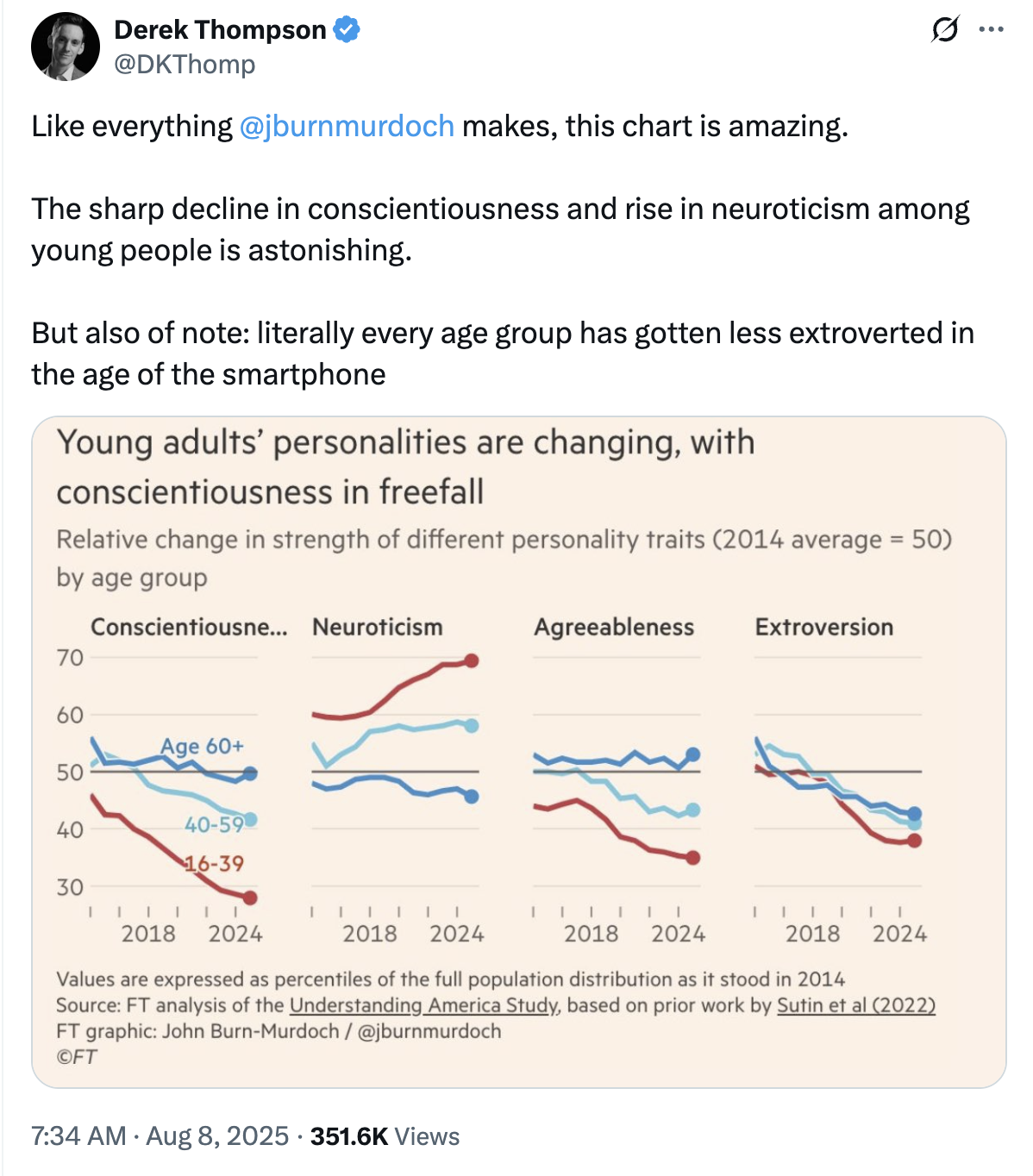
The Downside of Agreeableness

What is it to be (or not be) "agreeable"?

Michael Malice:

Michael Malice:

I score a zero or close to it on agreeableness Meaning, it makes little sense to me to say things or act in a certain way simply to accommodate others I view it as a form of dishonesty and long-term disaster If you are high-agreeableness, how would you explain it to me?

Question to Grok: With regard to the Big Five trait of agreeableness, what is the consequence of being extremely agreeable? What is the opposite of Agreeableness?

Consequences of Being Extremely Agreeable

ExtremeAgreeableness, a trait characterized by high levels of compassion, cooperation, and a desire to maintain harmony, can have both positive and negative consequences:Positive Consequences:Strong Relationships:

- Highly agreeable individuals are often well-liked, fostering trust and positive social bonds due to their kindness and empathy.

- Conflict Avoidance: Their tendency to prioritize harmony can de-escalate conflicts and promote group cohesion.

- Team Collaboration: They excel in cooperative settings, making them effective in team-oriented environments.

Negative Consequences:Difficulty Asserting Needs:

- Extreme agreeableness may lead to suppressing personal needs or opinions to avoid conflict, resulting in unmet needs or resentment.

- Vulnerability to Exploitation: Highly agreeable people may be taken advantage of, as they are less likely to confront manipulative behavior.

- Reduced Leadership Effectiveness: Excessive agreeableness can hinder decision-making or assertiveness, making it challenging to take charge in competitive or high-stakes situations.

- Neglect of Self-Interest: Constantly prioritizing others can lead to burnout or diminished self-esteem if their own goals are consistently sidelined.

Opposite of Agreeableness

The opposite of agreeableness in the Big Five personality framework is low agreeableness, often described as antagonism or disagreeableness. Individuals with low agreeableness exhibit traits such as:Competitiveness: Prioritizing personal goals over group harmony, often thriving in competitive environments.

- Skepticism or Cynicism: Being less trusting and more critical of others’ intentions.

- Assertiveness or Aggressiveness: Willingness to confront others, express disagreement, or pursue self-interest, sometimes at the expense of relationships.

- Lower Empathy: Less concern for others’ feelings, which can manifest as bluntness or insensitivity.

While low agreeableness can lead to conflicts or strained relationships, it can also be advantageous in situations requiring tough decision-making, negotiation, or standing firm on principles.

Continue ReadingThe Downside of Agreeableness

Rational Limits to Empathy and Inclusivity

Yeah, it's important that we pay some attention to people's feelings, but we aren't there to jump to action whenever someone else (especially strangers) claims that their feelings are hurt and that we owe them our time, energy and money. We need to be on guard so that our natural inclinations to be empathetic don't become toxic. We need to know that it's OK to draw boundaries. It's OK to say "No," and to say it often. Functional people do these things. That is how they develop and maintain strong moral character. Every day it important to put your own oxygen mask on, at least for awhile, before jumping to the rescue of others. We intuitively do this with regard to our money. If we acceded to the demands of all beggars, rent-seekers and scoundrels we encounter in person and on the Internet, everyone one of us would go broke in a week.

Today I spotted a post by Mom Wars:

When we tell kids to always be inclusive, we often fail to teach them discernment.

We don’t live in a world where every person has good intentions. We don’t live in a world where every peer is safe, healthy, or kind. And yet, we tell kids—especially girls—to include everyone, to make room for every voice, to keep the peace even when something feels off. We elevate kindness as the ultimate virtue, but we don’t equip them with the tools to know when and how to draw the line.

What does that teach them? That someone else’s feelings are always more important than their gut instincts. That avoiding awkwardness is more important than avoiding harm. That their discomfort is a small price to pay for another person’s inclusion.

And that’s a dangerous lesson.

When you preach “kindness” without nuance, without boundaries, without discernment, you unintentionally teach your child that being “nice” matters more than being safe, or emotionally well, or even just comfortable in their own skin. You teach them that their own mental health comes second to another person’s momentary hurt feelings. That ignoring their inner voice in favor of social harmony is maturity, rather than self-abandonment.

When you preach “acceptance” as a blanket virtue, you fail to give your child a framework for recognizing anti-social behaviors. For noticing when someone is manipulative, attention-seeking, boundary-breaking, or just draining to be around. Kids—especially empathetic ones—can easily absorb the idea that all behavior must be tolerated, all personalities embraced, all people welcomed no matter how they treat others.

But that’s not kindness. That’s codependency."

This is spot on. Such an important lesson that so many people need to learn and heed.

This topic relates to the work of Paul Bloom. In 2016 he wrote a book titled: Against Empathy: The Case for Rational Compassion. He defines “empathy” as follows: “Empathy is the act of coming to experience the world as you think someone else does.” He further describes empathy as “a spotlight directing attention and aid to where it’s needed.” According to Bloom, empathy is an emotion, not a good tool for moral decision-making. “Compassion,” on the other hand, is feeling concern or compassion for someone. Bloom contrasts empathy with “rational compassion,” which can productively be used to “make decisions based on considerations of cost and benefits.” Empathy, by contrast, has no such protective limitations, meaning that empathy often leads to ill-considered policies.

Continue ReadingRational Limits to Empathy and Inclusivity