About Anxiety
Today I watched this video by comedian Bill Hader. The topic, struggling with anxiety, is a serious--sometimes debilitating--topic, but, as one would expect, Hader deals with it in a serious way. I know more than a few people who are imprisoned by their anxious thoughts. They are often letting life pass them by, which is tragic.
I don't think I struggle more than most people with anxiety, but I know I can sometimes have anxious thoughts and these sometimes interfere with my ability to do my job (trial attorney) and deal with the other challenges of living life, which are, of course, ubiquitous. Lucky for me, I have never felt the need to take any medications. But I am always on the lookout for ways to tamp down those pesky and distracting anxious feelings.
I think Bill's approach is a good one. He reframes his anxiety as a thing separate from him. His anxiety is a thing that he does not need to accept as a part of himself.

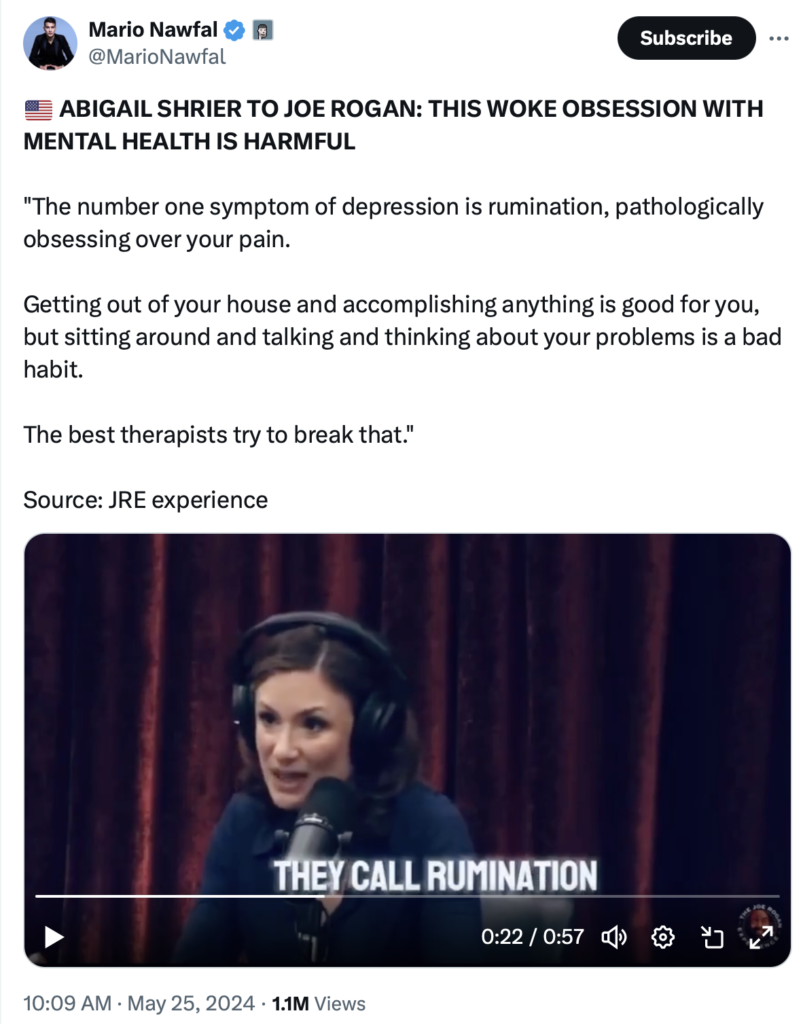
In this clip, Abigail Shrier points out potential environmental causes for anxiety in children. Interesting finding that I find unsurprising for the reasons she suggests. Lack of limits and rules (i.e., too much freedom) can be disorienting. I think we need foundational axiom in order to make sense of the world. They might not be perfect, but we need base assumptions of some sort or we become unanchored. We can't reason at all without at least some anchors: It's the same thing with geometry, as Bertrand Russell discussed:
Before I began the study of geometry somebody had told me that it proved things and this caused me to feel delight when my brother said he would teach it to me. Geometry in those days was still 'Euclid'. My brother began at the beginning with the definitions. These I accepted readily enough. But he came next to the axioms. 'These', he said, 'can't be proved, but they have to be assumed before the rest can be proved.' At these words my hopes crumbled. I had thought it would be wonderful to find something that one could PROVE, and then it turned out that this could only be done by means of assumptions of which there was no proof. I looked at my brother with a sort of indignation and said: 'But why should I admit these things if they can't be proved?' He replied: 'Well, if you won't, we can't go on.' I thought it might be worth while to learn the rest of the story, so I agreed to admit the axioms for the time being. But I remained full of doubt and perplexity as regards a region in which I had hoped to find indisputable clarity. In spite of these doubts, which at most times I forgot, and which I usually supposed capable of some answer not yet known to me, I found great delight in mathematics-much more delight, in fact, than in any other study.
From Basic Writings of Bertrand Russell, "Why I took to Philosophy," p. 57.
In this clip, Shrier mentions research showing "Boys in liberal families have higher anxiety than girls in conservative families."

In her book, Shrier states that obsessing about your inner depression and anxiety make those problems grow in you mind.

I have read excerpts from Shrier's book and heard several of her interviews. I asked Grok to summarize Shrier's main points on this topic and it did a great job:
In her book Bad Therapy: Why the Kids Aren’t Growing Up (published February 2024), Abigail Shrier argues that young adults who obsess over their mental health, particularly Generation Z (born 1997–2012), may worsen their condition due to a culture that overemphasizes therapy and emotional self-focus. Her key points on this issue, based on her investigation and interviews with psychologists, parents, teachers, and young people, include:1. Encouraging Rumination: Shrier contends that excessive focus on feelings—encouraged by therapists, schools, and parenting trends like “gentle parenting”—leads young adults to ruminate on their anxieties and sadness. This rumination can trap them in cycles of depression and anxiety, as they dwell on perceived traumas or minor emotional setbacks instead of moving forward. For example, she cites therapy practices that prompt young people to constantly explore “what might be wrong,” which can amplify distress rather than resolve it.
2. Pathologizing Normal Emotions: Shrier argues that the mental health industry and societal trends label normal challenges of adolescence and young adulthood (e.g., sadness, stress, or social struggles) as mental health disorders. This overdiagnosis convinces young adults they are inherently fragile or damaged, creating a self-fulfilling prophecy where they expect to need professional help to cope. She notes that 42% of Gen Z have a formal mental health diagnosis, yet their mental health is worse than previous generations, suggesting overtreatment may harm rather than help.