Data-Driven Portrait of Wokeness

I've followed psychologist Steve Stewart-Williams for years and really enjoy his rigorous scientific analysis of many aspects of the world. He recently posted: "12 Things Everyone Should Know About Wokeness: A data-driven look at the rise, effects, and psychology of one of the major cultural movements of our time." Many of his conclusions about wokeness, but not all, seem to be true to those of us who simply are watching what's going on around us. You've got the link to his article now and I would highly recommend reading the details, but I will give you the titles to though sections of his article on wokeness:

1. The woke worldview is associated with depression and anxiety

2. Women are more woke than men

3. Younger people are more woke than older ones

4. Many people pretend to be more woke than they are

5. Safe-space culture may function as reverse CBT (Cognitive Behavioral Therapy)

6. Many woke views are inaccurate

7. Woke people underestimate minority success

8. Woke ideas may foster dislike of majorities rather than concern for minorities

9. The woke may secretly look down on those they see as oppressed

10. Many interventions favored by the woke don’t work

11. Wokeness took off in the 2010s

12. We may have hit “peak woke” - or maybe not

Continue ReadingData-Driven Portrait of Wokeness

Coordinated Messaging Propaganda has Steered the US to the far Left

I think Wes Yang is correct. Persons unknown decided that they would perform a 180° turn on this issue and many others, including immigration.

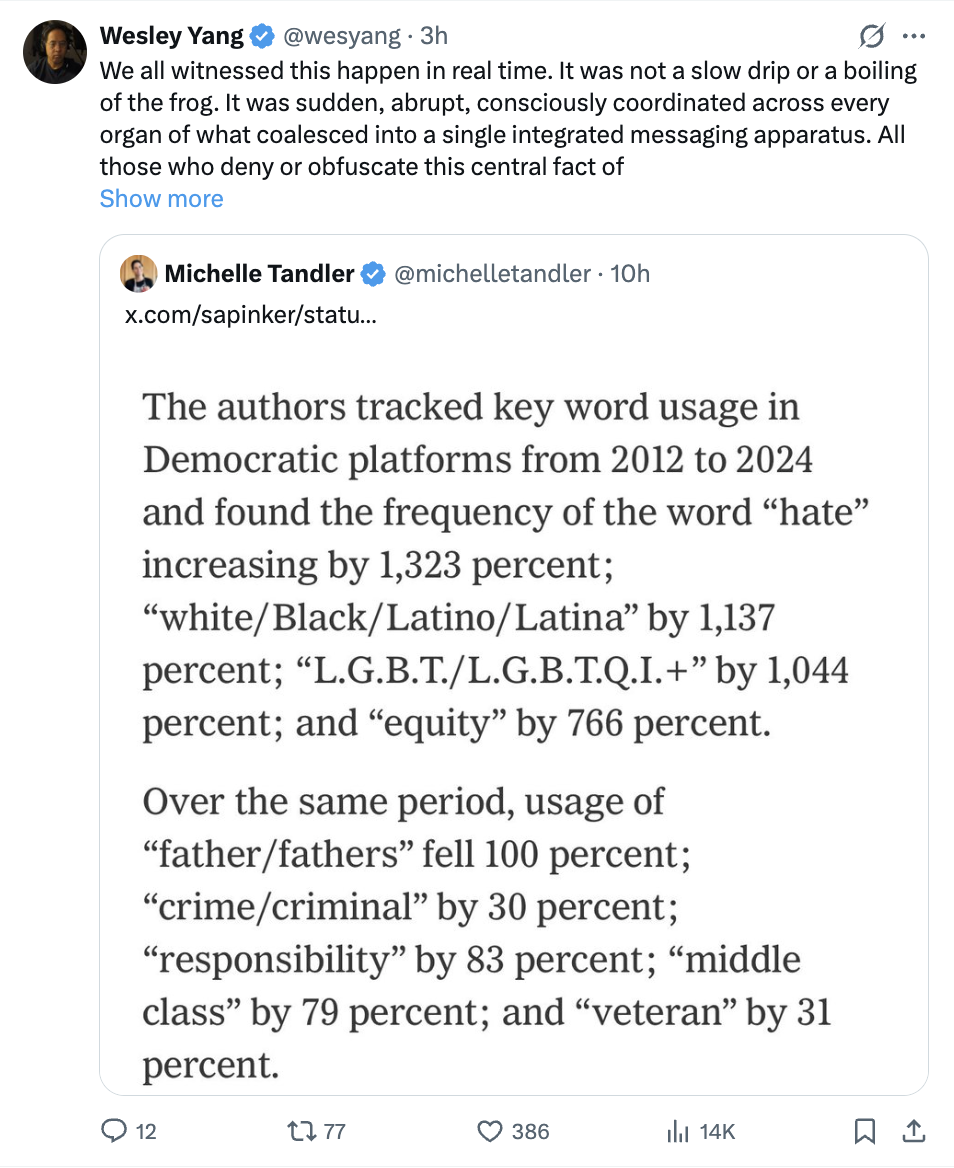
We all witnessed this happen in real time. It was not a slow drip or a boiling of the frog. It was sudden, abrupt, consciously coordinated across every organ of what coalesced into a single integrated messaging apparatus. All those who deny or obfuscate this central fact of American public life are engaged in conscious deceit.

This post leads to an opinion piece in the NYT, "‘I Wouldn’t Say the Democrats Are in Good Shape’". Here's an excerpt:

In October, the group behind the centrist Democratic WelcomePAC issued “Deciding to Win,” an analysis of “election results, hundreds of public polls and academic papers, dozens of case studies, and surveys of more than 500,000 voters” that found that “since 2012, highly educated staffers, donors, advocacy groups, pundits and elected officials have reshaped the Democratic Party’s agenda, decreasing our party’s focus on the economic issues that are the top concerns of the American people.”

The authors tracked key word usage in Democratic platforms from 2012 to 2024 and found the frequency of the word “hate” increasing by 1,323 percent; “white/Black/Latino/Latina” by 1,137 percent; “L.G.B.T./L.G.B.T.Q.I.+” by 1,044 percent; and “equity” by 766 percent.

Over the same period, usage of “father/fathers” fell 100 percent; “crime/criminal” by 30 percent; “responsibility” by 83 percent; “middle class” by 79 percent; and “veteran” by 31 percent.

Finally, in November, Politico’s Elena Schneider reported the findings of a 21-state research project funded by Democracy Matters involving polling, dozens of focus groups and message testing.

“Working-class voters see Democrats as ‘woke, weak and out of touch’ and six in 10 have a negative view of the party,” she wrote . . .

Continue ReadingCoordinated Messaging Propaganda has Steered the US to the far Left

Does Treatment for People Who Claim to be Transgender Reduce Suicides?

?Would you rather have a live daughter or a dead son? Transgender activists would ask this question to incentivize parents to provide "gender affirming care" to their sexually confused children.

But is it true that medical interventions reduce the number of suicides?

Consider this excerpt from "ACLU Attorney Confesses: Transgender-Suicide Claim is a Myth." Arguing before the Supreme Court, the ACLU's Chase Strangio concedes that suicide is “thankfully and admittedly rare” among transgender-identifying people:

Unfortunately for Strangio, Justice Alito had done his homework. Citing the U.K.’s Cass Review, Alito observed that “there is no evidence that gender-affirmative treatments reduce suicide.”

Then came Strangio’s remarkable concession:

MR. STRANGIO: What I think that is referring to is there is no evidence in some—in the studies that this treatment reduces completed suicide. And the reason for that is completed suicide, thankfully and admittedly, is rare and we’re talking about a very small population of individuals with studies that don’t necessarily have completed suicides within them.

However, there are multiple studies, long-term longitudinal studies that do show that there is a reduction in—in suicidality . . .

Here, the ACLU’s star attorney on trans issues seems to be at odds with Solicitor General Prelogar, who had said that the “rates” of “suicide” among gender-dysphoric youth were “striking.” Strangio admits, under oath, that suicide is actually “rare,” and that the research purporting to demonstrate benefits from hormones concerns suicidality, not suicide. Strangio’s use of “admittedly” is also striking, as it suggests the attorney is aware that claims about suicide prevention through sex “change” are false.

Continue ReadingDoes Treatment for People Who Claim to be Transgender Reduce Suicides?

Gen Z and Gender Ideology by the Numbers

Excerpt from "Understanding and Saving Gen Z To Save America," by Scott Atlas:

Gen Z’s dysfunction is undeniable. They average nine hours daily on screens, over three hours on social media, eroding real-world connections. This fuels asocial behavior, surging loneliness, and poor mental health; only half favor personal over virtual interactions. Financially, they falter: 55% find homeownership harder, 44% struggle to secure jobs, and 55% see promotions as elusive, fostering underachievement. Employers note that 65% of recent college graduates feel entitled, 63% are easily offended, and 55% lack professionalism and work ethic. Mental health crises are rampant, with depression, anxiety, and hopelessness spiking, especially among liberal-leaning youth, driven by a victimhood culture amplified by social media.

With regard to Gender Ideology, Gen Z's staggering numbers suggest social contagion:

Gen Z’s psychological frailty sets the stage for unique vulnerability to social contagion, suggested by the explosion of gender confusion. Transgender identification among young adults surged from 0.59% in 2014 to 3.08% in 2023 – a 422% increase – with non-binary identities up 1260% and transgender men quadrupling (309%), driven by social media echo chambers and peer pressure. Gallup’s 2025 poll shows LGBTQ+ identification at 9.3% overall, nearly triple 3.5% in 2012, doubling in five years, with over 23% of Gen Z (born 1997-2006) identifying as such. The Williams Institute’s 2025 poll estimates over 724,000 transgender youth.

Continue ReadingGen Z and Gender Ideology by the Numbers

Social Contagion and Kayfabe: When 2 + 2 = 5

Fascinated by the ubiquitous occurrences of social contagion, where seemingly intelligent people start saying things that don't add up. I've documented hundreds of these things at this website, many of which are illustrated under the category of "Media Narratives."

Recently, a friend of mine gave me an old example that is rather strange and stunning, the case of Florence Foster Jenkins, and exceedingly bad singer who was enthusiastically praised in the 1920s through the 1940s. I'll quote a few passages about her from Wikipedia:
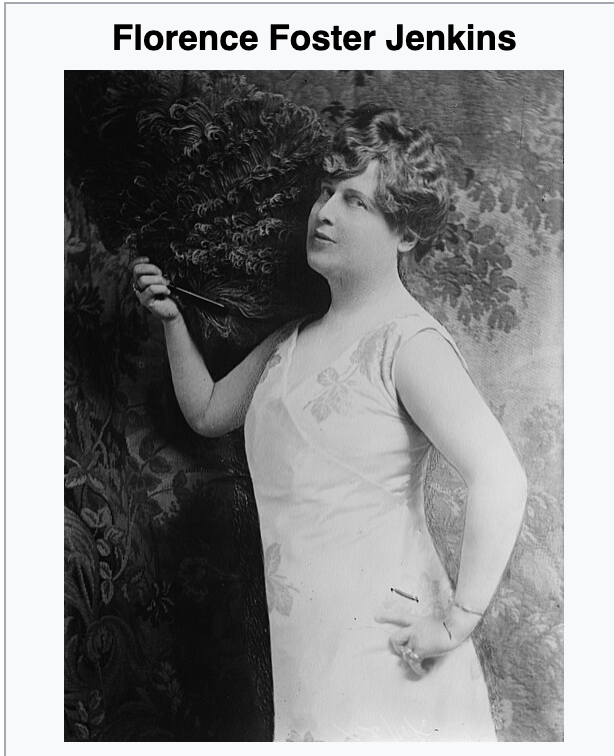
Florence Foster Jenkins (born Narcissa Florence Foster;[a] July 19, 1868 – November 26, 1944) was an American socialite and amateur coloratura soprano who became known, and mocked, for her flamboyant performance costumes and notably poor singing ability. Stephen Pile ranked her "the world's worst opera singer ... No one, before or since, has succeeded in liberating themselves quite so completely from the shackles of musical notation."[1]

Despite – or perhaps because of – her technical incompetence, she became a prominent musical camp cult-figure in New York City during the 1920s, 1930s, and 1940s. Cole Porter, Gian Carlo Menotti, Lily Pons, Sir Thomas Beecham, and other celebrities were counted among her fans.[2][3] Enrico Caruso reportedly "regarded her with affection and respect".[4]

The poet William Meredith wrote that a Jenkins recital "was never exactly an aesthetic experience, or only to the degree that an early Christian among the lions provided aesthetic experience; it was chiefly immolatory, and Madame Jenkins was always eaten, in the end."

Perhaps this is not exactly social contagion. Maybe it's better described as Kayfabe, the classic example being pro wrestling, but it seems to have widespread application in our dysfunctionally performative modern culture. Kayfabe [pronounced Kay-Fabe] is described by Grok as follows:

Kayfabe is a term originating from professional wrestling, referring to the practice of presenting staged events, characters, storylines, and rivalries as genuine or "real" to maintain the illusion for audiences.

It's essentially a form of suspension of disbelief, where wrestlers (and sometimes promoters) stay in character both in and out of the ring to preserve the fiction of the sport.

The word itself is believed to derive from carny slang (carnival worker lingo), possibly a Pig Latin variation of "be fake" or "fake," though its exact etymology is debated and dates back to the early 20th century in wrestling circles.

History and Usage in WrestlingIn the early days of pro wrestling, kayfabe was strictly enforced to protect the industry's secrets. Wrestlers would avoid being seen together in public if their characters were rivals, and they'd even use separate travel arrangements or fake injuries to sell storylines.

Breaking kayfabe—revealing the scripted nature of events, going off-script, or acknowledging the fakery—could result in fines, suspensions, or blacklisting. For example, in the 1980s and '90s, figures like Hulk Hogan or The Undertaker maintained their personas rigorously outside the arena.Over time, with the rise of the internet and "dirt sheets" (insider newsletters), kayfabe has become harder to uphold. The 1999 documentary Beyond the Mat and WWE's own "reality era" in the 2010s blurred lines further, leading to more meta-storylines where wrestlers reference real-life events.

Today, it's more flexible, but elements persist—like wrestlers "working" the crowd or media with in-character interviews.Broader Cultural MeaningBeyond wrestling, kayfabe has entered wider slang to describe any situation where people collectively pretend something scripted or artificial is authentic, such as in politics, reality TV, or corporate culture. For instance, it might apply to politicians maintaining a public facade despite behind-the-scenes deals.

It's about a tacit agreement to ignore the "fourth wall" for the sake of the performance.

Continue ReadingSocial Contagion and Kayfabe: When 2 + 2 = 5