Substitution as a Lazy Narrative-Preserving Technique (Using Gays Against Groomers as an Example)

What are the policy positions of Gays Against Groomers? Many people won’t know because corporate media on the left (I checked the NYT and WaPo) refuse to mention the organization. I recently asked someone who considers herself to be on the political left. She cringed and responded by saying that it sounds like a Republican or conservative group and that there is no grooming going on in America’s schools.

That seems like an answer to the question, but it isn’t. What just happened is subtle, but it is critically important. The person I was talking to completely failed to answer my question. Her answer illustrates Daniel Kahneman’s principle of “substitution,” which he discussed at length in Thinking, Fast and Slow (2011).

[W]hen faced with a difficult question, we often answer an easier one instead, usually without noticing the substitution.

(p. 12).

In my experience, this is a go-to technique in the culture war conversations. Quite often, when people are asked factual questions about a person or organization they don’t like (or they assume they don’t like), they will substitute an easy question for the more difficult question of detailing the facts. The substituted easy question will often be something like “Do you like this person/organization,” even though that was clearly not the question asked. As Kahneman describes, the new simple question will be unconsciously inserted. With the new simple question substituted in, the answer is also simple. In culture war discussions, it often takes the form of an ad hominem attack. Consider this example:

Q: “What are the policy position of [a particular person/group]?”

This is a factual question that should either be “I don’t know” or it should be a listing of the policy positions of the person/group. If the is about an organization and the answer is anything other than “I don’t know,” it should fairly track the “About Us” page of the website the person or organization.

However, the hard question is often unconsciously brushed to the side and a new easy question is inserted. In my example, if the person thinks they don’t like the person or organization, they could be expected to substitute in a new simple question like this:

“Do you like [the person or group] and what detrimental things can your emotionally generate (e.g., what deplorable person/affiliation/ad hominem label can you reflexively pull out) to express your emotions?”

For people politically on the Left, the answer will often be something like: “That [person/group] is like Hitler, Republicans, Satan, etc.

On this topic of Substitution, here is another excerpt from Kahneman book (p. 101):

The idea of substitution came up early in my work with Amos [Tversky], and it was the core of what became the heuristics and biases approach. We asked ourselves how people manage to make judgments of probability without knowing precisely what probability is. We concluded that people must somehow simplify that impossible task, and we set out to find how they do it. Our answer was that when called upon to judge probability, people actually judge something else and believe they have judged probability. System 1 often makes this move when faced with difficult target questions, if the an¬swer to a related and easier heuristic question comes readily to mind.
Consider the questions listed in the left-hand column of Table 1.
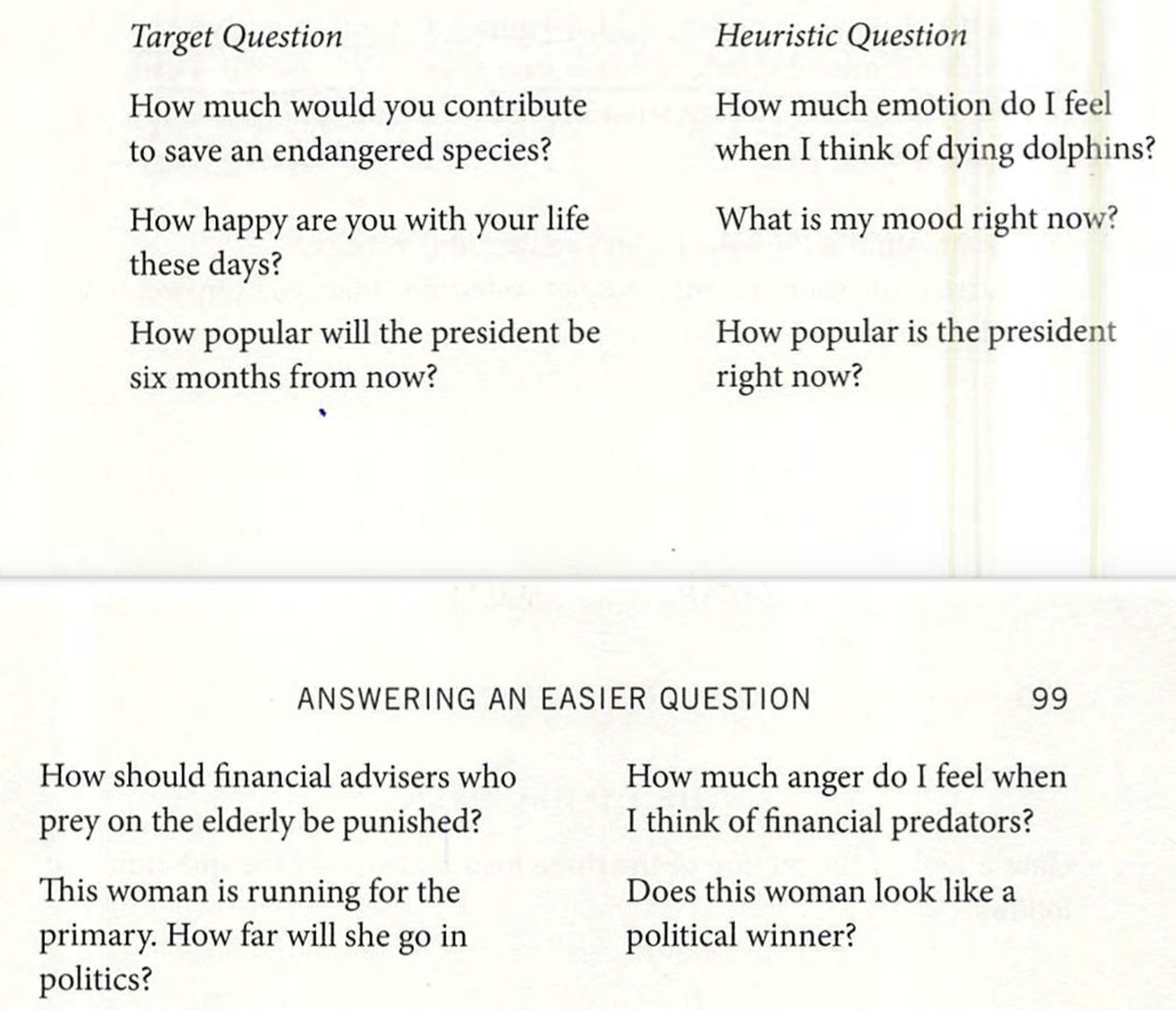
These are difficult questions, and before you can produce a reasoned answer to any of them you must deal with other difficult issues. What is the meaning of happiness? What are the likely political developments in the next six months? What are the standard sentences for other financial crimes? How strong is the competition that the candidate faces? What other environmental or other causes should be considered? Dealing with these questions seriously is completely impractical. But you are not limited to perfectly reasoned answers to questions. There is a heuristic alternative to careful reasoning, which sometimes works fairly well and sometimes leads to serious errors.

[More . . . ]

Continue ReadingSubstitution as a Lazy Narrative-Preserving Technique (Using Gays Against Groomers as an Example)

New Study Regarding Tribalism in Politics

New study by Bernstein, Zambrotta, Martin, & Micalizzi on political tribalism. Disturbing and not surprising to anyone who has eyes and ears. Title is: "Tribalism in American Politics: Are Partisans Guilty of Double-Standards?"

Here is the discussion section:

Across experiments, we found strong evidence for the existence of political tribalism and the application of double-standards. In Study 1, we found that tribalism occurs for the perceived legitimacy of hypothetical election outcomes. When asked whether Donald Trump or Joe Biden would be the legitimate president under three different scenarios, Republicans viewed Trump as more legitimate than Biden while Democrats viewed Biden as more legitimate than Trump. Similarly, in Study 2 Part 1, Republicans supported identical presidential policies and actions more under Donald Trump than Barack Obama while Democrats supported identical policies and actions more under Barack Obama than Donald Trump.

A noteworthy element this study is that each item was, in fact, true under both Presidents, which highlights the study’s real-world importance and is an important contribution over prior experiments. In Study 2 Part 2, we showed that Republicans viewed identical statements attributed to Bill Clinton as more bigoted than those attributed to Donald Trump while Democrats viewed the statements as more bigoted when attributed to Trump instead of Clinton. Further, Republicans viewed a statement advocating colorblindness to be generally not racist when attributed to either Dr. Martin Luther King (MLK) or Donald Trump (though racism scores were slightly higher in the latter condition); Democrats also viewed the statement as low in racism when attributed to MLK, but the racism score increased drastically when attributed to Trump. Taken together, these studies suggest that tribalism permeates many aspects of political life and discourse. Policy agreement differs according to the person enacting the policy. Perceptions of racism and xenophobia depend on the person who utters the statement. Alarmingly, even the perceived legitimacy of elections is dependent upon the winner; that is, people assign different standards for election legitimacy depending upon whether their preferred candidate wins or loses. Moreover, some of these effects are rarely seen in the social or cognitive sciences (e.g., Fs>250 when sample size <150), which suggests that tribalism plays a large role, at least in certain contexts.

Our main interest was in documenting if bias exists among each side of the political aisle. However, the study does invite us to ask which side exhibits greater tribal bias . . . To the degree that our results can help weigh in on this question, there was some indication that bias is higher among Democrats, which we call “left-leaning asymmetry”

Continue ReadingNew Study Regarding Tribalism in Politics

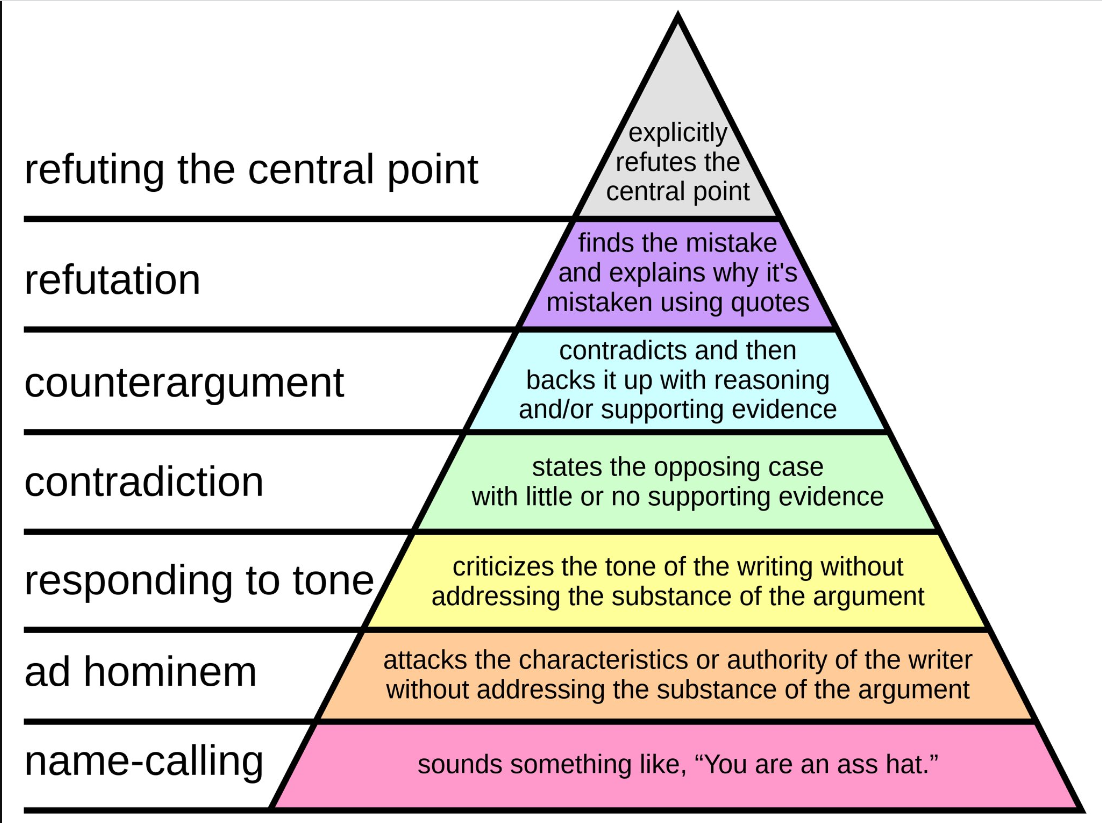
Argument Pyramid: Deploy in Case of Ad Hominem Attacks

This pyramid is an elegant response to shitstorms of ad hominem attacks.

If your response is "this pyramid sucks," it's especially for you.

Credit for this meme goes to Paul Graham, a computer scientist, essayist, entrepreneur, venture capitalist, and author.

Continue ReadingArgument Pyramid: Deploy in Case of Ad Hominem Attacks

The Mental Health Challenges of Liberal Girls

Janathan Haidt, writing at his new Substack:

In conclusion, I believe that Greg Lukianoff was exactly right in the diagnosis he shared with me in 2014. Many young people had suddenly—around 2013—embraced three great untruths:

They came to believe that they were fragile and would be harmed by books, speakers, and words, which they learned were forms of violence (Great Untruth #1).

They came to believe that their emotions—especially their anxieties—were reliable guides to reality (Great Untruth #2).

They came to see society as comprised of victims and oppressors—good people and bad people (Great Untruth #3).

Liberals embraced these beliefs more than conservatives. Young liberal women adopted them more than any other group due to their heavier use of social media and their participation in online communities that developed new disempowering ideas. These cognitive distortions then caused them to become more anxious and depressed than other groups. Just as Greg had feared, many universities and progressive institutions embraced these three untruths and implemented programs that performed reverse CBT on young people, in violation of their duty to care for them and educate them.

See also, this article discussing (among other things) The Coddling of the American Mind, by Haidt and Lukianoff.

Continue ReadingThe Mental Health Challenges of Liberal Girls

About Stupidity and Related Concepts

I've sometimes written about Hannah Arendt's idea of the "banality of evil," the idea that the lack of thought can be far more dangerous than evil intentions. And see here. BTW, it turns out that Adolf Eichmann, Arendt's Exhibit 1, was not a good example of this alleged lack of evil intentions, based on recent revelations.*

Here's a related idea: the problem with stupidity. I am bit uneasy with that word, because it is often used as a pejorative and connotes willful ignorance, ignorance for which someone has made conscious choices to put themselves into that state of ignorance. I would have preferred to simply use "ignorance" to express the idea that someone lacks the necessary information to make decisions that further human flourishing. Another related idea is the Dunning-Kruger effect:

a cognitive bias whereby people with low ability, expertise, or experience regarding a certain type of task or area of knowledge tend to overestimate their ability or knowledge. Some researchers also include in their definition the opposite effect for high performers: their tendency to underestimate their skills.
But back to "stupidity." As described by Dr. Peter McCullough in a recent article, Dietrich Bonhoeffer discussed individual and social damage caused by stupidity. First, McCullough's description of Bonhoeffer:

In 1943, the Lutheran pastor and member of the German resistance, Dietrich Bonhoeffer, was arrested and incarcerated in Tegel Prison. There he meditated on the question of why the German people—in spite of their vast education, culture, and intellectual achievements—had fallen so far from reason and morality. He concluded that they, as a people, had been afflicted with collective stupidity (German: Dummheit).

He was not being flippant or sarcastic, and he made it clear that stupidity is not the opposite of native intellect. On the contrary, the events in Germany between 1933 and 1943 had shown him that perfectly intelligent people were, under the pressure of political power and propaganda, rendered stupid—that is, incapable of critical reasoning.

What follows are a few excerpts from Bonhoeffer's writings on stupidity:

Stupidity is a more dangerous enemy of the good than wickedness. Evil can be protested against, exposed, and, if necessary, it can be prevented by force. Evil always harbors the germ of self-destruction by inducing at least some uneasiness in people. We are defenseless against stupidity. Nothing can be done to oppose it, neither with protests nor with violence. Reasons cannot prevail. Facts that contradict one's prejudice simply don't need to be believed, and when they are inescapable, they can simply be brushed aside as meaningless, isolated cases.

In contrast to evil, the stupid person is completely satisfied with itself. When irritated, he becomes dangerous and may even go on the attack. More caution is therefore required when dealing with the stupid than with the wicked. Never try to convince the stupid with reasons; it's pointless and dangerous.

To understand how to deal with stupidity, we must try to understand its nature. This much is certain: it is not essentially an intellectual, but a human defect. There are people who are intellectually agile who are stupid, while intellectually inept people may be anything but stupid. We discover this to our surprise in certain situations.

Continue ReadingAbout Stupidity and Related Concepts