
The Pot Shot Version of the Ad hominem Attack

Today I posted the following on my Facebook account:

I often post quotes, article excerpts or videos featuring the writings or conversation of others. I post these because I find them interesting and, sometimes, inspiring. Quite often, people respond in the comments by pointing out that that person once did something they disapprove of. They often write something like "I don't like that person."

I don't understand this way of thinking. There are many brilliant but flawed people out there. In fact, each of us can see one of those significantly flawed people in the mirror every morning. When I share information on FB, it is because I find the information interesting. I am not saying "This is a perfectly well-adjusted person who is always correct and who has never done anything I would ever question." For instance, there are severely flawed artists (e.g., Michael Jackson) whose work I admire greatly. Same thing with writers, podcasters, politicians and activists. Thomas Jefferson owned slaves. Is this a problem? Hell, yes. Was he also brilliant? Did his genius help establish this amazing (though flawed) country you call home? Absolutely. When I celebrate Jefferson's amazing accomplishments am I trying to say it's OK to own slaves? Some people apparently think so, because they've been renaming schools that bore Jefferson's name. This is performative, not serious thinking.

All of the people I find interesting are flawed. I am flawed, you are flawed. People of prominence often stumble in big public ways. If you've never gone out into the world to attempt something brave and ambitious, you are flawed in that way too. Can we have an understanding, then, that I am already aware that everyone I mention in my posts is a flawed human being, and many of them have fucked up more than once? Sometimes they've fucked up in intensely cringe-worthy ways. Many of them have fucked up, realized they've fucked up and already admitted that they've fucked up. Pot shots are especially strange in those situations. When you watch a movie, do you sit there obsessing that some of the actors are personally flawed human beings? Or do you enjoy the movie on its own merits? Why do you give your favorite actors a pass?

I don't share information about people BECAUSE they are flawed. Rather, I am sharing their work and observations because I have found that work to be interesting or admirable. I work hard to try to make sense of an extremely complex world and my thought process never stops evolving. I often disagree with things I have stated in the past and you have too. We do this all the time and there is no way to stop doing this. That's how people think and that is why we have conversations--to help each other when we fall off the tracks.

It is the easiest, lowest and most ignorant form of criticism to sit back and point out people's imperfections. This insidious pot shot form of ad hominem is ubiquitous on FB. I assure you that I could engage in taking pot shots at others every hour of every day, with very little effort, but it would do nothing to encourage meaningful conversation or human flourishing.
Continue ReadingThe Pot Shot Version of the Ad hominem Attack

On Confusing Correlation for Causation

Matt Stoller offers this excellent presentation of the commonly used fallacy of confusing correlation for causation:

For years, we’ve been told that while drinking too much is bad for your health, having just a glass of wine with dinner, as the French do, can be good for your heart. And many studies do indeed show such an association. But what we’re discovering is that this correlation is an illusion. In fact people who drink a small amount of wine every night are healthier, but only because it means they aren’t drinking soda. Even small amounts of alcohol are bad for you, but as academics are coming to understand, if you drink a glass of wine every evening, you also tend to exercise, eat fruits and vegetables, and refrain from smoking. And it is those habits, not the wine, that improve health.

This logical fallacy is known as confusing correlation with causation, or assuming that because A happened and then B happened, that A caused B. The media loves these kinds of associations, because they seem correct, but they are often just coincidence, or a result of a variable that’s not being observed. Sometimes correlations are silly, like saying that “there are more sick people at hospitals, therefore hospitals cause sickness.” They can even be ridiculous; one famous study found that shark attacks are common on beaches with more ice cream sales, the theory being that sharks like to eat people full of ice cream.

Every aspiring law student encounters this fallacy; it’s fundamental in law to understand when something is causal vs coincidental or associative. It’s such a commonly taught error to avoid that it was the basis for one of the first episodes of the famous show The West Wing, an episode named “Post Hoc, Ergo Propter Hoc” after the latin phrase describing this fallacy. Lawyers understand the difference between correlation and causation. So do academics. An entire generation of would-be lawyers who watched the West Wing understand it. It’s not a mystery.

Continue ReadingOn Confusing Correlation for Causation

Bret Weinstein Offers an Explanation for his COVID Disagreements with Sam Harris

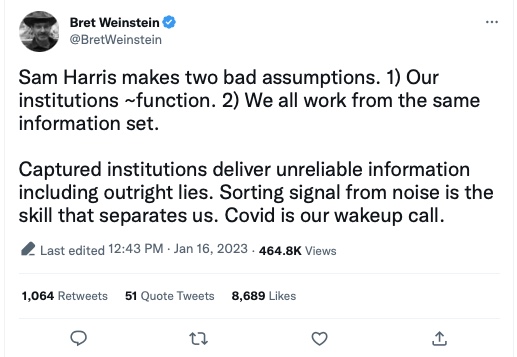
As I see it, Sam Harris, who I have much admired over the years, has somewhat fallen off the rails on COVID, Free Speech and Trump. It happens to all of us, some of the time. I hope he can settle himself and get back in the game. In the meantime, Harris and Bret Weinstein have been struggling to figure out why they have had recent pointed disagreements. Bret's Tweet offers a reason for their disagreements:

Jimmy Dore dissects Sam Harris' recent strange discussion about COVID (starting at hr./min. 2:51). This is about a strange as Sam Harris' recent discussion regarding Hunter Biden's laptop. Glenn Greenwald links to the video clip of Harris and offers this commentary:

All of this stems from the classic mentality of all would-be tyrants: our enemies are so dangerous, their views so threatening, that everything we do – lying, repression, censorship – is noble. That's what made the Sam Harris confession so vital: that's how liberal elites think.

Continue ReadingBret Weinstein Offers an Explanation for his COVID Disagreements with Sam Harris

Diagnosing Woke Ideologists

Josh Slouch lost a job he loved. In his current essay, he indicates that a Woke Mob came after him. He writes:

What was my sin? Had I hung a noose from the rearview mirror of my Prius? Did I assault a trans person? Did I don blackface and drop the n-bomb? No. It was more sinister than that. They discovered that I, a gay man, host a conservative podcast.

If you're wondering how a progressive gay liberal became a libertarian conservative, the story of that political transformation will be told on my Substack soon.

I'll be on the lookout for that forthcoming article. In the meantime, Josh has contemplated the types of people who joined the Woke Mob that cost him his job. Here's how he diagnoses them:
I believe part of the answer to this complicated question lies in the normalization of a type of psychology that drives domestic abuse known as Cluster B personality disorders. These include narcissistic personality disorder, borderline personality disorder, histrionic personality disorder, and anti-social personality disorder. The symptoms of these disorders are diverse and overlapping, and people with them engage in conflict, deception, abuse and mistreatment of others (almost always while claiming they themselves are victims).

These are more than “difficult people.” They are impossible, and often dangerous, people. A quick glossary of the Cluster B disorders. There is a lot of overlap in symptoms among them:

Narcissistic Personality Disorder—self-centered, vain, may be a braggart or may be the type that acts like a very special put-upon victim. The world revolves around them, and others are objects to be used, not people to love or respect.

Borderline Personality Disorder—extreme emotional instability, laughing one minute, crying or screaming the next. Borderlines fear abandonment but engineer conflicts with everyone around them until they fulfill their own fear of being rejected. Think “I hate you/don't leave me.”

Histrionic Personality Disorder—Big emotions about everything all the time. Life events are over-dramatized. Minor disagreements become relationship-shattering cataclysms. Histrionics are often sexually seductive and go beyond flirtation in acting out for attention.

Anti-social Personality Disorder—also known as “sociopathy” or “psychopathy.” An absence of conscience or empathy. Antisocials lead a parasitic life draining money and time from others. Many are criminals. Others stay within the law but torment their families and colleagues to get what they want.

Continue ReadingDiagnosing Woke Ideologists

The Biggest Dangers of Tribes

What should you make of the fact that you are passionate about your position on an issue?

Is that passion justified by real world facts and a careful and conscious cost/benefit analysis? Or did unconsciously adopt your position as a result of becoming a member of a tribe? Did social pressures and desires nullify your intellectual defenses to bullshit, allowing rickety beliefs to find a welcoming space in your head? Did you aggressively attack your new position, making sure that it is solid? Or did it slip in like the trojan horse after your sentries became completely distracted by their cravings to be liked (and not disliked) by others? After all, because called "inappropriate" "misguided," "a tool for the [bad people]" or "racist" hurts, especially when done in public arenas. Those slings and arrows take a toll and they have put Americas institutions at great risk. It takes a special person to be able to shake off those accusations and stay true your need to hyper-scrutinize all issues, especially your own position on those issues.

It takes courage and strength to constantly attack your own ideas and it needs to be constant because truth-seeking is never-ending work. And it's not enough to try as hard as you can to be skeptical of your own ideas, because we are blind to the problems with our own thought process.

We know this for sure, based on the work of many scientists who have studied the confirmation bias, including Jonathan Haidt:

Morality binds and blinds. It binds us into ideological teams that fight each other as though the fate of the world depended on our side winning each battle. It blinds us to the fact that each team is composed of good people who have something important to say.

From The Righteous Mind: Why Good People Are Divided by Politics and Religion.

You can't cure this problem alone. You need to expose yourself to viewpoints you find distasteful or even odious. That is the only solution because the confirmation bias is that strong. You cannot see the problem as long as you are clinging only to your favorite sources of information. You need quit being a coward and engage with people and ideas that challenge you. You need to visit websites and read books that you would rather not. That is your only chance to test your ideas, identify those that work and don't work. This need to constantly expose your thoughts to the marketplace of ideas was described with precision by John Stuart Mill (and see here). Recently, Jonathan Rauch has taken a deep dive on this challenge in his excellent book, The Constitution of Knowledge.

There will be many who read this who say "I'm not concerned because I am immune to both dumb things and the pressures of tribes." They are wrong to be complacent for two reasons.

Reason One: People think they are immune because they feel certain that they have things right. They feel this way even though ALL OF US change our opinions over time. We are guaranteed to change our views in the future just as we have in the past, but we don't remember how much we change over time.  We simply sit there smug and certain that we've got things figured out at each present moment. What is that feeling of certainty worth? Nothing, as explained by Robert Burton, in his book, On Being Certain.

[More . . . ]

Continue ReadingThe Biggest Dangers of Tribes