Social Media is the New Version of Brain-Destroying Lead

In this Interview with Joe Rogan, Tristan Harris of the Center for Humane Technology drew a haunting analogy.  The discussion begins at 1:24.

Throughout the 1900's, lead was increasingly used in paint, gasoline and other products.  It was hailed as a miracle substance.

What are the Health Effects of Lead? Lead can affect almost every organ and system in your body. In children six years old and younger even low levels of lead in the blood of children is poisonous. It can result in behavior and learning problems, lower IQ and hyperactivity, slowed growth and many other problems. Beginning in 1965, it took the heroic efforts by geochemist Clair Cameron Patterson (and see here) to convince the U.S. Government (over systematic misinformation from companies who profited from the sale of products using lead) that lead in the environment was dangerous to humans.

Tristan Harris argues that social media is the new lead.  Instead of brain damage, however, social media causes people to distrust each other, making it impossible for people from the opposing tribes to work with each other or compromise with each other. Social Media is thus causing a massive breakdown of our political system. The following exchange begins at 85:21):

TH: Let's replace lead with problem solving capacity . . .  Imagine that we have a societal IQ or a societal problem-solving capacity the US has a societal IQ, Russia has a societal IQ, Germany has a societal IQ:  How good is a country at solving its problems? Now imagine, what does social media do to our societal IQ?

JR: It distorts our ideas. It gives us a bunch of false narratives. It fills us with misinformation.

TH: It makes it impossible to agree with each other, and in a democracy if you don't agree with each other and you can't even do compromise . . .  People recognize that politics was invented to avoid warfare. So we have compromise and understanding so that we don't physically become violent with each other.  We have compromise and conversation.  If social media makes compromise, conversation and shared understanding and shared truth impossible, it doesn't drop our societal IQ by four points. It drops it to zero, because you can't solve any problem, whether it's human trafficking or poverty or climate issues or racial injustice. Whatever it is that you care about, it depends on us having some shared view about what we agree on.

Continue ReadingSocial Media is the New Version of Brain-Destroying Lead

Hate the Vote, not the Voter?

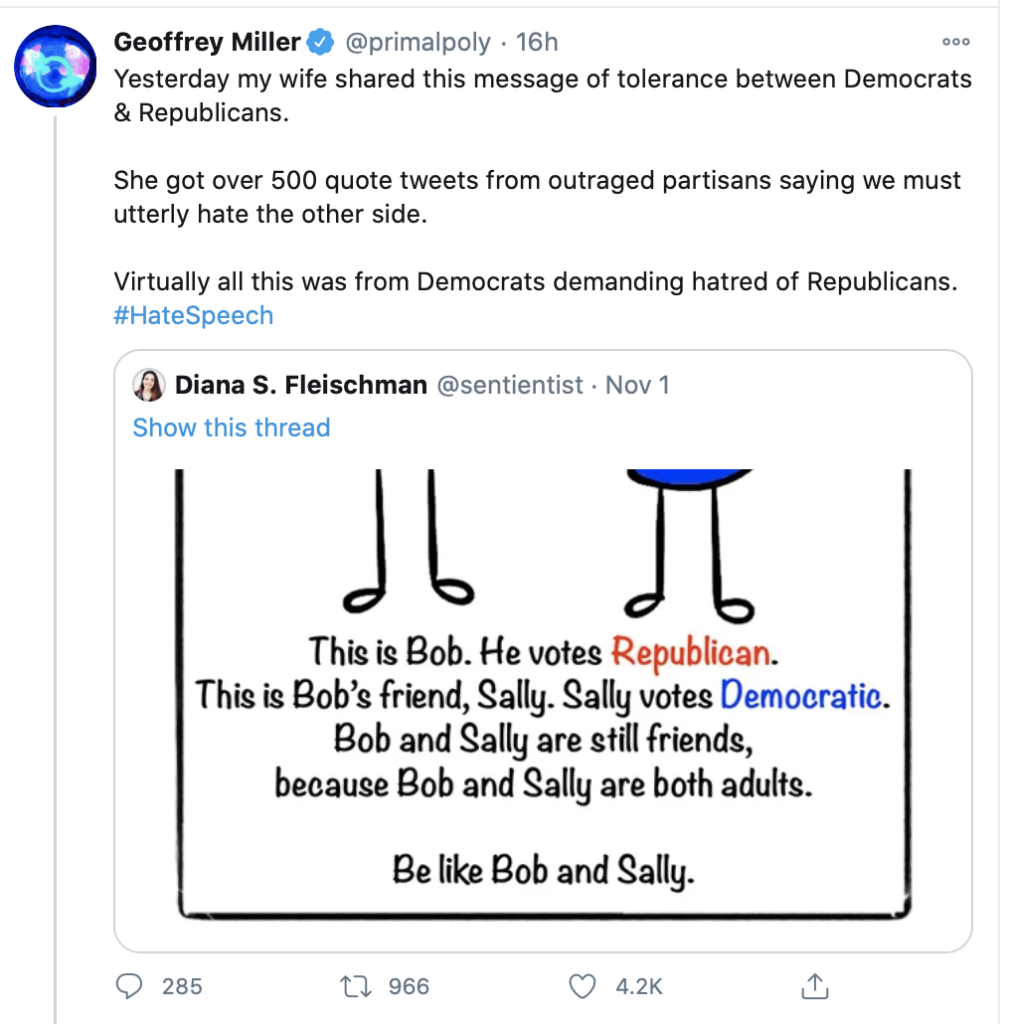
I already voted for Biden.I have several friends who have voted for Trump. I know for a fact that they are not mean people, stupid or racist. I'm am sure that they held their nose to vote for Trump; I held my nose to vote for Biden. I will remain friends with my Republican friends. I refuse to hate anyone based on how they vote. This is the context for this little experiment run by Diane Fleishman, as reported by her husband Geoffrey Miller (they are both evolutionary psychologists).

Continue ReadingHate the Vote, not the Voter?

About Calls to Prayer

For several years I have taught week-long courses at law schools in Istanbul, Turkey. Those visits have been put on pause due to COVID. I was a couple weeks from traveling to Istanbul once again in early March, 2020, but I reluctantly cancelled that.

I often think of the many people I repeatedly visit when I'm in Turkey. Like most of my friends in the U.S., digital technologies have made it possible to keep in touch, but I look forward to the day when I can once again take it all in through all five senses.

Back here in St. Louis, Missouri, I tend to my ordinary life. Every week or so, however, I fondly think of something that I couldn't have predicted before I first visited the Middle East. I often think of the call to prayer.

In the Middle East, the muezzin calls out from the top of nearby minarets five times each day (sometimes more than one at the same time if you are between minarets). It's a call, for sure, and almost seems like a song, but I've been told that it is not singing. The calls seemed like intrusions on my ears until I heard many of them. Gradually, over my repeated visits, the call to prayer became an exceptionally beautiful moment for me. I write this as an atheist who doesn't understand any of the words of the call to prayer. For me, its beauty is about the sounds and the moment, coupled with images of the venerable mosques I visited (I took these photos in Turkey and Egypt). Also coupled with the second-to-none hospitality of the people I met in the Middle East. It's different than church bells, because it's only five times each day and because you are not hearing a mechanical bell--you are hearing a human being earnestly calling out to you.

As I repeatedly visited Turkey, I started looking forward to the calls as opportunities to stop and think about life and my place in the world. I also took it as a reminder to always be tending to things that really matter because the day is always slipping away. It is also a reminder that you are part of a much bigger community because that call is to everyone in hearing distance, not just you.

There are many reasons for craving an effective vaccine for COVID. For me, this is a reason that I didn't anticipate. This is a good example of a reason that you should travel to new places: If you travel with the right state of mind, you will be changed by what you encounter.

Continue ReadingAbout Calls to Prayer

Deborah Tannen’s Observation that The Argument Culture Has Been Brewing for a Long Time

Deborah Tannen, The Argument Culture (1998), well before social media took over:

This is not another book about civility. “Civility”suggests a superficial, pinky-in-the-air veneer of politeness spread thin over human relations like a layer of marmalade over toast. "This book is about a pervasive warlike atmosphere that makes us approach public dialogue, and just about anything we need to accomplish, as if it were a fight. It is a tendency in Western culture in general, and in the United States in particular, that has a long history and a deep, thick, and farranging root system. It has served us well in many ways but in recent years has become so exaggerated that it is getting in the way of solving our problems. Our spirits are corroded by living in an atmosphere of unrelenting contention— an argument culture.

The argument culture urges us to approach the world— and the people in it— in an adversarial frame of mind. It rests on the assumption that opposition is the best way to get anything done: The best way to discuss an idea is to set up a debate; the best way to cover news is to find spokespeople who express the most extreme, polarized views and present them as “both sides”;the best way to settle disputes is litigation that pits one party against the other; the best way to begin an essay is to attack someone; and the best way to show you’re really thinking is to criticize.

Our public interactions have become more and more like having an argument with a spouse. Conflict can’t be avoided in our public lives any more than we can avoid conflict with people we love. One of the great strengths of our society is that we can express these conflicts openly. But just as spouses have to learn ways of settling their differences without inflicting real damage on each other, so we, as a society, have to find constructive ways of resolving disputes and differences. Public discourse requires making an argument for a point of view, not having an argument— as in having a fight."

Continue ReadingDeborah Tannen’s Observation that The Argument Culture Has Been Brewing for a Long Time