The Personal Mission of Daryl Davis to Melt the Ku Klux Klan

I love this podcast. Daryl Davis set out on a personal mission to melt the hate residing within members of the Ku Klux Klan. He did it with kindness, curiosity and a superhuman amount of patience and courage. I suspect that his gentle nature and his love of music also played helped to pave the way.  Here's an excerpt from the related article from FIRE (Foundation for Individual Rights in Education):

"Daryl Davis, a 58-year-old black man, grew up attending international schools and traveling the world with his parents who worked in the foreign service. ... “When I was overseas, I was multicultural. But when I would return home to the states, I was either in all black schools or black and white schools, depending on whether I was going to the newly integrated school or the still segregated one.”

Davis’ experience with segregation and racism in the United States led him to ask the question, “How can you hate me if you don’t even know me?” To find his answer, Davis began interviewing members of the Ku Klux Klan in the early ‘90s for a book he planned to write, ultimately titled “Klan-destine Relationships: A Black Man’s Odyssey in the Ku Klux Klan.” What he found in the course of researching his book was that while he was actively learning about Klan members, they were passively learning about him.

“If you spend five minutes with your worst enemy, you will find you have something in common,” said Davis. “If you spend 10 minutes, you’ll find you even have more in common. And the more you find that you have in common and build upon those things, the less the things that you have in contrast will begin to matter, like skin color.”

This open dialogue resulted in many of Davis’ interview subjects ultimately becoming his friends and giving up their prejudices. Today, he has dozens of Klan robes at his home that were given to him by former Klan members who shed their racist beliefs after meeting him.

Continue ReadingThe Personal Mission of Daryl Davis to Melt the Ku Klux Klan

Questioning the “Political Spectrum”: To What Extent Are Political Parties Social Clubs?

According to this article by Hyrum Lewis ("Our Big Fight Over Nothing: The Political Spectrum Does Not Exist"), the political "spectrum" is primarily tribal. Lewis states that many of the respective policy positions in the platforms of each of the two main political parties are not glued together by overarching consistently applied principles. These conclusions of Lewis run counter to the writings of George Lakoff, who (in his book, Moral Politics) argues that Republican positions derive from the metaphor of a "stern father," whereas the Democrat positions derive from the metaphor of the "nurturant parent." To the extent that Lewis is correct and that Lakoff has overstated his case, this is an inconvenient fact for those of us who claim that our political stances are completely principled, not adopted as the result of social pressure. Here are a few excerpts from Lewis' article:

In the essentialist theory, ideologies are unchanging, transcendent principles, while parties are evolving social organizations that can be “captured” by the ideologies. In the social theory, by contrast, ideologies don’t capture parties; parties capture ideologies—that is, they redefine them. Once again, research supports the latter: what is considered “right-wing” or “left-wing” is simply whatever the Republican and Democratic Parties happen to stand for at a given moment. Left-right ideologies are tools of self-delusion—they let us indulge the fantasy that our partisanship is principled rather than tribal, i.e., that there is some noble ideal connecting all the distinct and unrelated issues that our party happens to support. But essentialist predictions do not hold up to reality. . .

An alternative to this essentialist theory is the “social theory” of ideology, which says that distinct political positions correlate because they are bound by a unifying tribe. If the right-wing team is currently in favor of tax cuts and opposed to abortion, then those who identify with that team will adopt those positions as a matter of social conformity, not because both are expressions of some underlying principle.

... Public opinion polls further reinforce the point, showing that left-right ideologues often switch their beliefs to conform to the tribe. In the past decade alone we’ve seen self-described conservatives go from being anti-Russia to more pro-Russia, strongly pro-trade to strongly anti-trade, believing that personal character matters a great deal in politicians to believing that it matters hardly at all, staunchly interventionist in foreign policy to staunchly isolationist. Where is the “essence” behind all of this variation? It doesn’t exist. The views associated with left and right are constantly shifting for social reasons that have nothing to do with essential principles.

Continue ReadingQuestioning the “Political Spectrum”: To What Extent Are Political Parties Social Clubs?

Face2Facebook: A Proposed App for Decreasing Contentious Conversations on Facebook

I enjoy spending time with many of the people on Facebook. I’ve also had to endure more than a few rude exchanges with other Facebook users. On several occasions over the past two years, I’ve reached out to a FB user from my city who seemed rude. I sent a private FB message and I wrote something like this: “Hey, I’d bet that we have a lot in common. Would you be interested in having a face to face conversation, perhaps over coffee?” Several people accepted my invitations and every one of these conversations was cordial and productive. Several of these relationships are ongoing. We don’t agree on everything, but these in-person conversations are well worth it. I get the gift of learning how to see the world through the eyes of another person and that’s always a good thing. Also, we inevitably find out that we have many things in common, just as Donald Brown established in his classic 1991 work: “Human Universals.”

Over the past couple of years, it seems that FB has become an even more contentious place. It is increasingly expected that people will preach at each without a willingness to be changed by new information. When I offer information or ask a question on FB, I often receive huffy pushbacks, accusations, ridicule and name-calling instead of open-minded fact-finding and a willingness to start the conversation by finding each other where we are. The bad behavior we see is clearly not how adults should be interacting, but I don’t place all of the blame on the FB users. The format of social media dehumanizes us to each other, making it easy to lash out at mere words on a page, distracting us from the reality that real human beings seeking connections are writing those words. This is more than a frustration. This non-stop boorish behavior is convincing us that it is impossible to have conversations with those who see the world differently than we see it.

With this in mind, I’d like to offer FB this free idea: Face2Facebook. Here’s how it would work. If you believe that someone is being rude to you on FB, click the Face2Facebook button and it will bring up a scheduling app for both you and “the rude person.” The app asks both of you to designate various times when you would be available to have a ten-minute video conversation through FB. When that date and time arrives, the app will encourage you to start by getting to know each other as people by discussing a bit about each other’s family, community and interests. Only then should you ask each other about the topic that gave rise to the contentiousness. If you are both brave, you’ll listen to each other with open minds, putting each other’s best foot forward. A timer will ding after ten minutes, at which point you can (but need not) say farewell to each other. The best outcome is that each of you will be reminded that you were communicating with another human being. You will be reminded that there was a person behind those words. Perhaps the app will ask you to rate each other on whether you were good listeners. After you complete the ten-minute video conversation, Face2Facebook will publish a public acknowledgement that the two of you reached out to each other and had a conversation.

Not that every conversation will be easy or fun, but isn’t this worth a try? Maybe that conversation will change how you think about a topic. Then again, that video might only reveal that that “53-year old engineer” was a 14-year old boy whose highest aspiration is piss others off. If the other person refuses to talk to you on a video, perhaps this could be indicated on their profile so that the FB community would see statistics regarding who requests conversations and who cowardly refuses to meet on Face-to-Facebook.

This is only a rough draft idea, not a polished app. I don’t know if this is really workable. I do hope that FB might consider something like this because we desperately need something to get us out of our social media downward spiral.

Continue ReadingFace2Facebook: A Proposed App for Decreasing Contentious Conversations on Facebook

Rule #1: Take Time to Say Hello to Strangers

Over the past couple of decades, I've become eager to say hello to people I don't know, but it wasn't always this way. I'm most definitely an introvert and it was easy to walk on by.  Through trial and error, though, I've learned that you have no idea who that person is, the one you are passing on the street. It might be a person with a fantastic story. For instance, when my kids were young, I often walked past a man at my kids' grade school, merely saying hello. It was months later that I learned that he was a Grammy Award winning jazz piano player who toured the world.

About 20 years ago, at a Christmastime event at the home of a neighbor of my former family-in-law my father-in-law asked me, "Erich, have you met James Watson yet?" I hadn't. That night, while most of the neighbors sang Christmas carols, I had the opportunity to discuss the double helix with the co-discoverer of DNA.
There's all kinds of interesting people all around you. Most of them don't send you any clues to their accomplishments, not until you say hello and strike up a conversation.  You will miss out on some of the best parts of life if you don't take the time to say hello to strangers.

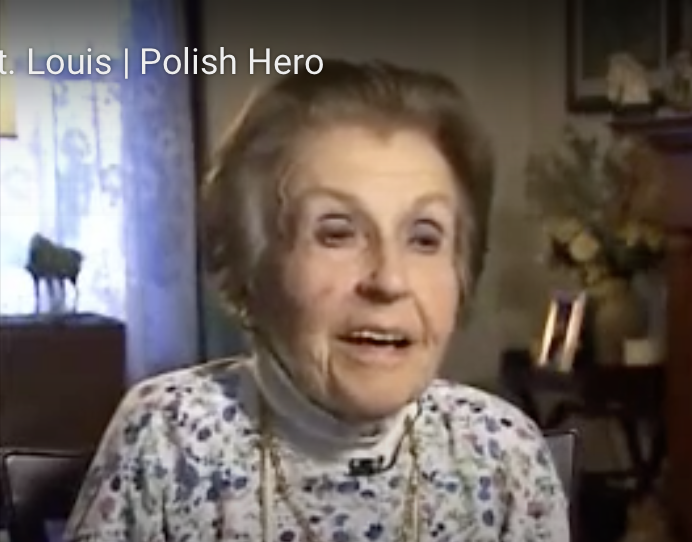
Sixteen years ago, in April, 2004, I took the time to get to know a woman who walked her two dogs (Cara Mia and Bobinskion) up and down my street every day. The woman's name was Bisia and it turned out that she was a Polish Countess who had an unusual story, a heroic story based on her life in Poland during World War II. She was 85-years old when I sat down to interview her for the Flora Place neighborhood newsletter. At that time, Bisa was married to her 95 year old husband, Isham. They have both passed away since I interviewed with her. After I wrote up her story, I noticed that the local PBS station had produced a feature on her too. I've embedded that link below.

I wrote this 15 years ago and rediscovered it today. I'd like to once again share her story. I hope you enjoy this.

The Countess of Flora Place

Originally Published April, 2004

Each of us might not have ended up living on Flora Place.  Life offers many paths to many other places.  I, for instance, grew up in St. Louis County and learned of this beautiful street through friends. My personal path to becoming a Flora Place resident, then, was not surprising.

For others, though, the journey followed convoluted and precarious paths.  One such person is Bisia Reavis, who has lived with her husband Isham at 4122 Flora Place since 1958.  As one of the most prominent dog-walkers on the street, Bisia is virtually an institution.  Always ready with her kind smile and encouraging words, she is generally accompanied on her walks by Cara Mia (a Doberman) and Bobinski (“Bo,” a Poodle).

The current editor of this newsletter has decided to begin a series of articles highlighting the stories some of our many interesting neighbors. Bisia was kind enough to share her journey from Poland to Flora Place as the first article in this series.

Formerly known as Countess Elizbieta Krasicka, Bisia was the youngest of six children born in 1921 to Count August from Siecin Krasicki and Countess Isabella from Granow Wodzicka.  The family lived at the Castle at Lesko, in Poland (present day Ukraine) tucked along the Carpathian Mountains.  The sprawling estate stretched to the borders of both Hungary and Czechoslovakia. The bright red family coat of arms is the symbol of a lineage of nobility stretching back to 1540.  Bisia’s story involves many ancillary episodes.  Her Grandfather Stanislaw traveled to Mexico to serve as one of Maximillian’s officers in the 1860’s.   Her uncle, the Archbishop of Krakow, ordained Pope John-Paul II.

Bisia was 17 when war broke out in September, 1939. The Germans and Soviets quickly decided that the San River (which flowed through the family garden) would serve as their contentious line of demarcation.

Continue ReadingRule #1: Take Time to Say Hello to Strangers