FTC Warns of Increased Rate of Romance Schemes During COVID

According to the FTC, there are a lot of broken hearts out there who also have broken wallets. I didn't realize the extent of the problem, which has skyrocketed since COVID:

Scammers fabricate attractive online profiles to draw people in, often lifting pictures from the web and using made up names. Some go a step further and assume the identities of real people. Once they make online contact, they make up reasons not to meet in person. The pandemic has both made that easier and inspired new twists to their stories, with many people reporting that their so-called suitor claimed to be unable to travel because of the pandemic. Some scammers have reportedly even canceled first date plans due to a supposed positive COVID-19 test.

While many people report losing money on romance scams that start on dating apps, even more say they were targeted on social media. These social media users aren’t always looking for love, and report that the scam often starts with an unexpected friend request or message.

Sooner or later, these scammers always ask for money. They might say it’s for a phone card to keep chatting. Or they might claim it’s for a medical emergency, with COVID-19 often sprinkled into their tales of woe. The stories are endless, and can create a sense of urgency that pushes people to send money over and over again.

What many of the largest reported dollar losses have in common is that people believe their new partner has actually sent them a large sum of money. Scammers claim to have sent money for a cooked-up reason, and then have a detailed story about why the money needs to be sent back to them or on to someone else. People think they’re helping someone they care about, but they may actually be laundering stolen funds. In fact, many reported that the money they received and forwarded on turned out to be stolen unemployment benefits.

In 2020, reports of gift cards being used to send money to romance scammers increased by nearly 70%. Gift cards, along with wire transfers, are the most frequently reported payment methods for romance scams. People said they mailed the gift cards or gave the card’s PIN number to the scammer. The median amount people sent romance scammers in 2020 using any method of payment was $2,500, more than ten times the median loss across all other fraud types.

Reports of money lost on romance scams increased for every age group in 2020. People ages 20 to 29 saw the most striking increase, with the number of reports more than doubling since 2019. People ages 40 to 69 were once again the most likely to report losing money to romance scams.7 And people 70 and older reported the highest individual median losses at $9,475.

Continue ReadingFTC Warns of Increased Rate of Romance Schemes During COVID

The Kinds of Things You Can Learn About Your Family for $99

Here's a rather amazing thing I recently learned about myself from 23 & Me: "You inherited a small amount of DNA from your Neanderthal ancestors. Out of the 7,462 variants we tested, we found 257 variants in your DNA that trace back to the Neanderthals." 23 & Me further told me I have up to 2% of Neanderthal DNA in my genome.

I've also checked out many hundreds of my 4th-6th cousins. They have many hundreds of last names and, based upon the profile photos, they come in every size, shape and skin color. They reside in dozens of countries all over the world. I have numerous relatives born in Africa, Asia and Australia. Six of my relatives are Egyptian. 34 of my closest 5,000 relatives are at least 25% Ashkenazi Jews.

As I'm learning these things, I'm recalling the joyous presentation A.J. Jacobs made about his expansive family tree at this TED talk.

That a company can reliably tell me these things for $99 would have been unfathomable even a few decades ago--It wasn't until 2003 that scientists could read the complete genetic blueprint for building a human being (the Human Genome Project). These findings and this modest cost to learn these things are stunning. So stunning that, as I found ever more about my family tree tonight, I even chuckled a little Neanderthal chuckle.

Continue ReadingThe Kinds of Things You Can Learn About Your Family for $99

Seek Neither Happiness Nor Pleasure

There is a vast literature on how to be happy. As I read most of the articles I encounter, I stop to question the meaning of "happiness," because it is too often understood as "pleasure." I'm not anti-pleasure, but I've personally seen that pleasure-seeking is not a path to a meaningful life. In fact, it is the opposite. I prefer to seek a meaningful life, but doing this involves many painful moments that are, in the end, worth the pain. Here's a caricature of these two approaches, from an article by Arthur Brooks, titled "There Are Two Kinds of Happy People: Some of us strive for a virtuous life. Others strive for a pleasant one. We could all use a better balance."

Epicurus (341–270 B.C.) led an eponymous school of thought—Epicureanism—that believed a happy life requires two things: ataraxia (freedom from mental disturbance) and aponia (the absence of physical pain). His philosophy might be characterized as “If it is scary or painful, work to avoid it.” Epicureans see discomfort as generally negative, and thus the elimination of threats and problems as the key to a happier life. Don’t get the impression that I am saying they are lazy or unmotivated—quite the contrary, in many cases. But they don’t see enduring fear and pain as inherently necessary or beneficial, and they focus instead on enjoying life.

Epictetus (c. 50–c. 135 A.D.) was one of the most prominent Stoic philosophers, who believed happiness comes from finding life’s purpose, accepting one’s fate, and behaving morally regardless of the personal cost. His philosophy could be summarized as, “Grow a spine and do your duty.” People who follow a Stoic style see happiness as something earned through a good deal of sacrifice. Not surprisingly, Stoics are generally hard workers who live for the future and are willing to incur substantial personal cost to meet their life’s purpose (as they see it) without much complaining. They see the key to happiness as working through pain and fear, not actively avoiding them.

Here's an alternate path offered by Emily Esfahani Smith. Instead of seeking happiness (which will not result in happiness), she urges us to seek meaningfulness in our lives. Her article in The Atlantic is titled "There's More to Life Than Being Happy: Meaning comes from the pursuit of more complex things than happiness." Here's an excerpt:

Meaning is not only about transcending the self, but also about transcending the present moment -- which is perhaps the most important finding of the study, according to the researchers. While happiness is an emotion felt in the here and now, it ultimately fades away, just as all emotions do; positive affect and feelings of pleasure are fleeting. The amount of time people report feeling good or bad correlates with happiness but not at all with meaning.

In her TED talk, Esfahani Smith explains that it is futile to seek happiness:

The data showed that chasing happiness can make people unhappy. And what really struck me was this: the suicide rate has been rising around the world, and it recently reached a 30-year high in America. Even though life is getting objectively better by nearly every conceivable standard, more people feel hopeless, depressed and alone. There's an emptiness gnawing away at people, and you don't have to be clinically depressed to feel it. Sooner or later, I think we all wonder: Is this all there is? And according to the research, what predicts this despair is not a lack of happiness. It's a lack of something else, a lack of having meaning in life.

01:35 But that raised some questions for me. Is there more to life than being happy? And what's the difference between being happy and having meaning in life? Many psychologists define happiness as a state of comfort and ease, feeling good in the moment. Meaning, though, is deeper. The renowned psychologist Martin Seligman says meaning comes from belonging to and serving something beyond yourself and from developing the best within you. Our culture is obsessed with happiness, but I came to see that seeking meaning is the more fulfilling path. And the studies show that people who have meaning in life, they're more resilient, they do better in school and at work, and they even live longer.

02:24 So this all made me wonder: How can we each live more meaningfully? To find out, I spent five years interviewing hundreds of people and reading through thousands of pages of psychology, neuroscience and philosophy. Bringing it all together, I found that there are what I call four pillars of a meaningful life. And we can each create lives of meaning by building some or all of these pillars in our lives.

Esfahani Smith's fourfold path to meaningfulness includes these four elements:

1) A Sense of Belonging, meaning relationships “where you really feel like you matter to others and are valued by them, and where you in turn treat others like they matter and are valued.”

2) Purpose, or “having something worthwhile to do with your time,” says Smith. “It’s this pursuit that organizes your life and involves making a contribution to others.” Smith writes and speaks about the best ways we can find purpose in our own lives. This includes locating our strengths and talents, what our unique perspective on the world is, and bringing that all together to give back.

3) Transcendence, “those moments where you're basically lifted above the hustle and bustle of daily life and you feel your sense of self fade away.” Transcendence, for a lot of people, is part of a religious pursuit, experienced through meditation, prayer, and other expressions of faith. But you can also experience it in nature, or at work, explains Smith.

4) Storytelling, the final pillar “surprised me in a lot of ways,” Smith says. “Storytelling is really about the story that you tell yourself about your life, about how you became you. It’s your personal myth.”

For several years, I've embraced Esfahani Smith's four principles. And, if you haven't noticed, neither happiness-seeking nor pleasure-seeking are among her paths.

I will pause this discussion at this point.  More to come . . .

Continue ReadingSeek Neither Happiness Nor Pleasure

The Upsides of Death

My family and I are currently working through a sudden death of someone central to all of us.  Anne Octavia Jay, my ex-wife, suddenly died.  For months, she was working through some medical issues that seemed surmountable, but then there was some extra-bad news. Then, about two weeks ago it started pouring bad news. This deluge included a sudden diagnosis of stage four cancer.  On Christmas Eve, she suffered cardiac arrest, which led to forty minutes of CPR. In the ICU we learned what kind of damage can happen to a person's brain after forty minutes of CPR.

On the day after Christmas, my two young adult daughters and I gathered around Anne in the ICU to say our goodbyes. I learned that for a patient who has suffered this sort of damage, the fact that she occasionally opened her eyes means nothing at all.   I learned what "comfort care" means. I am learning what it means to be the only surviving parent.  I am learning how hard it can be to lose a parent.  I am learning the awkwardness of being an ex-spouse who loses one's ex-spouse. What am I to be called?  An "ex-widower"? What is the proper name for a person in my position, someone who still cared deeply for my deceased ex but who feels awkward because our marriage fell apart and we divorced each other?

I don't really have an end in mind for this post. Mostly, I'm emoting, but I wanted to share that I was particularly right about one thing. I've always assumed that one can use most "bad" events as good experiences, not just as good learning experiences. We the survivors have learned a lot together.  I now know how to be a better friend to other people who have lost their loved ones.  I now know better how to appreciate the complexity of the human body.  We shouldn't be surprised when our bodies don't work; rather, we should be more more surprised that they ever actually work, given their mind-boggling complexity.  I've learned to appreciate the human heart.  Anne's heart faithfully beat for 59 years, which is a stunning achievement regularly exceeded by the heart-beating streaks of countless other people such as me (I'm in my 60's).

Mostly, I've learned to appreciate the importance of community.  I've seen many dozens of people come out of the woodwork to offer comfort and assistance for my daughters and me in many major and minor ways.  I now have increased respect for the way healthcare workers treat the family of dying patients. I've learned to appreciate straight talk from these professionals.  I've learned to appreciate the patience and kindness of all the people at the cremation service we are using.  We are surrounded by good-hearted people, including countless friends and relatives.  They are everywhere.  They are constantly bringing us flowers and soup and snacks and offers of ever-more help. It has been humbling.

We are in our George Bailey moment and people are running to our rescue in droves to tell us that we are not alone. It feels wonderful.  I know that the hard part will be when all of the adrenaline is gone and when my daughters and I will experience unrelenting emptiness.  That leads me to also appreciate the many friends and professionals who offer grief counseling individually and in groups.

Death in one's family can be one of the better ways to learn what it means to live a good life.  And to paraphrase Tim McGraw, I have better learned to live like I am dying.

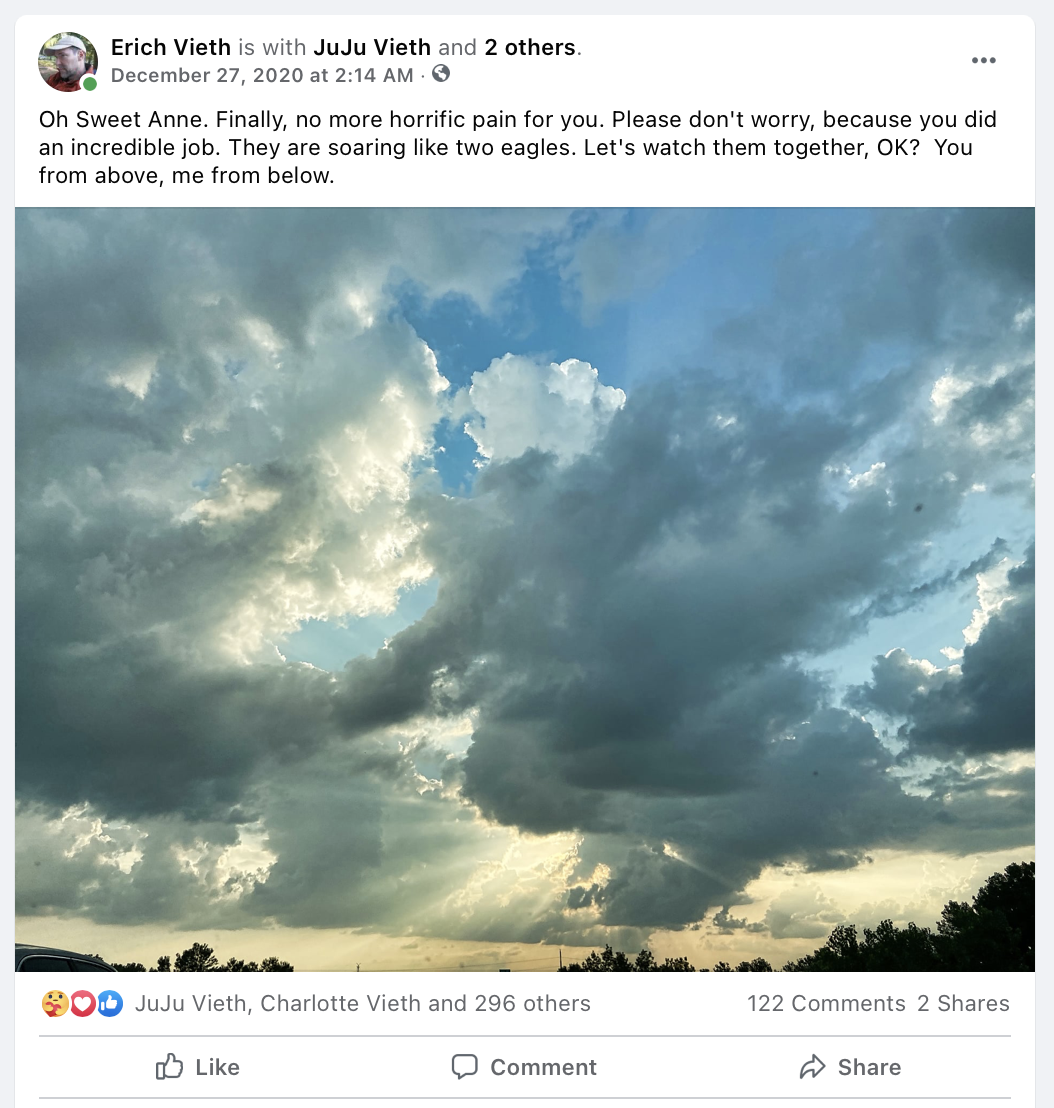
I'll end with a Facebook tribute I created for Anne. More than anything else, she wanted to make sure her children were OK. This was her prime directive.  My daughters are working through this with me and I am strongly convinced that we will be ultimately be OK as we continue our life journeys stronger and wiser. Thanks for reading through to the end.

Continue ReadingThe Upsides of Death