I like to create video interviews of interesting people. One of the most compelling interviews I have made was that of Ben Fainer, a holocaust survivor. He spent six tortured years in several camps. I loved Ben's attitude. He was patient and forgiving in spite of all that he had been through. And he was a wise man too. Many other people have been moved by Bens words too. More than 100,000 people have viewed his video. He died a few years after we created his video, so I was especially glad that his words were preserved.
I had another friend who almost died in WWII. Like Ben, she was Jewish. Susan was in her late 80s when she mentioned that she had escaped from Europe to the U.S. through Japan. It sounded like an amazing story. She agreed to tell me all about her escape. We agreed to meet the following week on a Tuesday. She died that weekend, so we will never know her story. Her death has served as a reminder to me that once I recognize something to be important I need to schedule it and do it promptly. Or else.
And I know that life isn't always that simple. There are conflicting platitudes that remind us that it's not that simple: A) "He who hesitates is lost." And B) "Look before you leap."
When I conclude that something is important, however, I try to jump at it. You see, I'm in my 60s. I hope to be around for decades, but I might get the horrible diagnosis tomorrow. Or that car might swerve into my lane next week.
We are all traveling along a Life Arc and there is nothing you can do to slow it down. Your only option is to fill it up with quality experiences. Schedule it and make it happen, Laura Vanderkam reminds us over and over. Do that, or don't do that, thereby allowing the sands of time to slip through your fingers. Those are your only options. Live your life or fail to live your life.
Here comes the next hour. What are you going to do with it?
People sometimes ask me for advice regarding relationships and I laugh. I've been divorced twice and I've been in about a half dozen serious relationships that are, alas, no more. Not that I regret a minute of this adventure. As Tennyson wrote: "Tis better to have loved and lost than never to have loved at all." And I truly celebrate vibrant romantic relationships, even though most of them fail, whether or not it is apparent to others. What a strange prelude to "advice" that I suspect is mostly tongue in cheek. Here are my two rules for preserving romantic relationships:
Don't expect your lover to change.
Don't expect your lover to not change.
There you have it. Good luck to all of us who are seeking love and affection out there! The quest is worth it, regardless of the outcome.
Oh, and one more thing. If you are in a marriage that fails and you need something to buoy your spirits, consider this advice from Louis CK:
Last month, Andrew Gutmann started speaking out against critical race theory, as it was being taught at his daughter's private expensive Manhattan school, Brearley School. In his letter to the Brearly community, he accused Brearly of teaching children illiberal and indoctrinating antiracism initiatives and divisive obsession with race. Gutmann has founded Speak Up For Education. .
There appears to be widespread belief that opposition to critical race theory is a view held solely by the political right. This perception is wrong. It is certainly true that the conservative media has almost exclusively embraced viewpoints unfavorable to critical race theory while the liberal-oriented media has been overwhelmingly approving. But our polarized media does not seem to accurately reflect the view of most Americans.
Since my letter became public, I have received several thousand supportive emails and messages from people across this country, including many from self-described Democrats and liberals. The tone of most of the messages sent to me is not at all political in nature; instead, the tenor is one of desperation and powerlessness.
I have received emails from parents expressing devastation that their kids, as young as five years old, are coming home from school after being taught to feel guilty solely because of the color of their skin. I have received messages from grandparents feeling hopeless that their grandchildren are being brainwashed and turned against their own families. And I have received notes from teachers brought to tears because they are being required, day after day, to teach fundamentally divisive, racist doctrines and being forced to demonize their own students.
Perhaps the most powerful – and most frightening – of the notes I have received are the several dozen from those who identify themselves as having immigrated to America from the former Soviet Union or from countries in formerly communist Eastern Europe. These emails are never political in nature and are nearly identical in message: These first-generation Americans all write that they have “seen this movie before.” They are familiar with the propaganda, the tactics of indoctrination and the pervasive fear of speaking up that plague today’s United States. Simply put, they cannot believe this is happening here.
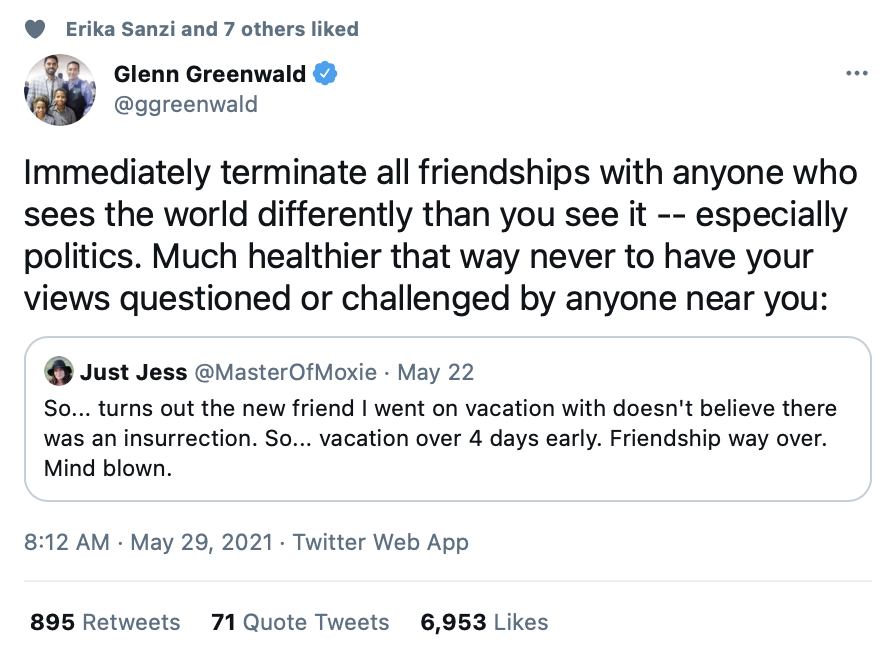
Glenn Greenwald has it about right. If I post something un-tribe-like on FB, it's crickets, scolding or ad hominem attacks. These are all well educated people who have become convinced that we cannot be friends unless we agree on politics.
A friend is quite perturbed at me for (as I view it) not adopting the top-to-bottom progressive platform. The friend found it disturbing that I would get some of my information from sources that the friend considered to be the other team. I told this friend: "You are the 1,000th person to get frustrated with me for wanting to get my facts straight without reference to the prevailing narratives of political tribes. I am prepared to die on this hill."
I am wired to make sense of things as best I can, letting the chips fall, regardless of whether I offend people in the process (with rare exceptions). I was prepared for this way of learning during a childhood where my father force-fed me buckets of religious dogma, resulting in this five-part essay.
I am willing to get useful information from anyone who has information that seems useful. I'm working hard to not divide the world into "good" people and "bad" people. Good people often say untrue things and bad people often say things that make sense. Everyone has a batting average. Everyone is flawed. It is my act of faith that we need to listen to all of it and then pretend that we are emotionally detached Martian anthropologists in order to decide what is accurate. In other words, we need to pay close attention to John Stuart Mill, who is as relevant as ever.
Hence, I reject any Manichean outlook. I fear that our two main political tribes and their respective news silos (amplified by social media) are poisoning our national dialogue. In fact, ruining our national dialogue to the point where, truly, our de facto national motto is getting to be "Fuck e pluribus unum!" It's gotten to the point where people are hating other people for ideas, whereas I think we can hate the idea but must always love the person. I am not religious, but I think that Jesus' "Love your enemy" is one of the most radical, brave and brilliant things ever said.
We need to listen to people that others call the "enemy" because sometimes they are right--sometimes it takes years for it to become apparent that they are correct. I have long been ridiculed for listening "to the enemy." That is, and will forever be, my plight, because the world is complex, not a cartoon, and no tribe has it completely right. We need to actively listen to each other and test each others' claims without feeling like this is a threatening thing to do, in order to make good sense of our world. Without each other, we are all prone to become ideologues who "win" all of our arguments because we refuse to consider competing views (and in fact many of us actively work to muzzle competing views). Hard earned, carefully distilled facts first to prepare the way for meaningful opinions, is the only way to make sense. Whenever we do the opposite, indulging in thinking and opinion-vomiting as a team sport, we are poisoning all dialogue and shutting down human flourishing.
I believe that real conversation (not the pundits barking at each other on CNN, or regular folks on the street, imitating the pundits) will dissolve many of the differences we see in each other. That brings me to an inspiring dialogue I recently heard: a discussion involving Joe Rogan and Glenn Greenwald. This is an odd couple in many ways. At the beginning of the show they both admitted that, in prior years, they weren't each others' favorite people. But they reached out, sat down for three hours and had a riveting conversation that covered many issues, including whistle-blowers, corruption in Brazil, Hunter Biden. My favorite part is where Joe and Glenn discussed the importance of reaching out to people who think differently in order to understand them and to better understand yourself.
Rogan and Greenwald both tout the long-form podcast as one of the best ways to dissolve the pundit-coating that people construct around themselves and to then get down to some interesting conversation--the kind of conversation where people learn interesting things about each other and about themselves. You can be a politician for a short session on FOX or NPR, maybe even 30 or 40 minutes, but you can't hide it for several hours. Rogan mentions that he stumbled upon this powerful revelation because he was too lazy to edit his long podcasts, but then he started to appreciates incredible power of the long-form podcast to reveal who people really are. This conversation between two wide-open complex minds is pure gold, and I invite you to listen to the entire podcast, but especially from 118 min mark to the 140 min mark. You can also read along here (beginning at 2:01:38).