Hey all. I haven't been posting since last summer, mostly because I've been drowning in graduate school duties. One of these duties has been interning at Chicago's Cook County Jail. There, I sit in on group therapy sessions for inmates with drug-related offenses. I've been consistently touched by the philosophical and psychological depth of these men, their gentleness and the span of their regrets. These are men who will sit down and opine for hours on topics you wouldn't expect low-SES drug dealers and addicts to have much knowledge of: gender identity is a big topic, for example (these guys live firsthand the consequences of masculinity). And when it comes to living with shame or regret, these guys are almost the best resource you can find.
The only place where you can find more affecting people, I think, is at prisons. I've been volunteering for a Chicago-based group called Tamms Year Ten, which advocates for prisoners housed in long-term solitary confinement. I write and read inmates' letters, respond to their requests for photos and magazines, and read their countless reports of abuse-- from medical staff, from Corrections Officers, from mail room staff, and from the state itself.
Let's be clear on what "long-term" solitary confinement means. These men at Tamms are housed alone for 23-hours a day, with zero human contact, for decades. Some have been locked up alone for 23-28 years.
[More . . . ]
Creation is daunting. Partly because the drive to create is always rooted in admiration for others' creations. What writer hasn't struggled against inadvertently ghost-writing their favorite author? What aspiring auteur, poet, or painter doesn't begin with work that is heartrendingly derivative of others' better attempts? Or worse-- what creative person hasn't struggled to make something 'great', something 'great' as the art they adore, only to find they can't quite compete? And who doesn't infer from these failings that maybe they weren't cut out to be a creative type after all?
Ira Glass, creator and longtime host of This American Life, says there's a very simple reason for the head-bashing frustrations of early creative production. Simply put: if you are interested in creating something, it's probably because you have immaculate taste. Taste that outpaces your own ability. At least, at first. Glass says:
“What nobody tells people who are beginners — and I really wish someone had told this to me . . . is that all of us who do creative work, we get into it because we have good taste. But there is this gap. For the first couple years you make stuff, and it’s just not that good. It’s trying to be good, it has potential, but it’s not.
But your taste, the thing that got you into the game, is still killer. And your taste is why your work disappoints you. A lot of people never get past this phase. They quit. Most people I know who do interesting, creative work went through years of this. We know our work doesn’t have this special thing that we want it to have. We all go through this. And if you are just starting out or you are still in this phase, you gotta know it’s normal and the most important thing you can do is do a lot of work. Put yourself on a deadline so that every week you will finish one story.
It is only by going through a volume of work that you will close that gap, and your work will be as good as your ambitions. And I took longer to figure out how to do this than anyone I’ve ever met. It’s gonna take awhile. It’s normal to take awhile. You’ve just gotta fight your way through.”
I found this snippet in a video interview with Glass (below) a year or two ago, and I find it incredibly inspiring. Glass' view of creativity suggests that even if you lack innate, immediate creative ability, you are not a lost cause-- and that, in fact, a little creative self-loathing may be a sign of good aesthetic instincts. It also suggests there is a solution to the problem of making unsatisfying dreck: just keep making more. And more. And more.
This wisdom is especially powerful in context. As a radio producer, Glass was a very late bloomer. He worked in public radio for twenty years before conceiving of This American Life; he readily admits (in another portion of his interview, and on his program) that the first seven years of his radio work was deeply underwhelming and often poorly-paced. He'll readily admit that his early stories were bad, and that even he knew they were bad, and that this tormented him. Only through tireless efforts and the cultivation of exceptional taste was he able to develop and bloom. And he bloomed big: This American Life is one of the most widely-heard public radio programs ever, with 1.7 million weekly listeners, and has topped the Itunes podcast chart continuously for years. If Ira had given up after a few years of shoddy radio stories, we'd all have missed out on TAL's hundreds of hours of thoughtful, poignant, high-quality public radio.
I found this interview snippet a little over a year ago, and Glass' words of experience have galvanized me ever since. Whenever I write something that strikes me as uninspiring or derivative dreck, I reassure myself it's a matter of taste, and time. And more time.
I'll assume that most of DI's readers, like me, hate the celebrity phenomenon of the "famous for being famous". This rising class of psuedo-celebs, the "famesque", are a newish phenomenon who owe their livelihoods to media over-saturation. In a world of thousands of channels and millions of websites, in an economy where celebrity gossip magazines and gossip sites flourish as newspapers decline, there is a consistent demand for fluffy content. The outrageous and fame-hungry, who are willing (it seems) to do anything to garner attention, bloom and profit in such an environment. If you have no standards and no shame, it is relatively easy to make a celebrity career of puff piece interviews and reality TV appearances. Far easier than launching a career based on hard-work, creative production, and talent, anyway.
But there is a new subclass of the 'famesque', one far more insidious than the droves of Paris Hiltons and Snookies and Osbornes and Kardashians we all despise and ignore. They are Celebrity Republicans- wannabe politicos who are pundits just for the sake of being pundits. And they are tearing the Republican party and political discourse apart.
The word "retard" possessed dual meanings for a long time. First used as a term forintellectual disability in 1788, the word took on a pejorative sense in the 1970s. For thirty years the two meanings curiously co-existed. Universities had "Mental Retardation and Developmental Disability" Departments and students who drunkenly called one another 'retards' for lobbing bad beer-pong balls, and the two existed in tandem.
But once medical and social service experts finally disavowed the word 'retard', it vanished from official usage with amazing swiftness. The Special Olympics ceased using the 'r-word' in 2004, initiating the trend. In 2006, the (former) American Association of Mental Retardation changed its name to the American Association on Intellectual and Developmental Disabilities.
By 2008, Special Olympics turned the abolishment of 'retard' into a full-time effort and launched R-word.org. The site protested the derogatory use of 'retard' (including a protest campaign against the 2008 film Tropic Thunder, which featured a lengthy discussion on 'retard' roles in film). Special Olympics and R-word.org also pushed for their fellow disability-service organizations to drop the term.
In 2010, 'retard' was legally banished from the professional lexicon. On October 5 of last year, Obama signed "Rosa's Law", which banned the use of "retard" in all federal health, education, and labor policy. "Intellectual disability" and "developmental disability" became the approved nomenclature. Non-federal organizations followed hastily: in Ohio, Google directs you to the "Department of Mental Retardation and Developmental Disabilities", but the website itself has already been scrubbed of the R-word(even if the url still has the dreaded 'r' in it).
It's official: 'retard' has no place in formal usage. Once a medical term for someone with an intellectual disability, it lives now only as an insult. One that means, roughly, unintelligent.
Like moron, which began as medical terminology for one with a mental age of 8 to 12.
Orimbecile, which meant 'a mental age of 6 to 9'.
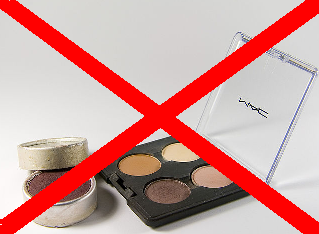
I stopped wearing cosmetics a few months ago, after about half a year of using the stuff only sparingly. I started weaning myself off makeup because I had come to hate the hassle of applying it, and because I hated fretting about my appearance. I was also beginning to think of makeup as old-fashioned, an antiquated 'modesty' that inspires shame in one's true appearance. The longer I go without a cosmetic product on my face, the more I believe that makeup needs to go the way of the girdle. The restrictive, uncomfortable, needless, obsolete girdle.
How many undergarments are you wearing right now? I'm guessing two at most. Likewise, I only wear two small undergarments below my clothes, even on the most formal occasions. Interview? Presentation? Class? Wedding? A bra and underwear are always adequate.
Since I've never had to wear more than two undergarments, I find it staggering that women used to wear massive bras, high-waisted underwear, girdles, pantyhose or stockings, garter belts, slips, and camisoles.
I often wear less than that as a full outfit. Anyone who knows me in real life can confirm that I regularly step out in leggings and a t-shirt (plus two small undergarments beneath). I don't say this to titilate, just to illustrate, because I suspect my bare-bones attire is quickly becoming the norm. I've spent a lot of time on college campuses- big and small, public and private, Jesuit and blessedly godless. Everywhere I've seen legions of women and girls decked out in equal or greater states of undress than my own. Gone are the girdles.
[More . . . ]
Hello, I invite you to subscribe to Dangerous Intersection by entering your email below. You will have the option to receive emails notifying you of new posts once per week or more often.