
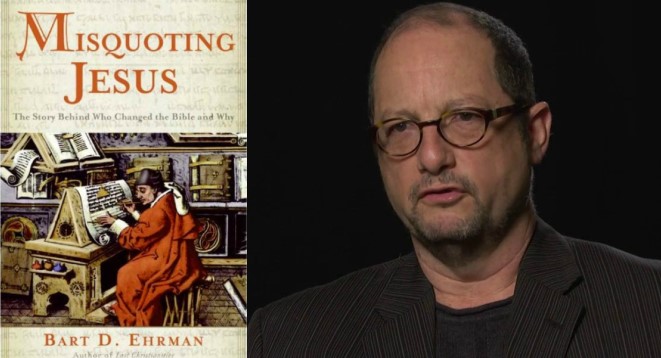
How often do we hear people “explaining” religious beliefs by stating “The Bible says so,” as if the Bible fell out of the sky, pre-translated to English by God Himself? It’s not that simple, according to an impressive and clearly-written book that should be required reading for anyone who claims to know “what the Bible says.”
Bart Ehrman’s Exploration: Who Changed the Bible and Why?
The 2005 bestseller, Misquoting Jesus, was not written by a raving atheist. Rather, it was written by a fellow who had a born-again experience in high school, then went on to attend the ultraconservative Moody Bible Institute in Chicago. Bart Ehrman didn’t stop there, however. He wanted to become an evangelical voice with credentials that would enable him to teach in secular settings. It was for this reason that he continued his education at Wheaton and, eventually, Princeton, picking up the ability to read the New Testament in its original Greek in the process.
As a result of his disciplined study, Ehrman increasingly questioned the fundamentalist approach that the “Bible is the inerrant Word of God. It contains no mistakes.” Through his studies, Ehrman determined that the Bible was not free of mistakes:
We have only error ridden copies, and the vast majority of these are centuries removed from the originals and different from them, evidently, in thousands of ways.
(Page 7). At Princeton, Ehrman learned that mistakes had been made in the copying of the New Testament over the centuries. Upon realizing this, “the floodgates opened.” In Mark 4, for example, Jesus allegedly stated that the mustard seed is “the smallest of all seeds on the earth.” Ehrman knew that this simply was not true. The more he studied the early manuscripts, the more he realized that the Bible was full of contradictions. For instance, Mark writes that Jesus was crucified the day after the Passover meal (Mark 14:12; 15:25) while John says Jesus died the day before the Passover meal (John 19:14).
Ehrman often heard that the words of the Bible were inspired. Obviously, the Bible was not originally written in English. Perhaps, suggests Ehrman, the full meaning and nuance of the New Testament could only be grasped when it was read in its original Greek (and the Old Testament could be fully appreciated only when studied in its original Hebrew) (page 6).
Because of these language barriers and the undeniable mistakes and contradictions, Ehrman realized that the Bible could not be the “fully inspired, inerrant Word of God.” Instead, it appeared to him to be a “very human book.” Human authors had originally written the text at different times and in different places to address different needs. Certainly, the Bible does not provide an an “errant guide as to how we should live. This is the shift in my own thinking that I ended up making, and to which I am now fully committed.”
How pervasive is the belief that the Bible is inerrant, that every word of the Bible is precise and true?
Occasionally I see a bumper sticker that reads: “God said it, I believe it, and that settles it.” My response is always, what if God didn’t say it? What if the book you take as giving you God’s words instead contains human words. What if the Bible doesn’t give a foolproof answer to the questions of the modern age-abortion, women’s rights, gay rights, religious and supremacy, western style democracy and the like? What if we have to figure out how to live and what to believe on our own, without setting up the Bible as a false idol–or an oracle that gives us a direct line of communication with the Almighty.
(Page 14). Ehrman continues to appreciate the Bible as an important collection of writings, but urges that it needs to be read and understood in the context of textual criticism, “a compelling and intriguing field of study of real importance not just to scholars but to everyone with an interest in the Bible.” Ehrman finds it striking that most readers of the Bible know almost nothing about textual criticism. He comments that this is not surprising, in that very few books have been written about textual criticism for a lay audience (namely, “those who know nothing about it, who don’t have the Greek and other languages necessary for the in-depth study of it who do not realize there is even any “problem” with the text).
Misquoting Jesus provides much background into how the Bible became the Bible. It happened through numerous human decisions over the centuries. For instance, the first time any Christian of record listed the 27 books of the New Testament as the books of the New Testament was 300 years after the books have been written (page 36). And those works have been radically altered over the years at the hands of the scribes “who were not only conserving scripture but also changing it.” Ehrman points out that most of the hundreds of thousands of textual changes found among the manuscripts were “completely insignificant, immaterial, of no real importance.” In short, they were innocent mistakes involving misspelling or inadvertence.
On the other hand, the very meaning of the text changed in some instances. Some Bible scholars have even concluded that it makes no sense to talk about the “original” text of the Bible. (Page 210). As a result of studying surviving Greek manuscripts of the New Testament, Ehrman concluded that we simply don’t have the original words constituting the New Testament.
Not only do we not have the originals, we don’t have the first copies of the originals. We don’t even have copies of the copies of the originals, or copies of the copies of the copies of the originals. What we have are copies made later-much later. In most instances, they are copies made many centuries later. And these copies all differ from one another, and many thousands of places . . . Possibly it is easiest to put it in comparative terms: there are more differences among our manuscripts and there are words in the New Testament.
In Misquoting Jesus Bart Ehrman spells out the ways in which several critical passages of the New Testament were changed or concocted. They are startling examples:
A.) Everyone knows the story about Jesus and the woman about to be stoned by the mob. This account is only found in John 7:53-8:12. The mob asked Jesus whether they should stone the woman (the punishment required by the Old Testament) or show her mercy. Jesus doesn’t fall for this trap. Jesus allegedly states “Let the one who is without sin among you be the first to cast a stone at her.”
The crowd dissipates out of shame. Ehrman states that this brilliant story was not originally in the Gospel of John or in any of the Gospels. “It was added by later scribes.” The story is not found in “our oldest and best manuscripts of the Gospel of John. Nor does its writing style comport with the rest of John. Most serious textual critics state that this story should not be considered part of the Bible (page 65).
B) after Jesus died, Mary Magdalene and two other women came back to the tomb to anoint the body of Jesus, according to Mark 16:1-2). They were met by a man in a white robe who told them that Jesus had been raised and was no longer there. The women fled and said nothing more to anyone out of fear (16:4-8). Everyone knows the rest of Mark’s Gospel, of course. The problem with the remainder of the story is that none of it was originally in the Gospel of Mark. It was added by a later scribe. Those additions include all of the following:
Jesus himself appeared to Mary Magdalene. She told the eleven apostles (minus Judas) about this vision, but they did not believe her. Jesus then appeared to the apostles, chastising them for failing to believe. He tells them that those who believe will be saved and those who don’t will be condemned. Then follows a critically important passage of the Bible.
And these are the signs that will accompany those who believe: they will cast out demons in my name; they will speak in new tongues; and they will take up snakes in their hands; and if they drink any poison, it will not harm them; they will place their hands upon the sick and heal them.
Jesus is then allegedly taken up into heaven and sits at the right hand of God, while the disciples go forth into the world to proclaim the Gospel in miraculous fashion.
Without the above passages (which, again, were not written by Mark) the Pentecostals lose their justification for speaking in “tongues.” And the Appalachian snake handlers have no basis for their dangerous practices.
C) John 5:7-8 is the only passage in the entire Bible “that explicitly delineates the doctrine of the Trinity (that there are three persons and God but that all three constitute a single God):
There are three that bear witness in heaven: the Father, the Word and the Spirit and these three are one; and there are three that bear witness on earth, the spirit, the water, and the blood, and these three are one.
Ehrman cites strong evidence that this Trinity passage was entirely concocted and foisted upon Erasmus by outraged theologians who needed support for their prized theological doctrine (page 81).
—
Ehrman reveals numerous other difficulties with the popular assumption that the Bible was perfectly handed down from its original written expression.
Many believers rely fervently on the King James version of the Bible, for instance. They sometimes even say “If the King James was good enough for St. Paul, it’s good enough for me.” Ehrman points out many problems with the King James version, warning that “we need to face up to the facts.”
The King James was not given by God but was a translation by a group of scholars in the early 17th century who based their rendition on a faulty Greek text.
(Page 209).
So what should we make of the Bible? Ehrman argues that the attacks of the New Testament are not simply collections of obvious, self-interpreting words. It’s the same problem we have with other important documents, such as the United States Constitution:
Texts do not simply reveal their own meanings to honest inquirers. Texts are interpreted and they are interpreted (just as they were written) by living, breathing human beings, who can make sense of texts only by explaining them in light of other other knowledge, explicating their meaning, putting the words of the text “in other words.”
(Page 217) The scribes changed the original words of the New Testament by putting them in other words.
In my experience, many people who cherry pick excerpts from the Bible as the proper way to determine what is moral are in utter denial that we don’t have accurate copies of the original writings. Most of them refuse to acknowledge that current popular versions of the Bible contain numerous discrepancies, even compared to the earliest manuscripts we do have. This is on top of the fact that their are hundreds of patent contradictions in the English version of the Bible. To most believers, none of this matters. Stay the course! In fact, in my experience most believers rarely read what the consider to be God’s own inspired word.
Ehrman’s book points out numerous troublesome issues that demand attention even assuming that the original writers of the Bible accurately reported the events described in their original writings (whatever those writings were). The elephant in the room, however, is that none of the authors of the Gospels ever claimed to witness any of the events they were reporting. Further, the extraodinary nature of Biblical claims demands extraordinary proof that ancient self-contradictory writings are simply incapable of providing, except to those of us who believe that the Bible is completely true “because it says so in the Bible.”
For all of those people who continue to go around clentching and thumping those Bibles they bought at Wal-Mart, and for all the rest of us who want to get the story straight, Ehrman’s Misquoting Jesus should be required reading.
[Administrator’s Note: More than 540 comments were quickly contributed to this post, making this page too long to download and display. Therefore, on March 23, 2007, I closed off new comments. Last night (February 4, 2009), I discovered a WordPress plugin that allows me to paginate comments, thereby protecting the site from the sudden and repeated load of 540 comments.
Here’s the good news, then. Anyone who has not yet had his or her say on Bart Ehrman’s book may now jump in at the original post and post a comment. That’s right! If none of the 540 comments that have come before you didn’t address an important aspect of Bart Ehrman’s book, you may now remedy that omission, right here in the comments to this original post. Godspeed. ]


As I read nowhereman's comment, I mentally replaced words such as "God," "Jesus," "Lord," "Father," etc., with the words "unicorn" or "Flying Green Spaghetti Monster," and I noticed that the text made just as much sense.
Personally, I think the Quran's description of God makes a lot more sense than the Bible's — as aMuslim says, "[God] is singular and doesn’t have any son or any parents or any siblings. And Jesus was a messenger and a human being."
If God is a supreme being, then why would he not be singular and why would he need offspring? Moreover if God wanted to absolve the human race of its sins, then why go through the time-consuming process of fathering a son, raising the son to adulthood, having the son be crucified, then raising the son from the dead, etc. — why not just skip all that nonsense and simply absolve the human race of its sins? Christians seem to take it for granted that God needed a human sacrifice, but why should that be necessary?
More likely, the use of a human sacrifice made Christianity more palatable to pagan cultures that had their own myths involving animal or human sacrifice. Thus, the earthly sacrifice of "God's son" makes more sense as a literary convenience than as a theological necessity.
I am surprised to see that this supposed specialist was talking about the New Testament in Greek.
Did Jesus speak Greek?
No, he spoke aramaic, and the apostles spoke aramaic as well.
So I guess this gentleman needs to go further in his studies…to the original language of the New Testament: aramaic.
Zbdakufitir
Whee! Lets spend all our time discussing a made up book! Yay!
There are no muslims in the world. The prophet (blessed be his name) said that all that adhere to his teachings are muslims, and no others. The punishment for straying from his teachings is basically death (if that's not in the books, well, someone will just issue a fatwa, so either way it's a practical reality). Way back when, he decreed that a Caliph (Khalifa) be elected by the people, with a fresh election each time the old one died. One dude died, and instead of a fresh election, his son was nominated. Some other dude got killed (which is why we have Shiites and Sunnis, and a bunch of people run around whipping themselves in the streets on a certain day) and the electoral process never came back.
Wham! Right there, practically all of dar-al-Islam disobeyed the prophet's teachings, and cast them by the wayside (for all practical purposes, as no elected Khalifa has since arisen).
Ergo, there are no muslims.
Babble on, children.
What a load of cow dung. The New Testament is the most well document ancient text in HISTORY. Literally thousands of copies exist that differ from each other less than 1%, and that 1% is grammatical and not contextual.
Yeesh.
Vic
A quick summary of the whole desert religion brigade.
Buncha people get a prophet, he leads them around for a while, performing random commandments from Gods (kill your son, cross a sea, wee only after you've cut off the end of your pecker). (I made that last one up).
They find a home, settle down, make a buncha money, have a rich temple.
Guy comes along, says, hey, let's tear down this temple and start afresh cos I spoke to God yestiddy and he told me my Mom's a virgin.
They kill him.
A few hundred years later, in desert, another dude comes along, says, hey you know that guy they killed? Well he was God's only son, but I'm his last prophet (promise, there won't be any after me) and now I say, let's kill all those other dudes who believe in the earlier son, cos they don't believe in me and I'm pissed.
Cue the Crusades.
Somewhere this dude gets pissed off with the whole Holy Roman Empire thingy, not because the Romans killed Christ, but because well, the temple's kinda rich and selling pardons and promising people they'll get into heaven for like a hundred bucks. He thinks it's too little money or something.
Cue a bunch of people killing each other, commoners all, while Kingdoms change hands. One kingdom has a bright idea to avert all this inquisitory hocus pocus, they set up their own religion! A buncha people are exiled to the Americas because they kinda take the whole Bible literally.
They get pretty prosperous out there in the Noveau Monde, and in time supersede even the Spaniards in New Spain who all right-minded people were betting on. Meanwhile back in the Old World, a buncha new religions are formed, all of them believe in the same god and the same heaven, but believe none of the others'll be in heaven, and so delight in killing each other 'cos they won't be neighbors in the afterlife and won't have to worry about social awkwardness at the all-you-can-eat buffet in Heaven on Sundays.
Meanwhile a latter day kinda bunch of people believe Jesus came out to the new world a long long time ago, and converted the Indians or something. Proof: look how many Mexicans are called Heysoos! Some dude believes them, though not exactly, and after some other dude is killed, this dude says: hey you know all the churches and stuff back on the East Coast? Well screw them, I spoke to God last night and he told me to go out West and take a few chicks with me, and a few generations later we'll get to fornicate with underaged teens in Utah, ain't that cool? He ends up with more than fifty wives and builds a big motel for them and gives them keys to their own rooms.
And these little vignettes leave out groups of people who gassed themselves, walled themselves up in compounds with stuff that the ATF badly needed for their druggy orgies, Christian gospels sung in tagalog and swahili, Virgin Mary's in tacos and salsa bottles, the various Inquisitions, and God (yeah, him) only knows what else.
In summary then:
They may talk of one God, but they sure needs a lot of Prophets!
And no prophet can profit without a buncha gullible people, and by even talking about this nonsense, you'll join in the fun, willy-nilly, as one of my Professors loved to say (yo Farrukh Khan!).
"Christ disclosed himself to mankind because of his Love for us. This is clear in the Gospel texts. To attack the text and claim lack of validity is to avoid this confrontation – What do I do with the real Jesus. "
The text gets attacked because "perfect" knowledge should be easily transmitted "perfectly" and it hasn't–ergo, the knowledge isn't what is claimed.
Jesus made many statements during his rabbinical years, most of which have substantial philosophical weight. To follow Jesus' teachings requires that one change one's life, substantively. They are recommendations for living better. None of them has much to do with an afterlife.
The "real" Jesus, as far as I can tell, was a hell of an interesting philosopher. A radical as well. What to do with the "real" Jesus would be the same thing as is done with the "real" Socrates, Aristotle, Pythagoreas, Spinoza, Hume, Locke….listen, learn, change your life accordingly. There is much of merit in his words–for this life.
His later followers deified him, put the idea of his divinity above his teachings, and turned him into a harmless icon–something you don't need to actually listen to and change your life accordingly, but only pray to in order to continue living the way you've been and ease your conscience.
All this theological debate is fairly pointless. The only people who should be worried about a demythologized Jesus are those who tend to use him as a weapon in the first place to berate those with whom they disagree.
Koendert:
It's not about a church membership or all the hypocrites. It's about Jesus. If you've had bad experiences in your church, I suggest finding another fellowship. Most churches probably have a certain percentage of people that are not Christ's.
Think seriously before casting off your faith.
grumpypilgrim:
1) God is love. For love to work, you need more than one person.
2) God is also perfect and holy and just. We have rebelled against Him, therefore incurred His wrath. As a just God, justice demands satisfaction. Or else he wouldn't be just. He loved us so much, He delivered His only Son to satisfy the judgement. He placed on Jesus the burden of us all (that is, of those that accept this substitution).
People:
These are really very basic teachings. I am amazed that you have not taken the time to study the bible. If you will only spend some time reading it through and let God speak to you through it, your eyes will begin to open.
For those of you who have trouble with Christianity due to those who call themselves Christian but are ravening wolves, try to see past the deception.
londonderry: you da man!! that was hilarious. and yet, so to the point.
"The basis of things is eccentric."
Wallace Stevens
Here's a documentary to supplement the original post. It's a two-hour documentary called "Who Wrote The Bible?" The video was narrated and written by Professor of Theology Robert Beckford. In this video, Beckford, a committed believer, began a journey to search for the answer of who wrote the Bible. http://www.infidelguy.com/modules.php?name=Video&…
[I learned quite a few things by watching this. For instance, it was in this documentary that I first learned that it is never indicated anywhere in the New Testament that Mary Magdalan was a prostitute.]
This is god
theres a whole universe out there.. why would i send someone down to see you!?..
you dont even make up a pin prick on the edge of a giant universe…
theres millions of galaxys out there… all with millions of stars.. with millions and millions of planets..
do u think 1 jesus visited all of the planets at the same time?.. maybe there was a zillion cloned jesus's and now theyre all sitting on my right hand.. why would i make a human jesus.. your all freaking idiots…
i cant be bothered with explaining it further ive got a million million other planets to worry about….
get your head out of the books and the clouds and live a real life!
actually its god speaking on behalf of himself.. but anyway.. why dose the world waste time money and brains on religion.. get a real job.. further our existance..
I'm honored that God Himself would take the time to visit this site. I'm surprised, though, that He's got so many typos in His comment.
yea i wrote the bible too!
"god himself Says:
October 22nd, 2006 at 11:57 pm
yea i wrote the bible too!"
Well that clears that up!
Londonderry, dude, you rock!
Interesting article, and I'm sure an interesting book. Although, I find it almost amusing the slant the article, and I presume the book, takes on the various biblical 'inconsistencies'. Another scholar could take the same points and present a picture of the accuracy of the bible.
For me this part of your article sums up a lot of the issues, and I find it suprising you could include this, but still end up with an overall tone that suggests the bible is mostly fabricated nonsense:
Obviously, there
(oops, clicked submit too early)
Obviously, there are plenty of lay christians who have a very naïve understanding of the bible text, such as those who think the KJV is textually perfect. A bit like some people who believe everything they hear on the news – "Oh, I heard it on the news, it must be true". (or could that be "I read it in a book by Bart Ehrman, it must be true" – OK, that was a bit cheeky)
I suspect that for every ignorant christian fundamentalist there is at least one ignorant amateur bible critic. If this book is balanced enough to educate both sides it will be welcome contribution.
I’m honored that God Himself would take the time to visit this site. I’m surprised, though, that He’s got so many typos in His comment.
god himself Says:
October 22nd, 2006 at 11:57 pm
yea i wrote the bible too!
Genius heckle!
The first thing that I learned about Buddhism was that none of the teachings were written down for 200 years after the Buddha's death. Then I learned that the Mahayana teachings came into existance after the Buddha's death, by way of dreams. My teacher told us that everything in Buddhism is metaphore and that indeed, everything in life is metaphore. Literalism seems to be a big problem. We should be able to discriminate what is helpful for ourselves and to humanity by testing out these doctrines using our own God given (if you will) minds. Even hundreds of years later, it is possible to get real benefit out of the world's religions, but it really requires that we not be sheep. That, I think, is the author's point and is very relevant to all of these discussions. May we all find truth and happiness through truely investigating the world with vast, open, discriminating minds. May we enjoy each other and not give way to partisan squabbles. We are all of us dying every moment, and every moment our minds are only arguing – with everyone else and with ourselves – this is a waste! On our death beds we will not be comforted by the arguments we have won, but only in that we have gained peace through our ardent and sincere warmth towards all of mankind. This is true for the Athiest and the Christian, it doesn't matter!
What really amazes me are people that believe in science as an absolute. How many times have theories been changed over the course of time because someone in his/her great wisdom figured out that the previous genius in his/her great wisdom was completely off? But yet, that seems to be dismissed time and again by those with faith in the world and humanity. The wisdom of man is foolishness to God. There are concepts of Christianity that cannot be understood by man (the virgin birth, the Trinity, etc.). They are all leaps of faith. The same can be said of history. How many times has history been rewritten? Does anybody out there know Napoleon? Maybe he was just misunderstood? Or Hitler, or George Washington? All we have to go on is what was written about them, which I'm sure had the writers' own interpretations and suggestions written in, but no one ever questions it. It is considered fact because its in our history books. Take any subject, for that matter. Are all books on psychology the same? or sociology? or pathology, biology, anthropology, philosophy? Even mathematics, which is claimed as an exact science, with its 3.14 and other infinite numbers which never conclude. Rarely does anyone challenge these sources of wisdom. But for all you Bible attackers out there let me ask you this…Let's say you are right, and the story of Jesus and the prostitute who was brought for the stoning was not in the original manuscripts, is it not still a great lesson? Can nothing be gained from this wisdom? How quick some are to judge the Bible because of its religious importance, but neglect to examine any other secular sources because they are more widely accepted as truth. The skeptics claim that the Bible cannot be true because it was written and rewritten by human authors, but ask yourselves, which edition or version of that textbook you are reading is…I doubt it is the first.
Funny, i have studied with Jehovah's Witnesses and a friend of mine was a very old Bible Scholar. We went through most of the things quoted above from the book…. almost 10 years ago and it seems the questions posed were answered a long time ago. They have dictionaries and concordances with references to sources and they are free. Also bible studies are free. You might even be able to get a copy of the searchable CD Rom with most of the publications and updates.
By the way, if just believing in Jesus got you into heaven, then I guess you heaven bound folks will be seeing Satan and his Demons there, because after the whipping they just received, you know THEY believe.
http://www.watchtower.org.
It's wildly amusing to hear people assert that the bible, and particularly the New Testament is literally True and Accurate in all particulars that matter — that God would not *permit* a translation to be inaccurate. That's a very convenient stance, taking the bible as axiomatic, because if your axioms contain a contradiction, you can rigorously prove any bloody thing.
What gets missed is the essence of the message. What does it matter exactly how Judas died or who exactly bought the potter's field? How many of the explicit contradictions materially affect the core message there to be discerned? Of course, that means that you have to actually *discern* the message instead of simply swallowing pap spewed by people whose motivations should be viewed with skepticism. What are they really selling?
Aah Just some more hints that God and Religions Inc. (c) dont have a great deal in common. Thanks to londonderry for his succinct summation of the history of humankind, er, by the way you have some textual errors
it's all a matter of faith isn't it? i can't believe that the copy of the king james version that i own is inerrant and inspired, but i have no problem with believing christian doctrine and the essential truth of the bible. some people have faith in the scientists that begin their sentences "somewhere between 150 and 200 million years ago…" and some people have faith in "in the beginning was the Word…" neither can be "proven"– it's just a question of where you place your belief.