
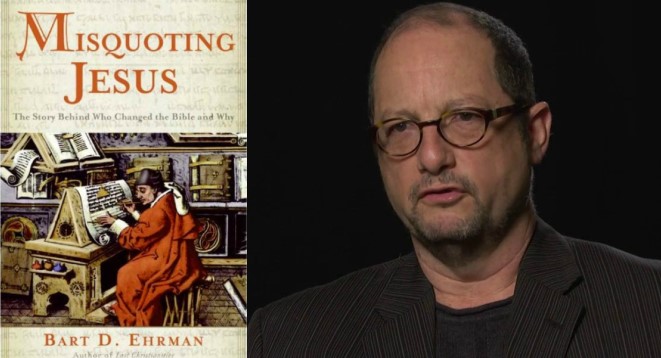
How often do we hear people “explaining” religious beliefs by stating “The Bible says so,” as if the Bible fell out of the sky, pre-translated to English by God Himself? It’s not that simple, according to an impressive and clearly-written book that should be required reading for anyone who claims to know “what the Bible says.”
Bart Ehrman’s Exploration: Who Changed the Bible and Why?
The 2005 bestseller, Misquoting Jesus, was not written by a raving atheist. Rather, it was written by a fellow who had a born-again experience in high school, then went on to attend the ultraconservative Moody Bible Institute in Chicago. Bart Ehrman didn’t stop there, however. He wanted to become an evangelical voice with credentials that would enable him to teach in secular settings. It was for this reason that he continued his education at Wheaton and, eventually, Princeton, picking up the ability to read the New Testament in its original Greek in the process.
As a result of his disciplined study, Ehrman increasingly questioned the fundamentalist approach that the “Bible is the inerrant Word of God. It contains no mistakes.” Through his studies, Ehrman determined that the Bible was not free of mistakes:
We have only error ridden copies, and the vast majority of these are centuries removed from the originals and different from them, evidently, in thousands of ways.
(Page 7). At Princeton, Ehrman learned that mistakes had been made in the copying of the New Testament over the centuries. Upon realizing this, “the floodgates opened.” In Mark 4, for example, Jesus allegedly stated that the mustard seed is “the smallest of all seeds on the earth.” Ehrman knew that this simply was not true. The more he studied the early manuscripts, the more he realized that the Bible was full of contradictions. For instance, Mark writes that Jesus was crucified the day after the Passover meal (Mark 14:12; 15:25) while John says Jesus died the day before the Passover meal (John 19:14).
Ehrman often heard that the words of the Bible were inspired. Obviously, the Bible was not originally written in English. Perhaps, suggests Ehrman, the full meaning and nuance of the New Testament could only be grasped when it was read in its original Greek (and the Old Testament could be fully appreciated only when studied in its original Hebrew) (page 6).
Because of these language barriers and the undeniable mistakes and contradictions, Ehrman realized that the Bible could not be the “fully inspired, inerrant Word of God.” Instead, it appeared to him to be a “very human book.” Human authors had originally written the text at different times and in different places to address different needs. Certainly, the Bible does not provide an an “errant guide as to how we should live. This is the shift in my own thinking that I ended up making, and to which I am now fully committed.”
How pervasive is the belief that the Bible is inerrant, that every word of the Bible is precise and true?
Occasionally I see a bumper sticker that reads: “God said it, I believe it, and that settles it.” My response is always, what if God didn’t say it? What if the book you take as giving you God’s words instead contains human words. What if the Bible doesn’t give a foolproof answer to the questions of the modern age-abortion, women’s rights, gay rights, religious and supremacy, western style democracy and the like? What if we have to figure out how to live and what to believe on our own, without setting up the Bible as a false idol–or an oracle that gives us a direct line of communication with the Almighty.
(Page 14). Ehrman continues to appreciate the Bible as an important collection of writings, but urges that it needs to be read and understood in the context of textual criticism, “a compelling and intriguing field of study of real importance not just to scholars but to everyone with an interest in the Bible.” Ehrman finds it striking that most readers of the Bible know almost nothing about textual criticism. He comments that this is not surprising, in that very few books have been written about textual criticism for a lay audience (namely, “those who know nothing about it, who don’t have the Greek and other languages necessary for the in-depth study of it who do not realize there is even any “problem” with the text).
Misquoting Jesus provides much background into how the Bible became the Bible. It happened through numerous human decisions over the centuries. For instance, the first time any Christian of record listed the 27 books of the New Testament as the books of the New Testament was 300 years after the books have been written (page 36). And those works have been radically altered over the years at the hands of the scribes “who were not only conserving scripture but also changing it.” Ehrman points out that most of the hundreds of thousands of textual changes found among the manuscripts were “completely insignificant, immaterial, of no real importance.” In short, they were innocent mistakes involving misspelling or inadvertence.
On the other hand, the very meaning of the text changed in some instances. Some Bible scholars have even concluded that it makes no sense to talk about the “original” text of the Bible. (Page 210). As a result of studying surviving Greek manuscripts of the New Testament, Ehrman concluded that we simply don’t have the original words constituting the New Testament.
Not only do we not have the originals, we don’t have the first copies of the originals. We don’t even have copies of the copies of the originals, or copies of the copies of the copies of the originals. What we have are copies made later-much later. In most instances, they are copies made many centuries later. And these copies all differ from one another, and many thousands of places . . . Possibly it is easiest to put it in comparative terms: there are more differences among our manuscripts and there are words in the New Testament.
In Misquoting Jesus Bart Ehrman spells out the ways in which several critical passages of the New Testament were changed or concocted. They are startling examples:
A.) Everyone knows the story about Jesus and the woman about to be stoned by the mob. This account is only found in John 7:53-8:12. The mob asked Jesus whether they should stone the woman (the punishment required by the Old Testament) or show her mercy. Jesus doesn’t fall for this trap. Jesus allegedly states “Let the one who is without sin among you be the first to cast a stone at her.”
The crowd dissipates out of shame. Ehrman states that this brilliant story was not originally in the Gospel of John or in any of the Gospels. “It was added by later scribes.” The story is not found in “our oldest and best manuscripts of the Gospel of John. Nor does its writing style comport with the rest of John. Most serious textual critics state that this story should not be considered part of the Bible (page 65).
B) after Jesus died, Mary Magdalene and two other women came back to the tomb to anoint the body of Jesus, according to Mark 16:1-2). They were met by a man in a white robe who told them that Jesus had been raised and was no longer there. The women fled and said nothing more to anyone out of fear (16:4-8). Everyone knows the rest of Mark’s Gospel, of course. The problem with the remainder of the story is that none of it was originally in the Gospel of Mark. It was added by a later scribe. Those additions include all of the following:
Jesus himself appeared to Mary Magdalene. She told the eleven apostles (minus Judas) about this vision, but they did not believe her. Jesus then appeared to the apostles, chastising them for failing to believe. He tells them that those who believe will be saved and those who don’t will be condemned. Then follows a critically important passage of the Bible.
And these are the signs that will accompany those who believe: they will cast out demons in my name; they will speak in new tongues; and they will take up snakes in their hands; and if they drink any poison, it will not harm them; they will place their hands upon the sick and heal them.
Jesus is then allegedly taken up into heaven and sits at the right hand of God, while the disciples go forth into the world to proclaim the Gospel in miraculous fashion.
Without the above passages (which, again, were not written by Mark) the Pentecostals lose their justification for speaking in “tongues.” And the Appalachian snake handlers have no basis for their dangerous practices.
C) John 5:7-8 is the only passage in the entire Bible “that explicitly delineates the doctrine of the Trinity (that there are three persons and God but that all three constitute a single God):
There are three that bear witness in heaven: the Father, the Word and the Spirit and these three are one; and there are three that bear witness on earth, the spirit, the water, and the blood, and these three are one.
Ehrman cites strong evidence that this Trinity passage was entirely concocted and foisted upon Erasmus by outraged theologians who needed support for their prized theological doctrine (page 81).
—
Ehrman reveals numerous other difficulties with the popular assumption that the Bible was perfectly handed down from its original written expression.
Many believers rely fervently on the King James version of the Bible, for instance. They sometimes even say “If the King James was good enough for St. Paul, it’s good enough for me.” Ehrman points out many problems with the King James version, warning that “we need to face up to the facts.”
The King James was not given by God but was a translation by a group of scholars in the early 17th century who based their rendition on a faulty Greek text.
(Page 209).
So what should we make of the Bible? Ehrman argues that the attacks of the New Testament are not simply collections of obvious, self-interpreting words. It’s the same problem we have with other important documents, such as the United States Constitution:
Texts do not simply reveal their own meanings to honest inquirers. Texts are interpreted and they are interpreted (just as they were written) by living, breathing human beings, who can make sense of texts only by explaining them in light of other other knowledge, explicating their meaning, putting the words of the text “in other words.”
(Page 217) The scribes changed the original words of the New Testament by putting them in other words.
In my experience, many people who cherry pick excerpts from the Bible as the proper way to determine what is moral are in utter denial that we don’t have accurate copies of the original writings. Most of them refuse to acknowledge that current popular versions of the Bible contain numerous discrepancies, even compared to the earliest manuscripts we do have. This is on top of the fact that their are hundreds of patent contradictions in the English version of the Bible. To most believers, none of this matters. Stay the course! In fact, in my experience most believers rarely read what the consider to be God’s own inspired word.
Ehrman’s book points out numerous troublesome issues that demand attention even assuming that the original writers of the Bible accurately reported the events described in their original writings (whatever those writings were). The elephant in the room, however, is that none of the authors of the Gospels ever claimed to witness any of the events they were reporting. Further, the extraodinary nature of Biblical claims demands extraordinary proof that ancient self-contradictory writings are simply incapable of providing, except to those of us who believe that the Bible is completely true “because it says so in the Bible.”
For all of those people who continue to go around clentching and thumping those Bibles they bought at Wal-Mart, and for all the rest of us who want to get the story straight, Ehrman’s Misquoting Jesus should be required reading.
[Administrator’s Note: More than 540 comments were quickly contributed to this post, making this page too long to download and display. Therefore, on March 23, 2007, I closed off new comments. Last night (February 4, 2009), I discovered a WordPress plugin that allows me to paginate comments, thereby protecting the site from the sudden and repeated load of 540 comments.
Here’s the good news, then. Anyone who has not yet had his or her say on Bart Ehrman’s book may now jump in at the original post and post a comment. That’s right! If none of the 540 comments that have come before you didn’t address an important aspect of Bart Ehrman’s book, you may now remedy that omission, right here in the comments to this original post. Godspeed. ]


"…the Bible was full of contradictions. For instance, Mark writes that Jesus was crucified the day after the Passover meal (Mark 14:12; 15:25) while John says Jesus died the day before the Passover meal (John 19:14)."
From E.W. Bullinger's Companion Bible, commentary on Mark 15:25: "25 the third hour. Of the day (John 11:9), i.e. 9 a.m. No discrepancy; for the sixth hour of John 19:14 was the sixth hour of the night (from about sunset), viz. “about” midnight (in the midst of the trial), when Pilate said “Behold your King”. The context there and here explains and settles the matter. Here, the trial was over; in John 19:14 the trial was going on. It was the hour of the morning sacrifice."
It's not common knowledge, as its not taught in the West, but in the Near East it's common knowledge that the bible was NOT written in Greek but in Aramaic. Some would have us believe the the Peshitta was translated from Greek when that is ridiculous.
I would suggest all read any works by George Lamsa. He was born an Assyrian and spoke Aramaic. The Assyrian church of the East has their bible in Aramaic and predates any Greek version of the bible. The common people of Galilee never learned to speak, let alone write in Greek. What causes so much confusion with the 'original' greek transalation is the obvious copying of the Aramaic idioms (figures of speech) that makes no sense in Greek. Even the learned jews of Palestine had a difficult time understanding the dialect of Galileans. Jesus said "you must be born again" to Nicodemus and he was not familiar with that common figure of speech.
The Greek language was the lingua franca of government and officials but so was French 40 years ago and I would ask how many common people in America speek and read and write in French?
The west knows very little of the Near east and the real history of the Peshitta. It predates the latin vulgate by 200 hundred years.
I encourage others to find the truth and to not accept western scholars decision that the Peshitta was translated from Greek.
http://www.aramaicpeshitta.com/
"Everyone knows the story about Jesus and the woman about to be stoned by the mob. This account is only found in John 7:53-8:12. The mob asked Jesus whether they should stone the woman (the punishment required by the Old Testament) or show her mercy. Jesus doesn’t fall for this trap. Jesus allegedly states 'Let the one who is without sin among you be the first to cast a stone at her.' The crowd dissipates out of shame. Ehrman states that this brilliant story was not originally in the Gospel of John or in any of the Gospels. 'It was added by later scribes.' The story is not found in 'our oldest and best manuscripts of the Gospel of John. Nor does its writing style comport with the rest of John. Most serious textual critics state that this story should not be considered part of the Bible."
From E.W. Bullinger's Companion Bible, commentary on John 7:52: "52 see. If they had looked, they would have found that Jonah and Hosea arose out of Galilee, and perhaps Elijah, Elisha, and Amos. From 7:53—8:11 is omitted by some of the older Manuscripts. WH place it in double brackets at the end of the Gospel, &c. It is contained in the Vulgate, and is found in many Greek and Latin Codices. &c. We may ask: How is it that all the MSS. which do contain it (including 300 Cursives) agree in placing it here? It was another attempt following on 7:32, and referred to in 8:15."
"Everyone knows the rest of Mark’s Gospel, of course. The problem with the remainder of the story is that none of it was originally in the Gospel of Mark.
[…]
[w]ithout the above passages (which, again, were not written by Mark)…"
From E.W. Bullinger's Companion Bible:
http://companionbiblecondensed.com
Excerpts from Appendix 168 which can be read at: http://www.companionbiblecondensed.com/AP/Ap_list…
…regarding the last 12 verses of Mark 16:
"As to MANUSCRIPTS, there are none older than the fourth century, and the oldest two I. unical Manuscripts (B and, see Appendix 94. V.) are without those twelve verses. Of all the others (consisting of some eighteen unicals and some six hundred cursive Manuscripts which contain the Gospel of Mark there is not one which leaves out these twelve verses.
[…]
There are nearly a hundred ecclesiastical writers older than the oldest of our Greek codices; while between A.D. 300 and A.D. 600 there are about two hundred more, and they all refer to these twelve verses.
[…]
When later transcribers of the Greek manuscripts came to the last twelve verses of Mark, and saw no trace of such spiritual gifts in existence, they concluded that there must be something doubtful about the genuineness of these verses. Hence, some may have marked them as doubtful, some as spurious, while others omitted them altogether. A phenomenon of quite an opposite kind is witnessed in the present day."
"For all of those people who continue to go around clentching and thumping those Bibles they bought at Wal-Mart, and for all the rest of us who want to get the story straight, Ehrman’s Misquoting Jesus should be required reading."
With all due respect, from the few actual citations listed from Ehrman's book, a quick cross examination with E.W. Bullinger's Companion Bible refutes each of Ehrman's analyses.
I'm a little tired of these textual critics popping up every once in a while with repeated accusations that were already answered many times.
The Holy Spirit teaches and gives understanding to those who are His. Why should He do likewise for the corrupt?
He had to go to Princeton to realize that the bible was not written/dictated by God? Sheesh! I think Dawkin's would find this article amusing.
Oops I should have written Dawkins. As in Richard Dawkins, author of "The God Delusion"
Why does the text of 19th century King James textual interpreter and apologist E. W. Bullinger trump the interpretations of subsequent scholars who studied more versions of the bible, and many earlier texts than Bullinger had access to, as well as Bullinger's notes and those of hundreds of other scholars?
In Bullinger's time, there were maybe 100 known scraps of biblical text from before the Council of Nicaea determined which gospels to include and which to repress. Now there are thousands of fragments, many nearly complete copies of the original first century letters, cataloged and available to scholars.
If one is of the "King James IS the Bible" school (like Bullinger), no amount of citations from earlier works will affect your opinion or interpretation. Thus the scientifically based, yet faithful, examinations of Ehrman and the few hundred others currently engaged in this sort of study (usually for the church, not against it) won't cause any more reflection than any other conflict between direct examination and true faith.
Those of us who believe that confirmable evidence trumps internal revelations don't feel a conflict in noting the many different types of Christianity based on differing interpretations of the variety of translations from some of the many unmatching transcriptions of the group of letters, stories, and revelations (hallucinations?) comprising the one true and inerrant text.
Anyone who believes in the bible is mentally ill.
I cannot understand how anyone can believe this crap
and justify all of the contradictions. E.W. Bullinger’s Companion Bible
is just garbage too.
There is Quran
It may sound out of topic, however, that’s exactly what Quran or Islam says. In Islam, Abraham, Moses, Jesus, and Muhammad are all human beings like us but special in that they are the messengers of God (In Islam, God is commonly referred to as Allah, although he has 99 names bearing various qualities). According to Quran, Moses and Jesus received God’s instructions similarly as what Muhammad had received; however, the previous books became corrupted over time. Furthermore, since Muhammad was the last messenger before the end of the world, God promised to save Quran from corruption.
No flames please. Just wanted to share a perspective—that’s it. I’m a muslim and I fully respect Judaism and Christianity.
I request you to visit sites that have Quran online such as this http://www.islamicity.com/QuranSearch/, and go read it to get a better idea about it.
To the Muslim (and all others):
According to your teachings, you have no assurance to heaven. In Christianity, you can have this assurance. All people come short of the standard of perfection, except for one – Jesus Christ. He is the benchmark. You can have His standard applied to you by believing in Him.
So, who wrote the bible in its current form? why isn't there an original?
Ah, Ray, just couldn't pass up a chance to proselytize could we. Join Christianity and you'll be pre-approved for Heaven(TM)!
Besides, everybody knows Muslims can be guaranteed entrance to heaven. You just have to die defending the faith. 😛
It hardly seems so, Ray. True, John 3:16 states that anyone who believes in Jesus will go to heaven, but the Bible seems to disagree with itself on this. In fact, Jesus himself says many different things about how to get into heaven. Some of the things Jesus says you "must" do to attain eternal life include:
-Love your neighbor as yourself (Luke 10: 25-28)
-Sell everything you own and give all of your money to the poor (Luke 18:18-22)
-Give up everything in your life, including all relationships to members of your family, friends, etc, and follow Jesus as a disciple (Luke 14:26-33)
-Take Communion (or as Jesus puts it, "eat the flesh of the Son of Man and drink his blood) (John 6: 53-54)
-Become "like a little child" (Matthew 18:2-3)
-Have righteousness surpassing that of the Pharises and the teachers of law, in other words, follow all 613 laws of the Old Testament (Matthew 5:17-20)
Among several others. The Why Won't God Heal Amputees website has a decent presentation of these contradictory rules: http://whywontgodhealamputees.com/video1.htm
Of course Jesus (or Isa in Arabic) is exemplary and one of the benchmarks. That’s why he was chosen even before he was born. The problem, according to Islam, is that way the one and only God wanted us to know Him, worship Him, and carry out our everyday actions has been distorted over time. One example is the nature of God—in Quran, God says He is singular and doesn’t have any son or any parents or any siblings. And Jesus was a messenger and a human being.
However, I understand your point Ray. Since you believe Jesus actually died and became alive again which no human being except God can do, Jesus is the God. It’s all about belief after all. Besides, once you decide not to ask questions or explore for the truth, it’s very hard even to check another doctrine or idea.
No offense please.
Erika,
All your Bible quotes should be taken in context of the point being made in each teaching. In the Christian walk is an internal transformation, daily progressing as you learn more of our Creator's heart and thoughts. Rules and regulations won't get you there. But putting on Jesus will.
Andrew,
You said:
Join Christianity and you’ll be pre-approved for Heaven. This comment ios hardly worth a response. I think you know what I meant. The Bible give us assurance as no other book of eternal life of joy, peace and love. To reject Christ is an eternal existence of misery and darkness and pain. For in rejecting God, you reject all the goodness that He provides.
Ray, I see what you mean- maybe we don't need to meet each minute requirement. But what you said- that we must remain in a state of constant improvement as part of a "Christian Walk"- contradicts what you said earlier. Doesn't believing in Christ get you into heaven? I don't believe any Bible passage commands that we enter into a state of constant transformation, either.
No offense taken aMuslim. I think you are honest in your thoughts. I challenge you to read some of the New Testament books (a good place to start is John) and see what your thoughts are afterwards.
Funny enough Ray, but the Quran makes mention of previous prophets, including Jesus.
Get educated. Read 'No God but God'. You'll enjoy it.
#1 Ehrman is a historian – not a theologian nor a philosopher. He is building on the arguements of others and nothing he says is original to him. He has scavenged other sources and is repeating century old problems with the Bible. These answers are not startling nor are they new.
#2 Ehrman studied under Elaine Pagels at Princton and if you have read her material you would see the heavy influence. I am only saying that Ehrman himself believes in "authority". Authority is the idea that some "voice" (professor, scholar, priest, etc…) has the authority to instruct us. Only ignorant people can't admit their beliefs came from some other source.
#3 Ehrman has no conclusive system. Dr. Ehrman when he speaks cannot connect the various methods used to critique the text to establish a uniform reality. In other words he claims a position of objective scientific authority but he depends on materialist naturalism for the descreet textual arguments. Suddenly in conclusion he makes 'existential leaps' to come to his ultimate conclusions. If he is being intellectually honest he would depend on one approach (materialism or existentialism) and not leap back and forth. Look for this in his time with Terri Gross on Fresh Air http://www.npr.org/templates/story/story.php?stor….
#4 The Bible itself claims complete authority over all knowledge – this is true of Judaism and Christianity. I understand this is a wild claim to have exclusive authority over all knowledge – but that's what the book says. Psalm 19:7 "The law of the Lord is perfect". Things which are perfect lack nothing and do not need to be added to. This is only one of many verses which speak of the Bible in exclusive authoritative terms.
#5 Jesus himself says in John 14 that knowledge and truth are relational – not simply ideas that people think. In fact he goes as far as saying that if you don't believe in him that God is not obligated to make you understand; "21Whoever has my commands and obeys them, he is the one who loves me. He who loves me will be loved by my Father, and I too will love him and show myself to him." Do you see the "show myself" – that means you don't know until he shows you.
#6 Christians do not believe that intelligence (or knowledge) is something you are born with or that you can sit by yourself and somehow come to the knowledge of things (this would be positivism). Nor do Christians believe that the world is cut off from the spiritual and everthing must be learned exclusively through the scientific method (scientism). We believe that knowing comes from God alone – this is really the only way we come to know anything. God SHOWS it to us (disclosure).
#7 Christ disclosed himself to mankind because of his Love for us. This is clear in the Gospel texts. To attack the text and claim lack of validity is to avoid this confrontation – What do I do with the real Jesus.
Muslims in the East respect the bible as written in Aramaic for a reason. Find out why.
http://www.aramaicpeshitta.com/
Heaven isn't something that should be granted easily to someone just for believing in someone. You have to earn it.
Adam,
So how do you earn it? By faith. That is the one thing required of you. By faith, works will be the natural result. Belief encompasses many things. By believing, you are putting your trust in it. You are putting your faith in it.
Ray, you have got to be kidding…..
Let's be serious,
I hate to burst your bubble, but it's better for you to wake up sooner then later, and I can sorely tell you this out of my own experience. I have been a believer (born-again dreamer) for years and realised more and more that church is all nice and fun but they are also a bunch of hypocrites coming together.
I know it's hard to wake up (it was and is for me) and as a good former christian I am willing to help you…
Greetings,
Koendert,
Netherlands