
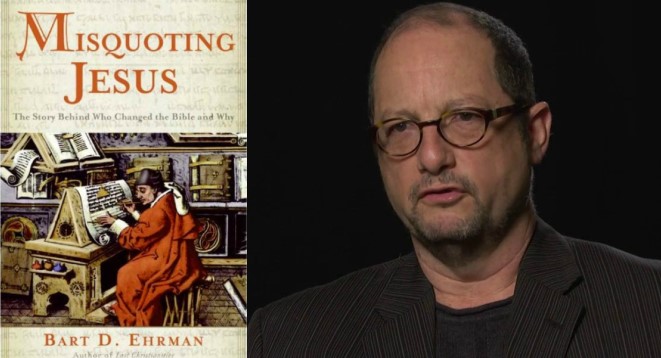
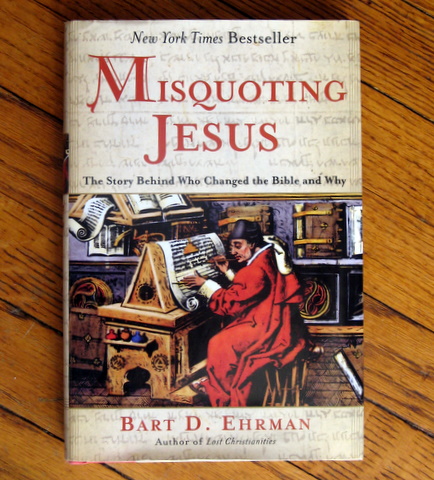
How often do we hear people “explaining” religious beliefs by stating “The Bible says so,” as if the Bible fell out of the sky, pre-translated to English by God Himself? It’s not that simple, according to an impressive and clearly-written book that should be required reading for anyone who claims to know “what the Bible says.”
Bart Ehrman’s Exploration: Who Changed the Bible and Why?
The 2005 bestseller, Misquoting Jesus, was not written by a raving atheist. Rather, it was written by a fellow who had a born-again experience in high school, then went on to attend the ultraconservative Moody Bible Institute in Chicago. Bart Ehrman didn’t stop there, however. He wanted to become an evangelical voice with credentials that would enable him to teach in secular settings. It was for this reason that he continued his education at Wheaton and, eventually, Princeton, picking up the ability to read the New Testament in its original Greek in the process.
As a result of his disciplined study, Ehrman increasingly questioned the fundamentalist approach that the “Bible is the inerrant Word of God. It contains no mistakes.” Through his studies, Ehrman determined that the Bible was not free of mistakes:
We have only error ridden copies, and the vast majority of these are centuries removed from the originals and different from them, evidently, in thousands of ways.
(Page 7). At Princeton, Ehrman learned that mistakes had been made in the copying of the New Testament over the centuries. Upon realizing this, “the floodgates opened.” In Mark 4, for example, Jesus allegedly stated that the mustard seed is “the smallest of all seeds on the earth.” Ehrman knew that this simply was not true. The more he studied the early manuscripts, the more he realized that the Bible was full of contradictions. For instance, Mark writes that Jesus was crucified the day after the Passover meal (Mark 14:12; 15:25) while John says Jesus died the day before the Passover meal (John 19:14).
Ehrman often heard that the words of the Bible were inspired. Obviously, the Bible was not originally written in English. Perhaps, suggests Ehrman, the full meaning and nuance of the New Testament could only be grasped when it was read in its original Greek (and the Old Testament could be fully appreciated only when studied in its original Hebrew) (page 6).
Because of these language barriers and the undeniable mistakes and contradictions, Ehrman realized that the Bible could not be the “fully inspired, inerrant Word of God.” Instead, it appeared to him to be a “very human book.” Human authors had originally written the text at different times and in different places to address different needs. Certainly, the Bible does not provide an an “errant guide as to how we should live. This is the shift in my own thinking that I ended up making, and to which I am now fully committed.”
How pervasive is the belief that the Bible is inerrant, that every word of the Bible is precise and true?
Occasionally I see a bumper sticker that reads: “God said it, I believe it, and that settles it.” My response is always, what if God didn’t say it? What if the book you take as giving you God’s words instead contains human words. What if the Bible doesn’t give a foolproof answer to the questions of the modern age-abortion, women’s rights, gay rights, religious and supremacy, western style democracy and the like? What if we have to figure out how to live and what to believe on our own, without setting up the Bible as a false idol–or an oracle that gives us a direct line of communication with the Almighty.
(Page 14). Ehrman continues to appreciate the Bible as an important collection of writings, but urges that it needs to be read and understood in the context of textual criticism, “a compelling and intriguing field of study of real importance not just to scholars but to everyone with an interest in the Bible.” Ehrman finds it striking that most readers of the Bible know almost nothing about textual criticism. He comments that this is not surprising, in that very few books have been written about textual criticism for a lay audience (namely, “those who know nothing about it, who don’t have the Greek and other languages necessary for the in-depth study of it who do not realize there is even any “problem” with the text).
Misquoting Jesus provides much background into how the Bible became the Bible. It happened through numerous human decisions over the centuries. For instance, the first time any Christian of record listed the 27 books of the New Testament as the books of the New Testament was 300 years after the books have been written (page 36). And those works have been radically altered over the years at the hands of the scribes “who were not only conserving scripture but also changing it.” Ehrman points out that most of the hundreds of thousands of textual changes found among the manuscripts were “completely insignificant, immaterial, of no real importance.” In short, they were innocent mistakes involving misspelling or inadvertence.
On the other hand, the very meaning of the text changed in some instances. Some Bible scholars have even concluded that it makes no sense to talk about the “original” text of the Bible. (Page 210). As a result of studying surviving Greek manuscripts of the New Testament, Ehrman concluded that we simply don’t have the original words constituting the New Testament.
Not only do we not have the originals, we don’t have the first copies of the originals. We don’t even have copies of the copies of the originals, or copies of the copies of the copies of the originals. What we have are copies made later-much later. In most instances, they are copies made many centuries later. And these copies all differ from one another, and many thousands of places . . . Possibly it is easiest to put it in comparative terms: there are more differences among our manuscripts and there are words in the New Testament.
In Misquoting Jesus Bart Ehrman spells out the ways in which several critical passages of the New Testament were changed or concocted. They are startling examples:
A.) Everyone knows the story about Jesus and the woman about to be stoned by the mob. This account is only found in John 7:53-8:12. The mob asked Jesus whether they should stone the woman (the punishment required by the Old Testament) or show her mercy. Jesus doesn’t fall for this trap. Jesus allegedly states “Let the one who is without sin among you be the first to cast a stone at her.”
The crowd dissipates out of shame. Ehrman states that this brilliant story was not originally in the Gospel of John or in any of the Gospels. “It was added by later scribes.” The story is not found in “our oldest and best manuscripts of the Gospel of John. Nor does its writing style comport with the rest of John. Most serious textual critics state that this story should not be considered part of the Bible (page 65).
B) after Jesus died, Mary Magdalene and two other women came back to the tomb to anoint the body of Jesus, according to Mark 16:1-2). They were met by a man in a white robe who told them that Jesus had been raised and was no longer there. The women fled and said nothing more to anyone out of fear (16:4-8). Everyone knows the rest of Mark’s Gospel, of course. The problem with the remainder of the story is that none of it was originally in the Gospel of Mark. It was added by a later scribe. Those additions include all of the following:
Jesus himself appeared to Mary Magdalene. She told the eleven apostles (minus Judas) about this vision, but they did not believe her. Jesus then appeared to the apostles, chastising them for failing to believe. He tells them that those who believe will be saved and those who don’t will be condemned. Then follows a critically important passage of the Bible.
And these are the signs that will accompany those who believe: they will cast out demons in my name; they will speak in new tongues; and they will take up snakes in their hands; and if they drink any poison, it will not harm them; they will place their hands upon the sick and heal them.
Jesus is then allegedly taken up into heaven and sits at the right hand of God, while the disciples go forth into the world to proclaim the Gospel in miraculous fashion.
Without the above passages (which, again, were not written by Mark) the Pentecostals lose their justification for speaking in “tongues.” And the Appalachian snake handlers have no basis for their dangerous practices.
C) John 5:7-8 is the only passage in the entire Bible “that explicitly delineates the doctrine of the Trinity (that there are three persons and God but that all three constitute a single God):
There are three that bear witness in heaven: the Father, the Word and the Spirit and these three are one; and there are three that bear witness on earth, the spirit, the water, and the blood, and these three are one.
Ehrman cites strong evidence that this Trinity passage was entirely concocted and foisted upon Erasmus by outraged theologians who needed support for their prized theological doctrine (page 81).
—
Ehrman reveals numerous other difficulties with the popular assumption that the Bible was perfectly handed down from its original written expression.
Many believers rely fervently on the King James version of the Bible, for instance. They sometimes even say “If the King James was good enough for St. Paul, it’s good enough for me.” Ehrman points out many problems with the King James version, warning that “we need to face up to the facts.”
The King James was not given by God but was a translation by a group of scholars in the early 17th century who based their rendition on a faulty Greek text.
(Page 209).
So what should we make of the Bible? Ehrman argues that the attacks of the New Testament are not simply collections of obvious, self-interpreting words. It’s the same problem we have with other important documents, such as the United States Constitution:
Texts do not simply reveal their own meanings to honest inquirers. Texts are interpreted and they are interpreted (just as they were written) by living, breathing human beings, who can make sense of texts only by explaining them in light of other other knowledge, explicating their meaning, putting the words of the text “in other words.”
(Page 217) The scribes changed the original words of the New Testament by putting them in other words.
In my experience, many people who cherry pick excerpts from the Bible as the proper way to determine what is moral are in utter denial that we don’t have accurate copies of the original writings. Most of them refuse to acknowledge that current popular versions of the Bible contain numerous discrepancies, even compared to the earliest manuscripts we do have. This is on top of the fact that their are hundreds of patent contradictions in the English version of the Bible. To most believers, none of this matters. Stay the course! In fact, in my experience most believers rarely read what the consider to be God’s own inspired word.
Ehrman’s book points out numerous troublesome issues that demand attention even assuming that the original writers of the Bible accurately reported the events described in their original writings (whatever those writings were). The elephant in the room, however, is that none of the authors of the Gospels ever claimed to witness any of the events they were reporting. Further, the extraodinary nature of Biblical claims demands extraordinary proof that ancient self-contradictory writings are simply incapable of providing, except to those of us who believe that the Bible is completely true “because it says so in the Bible.”
For all of those people who continue to go around clentching and thumping those Bibles they bought at Wal-Mart, and for all the rest of us who want to get the story straight, Ehrman’s Misquoting Jesus should be required reading.
[Administrator’s Note: More than 540 comments were quickly contributed to this post, making this page too long to download and display. Therefore, on March 23, 2007, I closed off new comments. Last night (February 4, 2009), I discovered a WordPress plugin that allows me to paginate comments, thereby protecting the site from the sudden and repeated load of 540 comments.
Here’s the good news, then. Anyone who has not yet had his or her say on Bart Ehrman’s book may now jump in at the original post and post a comment. That’s right! If none of the 540 comments that have come before you didn’t address an important aspect of Bart Ehrman’s book, you may now remedy that omission, right here in the comments to this original post. Godspeed. ]


What a shame in all of this. All this disagreement is also foretold, do your own look up.
Either you believe or you don't, your choice, man's free will, also spoken about in scripture. To tear the Bible apart is discusting to me, and I can't beleive you people call yourselves intelligent. Why is it so important to validate anything when if comes to God? So a few words were misspelled or left out, whoop dee do. The truth is still there and guess what I'm not a scholar I'm a human being who does feel Christ in my soul, have seen miracles happen AND AM NOT BRAINWASHED,. I feel the truth in my heart, don't care to pick it apart in hopes to find fault in all of it just so I can feel better about my lifestyle and choices I make in this life that are are pleasing to me ( selfish self) all about me syndrome that this world has embraced, techincally serving one's self and no other supreme God. now to me that is really igonrant.
Christians have quite an imagination. Your "faith" and "belief" and so forth are aspects of your own mind that you use to make yourself comfortable in this decidedly uncomfortable existence. Your views of "God" and "Jesus" and so forth are similarly delusional.
You're afraid of the unknown and you construct a fantasy (religion) to try and fend off that fear.
Humanity will be better off once we've grown up a little more, learned to face our fears, and abandoned these things for the childish fantasies that they are.
This argument is not new. Please read 'Honest to Jesus' by Funk and 'Cosmic Consciousness' by Bucke. 'Answer to Job' (Jung) will just sink you.
Ray said:
"According to your teachings, you have no assurance to heaven. In Christianity, you can have this assurance. "
Are you kidding me? Your reason and the reason your telling others to follow Christianity is to get into heaven? Last time I checked that reason is overly selfish and not what Christianity is about.
I picked up the bible when i was 13, was never force fed the bible. I still believe with all my heart. My heart goes out to all the people who want to spend time debating small matters when the big picture goes unseen. My prayers go out to all of you.
I just read up to your forth paragraph to realize that the gentlemen that you are talking about, was what Jesus called a tare among the wheat.
You quote John 19:14 as a contradiction, saying it shows Jesus was crucified before the Passover meal– this is ridiculous. And if you or that supposed scholar knew anything about the Jewish Holy Week of Feast of Unleavened Bread (also known as Passover Week as it is quoted in John 19:14 NIV), you would know that the day after the Passover meal was the day of preparation for the Feast of Unleavened Bread. So, by stating in KJV or other translations that it was the preparation to the Passover (not the Passover "meal") it is refering to the praparation to the Feast of Unleavened Bread which is a seven day observance.
So, with that contradiction to your own article, I need not read anymore.
I would recommend you study the Dead Sea Scrolls to find out for your self that it is amazing the few mistakes there were in translation, and the mistakes that were made in translation do not effect any doctrinal beliefs. It is total ignorance to take one mans word on a subject, just because he has some man-made credentials.
I have the credentials of Revelation Knowledge from Jesus Christ and I would debate you or that author anyday and neither of you would know what hit you.
Respectfully Yours,
RJS
The fact that no "greater power" exists gives us all more reason to discover love and compassion within ourselves.
One of Erich Vieth's statements (not sure if he is attributing this to Bart Erhman or not….) really stood out and I have to point it out:
"The elephant in the room, however, is that none of the authors of the Gospels ever claimed to witness any of the events they were reporting…"
Doesn't the gospel of John in Chapter 21, verse 24 claim otherwise?
This is the chapter in which Jesus tells Peter how he will die, and then
Peter replies in words to the effect "what about this guy? (meaning
the apostle John, that is how will he die?" Jesus replies if he should
live until I return, what is that to you?" (I am of course paraphrasing,
so perhaps it would be better to quote the scripture directly:)
20Then Peter, turning about, seeth the disciple whom Jesus loved following; which also leaned on his breast at supper, and said, Lord, which is he that betrayeth thee?
21Peter seeing him saith to Jesus, Lord, and what shall this man do?
22Jesus saith unto him, If I will that he tarry till I come, what is that to thee? follow thou me.
23Then went this saying abroad among the brethren, that that disciple should not die: yet Jesus said not unto him, He shall not die; but, If I will that he tarry till I come, what is that to thee?
24This is the disciple which testifieth of these things, and wrote these things: and we know that his testimony is true. (in some translations
it says "I am that disciple!")
It seems clear to me that according to this scripture, John is indeed
claiming authorship of this Gospel.
There are contradictions in the Bible, for instance there is one Gospel
which claims Judas hung himself, and another which claims he fell
down and his bowels split open. I'll leave it to others to research
the exact location of these scriptures. I have come to believe that
these accounts of the Gospel are much like eyewitness accounts
of a traffic accident. They may vary, perhaps even greatly. But
that doesn't mean that the accident never occurred. People forget
details as time goes by and our memory isn't completey trustworthy.
I look for the living truth behind the words in the Bible, rather than
believing that every sentence of every version is entirely correct
or inspired by God. Most of us believe as we do because of personal
experience, or because our beliefs have become shaped by our
experiences in life, which tend to confirm or deny what we may have
been taught.
And I may very well be wrong, but this is the best I can figure it
out. I was an agnostic for about 10 years of my life – almost an
atheist, actually. It was only have personal experience (or if
you wish – a deep, personal conversion experience) that I began
to question my doubts. I have many questions, but I would be
intellectually dishonest if I didn't identify myself as a believer
in the divinity (and also the humanity) of Jesus Christ
Reading Simone Weil's spiritual autobiography WAITING FOR GOD
has been very useful to me also.
Simone Weil wrote "Christ prefers that we choose truth" before him, because one can never pursue the truth for too long before
"falling into his arms."
Let's continue the debate and keep an open mind. Thanks to all
of you who have written to this weblog.
We all seem to need answers. Myself, I dont know what to beleive, science or religion. All I know is the universe and humans themselves are a little too complicated to just come from a little organism. There has to be something bigger that explains this.
To me I Am never ceased to be amazed at the levels people on earth are willing to go to be right or to be heard ……and as they tear each other apart with words and mean spirites statements when in all acuality the appear to be acting as if they are GOD and able to judge anything or anyone …All I can speak of from my experience is this …I am no scholar I am no intellect I am a mere mortal A HUMAN born into a world where battles are fought and people DIE ….over such things as this arguement who is right and who may be wrong about the Bible …In the name of Jihad and so on …Look at the battles that have been waging on for years on the very ground That Jesus walked on …I mean seriously ….I believe that this arguement and conflictual statements and writings over the Bible are another way for us to become more God -Centered and less Self centered whch then leads to being a Centered -self I believe that all the things I have read ,learned ,and studied were put into my hands at the time I needed them by a ALL Knowing All Encompassing Power FAR beyond the reaches of my understanding But ,I Know now after living 42 short years that I have been allowwed to live thru things only by the grace of GOD and that All things come from him ALL THINGS GOOD …That is for the greater GOOD OF US …….WE may not feel or undedrstand how going thru trials and tribulations are good at the time we go thru them but later on inhindsight for me all that I have gone thru Good BAD or otherwise the end result Helped to Refine me and Strengthen me for any BATTLE or conflict OR TEMPTATION that I may encounter in my Journey in THIS LIFE ….I am truly Thankful for these things I have The ablity to believe .free will …..A Bible whether it be in correct context or not accurate or not Has brought me a greater understanding of SELF and A GOD I choose to understand It comforts me none the less accuracy as with all things human has a ratio leaning to error AND Errors and mistakes Is the very things which I have grown from and become more closer with GOD as result of making and doing so really Again who r we to judge this for clarity when all it seems to be is that the author of Misquoting Jesus is another tool 4 us all ti use to become more God- reliant and less self -reliant and have the where witha ll to PRAY ABOUT IT FOR THE ANSWERS FOR US ONLY
For those swearing that the King James version is the end all/be all, may I ask… Did god fax them the bible or something??
I'd be very curious to see what some of the "unpublished" gospels that the Vatican is hiding have to say. Also, why would the Vatican be hiding these gospels??
P.S. londonderry: HYSTERICAL!
"To tear the Bible apart is discusting (sic) to me"
Yes, I'm sure that any intelligent discussion regarding the fundamental truthfulness of the bible is "disgusting" as it points out gross inaccuracies that would put your "faith" in question…
"… AM NOT BRAINWASHED"
When you’re presented with credible scientific research that calls your book into question, you disregard it out of hand “I… don’t care to pick it apart in hopes to find fault”. The fact that you blindly believe in something that evidence shows to be completely unfounded is the definition of brainwashed.
Okay, why does Ehrman look at Greek texts. The answer is obvious: the translations of the Bible (and yes the Bible was translated into English by religious people with socio-political agendas) came from the Greco-Roman tradition. The monks who did the transcriptions spoke copied Latin and Greek texts under the doctrine of religious people who had orders from the pope, who was "infallible" in doctrine, but who was also a politician. The history of the Roman Catholic Church show us how corrupt the church officials were–is it unsafe to make the cognitive leap that some of that shows up in the translations and copying?
Secondly, we all know there were books deliberately left out of the Bible. A council of men made the decision of what books were to be included. Paul, who never even knew the living Jesus is given more pages than anybody in the new testament. Like the dialogues of Socrates, many of the stories of Jesus were written by people who weren't eyewitnesses or weren't even alive when Jesus lived. These are transcribed stories from oral stories (many of which were kept alive by word of mouth for fear of the wrath of Pharisees and/or Romans if the texts were written down). How well do you trust a story told by word of mouth for twenty days, never mind twenty or more years?
Much of what we now have as a Bible is based on a vision of the church which developed when Paul (with his Roman-centric vision) usurped power from Peter and James (Jesus's brother), who had a Judaeo-centric view of the teachings of Jesus.
The Bible contradicts itself all over the place. Do any of the Christians who blieve in the ten commandments (which are just a preamble for the laws of Deuteronomy and Leviticus) believe that a young woman who disobeys her parents ought to be stoned to death? Since the Bible clearly condones slavery (there are laws in the Bible discussing the proper treatment of slaves; Jesus heals a slave and lauds the slave's master for caring for the slave so well), do you Christians belive slavery is a good practice or should it be outlawed? The Bible says it's a perfectly legitimate practice and gives guidelines even to the value of slaves: 30 shekels of silver.
There is not an iota of archaeolgical evidence for the existence of a Jesus Christ. The mythological figure was concocted first by desperate people under severe conditions that needed a force to help. People simply created one out of the surroundings of constant multiple crucifixtions and legends of the past. Forty years after the alleged event, there came the so-called Paul's letters. They had no mention of a Jesus, aposteles, Karishna-like virgin birth, resurrection, miracles, or anything like that. Some thirty years later, people started authoring so-called Bibles. many were written and copied over and over. Finally two centuries later, four bibles were selected by a council in Constantinople as legitimate out of gathered 27 of them. In fact, supposedly another one was found in Naga Hammadi, Egypt in 1954 and credited to, of all people, Mary Magdalene.
I know that we are all feeling insecure because we can't prevent bad things to happen to us. Faith is a drug, but it is harmless to the non-thinkers. People should realize that before Pasteur discovered the vaccine for Rabies, we were a lot more insecure.
ARE YOU ALL SERIOUS? ARE WE REALLY ARGUING OVER WHAT IS THE TRUTH ABOUT GOD, THE HOLY SPIRIT AND JESUS? THOSE THREE DO MAKE UP THE ALL IN ONE. I BELIEVE IN GOD AND I BELIEVE IN THE FATHER AND THE HOLY SPIRIT. I DO BELIEVE THAT GOD BUILT THE EARTHS AND THE HEAVENS, AND THAT ONE DAY WE WILL ALL BE IN HEAVEN. GOD DIED TO SAVE US ALL, IN THE PAST, PRESENT AND FUTURE. IT DOES NOT MATTER WHAT CULTURE YOU ARE OR WHAT BELIEF YOU ARE, WE ALL WILL GO TO HEAVEN AND HAVE ETERNAL LIFE. NO MAN NOW OR EVER WILL LET HIMSELF BE PUT ON A CROSS AND PRETTY MUCH ROT TO SAVE US, ONLY GOD HIMSELF WILL DO THAT. AND HE DID. IT IS HARD TO BELIEVE THAT ONE MAN DID THE HEAVENS AND EARTHS AND DID THE THINGS THAT HAS BEEN SAID IN ALL THE TESTAMENTS. HEALING THE SICK AND THE BLIND. I QUESTION IT TOO, BUT WE ALL HAVE TO REALIZE THAT THE BIBLE ONCE WAS WRITTEN AND IT DID HAVE MEANING, EVEN IF IT WAS REWRITTEN SEVERAL TIMES AND PUT INTO DIFFERENT TERMS, MAYBE TO TRANSLATE IN THE WAY WE WOULD UNDERSTAND IT. BUT THAT DOES NOT MATTER TO US, WHAT MATTERS IS THAT THERE WAS A GOD AND STILL IS A GOD. AND THAT HE LOVES US ENOUGH TO FORGIVE US FOR THE TERRIBLE THINGS WE SAY OR DO. THIS IS NOT JUST ABOUT BRAINWASHING OR CRITIZING THE BIBLE, OR GOING AGAINST THE WORD OF GOD. ONE QUESTION THAT I WOULD LIKE TO ASK AND HOPEFULLY THIS WILL MAKE YOU THINK MORE OF WHAT GOD HAS DONE FOR US, WOULD YOU DIE FOR YOUR LOVED ONES AND EVEN YOUR OWN CHILDREN? I KNOW I WOULD, AND THAT IS WHAT GOD DID FOR US, HE IS THE FATHER AND WE ARE HIS CHILDREN AND IT IS UP TO US TO TRY TO CARRY OUT HIS WORD, AND HELP OTHERS BELIEVE IN HIS WORD. WE ALL KNOW WE GOT HERE SOME HOW, AND I KNOW IT WAS NOT FROM THE MOMMY AND DADDY DINOSAUR. I BELIEVE THAT IT WAS FROM A HUMAN-MAN-KIND.
jesus said i am the way, the truth and the life and no one comes to the father except through me. if you don't believe that than there is no point in talking to you about anything else.
its true, the words in the bible cannot be proven–thats why they call it faith
For Vieth and Ehrman: Sometimes the original brings one closer to God's purpose. There was also another religious edit in the 4th century that took years to fix regarding the role of Mary of Magdela. Societal aims then as now make editorial decisions. Great read: See the following academic treatment of the subject.
The Woman Jesus Loved: Mary Magdalene in the Nag Hammadi Library and Related Documents (Nag Hammadi and Manichaean Studies, 40) by Antti Marjanen
An Intellectual Treatment of the Da Vinci Code , June 10, 2006
While this book will never make it to the silver screen, it is researched and written throughtfully. The author accurately describes the meaning of the love of Jesus toward Mary of Magdela. It was the love of a teacher to a prize student. One who he could count on, who understood the rivalries …… Read More
Hey, none of you considered me in this discussion! I was on my way to Damascus to whack a bunch of those in "The Way" (they didn't call themselves Christians in those days) when… well you know the story. I had no reason to adopt this lifestyle, but when I got my sight back and the Spirit came over me, I had no reason not to join them. Most of those letters I wrote were only 30-40 years after Jesus was crucified. And remember, I met Peter and some of the others who actually walked with Him. This alone should tell you that even with a few mis-interpretations that the whole story is true.
So what if you don't know 'exactly' what Jesus said or did down to the letter. You get enough of the general idea to stop all this whining and joking around – it's time to get serious about spreading the love on this planet. All you people who want to "know" if this stuff is true with a .001 degree of accuracy are missing the point. God loves each of us so much that he sent Jesus as a model for each of us to follow. Stop trying to read the Bible as if there was going to be a test on it and start living the principles.
And forget about Revelations. First, nobody knows what's going to happen except God and he's not telling. Secondly, since nobody knows, then start living in the moment and doing what counts NOW, not trying to get ready for some apocalypse.
Sheesh!
– A.P.
zzzz…z.z.zz……what else is new?
Hence the reason for God giving us the Book of Mormon…an additional and sure testament of Jesus Christ, which we can use hand in hand with the Bible to identify its eternal truths. Give it a try! You'd be amazed at how clear and concise it is and how much meaning it brings to the Bible.
yes its true when you translate it there is a big change in meaning and specially when translator is human being………for the the old testament was acceptable but when I saw do's and don'ts have been changed in New testament………I doubt the old testament now………
Swine is not allowed in both but every one believe that its the best food from so called god……….is that right????
Matthew
Good point, as far as it goes…
As far as I know, the texts on the subjects you mention (psychology, sociology, pathology, biology, anthropology, philosophy and mathematics) don't generally claim to be perfect. Have your actually read a philosophy text that claims to have all the answers.
Most of us sceptics (realists) don't have a problem with your beliefs, We just object to your insistence that you and only you are right (based on a book with debatable origins). It's the way that many in this country who claim to represent your faith use the bible as a weapon. It's how the vast majority of evangelicals throughout history have been willing to kill and die defending their faith (or at least get poor people to kill and die for them). Your willingness to connect religion with politics absolutely negates any claim to the moral high ground you people so fiercely harangue the rest of us with.
Meanwhile, millions of others are willing to kill and die for a different set of beliefs. I wish yo folks would leave the rest of us out of it.
1cor2:14 speaks about the ignorance of 'natural man' and his incapablility of understanding "MOST HIGH " matters & look how true it is! Bart Ehrman will do much better if he applies 'textual criticism' in other WORLDLY, the so called literatures.(right where he BELONGS.) What a crooked way to become FAMOUS! DISGUSTING.
Interesting Debate. We are stuck up with man made differences. Basic core teaching is the same: to be an honest man; good person; do good deeds and go to heaven thereafter if it exists!
Religions are like different paths leading to the light at the top of the mountain! Be enlightened and live in peace.