
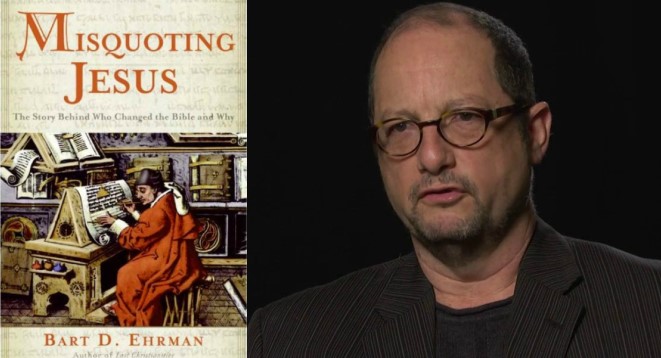
How often do we hear people “explaining” religious beliefs by stating “The Bible says so,” as if the Bible fell out of the sky, pre-translated to English by God Himself? It’s not that simple, according to an impressive and clearly-written book that should be required reading for anyone who claims to know “what the Bible says.”
Bart Ehrman’s Exploration: Who Changed the Bible and Why?
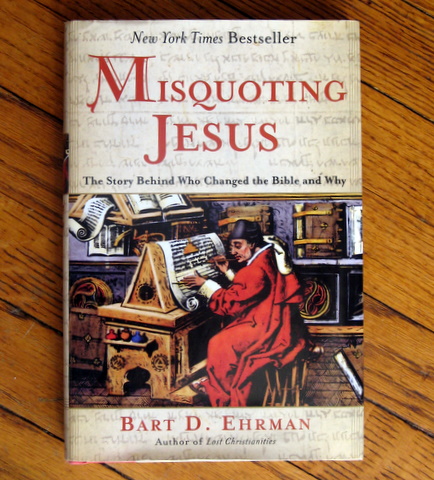
The 2005 bestseller, Misquoting Jesus, was not written by a raving atheist. Rather, it was written by a fellow who had a born-again experience in high school, then went on to attend the ultraconservative Moody Bible Institute in Chicago. Bart Ehrman didn’t stop there, however. He wanted to become an evangelical voice with credentials that would enable him to teach in secular settings. It was for this reason that he continued his education at Wheaton and, eventually, Princeton, picking up the ability to read the New Testament in its original Greek in the process.
As a result of his disciplined study, Ehrman increasingly questioned the fundamentalist approach that the “Bible is the inerrant Word of God. It contains no mistakes.” Through his studies, Ehrman determined that the Bible was not free of mistakes:
We have only error ridden copies, and the vast majority of these are centuries removed from the originals and different from them, evidently, in thousands of ways.
(Page 7). At Princeton, Ehrman learned that mistakes had been made in the copying of the New Testament over the centuries. Upon realizing this, “the floodgates opened.” In Mark 4, for example, Jesus allegedly stated that the mustard seed is “the smallest of all seeds on the earth.” Ehrman knew that this simply was not true. The more he studied the early manuscripts, the more he realized that the Bible was full of contradictions. For instance, Mark writes that Jesus was crucified the day after the Passover meal (Mark 14:12; 15:25) while John says Jesus died the day before the Passover meal (John 19:14).
Ehrman often heard that the words of the Bible were inspired. Obviously, the Bible was not originally written in English. Perhaps, suggests Ehrman, the full meaning and nuance of the New Testament could only be grasped when it was read in its original Greek (and the Old Testament could be fully appreciated only when studied in its original Hebrew) (page 6).
Because of these language barriers and the undeniable mistakes and contradictions, Ehrman realized that the Bible could not be the “fully inspired, inerrant Word of God.” Instead, it appeared to him to be a “very human book.” Human authors had originally written the text at different times and in different places to address different needs. Certainly, the Bible does not provide an an “errant guide as to how we should live. This is the shift in my own thinking that I ended up making, and to which I am now fully committed.”
How pervasive is the belief that the Bible is inerrant, that every word of the Bible is precise and true?
Occasionally I see a bumper sticker that reads: “God said it, I believe it, and that settles it.” My response is always, what if God didn’t say it? What if the book you take as giving you God’s words instead contains human words. What if the Bible doesn’t give a foolproof answer to the questions of the modern age-abortion, women’s rights, gay rights, religious and supremacy, western style democracy and the like? What if we have to figure out how to live and what to believe on our own, without setting up the Bible as a false idol–or an oracle that gives us a direct line of communication with the Almighty.
(Page 14). Ehrman continues to appreciate the Bible as an important collection of writings, but urges that it needs to be read and understood in the context of textual criticism, “a compelling and intriguing field of study of real importance not just to scholars but to everyone with an interest in the Bible.” Ehrman finds it striking that most readers of the Bible know almost nothing about textual criticism. He comments that this is not surprising, in that very few books have been written about textual criticism for a lay audience (namely, “those who know nothing about it, who don’t have the Greek and other languages necessary for the in-depth study of it who do not realize there is even any “problem” with the text).
Misquoting Jesus provides much background into how the Bible became the Bible. It happened through numerous human decisions over the centuries. For instance, the first time any Christian of record listed the 27 books of the New Testament as the books of the New Testament was 300 years after the books have been written (page 36). And those works have been radically altered over the years at the hands of the scribes “who were not only conserving scripture but also changing it.” Ehrman points out that most of the hundreds of thousands of textual changes found among the manuscripts were “completely insignificant, immaterial, of no real importance.” In short, they were innocent mistakes involving misspelling or inadvertence.
On the other hand, the very meaning of the text changed in some instances. Some Bible scholars have even concluded that it makes no sense to talk about the “original” text of the Bible. (Page 210). As a result of studying surviving Greek manuscripts of the New Testament, Ehrman concluded that we simply don’t have the original words constituting the New Testament.
Not only do we not have the originals, we don’t have the first copies of the originals. We don’t even have copies of the copies of the originals, or copies of the copies of the copies of the originals. What we have are copies made later-much later. In most instances, they are copies made many centuries later. And these copies all differ from one another, and many thousands of places . . . Possibly it is easiest to put it in comparative terms: there are more differences among our manuscripts and there are words in the New Testament.
In Misquoting Jesus Bart Ehrman spells out the ways in which several critical passages of the New Testament were changed or concocted. They are startling examples:
A.) Everyone knows the story about Jesus and the woman about to be stoned by the mob. This account is only found in John 7:53-8:12. The mob asked Jesus whether they should stone the woman (the punishment required by the Old Testament) or show her mercy. Jesus doesn’t fall for this trap. Jesus allegedly states “Let the one who is without sin among you be the first to cast a stone at her.”
The crowd dissipates out of shame. Ehrman states that this brilliant story was not originally in the Gospel of John or in any of the Gospels. “It was added by later scribes.” The story is not found in “our oldest and best manuscripts of the Gospel of John. Nor does its writing style comport with the rest of John. Most serious textual critics state that this story should not be considered part of the Bible (page 65).
B) after Jesus died, Mary Magdalene and two other women came back to the tomb to anoint the body of Jesus, according to Mark 16:1-2). They were met by a man in a white robe who told them that Jesus had been raised and was no longer there. The women fled and said nothing more to anyone out of fear (16:4-8). Everyone knows the rest of Mark’s Gospel, of course. The problem with the remainder of the story is that none of it was originally in the Gospel of Mark. It was added by a later scribe. Those additions include all of the following:
Jesus himself appeared to Mary Magdalene. She told the eleven apostles (minus Judas) about this vision, but they did not believe her. Jesus then appeared to the apostles, chastising them for failing to believe. He tells them that those who believe will be saved and those who don’t will be condemned. Then follows a critically important passage of the Bible.
And these are the signs that will accompany those who believe: they will cast out demons in my name; they will speak in new tongues; and they will take up snakes in their hands; and if they drink any poison, it will not harm them; they will place their hands upon the sick and heal them.
Jesus is then allegedly taken up into heaven and sits at the right hand of God, while the disciples go forth into the world to proclaim the Gospel in miraculous fashion.
Without the above passages (which, again, were not written by Mark) the Pentecostals lose their justification for speaking in “tongues.” And the Appalachian snake handlers have no basis for their dangerous practices.
C) John 5:7-8 is the only passage in the entire Bible “that explicitly delineates the doctrine of the Trinity (that there are three persons and God but that all three constitute a single God):
There are three that bear witness in heaven: the Father, the Word and the Spirit and these three are one; and there are three that bear witness on earth, the spirit, the water, and the blood, and these three are one.
Ehrman cites strong evidence that this Trinity passage was entirely concocted and foisted upon Erasmus by outraged theologians who needed support for their prized theological doctrine (page 81).
—
Ehrman reveals numerous other difficulties with the popular assumption that the Bible was perfectly handed down from its original written expression.
Many believers rely fervently on the King James version of the Bible, for instance. They sometimes even say “If the King James was good enough for St. Paul, it’s good enough for me.” Ehrman points out many problems with the King James version, warning that “we need to face up to the facts.”
The King James was not given by God but was a translation by a group of scholars in the early 17th century who based their rendition on a faulty Greek text.
(Page 209).
So what should we make of the Bible? Ehrman argues that the attacks of the New Testament are not simply collections of obvious, self-interpreting words. It’s the same problem we have with other important documents, such as the United States Constitution:
Texts do not simply reveal their own meanings to honest inquirers. Texts are interpreted and they are interpreted (just as they were written) by living, breathing human beings, who can make sense of texts only by explaining them in light of other other knowledge, explicating their meaning, putting the words of the text “in other words.”
(Page 217) The scribes changed the original words of the New Testament by putting them in other words.
In my experience, many people who cherry pick excerpts from the Bible as the proper way to determine what is moral are in utter denial that we don’t have accurate copies of the original writings. Most of them refuse to acknowledge that current popular versions of the Bible contain numerous discrepancies, even compared to the earliest manuscripts we do have. This is on top of the fact that their are hundreds of patent contradictions in the English version of the Bible. To most believers, none of this matters. Stay the course! In fact, in my experience most believers rarely read what the consider to be God’s own inspired word.
Ehrman’s book points out numerous troublesome issues that demand attention even assuming that the original writers of the Bible accurately reported the events described in their original writings (whatever those writings were). The elephant in the room, however, is that none of the authors of the Gospels ever claimed to witness any of the events they were reporting. Further, the extraodinary nature of Biblical claims demands extraordinary proof that ancient self-contradictory writings are simply incapable of providing, except to those of us who believe that the Bible is completely true “because it says so in the Bible.”
For all of those people who continue to go around clentching and thumping those Bibles they bought at Wal-Mart, and for all the rest of us who want to get the story straight, Ehrman’s Misquoting Jesus should be required reading.
[Administrator’s Note: More than 540 comments were quickly contributed to this post, making this page too long to download and display. Therefore, on March 23, 2007, I closed off new comments. Last night (February 4, 2009), I discovered a WordPress plugin that allows me to paginate comments, thereby protecting the site from the sudden and repeated load of 540 comments.
Here’s the good news, then. Anyone who has not yet had his or her say on Bart Ehrman’s book may now jump in at the original post and post a comment. That’s right! If none of the 540 comments that have come before you didn’t address an important aspect of Bart Ehrman’s book, you may now remedy that omission, right here in the comments to this original post. Godspeed. ]


You go Grumpy!
Notice the vehemence with which "to Grumpy" and "Grumpy's logic sucks" attack him. That is insecurity speaking. He is shaking them. They know deep down inside just how much they NEED their god and he is not allowing them to comfortably and blindly go on with their pretense and ignore logic. How cruel of Grumpy! (sarcasm)
Using words like "dog vomit" to describe Grumpy's intelligent opinions do not show how much you love god. They reveal panic and an inability to debate Grumpy at his level. It seems to be a common reaction by many (but not all) of you believers out there. A frightened creature snaps. (I know what I'm talking about. I was bitten by my girlfriend's chihuahua last night while trying to pet him!) That kind of speech is unflattering and does little to help your argument.
To grumpypilgrim:
To answer a question you recently raised, as to why the news wasn't written down immediately after Jesus' resurrection speaks volumes as to your lack of study of the Bible, which isn't surprising, though you start answering on the right track. The good news of Jesus was not a literary event. You have to try and understand the time and purpose of His message as it was perceived by those in that day. The first people in the church were under the assumption that Jesus was returning soon, in their lifetimes, because He was not explicit about the time He would return. I believe He was not explicit for a reason, to keep us anticipating. Do you think it would have deflated their enthusiasm that it would be more than 2000 years (and counting)?
Also, the majority of those being converted were illiterate and could only be explained the message by those who were the apostles, vocally, as they went around the countryside. It wouldn't have occurred to them to write it down because they were trying to spread the news as fast as they could.
Also, the powers that be of the day were not exactly accepting of a coming King who would dethrone them all. All this and more give legitimate explanation as to why it was not important to them to write it all down. However, they realized after a generation or so, that they were not told how long it would be, so the church had to make a shift, and they realized that there were many out there seeking to take the church out of business by spreading false doctrine, thus the age of the written Word began. It was always the Word first, spoken, but later became the Bible, for us in the 21st century.
mnowlan
Your explanation (immediately above) doesn't hold water. It would be stunning for a man to perform as many miracles as were attributed to Jesus, but then for even Christian literature to ignore them for at least 40 years. There is no talk of the Jesus of Galilea in the Epistles.
See this article by Earl Doherty: THE SOUND OF SILENCE: 200 Missing References to the Gospel Jesus in the New Testament Epistles
http://pages.ca.inter.net/~oblio/silintro.htm
The only reasonable conclusion is that the miracles that were ignored for 40 years never occurred. See also http://dangerousintersection.org/?p=126
Mnowlan writes: "The first people in the church were under the assumption that Jesus was returning soon, in their lifetimes…."
That wasn't an assumption: Jesus *told* them he would return in their lifetimes. Therefore, if we interpret the Bible literally, it means Jesus was either wrong or he was lying.
Mnowlan continues: "…He was not explicit about the time He would return. I believe He was not explicit for a reason, to keep us anticipating. Do you think it would have deflated their enthusiasm that it would be more than 2000 years (and counting)?"
Why would Jesus lie about his return date merely "to keep us anticipating?" What is gained? If you truly believe you must live a good Christian life, then what difference does it make when Jesus returns? Why does Jesus need to dangle phony return dates in front of his loyal followers, if they are truly loyal? If you knew that Jesus would not return for, say, 50,000 years, would it deflate *your* enthusiasm?
I often wonder why evangelicals work so hard to make excuses for Jesus' illogical behavior, when it is so much simpler and more sensible to just admit that the Bible is not literally true.
To grumpypilgrim:
Why was Jesus' behavior illogical? To you perhaps. It is human nature to procrastinate. Most people do not get things done early, but wait until the last moment to get something done, if they know it must be done by a certain date. If people knew when Jesus was going to return, and it was not to be for 2000 years (or more), what urgency would there have been? Are you now going to ask, why did Jesus need to be ambiguous? Does He not trust us to make the right decision? Shouldn't it be simple enough, if it is the Truth, to be obvious? Shouldn't we be programmed to make the right decision? For a created being who wants to have control of their universe, it should be made clear to them, right? So they can make the appropriate decision, knowing all the facts?
Well, we do not have control, never did, never will. We can't know everything, never have and never will. God purposely kept us in the dark about the return of Jesus. Because the best time to surrender (willingly) to the God who created you is now, today. I can imagine all the rationalizations for those who would hear the message of Jesus and say, I'll wait until the end of my life before I give it back to God. What good would that do? It's like saying "I'll wait until I'm almost dead before I seek life." God is life. How can anyone say they recognize God's message/authority, but ignore it until it is convenient for that person? (I'm not saying you grumpy because you have expressly rejected the God of the Bible).
By the way, grumpy, Jesus never told people when He would return (in bodily form). He simply stated the manner of His return, not the date. If you can cite a Bible verse otherwise please enlighten me. So, nice try, but He did not lie. I believe that in the form of the Holy Spirit, He is still here, because I believe there is no real separation between God, Jesus and the Holy Spirit.
Now, to get back to other issues you have raised… like why would God not communicate His message more directly through a voice, and just do away with the Bible stories and having to believe them? How would you propose a God would communicate? If you heard an audible voice in your head would you automatically know it was God? If an angelic being appeared before you and paid you a personal visit would it satisfy you? What manner can you imagine would be an unquestionable presence of God? I'm eager to hear your answer. I would argue that in this physical realm there is no experience by sight that can unequivocally be proclaimed as God and convincing to every unbeliever. I believe that God is beyond visibility. I also believe that the manner in which believe is intangible. Faith is the evidence of things not seen. My arguments have been (by others I think) been proclaimed "straw man" arguments. Because they are founded on an invisible God and not some tangible "thing" that is provable and repeatable? If I could prove God exists in the manner in which most scientists think, then I would be controlling Him, containing Him. I'm glad I can't prove He is who He is. I'm going to leave that to Him. Deny all you want. Belittle the believer all you want. You cannot dictate what is in someone else's heart, nor can you tell God how to run His universe.
Erich Vieth:
Glad you could join the discussion. This is your site (and grumpy's too I believe). It is an interesting form of argument that you raise. I have read a bit about the development of "dangerous intersection" and I applaud your skepticism in that it sounds like you are seeking Truth.
To get to your argument… What exactly does the absence of something tell? Just because someone expects something to be a certain way, and then it doesn't fit that expectation, does it negate all other arguments? Why would it be expected that Paul would continually bring up the miracles of Jesus during his letters to the churches? I guess the argument isn't that Paul should have continually been doing it, but should have done it at least once or twice. It's sad that this attack on the New Testament would hold any water, but I suppose anyone who is looking for a reason to not believe could latch onto this type of argument.
Do you know who Paul was? Formerly Saul, he was not a follower of Christ while Jesus was alive, but became a believer on the road to Damascus, during his persecution of Christians. He was a Jew and a scholarly one to boot. Once he became a believer he spoke of the miracles he witnessed. He spoke of the resurrection of Jesus in his epistles. His letters were, for the most part, not intended to convert people who did not believe, though he did do that as part of his ministry. No, his letters were intended for an audience of believers for the most part, to point out important things that needed discussing during the growth of the church. It makes perfect sense to me that Paul's writings would would be lacking mention of the miracles before the resurrection (the most important miracle). Once the resurrection occurred, the proof of Jesus being God in the flesh was more certain. Changing water into wine, healing the sick, were very convincing before the resurrection, but they paled in comparison afterwards.
Talk about "straw man" arguments!
mnowlan:
I don't think my argument (4 posts above) is a straw man argument. 2,000 years ago people would have been utterly fascinated by the tales of miracles performed by the amazing Jesus just like Christians are today fascinated. If those miracles had really been performed, there's no way someone writing about Jesus would fail to mention all of them. "Jesus? Jesus who?" The response would be "Jesus Christ, who rose from the dead and walked on water and healed the sick . . . " Maybe the miracles wouldn't all be found in each Epistle letter, but over 40 years, many of them should have shown up in the Epistles, if they really occurred as set forth in the Gospels.
Check out the article I cited earlier and let me know what you think: http://pages.ca.inter.net/~oblio/silintro.htm
As far as "joining the discussion," I authored this original post more than 400 comments ago, but got frightened away for that torrent of comments!
I applaud Mnowlan, not because I believe a single thing he says, but because he is stubborn and determined. Some of my earlier posts made mention of being able to "put yourself in THEIR shoes". If I take my own advice and put myself in Mnowlan's shoes, I can't see anything except a strong, righteous person who actually means well in his own way. If only Mknowlan could/would utilize this technique and see where we are coming from…we would at least be starting on the same page (of the Koran/Bible/Buddha).
Scholar
mnowlan writes: "If people knew when Jesus was going to return, and it was not to be for 2000 years (or more), what urgency would there have been?"
People don't know when they are going to be delivered to their judgment day (i.e., die); therefore, there is always urgency, no matter when Jesus returns. Indeed, Jesus' return date is irrelevant. Therefore, there was no logical reason for Jesus to mislead his followers about when he would return. So, I will ask again: why would Jesus do this and why would a loyal Believer need an artificial incentive to safeguard his or her immortal soul?
mnowlan asks: "By the way, grumpy, Jesus never told people when He would return (in bodily form)…If you can cite a Bible verse otherwise please enlighten me."
Luke 9:27 — Jesus said, "But I tell you of a truth, there be some standing here, which shall not taste of death, till they see the kingdom of God."
mnowlan continues: "If an angelic being appeared before you and paid you a personal visit would it satisfy you?"
I suppose it would…if I knew what an angelic being looked like. Or, as I've mentioned before, why doesn't God simply scoop us up and give us a little preview of heaven? You know, like the exciting movie trailers we see in theaters to get us fired up for future releases. Imagine how many loyal believers there might be if we all had a glimpse of heaven and we could excitedly share our experience around the dinner table.
Notice that our being certain about the *existence* of heaven would not undermine human free will or our need for faith, because we would still need faith that Jesus is the conduit to get to heaven, and we would still have free will to decide whether or not to seek entry.
To grumpypilgrim:
My friend (not sarcastically), I see now why you may have an aversion to Scripture. Luke 9:27 is not speaking of Jesus' return, but of the witness of some (not all) of his disciples of the kingdom of God. In the previous verse He does speak of His coming, and is referring to the time of His return to earth, but the context of the verse is focusing on the response Jesus will have to those who are ashamed of Him and His words before His return. I believe that Luke 9:27 is a follow up to 9:26 (and the whole section beginning at verse 23) in that it speaks of the gift that will be given to those who stand daily for Jesus and His teachings, who "take up their cross daily". If you have read the Bible you may recall that two individuals were granted a gift of seeing heaven before they "tasted death". Stephen in the book of Acts, and John on the island of Patmos. The events which led up to their witnessing heaven were surely filled with difficulty and persecution (take up their cross daily), but they were faithful. I'm not saying they earned the right to see heaven before they died, but the Bible is clear that they did.
The meaning which you interpreted seems a logical conclusion since the verse before speaks of His return, but I still don't see a clear promise from Jesus to His disciples of a "within their lifetime" return to earth after His resurrection. If this portion of Scripture means something different than you thought, then is it possible that you have been understanding Scripture incorrectly?
I appreciate your positions, but I respectfully disagree.
Hi Christians, its me scholar. I don't want this debate to degrade into arguments about any single religion, so in fairness, here is another viewpoint. The fact still exists that books of faith can (mistakenly or not) be interpreted many ways.
QUR'AN or Koran–the sacred book of Islam. Revealed by God to the Prophet Muhammad in separate revelations over the major portion of the Prophet's life at Mecca and at Medina, the Qur'an was intended as a recited text, and was not compiled as a single volume during the life of the Prophet. The establishment of the canonical text is attributed to the caliph, Uthman, who appointed a committee to reconcile the conflicting versions then available, under the direction of Zaid ibn Thabit, one of the Prophet's scribes. The internal organization of the Qur'an is somewhat ad hoc. Revelations consisted of verses (ayat) grouped into 114 chapters (suras). The arrangement of the suras is mechanical: the first, al-Fateha or "the Opening," is a short prayer exalting God that has become an essential part of all Islamic liturgy and prayer. The rest are graded generally by length, from longest to shortest. It is thus impossible to tell from the book the chronological order of revelations; generally, however, the shorter suras, more electric and fervent than the rest, are the earlier. The Qur'an refers to religious and historical events but seldom provides comprehensive accounts. Its focus is their significance, rather than their narration. God in the Qur'an speaks in the first person. Tafsir, Qur'anic exegesis, initially emerged as a branch of the science of Hadith, in the attempt to gather Muhammad's elucidations of obscure Qur'anic passages, then developed into a separate discipline with the introduction of etymological and literary analysis tools. Being the verbatim Word of God, the text of the Qur'an is valid for religious purposes only in its original Arabic, cannot be modified, and is not translatable, although the necessity for non-Arabic interpretations is recognized. This has made the Qur'an the most read book in its original language and preserved a classical form of Arabic as an Islamic lingua franca and medium of learning.
…ok done reading. I especially liked the part about the "verbatim Word of God" …sound familiar mnowlan?
Scholar:
Your point?
If you mean to imply that the interpretation of all religious texts are tainted by our humanness, that should be obvious. I'm not sure… but it sounds like you are implying that the Koran is superior in some way? You sure seem to know all the references and structure of the book. Are you Muslim? Since I've disclosed my being a Christian, the least you could do is disclose your position. I confess I have not read every one of your previous postings since most of my exchanges have been with gatomjp and grumpypilgrim. Save me some time if you have mentioned it. If not, come clean. Or as a Muslim do you ascribe to the belief that Muslims can freely lie to infidels and still be ok with God? If you're not a Muslim, can you explain your fascination with the Koran?
Hi Christians. I am not muslim, I just came across the above definition while I was browsing the encylopedia. I did not write the article, but yes mnowlan, it seems that muslims (and Christians for that matter) believe that their holy book is "superior in some way". In terms of my religion, I highly DISbelieve in ANY deities, but I still celebrate hannukah and christmas the same as I always have (as a half-jew/half-christian). I even enjoy the "stories" of the hannukah oil, the ten plagues, and my favorite (because he always had the biggest gifts) was the story of santa claus. I was never exposed to kwanza, and unfortunately, I think I probably do not understand enough about it and the joy it brings to some.
To be fair, here's another religion, not to be confused with muslim(islam), which does not share as many of the similarities exhibited by Christianity and muslim(islam).
Hinduism is a religion that originated on the Indian subcontinent. Hinduism encompasses many religious beliefs, practices, and denominations. Most Hindus believe in a supreme cosmic spirit called Brahman that is worshipped in many forms, represented by individual deities such as Vishnu, Shiva and Shakti. Hinduism centers around a variety of practices that are meant to help one experience the divinity that is everywhere and realize the true nature of the Self.
Hinduism is the third largest religion in the world, with approximately 1 billion adherents figure, of whom about 890 million live in India. Other countries with large Hindu populations include Nepal, Bangladesh, Pakistan, Sri Lanka, Indonesia, Malaysia, Singapore, United Kingdom, Canada and the United States, with Nepal being the only country with Hinduism as its official religion.
Considered to be the oldest living religion in the world, Hinduism has no single founder and is based on a number of religious texts developed over many centuries that contain spiritual insights and practical guidance for religious life. Among such texts, the Vedas are the most ancient. Other important scriptures include Upanishads, the eighteen Puranas and the epic poems Mahabharata and Ramayana. Hinduism is sometimes referred to as a polytheistic religion, but strictly speaking, this is not accurate. Mainstream Hinduism believes in One God, but asserts that the One God can appear to humans in multiple names and forms.
-S
After reading all that junk about Islam and then all the junk about Hinduism, I feel the same way you do about it Mnowlan. It's all a bunch of nonsense written hundreds of years ago by men chewing khat. You however, have gone off the DEEP end by FAILING to put CHRISTIANITY in the NONSENSE group where it BELONGS!!
-S
Scholar:
It seems that we have lost grumpypilgrim et al and we are the last ones still posting. All I can say is that I was where you are (roughly) about 20 years ago. Majoring in engineering at the top of my class, minoring in philosophy, raised Catholic but never believed. I just went through the motions for years until I stopped going to church all together. I thought I had it all figured out, or that at least I could if I put my mind to it. I was sharp. I studied Buddhism, Hinduism, Taoism, read all kinds of spiritual books. I even lived in Africa and learned about Islam in a Muslim country and learned arabic (some).
You're right in some ways. Most of the people out there buy whatever is fed to them. They don't question or test. After all that "experimentation" God finally started introducing me to the Truth. I learned that I don't decide what truth is, because if it depends on your perspective, it ain't truth. I realized that this earthly life system of a planet we live on is far, far, far too complex to be just an accident. Even a slow incremental one (the latest response to intelligent design). If we evolved from the primordial ooze, what was the starting life form? And why can't we brilliant egotistical humans figure out how to make life in even its simplest form? Because we can't. It's like a piece of clay trying to make itself into a sculpture.
I know what the confusion that masks itself as "clarity" looks like. I lived it for a long time. Dismissing coincidences in my life. As long as we live comfortably we can luxuriously declare that there is no God. But if you're put in a life or death situation just watch the facade of self confidence melt away. That's when God can really reach you, when your guard is down. As long as your hands are over your eyes, you will never understand that God loves you. If you keep kicking everything around you and you realize your leg is hurting, don't go blaming the wall. Of course if you can't see the wall because your hands are over your eyes, well, you get the picture.
Now, you can dismiss the Bible as nonsense. That's your free will. But don't tell me I can't believe the Bible, or that I'm stupid because of it. Only the ones who are truly insecure about their beliefs resort to name calling. While you may not be using profanity, your words are profane. I do not call the words of any religion "junk" or "nonsense". Those people are searching for meaning in their lives. They think they can achieve it by following a prescribed path, or following some ritual. At least they realize that they can't define their own truth. I don't want to bash them or to bash you. My job is to gently and lovingly point out where I see inconsistencies with their philosophy.
Take you for instance. If you have it all figured out, then why are you here reading and typing away? Why aren't you placing yourself in the most comfortable or exciting places on earth and disregarding these conversations as simply a waste of time? Or do you gain pleasure from feeling superior to me or anyone else? Does belittling me or every other religious believer make you feel bigger? Unlike the stereotypes, as a Christian, my job is to be a servant and to be as humble as possible. I believe that Jesus came to do away with religion, because it was tainted with human selfishness and the need to "feel superior". I am a sinner, always was, and always will be. Thus I will always need God to give me life and I will never more claim that my life is my own doing. As long as you think you can do it all on your own, that is where you will end up, eventually. And getting together with a bunch of people who think just like you doesn't make your way of thinking any more valid.
The essential non-mystical difference between inanimate matter and life becomes clear if you learn some information theory and biophysics.
We can't "make life in even its simplest form" in much the same way that we can't make sustainable nuclear fusion. There are some visible gaps in out knowledge of procedure, and the necessary technology is beyond the edge of our present capabilities. These things are completely possible, but we haven't yet figured out how.
As mnowlan says, when one is at his lowest spiritual ebb, clutching at straws, then faith in an eternal creator/savior can seem to be truth. When one regains a confident grip on material reality, it is easier to dismiss this fantasy.
The big business of religion perpetuates the insecurity and keep people believing in {names of gods here} for a variety of economic and political reasons. If faith is truth, why are there about 10,000 competing varieties of Christianity?
And so we loop back to the subject of "who changed the bible and why?"
To Dan Klarmann:
Interesting response. Your response suggests that we are not in our right mind when we are in our "lowest spiritual ebb" and that once things have subsided we "recover" from our delusion or disease. I am paraphrasing, but is that what you're saying? You also state that "faith is truth". I don't buy your dismissal and the last time I looked "faith" and "truth" are two totally different things. I think that such dismissals are the illusion of the self being in control. I don't think anyone can escape these "lowest spiritual ebbs" as you call them, no matter how intellectual or self serving we are. Are we not all going to die? Can you tell me that you will cling to your beliefs that you're in total control at that moment? And you know what, God told us that we would never understand Him completely. The part can never contain the whole, no matter how much we proclaim we can. The claim that we just "haven't figured it out yet" is just another proclamation that we are full of ourselves. Another arrogant (adolescent) response to a situation that the self doesn't want to face.
Now, simply because there are "10000" denominations doesn't mean there is no God, it simply means that people claim to know God and yet continue to put their own slant on who God is, and then divide themselves because of it. It's this human selfishness that caused these religious rifts and all rifts between human beings, not God or His Truth.
I hope that you can admit that life is way bigger than any of us (even collectively) can possibly imagine. I believe it will continue to be so because God is infinite.
Well said Mnowlan. (Please join the daily posts, some interesting things have been posted since our first encounters, just click on Erich's name and it will bring you the most recent ones.)
Christians/Mnowlan, it seems that both of us have our minds made up. You have wished me well on my journey and pray for my soul that I find God, and vice versa, I wish you well, and "hope" that you eventually stop preaching the Bible, and see Christianity for what it really *isn't*. In your prose about how life was created, you asked some valid questions such as… "If we evolved from the primordial ooze, what was the starting life form?" Here is a good answer, (from http://www.encylopedia.com)
"Fundamental religious concepts center around special creation and belief in the infusion of life into inanimate substance by God or another superhuman entity. On the other hand, many scientists have hypothesized that during an early geological period there gradually formed in the atmosphere increasingly complex organic substances composed of available inorganic compounds and water, utilizing ultraviolet rays and electrical discharges as energy sources. At a certain stage they formed a diffuse solution of "nutrient broth." Then in some way they were drawn together and developed the capacity for self-renewal and self-reproduction. In 1953, S. L. Miller synthesized several of the most basic amino acids in a glass flask by introducing an electrical discharge into an atmosphere of water vapor and some simple compounds thought to have been present naturally at the time when life first developed on earth. A more recent theory now widely held is that life originated in a volcanic setting more than 3.5 billion years ago, perhaps in hot deep-sea vents, utilizing a biochemistry based largely on sulfur and iron. The theory that life on earth came in a simple form from another planet has had small currency, although the discovery by Melvin Calvin of molecules resembling genetic material in meteors has given it some force.
Stromatolites are the oldest known fossils, dating back more than 3 billion years. They are colonial structures formed by photosynthesizing cyannobacteria and other microbes. Stromatolites are prokaryotes(primitive organisms lacking a cellular nucleus) that thrived in warm aquatic environments and built reefs much the same way as coral does today. Cyannobacteria were likely responsible for the creation of earth's oxygen atmosphere. They were the dominant lifeform on Earth for over 2 billion years. Today they are nearly extinct, living a precarious existence in only a few localities worldwide."
That should answer your first question. You will find that science does have most of the answers. Keep on asking…its healthy to be curious. Curiousity is how WE separated from the other hominids, (also the ability to learn and think rationally, use tools, speak, ETC).
-S
Hey Scholar:
Here is YOUR leap of faith.
"Then in some way they were drawn together and developed the capacity for self-renewal and self-reproduction."
A paragraph of hard science precedes that sentence and a paragraph of hard science follows it. But that sentence itself is hardly scientific. That particular sentence has been the evolutionist's nightmare for quite some time now. It's quite fantastical to imagine inanimate substances and lightning becoming self-aware, you must admit. To believe it as wholeheartedly as you do, without hard evidence, requires faith.
"In SOME way" is an interesting choice of words. Maybe it was the "hand of god" stirring those primordial waters. You don't know for sure.
You are partially right Gato, the science link I pasted in was not a complete analysis of the primordial stew. In fact, I too had doubts about how convincing this specific Encylopedia article would be. However, that does not give me license to change the Encylopedia entry (as your people change the Bible at whim).
The posted encylopedia entry, in my opinion, does a SUPERB job in that it summarizes the complex principles in a concise manner which proved wieldy enough to cut and paste so the uneducated (you) could have a peak into the world of science. Obviously it would not be practical for me to give you an entire lesson on Biochemistry here on Erich's (our) forum. If you are curious, and you must be, I will clarify that specific part of the scientific explanation for the creation of life. Following my post is a link to some of the *hard* science which I base my conclusion. Most folks are not capable of dissecting this kind of graduate-level science. I understand that many folks may not have the same access I have to science libraries (i near a major university, and I also work in a major scientific institution). Therefore I prefer to post information which is easily digestible, but I am excited that I have found a pupil. Here Gato….
http://www.resa.net/nasa/origins_life.htm
Here is some more link which are a part of my science "Bible". Isn't science beautiful, when we aren't sure about certain things, we DEVELOP theories to explain the evidence, rather than declare what our "gut" tells us. You are right in that some cases such (such as the origin of life) the verdict is still being debated. At this point, having re-read parts of the NASA website (thanks to you 🙂 ) , and after having had some time to evaluate Stephen Hawking's latest conclusions about mankind needing to expand to other planets, I am considering the "intergalactic spore" theory more that I did this morning. However, no matter how hard you search and stretch, the "God" theory is WAY WAY down on the list, in fact it doesn't make the NASA list at all.
http://www.geocities.com/capecanaveral/lab/2948/o…
Here is some more of the real juicy science Gato…
http://www.resa.net/nasa/links_origins_life.htm
-S
Scholar,
Sorry, I guess I'm just too stupid to understand. It must be great being you. How does it feel to know everything? If I did have any interest in exporing your links, you have squashed that by your insulting tone. Once again "Scholar" you have shown that you are not as smart as you think you are and have little knowledge about or love for people. A truly intelligent person could have responded to my post in a way that made me feel good and heightened my desire to learn more.
I don't want these discussions to degenerate into personal attacks but I don't know if you realize how condescendingly smug you come off in your writing. Erich tried to gently tell you this in a response on another post when he asked you to consider showing more tolerance for people who simply use a belief in god as a personal guide and source of strength. I know some brilliant people who do just that and none of them would ever think of speaking to anyone the way you do. The fact that you are posting on the net and not speaking in person is no excuse.
You say, "(as your people change the Bible at whim)." Who are MY people? I think I have clearly established in these posts my distaste of the bible and those who fail to question their adherence to its outdated notions. I have told you that I share your beliefs. I am merely playing devil's advocate here and asking everyone to re-examine their beliefs and their reasons for holding to them…no matter what side they are on.
You quote from scientific texts with the zeal of a Baptist preacher. In your mouth the words "Nasa says so" comes out sounding very much like "Ezekiel 32:45 says so". I find your scientific fundamentalism distasteful and am sometimes embarrassed to be on your side. The ultimate aim of these discussions are to bring people together, not alienate them.
Gato,
I am finished apologizing to you. However, I was trying to make a point when I said "your people". The point being that you are no different than a *bible thumper* in that you are extremely unwilling to explore what you can't comprehend. Please explore the links, for your own good, even if I have insulted you.
Unfortunately, science is not always warm and fuzzy. In fact the implications of the links which I provide can be interpreted as evidence of a "cold" world (and are by many misguided souls). I choose to make the best of the godless world we live in, because I know deep down, it is up to us to provide the "warmth". I am a very confident and borderline conceited, the same can be said for you, though. You seem more interested in a philosophical argument, and I agree, this doesn't seem to be the place. Oh, yeah, I bet it does feel good to know "everything", thats why I keep learning (not whining). Besides, anyone who may be insulted by my comments has the added bonus that they can "use a belief in god as a personal guide and source of strength", therefore my comments can be disregarded by these folks. I apologize to them, but I am not going to apologize to you anymore, for the same thing I already have. Your friend, Scholar
A wise man once said, "The ultimate aim of these discussions are to bring people together, not alienate them."
I think the aim may be somewhat different for me. For me, a more important function of this forum is to explore our differences. The varied points of view (sometimes subtle) here are what makes it so fascinating. I may have misinterpreted your "leap of faith" post as an attack, and my response was somewhat heated for that reason. The fact remains that we makes "leaps" of faith every day (for example driving on a 2 way street and "trusting" that the other guy is awake) which are much, much smaller than the ones I make in declaring that GOD DOES NOT EXIST.
Scholar,
Another wise man once said, "We condemn most strongly in others the faults we have in ourselves." That is why we butt heads much of the time, I think.
My ultimate aim here and everywhere else in my life is to bring people together by exploring our differences. Understanding is the first step to acceptance. Insulting people and acting superior turns people off, shuts down communication and short circuits the discussion. I can't help but notice that you do that in almost every post, even though I enjoy reading them, and I thought it my duty as someone who's "been there", to bring it to your attention. Self awareness is the key to personal growth. That's all I'm trying to say.