
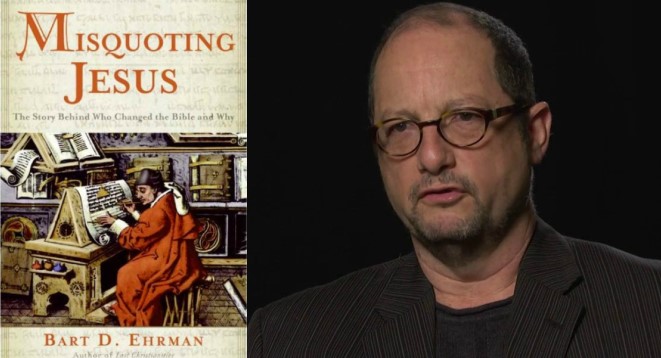
How often do we hear people “explaining” religious beliefs by stating “The Bible says so,” as if the Bible fell out of the sky, pre-translated to English by God Himself? It’s not that simple, according to an impressive and clearly-written book that should be required reading for anyone who claims to know “what the Bible says.”
Bart Ehrman’s Exploration: Who Changed the Bible and Why?
The 2005 bestseller, Misquoting Jesus, was not written by a raving atheist. Rather, it was written by a fellow who had a born-again experience in high school, then went on to attend the ultraconservative Moody Bible Institute in Chicago. Bart Ehrman didn’t stop there, however. He wanted to become an evangelical voice with credentials that would enable him to teach in secular settings. It was for this reason that he continued his education at Wheaton and, eventually, Princeton, picking up the ability to read the New Testament in its original Greek in the process.
As a result of his disciplined study, Ehrman increasingly questioned the fundamentalist approach that the “Bible is the inerrant Word of God. It contains no mistakes.” Through his studies, Ehrman determined that the Bible was not free of mistakes:
We have only error ridden copies, and the vast majority of these are centuries removed from the originals and different from them, evidently, in thousands of ways.
(Page 7). At Princeton, Ehrman learned that mistakes had been made in the copying of the New Testament over the centuries. Upon realizing this, “the floodgates opened.” In Mark 4, for example, Jesus allegedly stated that the mustard seed is “the smallest of all seeds on the earth.” Ehrman knew that this simply was not true. The more he studied the early manuscripts, the more he realized that the Bible was full of contradictions. For instance, Mark writes that Jesus was crucified the day after the Passover meal (Mark 14:12; 15:25) while John says Jesus died the day before the Passover meal (John 19:14).
Ehrman often heard that the words of the Bible were inspired. Obviously, the Bible was not originally written in English. Perhaps, suggests Ehrman, the full meaning and nuance of the New Testament could only be grasped when it was read in its original Greek (and the Old Testament could be fully appreciated only when studied in its original Hebrew) (page 6).
Because of these language barriers and the undeniable mistakes and contradictions, Ehrman realized that the Bible could not be the “fully inspired, inerrant Word of God.” Instead, it appeared to him to be a “very human book.” Human authors had originally written the text at different times and in different places to address different needs. Certainly, the Bible does not provide an an “errant guide as to how we should live. This is the shift in my own thinking that I ended up making, and to which I am now fully committed.”
How pervasive is the belief that the Bible is inerrant, that every word of the Bible is precise and true?
Occasionally I see a bumper sticker that reads: “God said it, I believe it, and that settles it.” My response is always, what if God didn’t say it? What if the book you take as giving you God’s words instead contains human words. What if the Bible doesn’t give a foolproof answer to the questions of the modern age-abortion, women’s rights, gay rights, religious and supremacy, western style democracy and the like? What if we have to figure out how to live and what to believe on our own, without setting up the Bible as a false idol–or an oracle that gives us a direct line of communication with the Almighty.
(Page 14). Ehrman continues to appreciate the Bible as an important collection of writings, but urges that it needs to be read and understood in the context of textual criticism, “a compelling and intriguing field of study of real importance not just to scholars but to everyone with an interest in the Bible.” Ehrman finds it striking that most readers of the Bible know almost nothing about textual criticism. He comments that this is not surprising, in that very few books have been written about textual criticism for a lay audience (namely, “those who know nothing about it, who don’t have the Greek and other languages necessary for the in-depth study of it who do not realize there is even any “problem” with the text).
Misquoting Jesus provides much background into how the Bible became the Bible. It happened through numerous human decisions over the centuries. For instance, the first time any Christian of record listed the 27 books of the New Testament as the books of the New Testament was 300 years after the books have been written (page 36). And those works have been radically altered over the years at the hands of the scribes “who were not only conserving scripture but also changing it.” Ehrman points out that most of the hundreds of thousands of textual changes found among the manuscripts were “completely insignificant, immaterial, of no real importance.” In short, they were innocent mistakes involving misspelling or inadvertence.
On the other hand, the very meaning of the text changed in some instances. Some Bible scholars have even concluded that it makes no sense to talk about the “original” text of the Bible. (Page 210). As a result of studying surviving Greek manuscripts of the New Testament, Ehrman concluded that we simply don’t have the original words constituting the New Testament.
Not only do we not have the originals, we don’t have the first copies of the originals. We don’t even have copies of the copies of the originals, or copies of the copies of the copies of the originals. What we have are copies made later-much later. In most instances, they are copies made many centuries later. And these copies all differ from one another, and many thousands of places . . . Possibly it is easiest to put it in comparative terms: there are more differences among our manuscripts and there are words in the New Testament.
In Misquoting Jesus Bart Ehrman spells out the ways in which several critical passages of the New Testament were changed or concocted. They are startling examples:
A.) Everyone knows the story about Jesus and the woman about to be stoned by the mob. This account is only found in John 7:53-8:12. The mob asked Jesus whether they should stone the woman (the punishment required by the Old Testament) or show her mercy. Jesus doesn’t fall for this trap. Jesus allegedly states “Let the one who is without sin among you be the first to cast a stone at her.”
The crowd dissipates out of shame. Ehrman states that this brilliant story was not originally in the Gospel of John or in any of the Gospels. “It was added by later scribes.” The story is not found in “our oldest and best manuscripts of the Gospel of John. Nor does its writing style comport with the rest of John. Most serious textual critics state that this story should not be considered part of the Bible (page 65).
B) after Jesus died, Mary Magdalene and two other women came back to the tomb to anoint the body of Jesus, according to Mark 16:1-2). They were met by a man in a white robe who told them that Jesus had been raised and was no longer there. The women fled and said nothing more to anyone out of fear (16:4-8). Everyone knows the rest of Mark’s Gospel, of course. The problem with the remainder of the story is that none of it was originally in the Gospel of Mark. It was added by a later scribe. Those additions include all of the following:
Jesus himself appeared to Mary Magdalene. She told the eleven apostles (minus Judas) about this vision, but they did not believe her. Jesus then appeared to the apostles, chastising them for failing to believe. He tells them that those who believe will be saved and those who don’t will be condemned. Then follows a critically important passage of the Bible.
And these are the signs that will accompany those who believe: they will cast out demons in my name; they will speak in new tongues; and they will take up snakes in their hands; and if they drink any poison, it will not harm them; they will place their hands upon the sick and heal them.
Jesus is then allegedly taken up into heaven and sits at the right hand of God, while the disciples go forth into the world to proclaim the Gospel in miraculous fashion.
Without the above passages (which, again, were not written by Mark) the Pentecostals lose their justification for speaking in “tongues.” And the Appalachian snake handlers have no basis for their dangerous practices.
C) John 5:7-8 is the only passage in the entire Bible “that explicitly delineates the doctrine of the Trinity (that there are three persons and God but that all three constitute a single God):
There are three that bear witness in heaven: the Father, the Word and the Spirit and these three are one; and there are three that bear witness on earth, the spirit, the water, and the blood, and these three are one.
Ehrman cites strong evidence that this Trinity passage was entirely concocted and foisted upon Erasmus by outraged theologians who needed support for their prized theological doctrine (page 81).
—
Ehrman reveals numerous other difficulties with the popular assumption that the Bible was perfectly handed down from its original written expression.
Many believers rely fervently on the King James version of the Bible, for instance. They sometimes even say “If the King James was good enough for St. Paul, it’s good enough for me.” Ehrman points out many problems with the King James version, warning that “we need to face up to the facts.”
The King James was not given by God but was a translation by a group of scholars in the early 17th century who based their rendition on a faulty Greek text.
(Page 209).
So what should we make of the Bible? Ehrman argues that the attacks of the New Testament are not simply collections of obvious, self-interpreting words. It’s the same problem we have with other important documents, such as the United States Constitution:
Texts do not simply reveal their own meanings to honest inquirers. Texts are interpreted and they are interpreted (just as they were written) by living, breathing human beings, who can make sense of texts only by explaining them in light of other other knowledge, explicating their meaning, putting the words of the text “in other words.”
(Page 217) The scribes changed the original words of the New Testament by putting them in other words.
In my experience, many people who cherry pick excerpts from the Bible as the proper way to determine what is moral are in utter denial that we don’t have accurate copies of the original writings. Most of them refuse to acknowledge that current popular versions of the Bible contain numerous discrepancies, even compared to the earliest manuscripts we do have. This is on top of the fact that their are hundreds of patent contradictions in the English version of the Bible. To most believers, none of this matters. Stay the course! In fact, in my experience most believers rarely read what the consider to be God’s own inspired word.
Ehrman’s book points out numerous troublesome issues that demand attention even assuming that the original writers of the Bible accurately reported the events described in their original writings (whatever those writings were). The elephant in the room, however, is that none of the authors of the Gospels ever claimed to witness any of the events they were reporting. Further, the extraodinary nature of Biblical claims demands extraordinary proof that ancient self-contradictory writings are simply incapable of providing, except to those of us who believe that the Bible is completely true “because it says so in the Bible.”
For all of those people who continue to go around clentching and thumping those Bibles they bought at Wal-Mart, and for all the rest of us who want to get the story straight, Ehrman’s Misquoting Jesus should be required reading.
[Administrator’s Note: More than 540 comments were quickly contributed to this post, making this page too long to download and display. Therefore, on March 23, 2007, I closed off new comments. Last night (February 4, 2009), I discovered a WordPress plugin that allows me to paginate comments, thereby protecting the site from the sudden and repeated load of 540 comments.
Here’s the good news, then. Anyone who has not yet had his or her say on Bart Ehrman’s book may now jump in at the original post and post a comment. That’s right! If none of the 540 comments that have come before you didn’t address an important aspect of Bart Ehrman’s book, you may now remedy that omission, right here in the comments to this original post. Godspeed. ]


I've "been there" too. These folks need a wake up call, no doubt about it. I have had great success using the techniques I do. (You must realize that in order to call somebody else smug, you are the definition of smugness.) One of my favorite jokes is to tell people that I am the "most modest person in the World", seems like you have taken a page out of my book.
I have probably converted, or been influential in converting about a dozen people to Atheism. Sometimes people need to hear/read that you disagree with them in a more aggressive manner. Simple logic often does not work with these folks.
Now, back to those who believe that Darwin's Evolution is a "theory". No matter WHAT your definition of "theory" is, the fact remains that NOBODY (even with all the brilliant scientists and discoveries since Darwin), has been able to disprove IT!
Here are some links about Atheism which may help you understand why I am adamant. I find much wisdom in the words of Dawkins, Harris, Pilgrim.
http://richarddawkins.net/godDelusion
Here is an excerpt from the newsweek interview with Dawkins…
http://www.msnbc.msn.com/id/15363394/site/newswee…
Has he ever converted a believer into an unbeliever? "I may have been a proximate cause," he says. "People really do move from being fundamentalists to atheists; I can attest to that because I get a lot of e-mails from them."
Updated for clarity: despite the oppobrium leveled against Dawkins by his critics, there is no sense in which he hates Christians or other religious people. What he hates is the instituion of religion, and supestitious beliefs which keep people in fear and ignorance who might otherwise be happy. And it is important to note: Dawkins himself denies that religion is "the root of all evil." It is one of the causes of human misery, and by Dawkins' account a primary cause; but it is not the only cause.
Scholar wrote:
"(You must realize that in order to call somebody else smug, you are the definition of smugness.)"
So what you are saying is that you are rubber and I'm glue, is that it? Or does it take one to know one? I just want to be clear on this. (kidding!)
I love Dawkins by the way! Thanks for the links.
Scholar:
Here's a Dawkins link for you…
I wrote: "Insulting people and acting superior turns people off, shuts down communication and short circuits the discussion."
In this Youtube clip Neil deGrasse Tyson makes my point much more eloquently than I ever could. Unfortunately, you will probably agree with Dawkins' rebuttal! 🙂
http://www.youtube.com/watch?v=LEl4QfcAK2o
Gato
Thanks Dude, I appreciate you giving me the benefit of the doubt. 😉
Sticks and stones will break my bones but God will never phase me!
What I don't understand is this new game on the market designed by the right winged conservative Christians whose purpose is to kill all Jews, Moslems, Gays, etc.. at the end of the world. It makes me think, if Christ came to our country today, he'd still be a Jew and Arabic. Our National Security would probably keep an eye on him as an suspected terrorist. The Fundamentalists would dismiss him, claiming he would not go to heaven because of his religion, after all they are "good Christians". I guess it's a good thing he hasn't returned to our country, filled with people who have forgotten his true message.
"I guess it’s a good thing he hasn’t returned to our country, filled with people who have forgotten his true message."
In my experience, those who profess to be "Christians" most strongly are the least Christ-like people I have ever met. Jesus (if he existed and if he exists) would be appalled at the behaviour in his name!
Are you aware there are many different “Bible” versions today claiming to be the Word of God. Each one tells us that it is the most reliable, most accurate, etc. etc.. But which of them is God’s Word? Since they all disagree with one another, we can’t possibly say that they all are. Can we? Are we to suppose that God has written more than one Bible and that he makes statements in one and then disagrees with himself in another? No, of course not. God only wrote one Bible. How, then, do we go about determining which “Bible” is the Bible? If we look to human opinion for the answer, we will find nearly as many opinions as we find people. One person will like one. Another person will prefer another. Yet a third person will assure us that it really doesn’t matter, telling us that any of them will do just fine. Since we aren’t interested in human opinion here, we need to look to scripture for help in resolving this issue. There are two questions that we will need to consider. (1) Which are the correct manuscripts?
(2) Which is the proper translation of those (the correct) manuscripts? Go to web site for answer. <a href="http://www.biblediscernment.com” target=”_blank”>www.biblediscernment.com
[Note from admin: For an alternate point of view, check out http://dangerousintersection.org/?p=668 ]
KJV might also like to read this post:
http://dangerousintersection.org/?p=195
Good work, "admin"! Pointing up to the actual start of this post to underscore a point to someone who obviously hasn't read the book in question, nor possibly even the root of the post.
http://www.Biblediscernment.com is a KJV defense site that seems to ignore the almost 1,500 years of conflicting Christian texts and bibles predating the KJV, focusing its criticisms on attacking later, more exhaustively translated ones.
I laughed out loud when I saw the Biblediscernment.com website. To think that someone put so much time and effort into so many utterly vacuous arguments makes me appreciate just how far human reason has advanced since the Dark Ages. For example, the argument it provides against evolution consists of nothing more than a list of quotes, taken out of context, from people who, at some point in their lives, expressed doubts about evolution. No mention is made of any scientific evidence in support of evolution, or of Darwin's theory of evolution, or of the gigantic amount of written material that supports evolution. It is logically equivalent to "proving" the existence of extraterrestrial life by listing quotes of people who believe they have been abducted.
Similarly, the argument it provides about the supremacy of the KJV Bible over other versions consists of little more than conclusory statements written in BOLD TEXT, as if writing things in big, bold letters somehow makes them true.
It is hard to imagine why someone would put so much energy into such a ridiculous piece of work. I would urge KJV to revise the website after gaining an understanding of logic, evolution and Darwin's theory of natural selection.
I went to Biblediscernment.com. Wow! And to think we all wasted hours of our time posting and discussing this topic when all the along the answer was right under our noses!
KJV wrote:
"Since we aren’t interested in human opinion here, we need to look to scripture for help in resolving this issue." "God only wrote one bible."
Sorry to bust your bubble KJV, but the scriptures were written by humans, no matter what you NEED to believe. I would suggest (as I have many times in these posts) that you explore what drives your need to believe. You may find it an interesting journey.
The KJV supporters remind me of the Amish whose distrust of technology I find arbitrary. They have decided to halt the progress of civilization and conduct their lives as if it was still the 1800's, rejecting modern technology. And yet, the harness and plow is technology too. So is the hammer and nail. Why not go back to hunter/gatherer techniques in order to survive? Why pick some technology and not others?
In the same way, the KJV-ers have decided to try and stop time and cling to what is comforting. They have determined that the bible that they are familiar with is the only right and correct bible. To me that's fundamnetalism in a nutshell. That which comforts me is good…all else is evil. End of story.
gatomjp wrote: "Sorry to bust your bubble KJV, but the scriptures were written by humans, no matter what you NEED to believe."
Indeed, even if we consider just the four gospels, we find significant human influence. The gospels tell different stories, using different writing styles to report different events. For example, the book of Matthew was written for newly-converted Jews, so it pulls heavily from OT prophesy, to try to support the claim that Jesus was the messiah. By contrast, Luke was written for pagan non-believers, who had their own prior beliefs about the supernatural, so it seeks to appeal to their superstitions by pulling heavily from stories about Jesus' alleged miracles. The book of Mark makes no claim that Jesus' was born to a virgin, which raises questions about why the later-written gospels contain this claim: did later authors invent this story to avoid the suggestion that Jesus was illegitimate?
In any case, the authors of the gospels almost certainly embellished their stories with fiction to enhance their arguments. For example, Matthew claims that Jesus was born in Bethlehem, which conveniently fits Jewish belief that their messiah would be born there, but Matthew fails to explain why Jesus is then called "Jesus of Nazareth" rather than "Jesus of Bethlehem."
Would the "perfect" god-of-the-Bible have used misleading embellishments to enhance his arguments? Not if the biblical description of that god is accurate. But human authors, eager to attract converts, certainly might. They were, after all, traveling salesmen — a profession with a long history of embellishments and half-truths, if not outright lies.
BTW, the KJV contains at least one explicit error, known as the Comma Johanneum (see http://en.wikipedia.org/wiki/Comma_Johanneum). According to Wikipedia, the Comma was likely a margin note that was mistakenly incorporated into some pre-KJV Christian texts and subsequently included in the KJV. Later scholars recognized the error, because the wording of the Comma is not found in any ancient manuscripts.
So much for the inerrancy of God's Word.
Jesus was not the person who made up the "Golden Rule". Hillel of the Old Testament said it long before Jesus was on this earth.
londonderry, you are TERRIFIC! I'm still laughing 🙂
It's amazing how primitive all the "true believers" sound. I know exactly what they do when they read these pages: they scan the text, ascertain for themselves that this so-called "intellectual", who probably went to a university to learn "facts" and has no "inward transformation from the touch of the Holy Spirit" (or what the hell ever), is bashing their precious religion, and then they harden their minds so that not one of those terrible "facts" seeps in. Faith presents such insurmountable barriers for a functioning intellect that I have begun to think of it as voluntary retardation– and I'm not even being sarcastic. Just listen to these dumbasses! They have literally chosen to fence off large portions of their minds, stunting their cognitive development. If parents tied cords around children's arms to deform them, the government would step in and do something, saying it was child abuse. But apparently it's just fine to hobble your kids' minds with faith.
Traditional religious practices actually do involve mutilating body parts. Clitorectomy is one of the most brutal which is still practiced today. My own Johnson is not the way nature intended either, thanks to Judaism. (The famous explorer Magellan circumcized the globe with a 180 foot clipper).
The History Channel is airing a documentary called "Who Wrote the Bible" tonight, I hope it informative and entertaining as was "Ape to Man"
http://video.google.com/videoplay?docid=-37265520…
I am a rare type of theologian that loves science and is not afraid of biblical errors. I see the bible as it is, a collection of ancient texts that have been translated by men with agendas. I see the stories as individual accounts of men attempting to commune with God. It does not mean that it was always the right way or that God intended them to do what they did (kill innocent women and children for example). But instead it serves to show us how others in the past have viewed God and it shows both the breakthroughs and the mistakes that they made. So I see the value in these stories and in the bible as a whole. What dumbfounds me is why there has to be essentially no middleground. There are basically two groups, one that sees the bible as God incarnate itself, and those who see it as rubbish. Am I the only one in the middle?
As a former fundamentalist and bible "thumper" I am finding it difficult to explain my new way of looking at the bible to my fundamentalist friends. My former "pastor" from my early fundamentalist days has already condemned me to hell for my denial of fundamentalism publicly in my blog! Anyone have any advice or know of a support group for former fundamentalists (but still 'christian')?
-John
First of all, congratulations on putting down the bible as fiction. Now, what is this God you speak of? I have an idea in my head, of some guy peering down over the clouds at us and his bearded son suffering on the cross in a loincloth. Is this God? Or is God some idea that is just implanted in YOUR brain? JOHN, what makes you think that God is fact? Other than stuff that people told you, who were the *same people* who told you the bible was fact. I am one of those who understands that the middleground EXISTS. However, I do not believe that the middleground is OKAY in this case.
To me, middleground typically implies naiveness, laziness, and stubborness. If I find myself on the fence in some area, I keep searching and asking. That is not to say that the middleground is necessarily wrong in every case, but that the middleground is not a place to get too comfortable.
Hi John!
You're not the only one in the middle! Actually I think the two camps that are most vocal on this blog are pretty close together- they both agree that the Bible has to be the inerrant word of God or it's completely worthless. Your position is that of mainstream Christian theology. If you look at the Bible as a literary record of humanity's struggle with the concept of the divine, there is much that resonates with the human experience. It would be hard to improve on I Corinthians 13 for example: "If I have the gift of prophecy and can fathom all mysteries and all knowledge, and if I have a faith that can move mountains, but have not love, I am nothing."
John's outlook is a threat to our way of life! What if everyone adopted his common sense viewpoint? There would be no more need for blogs like this and many others that provide us all with so many hours of debate and entertainment!
With John's outlook there is no more "us" against "them" and we would all have to get along! What a horrifying prospect! No more late nights perfecting a long ranting post that you are so sure will make Larry squirm. No more getting in trouble on the job for visiting DI 27 times a day while work piles up! John should be banned from this blog for even suggesting such an intelligent view of the bible!
It's okay to be curious here. Investigate as much as you want. Ask your friends honest questions when it is the right time (now!). Keep in mind that America is not the only country in the world, Christianity is nothing but a farce, and the sooner we put down our Bibles the better.
Gato: Smiley when you say that. One thing I'd learned back when writing letters to the editor (the Ur-blog) is that a remarkable portion of humanity has no sense of humor. They might need a clue ; )
Anyway, there will always be a place (need) for blogs like this as long as there is political profit to be garnered from pulpit pounding. As it has always been, so shall it be.
The problem with John's middle road is that it is contrary to the Bible's own teachings. While John's view of god might be "intelligent" (as gatomjp suggests) or "mainstream Christian theology" (as Vicki states), it is inconsistent with God's Word. The god-of-the-Bible is a ranting, raving, genocidal, megalomaniacal, self-absorbed lunatic. John wants to turn this sociopathic god into something it is not: more acceptable to a broader audience. John wants to make his god more popular…less dislikable…something more suitable to a middle-class society that lives in the suburbs…something akin to pop music; i.e., offensive to the fewest number of people. And who could blame John for wanting to do this…to water down his god-of-the-Bible? Clearly not other middle-class Christians like himself, because they, too, have already created this fictional god in their own imaginations. But his god, if it exists as described in the Bible, would almost certainly condemn John for his slander. The god-of-the-Bible doesn't want tepid followers, he wants converts — people who will give all they have to the poor. Come on, John, if you really want to be a Christian, then BE one.