
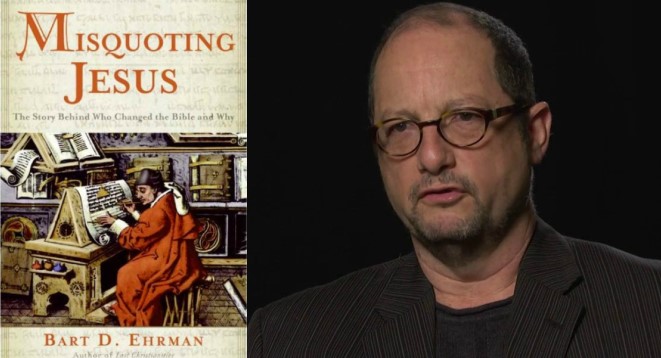
How often do we hear people “explaining” religious beliefs by stating “The Bible says so,” as if the Bible fell out of the sky, pre-translated to English by God Himself? It’s not that simple, according to an impressive and clearly-written book that should be required reading for anyone who claims to know “what the Bible says.”
Bart Ehrman’s Exploration: Who Changed the Bible and Why?
The 2005 bestseller, Misquoting Jesus, was not written by a raving atheist. Rather, it was written by a fellow who had a born-again experience in high school, then went on to attend the ultraconservative Moody Bible Institute in Chicago. Bart Ehrman didn’t stop there, however. He wanted to become an evangelical voice with credentials that would enable him to teach in secular settings. It was for this reason that he continued his education at Wheaton and, eventually, Princeton, picking up the ability to read the New Testament in its original Greek in the process.
As a result of his disciplined study, Ehrman increasingly questioned the fundamentalist approach that the “Bible is the inerrant Word of God. It contains no mistakes.” Through his studies, Ehrman determined that the Bible was not free of mistakes:
We have only error ridden copies, and the vast majority of these are centuries removed from the originals and different from them, evidently, in thousands of ways.
(Page 7). At Princeton, Ehrman learned that mistakes had been made in the copying of the New Testament over the centuries. Upon realizing this, “the floodgates opened.” In Mark 4, for example, Jesus allegedly stated that the mustard seed is “the smallest of all seeds on the earth.” Ehrman knew that this simply was not true. The more he studied the early manuscripts, the more he realized that the Bible was full of contradictions. For instance, Mark writes that Jesus was crucified the day after the Passover meal (Mark 14:12; 15:25) while John says Jesus died the day before the Passover meal (John 19:14).
Ehrman often heard that the words of the Bible were inspired. Obviously, the Bible was not originally written in English. Perhaps, suggests Ehrman, the full meaning and nuance of the New Testament could only be grasped when it was read in its original Greek (and the Old Testament could be fully appreciated only when studied in its original Hebrew) (page 6).
Because of these language barriers and the undeniable mistakes and contradictions, Ehrman realized that the Bible could not be the “fully inspired, inerrant Word of God.” Instead, it appeared to him to be a “very human book.” Human authors had originally written the text at different times and in different places to address different needs. Certainly, the Bible does not provide an an “errant guide as to how we should live. This is the shift in my own thinking that I ended up making, and to which I am now fully committed.”
How pervasive is the belief that the Bible is inerrant, that every word of the Bible is precise and true?
Occasionally I see a bumper sticker that reads: “God said it, I believe it, and that settles it.” My response is always, what if God didn’t say it? What if the book you take as giving you God’s words instead contains human words. What if the Bible doesn’t give a foolproof answer to the questions of the modern age-abortion, women’s rights, gay rights, religious and supremacy, western style democracy and the like? What if we have to figure out how to live and what to believe on our own, without setting up the Bible as a false idol–or an oracle that gives us a direct line of communication with the Almighty.
(Page 14). Ehrman continues to appreciate the Bible as an important collection of writings, but urges that it needs to be read and understood in the context of textual criticism, “a compelling and intriguing field of study of real importance not just to scholars but to everyone with an interest in the Bible.” Ehrman finds it striking that most readers of the Bible know almost nothing about textual criticism. He comments that this is not surprising, in that very few books have been written about textual criticism for a lay audience (namely, “those who know nothing about it, who don’t have the Greek and other languages necessary for the in-depth study of it who do not realize there is even any “problem” with the text).
Misquoting Jesus provides much background into how the Bible became the Bible. It happened through numerous human decisions over the centuries. For instance, the first time any Christian of record listed the 27 books of the New Testament as the books of the New Testament was 300 years after the books have been written (page 36). And those works have been radically altered over the years at the hands of the scribes “who were not only conserving scripture but also changing it.” Ehrman points out that most of the hundreds of thousands of textual changes found among the manuscripts were “completely insignificant, immaterial, of no real importance.” In short, they were innocent mistakes involving misspelling or inadvertence.
On the other hand, the very meaning of the text changed in some instances. Some Bible scholars have even concluded that it makes no sense to talk about the “original” text of the Bible. (Page 210). As a result of studying surviving Greek manuscripts of the New Testament, Ehrman concluded that we simply don’t have the original words constituting the New Testament.
Not only do we not have the originals, we don’t have the first copies of the originals. We don’t even have copies of the copies of the originals, or copies of the copies of the copies of the originals. What we have are copies made later-much later. In most instances, they are copies made many centuries later. And these copies all differ from one another, and many thousands of places . . . Possibly it is easiest to put it in comparative terms: there are more differences among our manuscripts and there are words in the New Testament.
In Misquoting Jesus Bart Ehrman spells out the ways in which several critical passages of the New Testament were changed or concocted. They are startling examples:
A.) Everyone knows the story about Jesus and the woman about to be stoned by the mob. This account is only found in John 7:53-8:12. The mob asked Jesus whether they should stone the woman (the punishment required by the Old Testament) or show her mercy. Jesus doesn’t fall for this trap. Jesus allegedly states “Let the one who is without sin among you be the first to cast a stone at her.”
The crowd dissipates out of shame. Ehrman states that this brilliant story was not originally in the Gospel of John or in any of the Gospels. “It was added by later scribes.” The story is not found in “our oldest and best manuscripts of the Gospel of John. Nor does its writing style comport with the rest of John. Most serious textual critics state that this story should not be considered part of the Bible (page 65).
B) after Jesus died, Mary Magdalene and two other women came back to the tomb to anoint the body of Jesus, according to Mark 16:1-2). They were met by a man in a white robe who told them that Jesus had been raised and was no longer there. The women fled and said nothing more to anyone out of fear (16:4-8). Everyone knows the rest of Mark’s Gospel, of course. The problem with the remainder of the story is that none of it was originally in the Gospel of Mark. It was added by a later scribe. Those additions include all of the following:
Jesus himself appeared to Mary Magdalene. She told the eleven apostles (minus Judas) about this vision, but they did not believe her. Jesus then appeared to the apostles, chastising them for failing to believe. He tells them that those who believe will be saved and those who don’t will be condemned. Then follows a critically important passage of the Bible.
And these are the signs that will accompany those who believe: they will cast out demons in my name; they will speak in new tongues; and they will take up snakes in their hands; and if they drink any poison, it will not harm them; they will place their hands upon the sick and heal them.
Jesus is then allegedly taken up into heaven and sits at the right hand of God, while the disciples go forth into the world to proclaim the Gospel in miraculous fashion.
Without the above passages (which, again, were not written by Mark) the Pentecostals lose their justification for speaking in “tongues.” And the Appalachian snake handlers have no basis for their dangerous practices.
C) John 5:7-8 is the only passage in the entire Bible “that explicitly delineates the doctrine of the Trinity (that there are three persons and God but that all three constitute a single God):
There are three that bear witness in heaven: the Father, the Word and the Spirit and these three are one; and there are three that bear witness on earth, the spirit, the water, and the blood, and these three are one.
Ehrman cites strong evidence that this Trinity passage was entirely concocted and foisted upon Erasmus by outraged theologians who needed support for their prized theological doctrine (page 81).
—
Ehrman reveals numerous other difficulties with the popular assumption that the Bible was perfectly handed down from its original written expression.
Many believers rely fervently on the King James version of the Bible, for instance. They sometimes even say “If the King James was good enough for St. Paul, it’s good enough for me.” Ehrman points out many problems with the King James version, warning that “we need to face up to the facts.”
The King James was not given by God but was a translation by a group of scholars in the early 17th century who based their rendition on a faulty Greek text.
(Page 209).
So what should we make of the Bible? Ehrman argues that the attacks of the New Testament are not simply collections of obvious, self-interpreting words. It’s the same problem we have with other important documents, such as the United States Constitution:
Texts do not simply reveal their own meanings to honest inquirers. Texts are interpreted and they are interpreted (just as they were written) by living, breathing human beings, who can make sense of texts only by explaining them in light of other other knowledge, explicating their meaning, putting the words of the text “in other words.”
(Page 217) The scribes changed the original words of the New Testament by putting them in other words.
In my experience, many people who cherry pick excerpts from the Bible as the proper way to determine what is moral are in utter denial that we don’t have accurate copies of the original writings. Most of them refuse to acknowledge that current popular versions of the Bible contain numerous discrepancies, even compared to the earliest manuscripts we do have. This is on top of the fact that their are hundreds of patent contradictions in the English version of the Bible. To most believers, none of this matters. Stay the course! In fact, in my experience most believers rarely read what the consider to be God’s own inspired word.
Ehrman’s book points out numerous troublesome issues that demand attention even assuming that the original writers of the Bible accurately reported the events described in their original writings (whatever those writings were). The elephant in the room, however, is that none of the authors of the Gospels ever claimed to witness any of the events they were reporting. Further, the extraodinary nature of Biblical claims demands extraordinary proof that ancient self-contradictory writings are simply incapable of providing, except to those of us who believe that the Bible is completely true “because it says so in the Bible.”
For all of those people who continue to go around clentching and thumping those Bibles they bought at Wal-Mart, and for all the rest of us who want to get the story straight, Ehrman’s Misquoting Jesus should be required reading.
[Administrator’s Note: More than 540 comments were quickly contributed to this post, making this page too long to download and display. Therefore, on March 23, 2007, I closed off new comments. Last night (February 4, 2009), I discovered a WordPress plugin that allows me to paginate comments, thereby protecting the site from the sudden and repeated load of 540 comments.
Here’s the good news, then. Anyone who has not yet had his or her say on Bart Ehrman’s book may now jump in at the original post and post a comment. That’s right! If none of the 540 comments that have come before you didn’t address an important aspect of Bart Ehrman’s book, you may now remedy that omission, right here in the comments to this original post. Godspeed. ]


well said ME, hip hip HOORAY!:
A few months ago, I attempted to answer the question you raised. Check out this post: http://dangerousintersection.org/?p=341 Hope this helps.
Gato, you were right. I looked at the definition, and I am indeed an Agnostic. Atheists are a bit too sure of themselves. I guess we agree on just about everything now. (I guess I'm probably a "strong" agnostic and you would be an "average" agnostic.) One day I may become smart enough to be an Atheist/Eminent Scientist, if I keep studying….
"Scientists and Religion in America"
"Whereas 90% of the general population has a distinct belief in a personal god and a life after death, only 40% of scientists on the B.S. level favor this belief in religion and merely 10 % of those who are considered 'eminent' scientists believe in a personal god or in an afterlife."
Contrary to the notion fostered by so-called 'creation-scientists', Albert Einstein did not believe in a personal god.
"Leading Scientists Still Reject God"
A recent survey of members of the National Academy of Sciences showed that 72% are outright atheists, 21% are agnostic and only 7% admit to belief in a personal God.
Personal belief 7.0 %
Personal disbelief 72.2
Doubt or agnosticism 20.8
Belief in human immortality
Personal belief 7.9 %
Personal disbelief 76.7
Doubt or agnosticism 23.3
…..Scientific American, September 1999
Wow Erich, I didn't realize what this site was…do you think I am too vocal (abusive) to become one of your "disciples"? I am the guy who has been posting much of the inflammatory Atheist stuff (Scholar…teacher, etc). I also, was impressed by GrumpyPilgrim, and will be reading more about the history of this site. Some of the stuff I have posted was in an attempt to incite arguements from both sides and may not have been entirely truthful. But this is probably because I, even in my vast, vast, vast, knowledge (vast), am still searching for some answers about nature. Anyway, thanks for providing this superb, free forum.
GrumpyScholar (i hope HE doesn't mind)
To grumpypilgrim:
I will be the first to admit that the "church" contains people that have their own agendas, and seek to control others in different ways. I don't believe that was what the church was intended for though. I don't believe that was why Jesus was on this earth. To paraphrase the Bible, "In Christ there is neither Jew nor Gentile, slave nor free" What message would you derive from such a statement if you weren't aware of it being from the Bible?
I believe that the division in this world comes from our own human thinking. I think that is what Jesus was trying to point out to the Pharisees and to all of us. Power and position can be used against others, and when used as such what they really do is serve to isolate ourselves. God was trying to show the world that He can exalt even the "ragtagiest" peoples and make them a great nation when He created Israel (originally). When they forgot that He was the one that made them a great nation He humbled them, not because He enjoyed taking them down, but because they needed to be reminded that He was the one that made them in the first place. I believe that He did that when He came to die for our sins. To provide a clear message that we humans do not have the power over life and death, but only God has that power. And we should not try and exert that power over anyone.
I believe that some choose to pick fights and then once the fight is begun, they try and make it look like the defenders are the offenders. I believe that is the case with all conflicts, Israelis and Palestinis, and with pro-life and pro-abortion, and with marriage and gay-marriage. Once the fight begins it becomes difficult to know who started it, and more importantly how to stop it. In raising this point I am not trying to point out who is right and who is wrong. I will admit that much of the strength of the gay movement comes from the fact that they were oppressed and stigmatized for so long, even by the people in the church, that their arguments seem so convincing. I deeply believe that we are not equipped to be judges, especially when we purport to have a relationship with Him. Love 'em all and let God sort 'em out. More easily said than done.
Scholar,
You fluster me because we are on the same side and yet you misunderstand me.
I have been a fan of hard science since we landed on the moon. I know that's ancient history to you but I was THERE man! I was eight years old, glued to the TV and it blew me away. Apollo, Skylab, the Space Shuttle, Challenger, Voyager, Hubble, the International Space Station, Mars…I've been on board the whole trip.
As for evolution…Darwin to Gould, I'm with ya every step of the way. It's all good and it has always excited the hell out of me. So please don't try and educate me. I've read all the texts and I'm not saying they aren't true.
I remember being 17 and I remember what it was like to be exploring, finding new things, putting old ideas behind me. It is an exciting time and it will define who you will become as an adult. But you are being just as naive as the fundies when you put all of your certainty in numbers and facts about something as uncertain as the concept of god.
Try not to see eveything in terms of black and white. I know that is exactly what a 17 year old would do, so I can forgive you your youth. What I find hard to forgive is adults who still think that way, putting all their faith in science or the bible. There's a lot of gray out there!
I don't believe god exists but I am willing to acknowledge that I am too small to know anything for sure. That is maturity to me.
Erich or Grumpy,
May I please have some more links to the discussions here at dangerous intersections which you have found to be most interesting, *must read*, or highlights in general.
Thanks,
Scholar
Here is a great link to in-depth discussions of ID versus science. http://www.evolutionblog.blogspot.com/
Gato,
I still respect you, even if you think I am childish etc. I am in fact, 31 years old, but my intellectual age is about that of Noah (ya the ark guy). Did you know that Grumpy is actually a blog writer for this site and others? Pretty cool stuff, and I thought he was just some guy chiming in his 2 cents. I have a feeling that you would be hesistant to put down the idea of "God" even if science were to disprove it. I am ALWAYS willing to change my beliefs, they are only as strong as science and reason. That is the main difference between us, I am willing to change my point of view, but you stated that you are (religiously?) firm in yours. Gato writes…
"…Agnositcs feel that you can never be sure (at least this one does)… "
"…even if I were to be 100% convinced of the existence of god tomorrow, I still wouldn’t embrace… "
Maybe I have quoted you out of context, but you still formed the thoughts and typed the words, so I think it bears noting your inflexibility toward reason. (this is where I would call you an old-maid, but I'm trying to be more respectful 😛 )
U know hu
PS. I just checked out http://www.whydoesgodhateamputees.com IT ROCKS!!!
Scholar,
Check out this one
http://dangerousintersection.org/?p=342#comment-8…
Russel neatly encapsulates so much of what you and I have been talking about.
Gato you are becoming quite popular, I guess it is your open-ness and keen attention to detail. I did not realize you were one of the astronauts who walked on the moon, congratulations! (I have been making an effort to read your posts more carefully…did it hurt when the tv exploded and the glue peeled off your skin?).
I guess I just think there is a lot less "gray" out there than you do. Even though you already know all this "science stuff", let me oblige the rest of the readers with a bit more information to digest.
Common Misconception: "There’s no evidence for the Big Bang"
I have no idea where people get the idea that scientists make things up without having good evidence behind it (oh wait… we’re out to disprove God because all scientists hate God or some crap like that).
The Big Bang theory does have a good amount of evidence behind it.
Cosmological Redshift — we can use spectroscopy to determine the rate at which galaxies are moving away from us. Additionally, since it takes light time to travel, the further away we look, the further back in time we are looking.
What we find, is that all galaxies in the universe are moving away from us. The further they are, the faster they’re moving away. So if we play the whole thing in reverse, all the galaxies will come back together at a single point in time. This point in time is what we call the Big Bang.
Distribution of Elements–With the conceptual framework intact thanks to the first point, it was also possible to calculate how much of each element should be formed in the initial event. It should be obvious that, given a bunch of protons, electrons, and neutrons, hydrogen should be the easiest to form. Indeed, stick a proton and an electron in a room together and they’ll automatically hook up due to their magnetic attractions.
Additionally, with such high energies, it would be possible to fuse some of this hydrogen into helium and even a little bit of heavier elements. Since astronomers had a good handle on the energies, it was possible to calculate how much of each there should be. If that number didn’t match up with observations, the Big Bang theory would be shot.
Fortunately, the predictions do match up pretty closely. In the universe today, we observe 75% hydrogen, 24% helium, and 1% everything else (as opposed to 80% hydrogen 20% helium originally). This discrepancy is easily accounted for by nearly 14 billion years of stars cooking hydrogen into helium and other heavier elements.
–Andy Dufresne
The message of this post is both quite profound and quite baffling. It is this: Everything that we associate with religion is imaginary. God, the Bible, Jesus, the resurrection, prayer, the Ten Commandments, the creation story, your soul, everlasting life, heaven… every bit of it is the product of human imagination. The same goes for Allah, the Koran and so on. As a species we have believed all of this religious dogma for centuries, and many people believe it today to some degree. And yet, it is all fiction. It is just as fictional as were the gods of the Egyptians, the Romans and the Aztecs. The clear, unambiguous evidence is all around us.
If it is so obvious that God is imaginary, then why might half of the American population profess belief in God? We have asked this question throughout the book because the whole situation is profoundly strange. Why would we, as a species, create all of this mythology and nonsense over and over again through the millennia? We must do it for a reason.
If we can understand the reasons and deal with them rationally rather than through the silliness and mythology that is religion, we actually can do ourselves a great deal of good.
There are two important reasons why humans fabricate all of our religions:
1. People invent God as a way to cope with death. Many humans are terrified by death for some reason. They invent religion as a way to deal with their terror.
2. People invent God as a proxy for goodness. People want a way to promote "goodness" and eliminate "evil" in their societies. In the past, inventing an imaginary God has been perceived to be one way to facilitate that process.
courtesy of http://www.whydoesgodhateamputess.com
If you had been raised in Nazi Germany…would you have been a follower of Hitler? The sad answer is yes (for most of us). The evidence is in the atrocities at Auschwitz. If you had been raised in a Christian home, would you entertain the same belief that Gato has…that "nothing is certain" even in the face of insurmountable evidence to the contrary?. This is a potenially harmful way of thinking. I can see from the posts that just about everyone is starting to put 2 cents and 2 cents together…even Gato.
The quotes below are from 'Flying Spaghetti Monster is Buddha':
"Atheism claims that the physical universe is all that exists, period."
Actually, atheism does not claim that the physical universe is all that exists; it merely denies the existence of supernatural deities.
"Atheism rejects every finding of cosmological, design, and moral arguments."
Nonsense. Atheism rejects only those notions of cosmology, design and morality that are premised on the existence of supernatural deities.
"But atheism does not provide adequate alternate explanations for how the universe came into existence, for the appearance of design in the universe, and for the existence of morality."
First, information about how the universe came into existence is unknowable; therefore, atheism's failure to provide such information is irrelevant.
Second, the "appearance of design" is trivial to explain: humans are pattern-seeking animals. We see patterns among the stars at night (constellations), patterns among the clouds on a summer day, patterns among random cracks on a wall…the list goes on. The "appearance of design" happens not because there *is* design, but because we humans are exceedingly prolific at *imagining* designs from random evidence.
Finally, morality is also easy to explain: any complex society needs rules to govern the conduct of its members: nations have constitutions, corporations have bylaws, shoppers have queues, sports have rules, etc. "Morality" is merely a label that has been attached to one category of such rules.
"The ideas for actual infinites in the real world, macroevolution, and relativism attempt to provide these explanations but are all deeply flawed."
That is a conclusory statement that is conspicuously lacking evidence.
It is so funny how atheists speak as if everything that they are stating is fact.
Stick with the scientific facts guys. When you say that humans fabricate "all" of our religions you are making foolish statements because you say it as though it has 100% certainty attached. It's an oppinion, or an educated conclusion at best but often times these are wrong.
It is really quite simple. Atheists believe that something came from nothing and creationists don't. That is the bottom line. That's it. Done.
There is a bunch of nerds in this forum. NERDS NERDS NERDS.
Let's play X-box!
Grumpy,
The flying spaghetti monster posts were just jabs as the folks who originally wrote them. All I did was replace the word "God" in every instance with "flying spaghetti monster". Notice how the posts do not really change in terms of their meaning, thus the terms "God" and "Spaghetti Monster" are interchangeable. I have not yet read your complete analysis, but look forward to seeing you dissect the ORIGINAL poster's religious drivel.
Thanks again for keeping it real. 🙂
–Andrew Dufresne
Thanks, I guess. I actually was asking Erich and Grumpy for links, but you responded first. Ironically, the link was to one of my own posts…Scholar posting as "swarthy sammy" (i hope that name made everyone chuckle). Funny how we are able to read the same scholarly article and interpret it so differently. My interpretation as an arguement against GOD, and yours as evidence that we still don't know for sure. Nonetheless, amazing/confusing that you provided one of my posts to respond to my call for links. I guess this is what I get for using psuedonyms.
Andrew Dufresne
Scholar wrote: "I did not realize you were one of the astronauts who walked on the moon, congratulations!"
Very funny. From now on I'm going to call you Professor Literal. You need to take a poetry course to balance all of the hard science!
"The answers to your prayers (questions) Gato" wrote: "Everything that we associate with religion is imaginary."
I agree with that. If there isn't a god the human race still would have had to invent one in order to calm our fears of death, as you've said.
"…why might half of the American population profess belief in God?"
Because it's much harder to accept that there might not be one. Too hard, in fact, for most people because it makes them feel unimportant and insignificant. I, on the other hand, am pretty much sure that I'm unimportant and insignificant and don't really care. I'm okay with that.
"…would you entertain the same belief that Gato has…that “nothing is certain” even in the face of insurmountable evidence to the contrary?. This is a potenially harmful way of thinking."
You are right to call me on that point. I have been sloppy with my choice of words at times. Uncertainty, taken to its extreme can lead to indecision. I am not advocating indecision. As with all things in life, agnosticism is a balancing act. One must balance one's skepticism with resolve. In other words, question everything. Realize that it is almost impossible to know anything for certain but don't let that paralyze you when presented with good evidence.
To "we are friends Gato, I think";
We ARE friends. There's no reason why all of us can't be freinds on this blog and still have our differences.
You are also right to call me on my sometimes inaccurate languge. Thanks for keeping me on my toes. Let me clarify my statements a little if I can. Beleive it or not my ideas about all of this are evolving as we discuss it. Changing? A bit, yes. More like crystalizing thoughts that were running around loose in my brain.
"I have a feeling that you would be hesistant to put down the idea of “God” even if science were to disprove it."
Not at all. I already don't have much believe in god and I often propose just that scenario to very religious people to see what their reaction is. I did it much earlier in this blog and got no good responses.
"I am willing to change my point of view, but you stated that you are (religiously?) firm in yours."
I'm sorry I gave that impression. I thought I had mentioned many times in these posts of my flexibility of thought. If I didn't, I should have. I'm open for just about anything rational. If you want me to be open to the possibility that science can prove there is no god, I'm sorry, there I am adamant that it can't be done. That's not rational and shouldn't even be attempted! It's a waste of time.
Then you quote me, “…Agnositcs feel that you can never be sure (at least this one does)… ”
How does this show inflexibility to reason? It shows quite the opposite I would think. By acknowledging that it is impossible to truly KNOW anything, I am implying (or so I thought) that one's mind can never be closed. But maybe I shouldn't use absolute words like "never" or "always". That does sound inflexible, doesn't it? Well, just chalk it up to language being an imperfect method of communication and I'll try to be less sloppy.
Again you quote me to me, “…even if I were to be 100% convinced of the existence of god tomorrow, I still wouldn’t embrace… ”
Wouldn't embrace what?? Finish the quote."Wouldn't embrace the bible." That's what I said. Agosticsm is fine, but as I said above, I don't let it paralyze me. I have heard enough from historians and scholars and seen enough of human nature to FEEL VERY STRONGLY (not KNOW) that the bible is a pastiche of fabrications. It doesn't hold up to simple common sense. If subscribing to that idea makes me inflexible, then so be it. I am inflexible with regard to that subject. I never said I was the perfect agnostic!
David Michaels wrote: "To my knowledge, the EARLIEST gospel was written between 40 and 60 AD, at least 10 years (plus or minus) after Jesus’s death and resurrection."
Erich added: "…according to the article on this topic in Wikipedia, the earliest Gospel (Mark) was not written until at least 68 AD. This would be a full generation after the purported crucifixion of Jesus…."
So, here's my question: if Jesus actually performed all the miracles the Bible says he did, then why did it take *decades* for anyone to write about them? Wouldn't someone *rising from the dead* make news a bit sooner? Wouldn't someone who could walk on water, cure the blind, feed the multitudes, etc., make news *that day*? Wouldn't witnesses who had seen these miracles drop everything they were doing to tell their stories? If Ronald Reagan, JFK, or any other dead person were to suddenly appear before me, I'm pretty sure I would realize it was *the biggest news event in human history*, and would find some witnesses and then tell the story.
Of course, the answer to some of these questions is that most people in Jesus' time were illiterate, so they couldn't have written about anything. Still, it seems odd that despite all the miracles that Jesus allegedly performed, not one literate person saw a miracle and wrote about it. You'd think that an omniscient God would have planned things better.
Laughing wrote: "When you say that humans fabricate “all” of our religions you are making foolish statements because you say it as though it has 100% certainty attached. It’s an oppinion, or an educated conclusion at best but often times these are wrong."
As I have discussed elsewhere (http://dangerousintersection.org/?p=195), there are more than 10,000 distinct religions on our planet, which means that although the certainty might not be 100%, it is greater than 99.99%. If we add the many religions that have already gone extinct, the percentage would be even closer to 100%. If we now consider that *not one* of the world's religions has even the smallest shred of objective evidence to support its claims, we see that there is no rational basis upon which to prefer any religion over another. Therefore, even if one of the world's religions were valid, there is no objective evidence to distinguish it from the 99.99+% that are invalid, which raises the question: if the one valid religion is indistinguishable from the tens of thousands of invalid ones, then in what way is the one valid religion valid?
With the above thoughts in mind, I do not agree that it is a "foolish statement" to assert that "humans fabricate “all” of our religions." Certainly the available evidence indicates that we do.
Andrew,
Yes it is confusing when you post under different names. We're trying to have a conversation here! I like to know who I'm talking to
Actually, the link I sent was intended for the Russel quotes above, not the post below although it is funny that the post was written by you! I should have known…percentages, statistics and more percentages. Your trademark!
"Didnt mean to confuse ya grumps" pointed out that his comment was a parody of an earlier comment. Indeed so. Accordingly, please consider my reply — which was independent of the parody (i.e., was about atheism, design, evolution, etc.) — to be directed to the earlier comment.
Well, it looks like things are coming to a close here. You make good arguements, and I have begun to get tired of defending/attacking. Maybe I need to find less formidable opponents 🙂
Gato, we hold similar beliefs, however I am not so sure as you are that we can't be sure about anything. Profound.
Maybe after the holidays I will check back, but for now I'm gonna put my tail between my legs and go ignite some other blogs. Thanks for the good times, even you crazy bible thumpers, who serve as examples of the human condition.
–The science guy
You said:
"You’d think that an omniscient God would have planned things better. "
Dude, you are thinking on things as if you were God and what you would do. You're not God, thus, your argument smells of bloody sloppy earth worms. You are not God and in fact are nothing more than an insignificant creature as we all are. If you were intelligent, you would know that you know nothing….. But I think you actually think you have it figured out. WOW, this is amazing to me.
You also yelled at the flying spaghetti monster by accident because you are so quick to attack. because of your attitude, you lose all credibility with me. Your words are like dog vomit.
Grumpy's logic:
"With the above thoughts in mind, I do not agree that it is a “foolish statement” to assert that “humans fabricate “all” of our religions.” Certainly the available evidence indicates that we do."
You're right it's not foolish, it's down right ignorant. if you know that there are 10,000 religions and you are still making this staement, then you are ignorant because I bet you couldn't even name 100 religions with detail to their back ground. You are a little (very little) pon in the game of life.
'To Grumpy' writes to me: "You are not God and in fact are nothing more than an insignificant creature as we all are. "
I agree. I am not a god and I am just as insignificant as everyone else. However, the god-of-the-Bible made a mistake that I would not have made; therefore, the god-of-the-Bible must be dumber than me. Thus, if my argument smells of bloody sloppy earth worms, the god-of-the-Bible must be making arguments that smell of stale, bloody, sloppy earth worms.
'Grumpy's logic sucks' is trying to use an ad hominem attack to avoid addressing the merits of my argument. Sorry, GLS, but your effort is not going to work. Whether or not I can name 100 religions (or 10 or 1000) is irrelevant to the fact that there are many thousands of religions and, because of this surfeit, the odds are vanishingly small that any of us will ever find the right one. Indeed, for every person who believes a particular religion, there are billions of other people who reject that religion. Not very good odds.
I disagree with Grumpy on one point. I do not think GrumpyPilgrim is insignificant. GrumpyPilgrim displays traits of a "wise man" or "village elder" in his generosity to share what he has learned and should be admired and respected (if only for that). He is not attacking anyone by stating facts. The facts do, however, contradict what many folks have learned to be otherwise in their lives. Rather than be offended by the contradictions, utilize this knowledge you have stumbled upon. Trust me, its not gonna shatter your life to finally let go of what you have probably had doubts about all along…the existence of a higher power. And if you are not ready, or don't believe that god is fake, that's okay too, but just try and "lighten" up a bit to modern science's opinions. In closing, ALWAYS carry with you the possibility that NOBODY is watching over us (except maybe the IRS).
–your friendly neighborhood village elder