
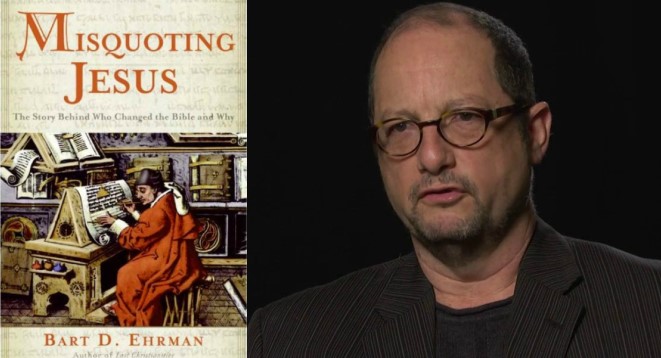
How often do we hear people “explaining” religious beliefs by stating “The Bible says so,” as if the Bible fell out of the sky, pre-translated to English by God Himself? It’s not that simple, according to an impressive and clearly-written book that should be required reading for anyone who claims to know “what the Bible says.”
Bart Ehrman’s Exploration: Who Changed the Bible and Why?
The 2005 bestseller, Misquoting Jesus, was not written by a raving atheist. Rather, it was written by a fellow who had a born-again experience in high school, then went on to attend the ultraconservative Moody Bible Institute in Chicago. Bart Ehrman didn’t stop there, however. He wanted to become an evangelical voice with credentials that would enable him to teach in secular settings. It was for this reason that he continued his education at Wheaton and, eventually, Princeton, picking up the ability to read the New Testament in its original Greek in the process.
As a result of his disciplined study, Ehrman increasingly questioned the fundamentalist approach that the “Bible is the inerrant Word of God. It contains no mistakes.” Through his studies, Ehrman determined that the Bible was not free of mistakes:
We have only error ridden copies, and the vast majority of these are centuries removed from the originals and different from them, evidently, in thousands of ways.
(Page 7). At Princeton, Ehrman learned that mistakes had been made in the copying of the New Testament over the centuries. Upon realizing this, “the floodgates opened.” In Mark 4, for example, Jesus allegedly stated that the mustard seed is “the smallest of all seeds on the earth.” Ehrman knew that this simply was not true. The more he studied the early manuscripts, the more he realized that the Bible was full of contradictions. For instance, Mark writes that Jesus was crucified the day after the Passover meal (Mark 14:12; 15:25) while John says Jesus died the day before the Passover meal (John 19:14).
Ehrman often heard that the words of the Bible were inspired. Obviously, the Bible was not originally written in English. Perhaps, suggests Ehrman, the full meaning and nuance of the New Testament could only be grasped when it was read in its original Greek (and the Old Testament could be fully appreciated only when studied in its original Hebrew) (page 6).
Because of these language barriers and the undeniable mistakes and contradictions, Ehrman realized that the Bible could not be the “fully inspired, inerrant Word of God.” Instead, it appeared to him to be a “very human book.” Human authors had originally written the text at different times and in different places to address different needs. Certainly, the Bible does not provide an an “errant guide as to how we should live. This is the shift in my own thinking that I ended up making, and to which I am now fully committed.”
How pervasive is the belief that the Bible is inerrant, that every word of the Bible is precise and true?
Occasionally I see a bumper sticker that reads: “God said it, I believe it, and that settles it.” My response is always, what if God didn’t say it? What if the book you take as giving you God’s words instead contains human words. What if the Bible doesn’t give a foolproof answer to the questions of the modern age-abortion, women’s rights, gay rights, religious and supremacy, western style democracy and the like? What if we have to figure out how to live and what to believe on our own, without setting up the Bible as a false idol–or an oracle that gives us a direct line of communication with the Almighty.
(Page 14). Ehrman continues to appreciate the Bible as an important collection of writings, but urges that it needs to be read and understood in the context of textual criticism, “a compelling and intriguing field of study of real importance not just to scholars but to everyone with an interest in the Bible.” Ehrman finds it striking that most readers of the Bible know almost nothing about textual criticism. He comments that this is not surprising, in that very few books have been written about textual criticism for a lay audience (namely, “those who know nothing about it, who don’t have the Greek and other languages necessary for the in-depth study of it who do not realize there is even any “problem” with the text).
Misquoting Jesus provides much background into how the Bible became the Bible. It happened through numerous human decisions over the centuries. For instance, the first time any Christian of record listed the 27 books of the New Testament as the books of the New Testament was 300 years after the books have been written (page 36). And those works have been radically altered over the years at the hands of the scribes “who were not only conserving scripture but also changing it.” Ehrman points out that most of the hundreds of thousands of textual changes found among the manuscripts were “completely insignificant, immaterial, of no real importance.” In short, they were innocent mistakes involving misspelling or inadvertence.
On the other hand, the very meaning of the text changed in some instances. Some Bible scholars have even concluded that it makes no sense to talk about the “original” text of the Bible. (Page 210). As a result of studying surviving Greek manuscripts of the New Testament, Ehrman concluded that we simply don’t have the original words constituting the New Testament.
Not only do we not have the originals, we don’t have the first copies of the originals. We don’t even have copies of the copies of the originals, or copies of the copies of the copies of the originals. What we have are copies made later-much later. In most instances, they are copies made many centuries later. And these copies all differ from one another, and many thousands of places . . . Possibly it is easiest to put it in comparative terms: there are more differences among our manuscripts and there are words in the New Testament.
In Misquoting Jesus Bart Ehrman spells out the ways in which several critical passages of the New Testament were changed or concocted. They are startling examples:
A.) Everyone knows the story about Jesus and the woman about to be stoned by the mob. This account is only found in John 7:53-8:12. The mob asked Jesus whether they should stone the woman (the punishment required by the Old Testament) or show her mercy. Jesus doesn’t fall for this trap. Jesus allegedly states “Let the one who is without sin among you be the first to cast a stone at her.”
The crowd dissipates out of shame. Ehrman states that this brilliant story was not originally in the Gospel of John or in any of the Gospels. “It was added by later scribes.” The story is not found in “our oldest and best manuscripts of the Gospel of John. Nor does its writing style comport with the rest of John. Most serious textual critics state that this story should not be considered part of the Bible (page 65).
B) after Jesus died, Mary Magdalene and two other women came back to the tomb to anoint the body of Jesus, according to Mark 16:1-2). They were met by a man in a white robe who told them that Jesus had been raised and was no longer there. The women fled and said nothing more to anyone out of fear (16:4-8). Everyone knows the rest of Mark’s Gospel, of course. The problem with the remainder of the story is that none of it was originally in the Gospel of Mark. It was added by a later scribe. Those additions include all of the following:
Jesus himself appeared to Mary Magdalene. She told the eleven apostles (minus Judas) about this vision, but they did not believe her. Jesus then appeared to the apostles, chastising them for failing to believe. He tells them that those who believe will be saved and those who don’t will be condemned. Then follows a critically important passage of the Bible.
And these are the signs that will accompany those who believe: they will cast out demons in my name; they will speak in new tongues; and they will take up snakes in their hands; and if they drink any poison, it will not harm them; they will place their hands upon the sick and heal them.
Jesus is then allegedly taken up into heaven and sits at the right hand of God, while the disciples go forth into the world to proclaim the Gospel in miraculous fashion.
Without the above passages (which, again, were not written by Mark) the Pentecostals lose their justification for speaking in “tongues.” And the Appalachian snake handlers have no basis for their dangerous practices.
C) John 5:7-8 is the only passage in the entire Bible “that explicitly delineates the doctrine of the Trinity (that there are three persons and God but that all three constitute a single God):
There are three that bear witness in heaven: the Father, the Word and the Spirit and these three are one; and there are three that bear witness on earth, the spirit, the water, and the blood, and these three are one.
Ehrman cites strong evidence that this Trinity passage was entirely concocted and foisted upon Erasmus by outraged theologians who needed support for their prized theological doctrine (page 81).
—
Ehrman reveals numerous other difficulties with the popular assumption that the Bible was perfectly handed down from its original written expression.
Many believers rely fervently on the King James version of the Bible, for instance. They sometimes even say “If the King James was good enough for St. Paul, it’s good enough for me.” Ehrman points out many problems with the King James version, warning that “we need to face up to the facts.”
The King James was not given by God but was a translation by a group of scholars in the early 17th century who based their rendition on a faulty Greek text.
(Page 209).
So what should we make of the Bible? Ehrman argues that the attacks of the New Testament are not simply collections of obvious, self-interpreting words. It’s the same problem we have with other important documents, such as the United States Constitution:
Texts do not simply reveal their own meanings to honest inquirers. Texts are interpreted and they are interpreted (just as they were written) by living, breathing human beings, who can make sense of texts only by explaining them in light of other other knowledge, explicating their meaning, putting the words of the text “in other words.”
(Page 217) The scribes changed the original words of the New Testament by putting them in other words.
In my experience, many people who cherry pick excerpts from the Bible as the proper way to determine what is moral are in utter denial that we don’t have accurate copies of the original writings. Most of them refuse to acknowledge that current popular versions of the Bible contain numerous discrepancies, even compared to the earliest manuscripts we do have. This is on top of the fact that their are hundreds of patent contradictions in the English version of the Bible. To most believers, none of this matters. Stay the course! In fact, in my experience most believers rarely read what the consider to be God’s own inspired word.
Ehrman’s book points out numerous troublesome issues that demand attention even assuming that the original writers of the Bible accurately reported the events described in their original writings (whatever those writings were). The elephant in the room, however, is that none of the authors of the Gospels ever claimed to witness any of the events they were reporting. Further, the extraodinary nature of Biblical claims demands extraordinary proof that ancient self-contradictory writings are simply incapable of providing, except to those of us who believe that the Bible is completely true “because it says so in the Bible.”
For all of those people who continue to go around clentching and thumping those Bibles they bought at Wal-Mart, and for all the rest of us who want to get the story straight, Ehrman’s Misquoting Jesus should be required reading.
[Administrator’s Note: More than 540 comments were quickly contributed to this post, making this page too long to download and display. Therefore, on March 23, 2007, I closed off new comments. Last night (February 4, 2009), I discovered a WordPress plugin that allows me to paginate comments, thereby protecting the site from the sudden and repeated load of 540 comments.
Here’s the good news, then. Anyone who has not yet had his or her say on Bart Ehrman’s book may now jump in at the original post and post a comment. That’s right! If none of the 540 comments that have come before you didn’t address an important aspect of Bart Ehrman’s book, you may now remedy that omission, right here in the comments to this original post. Godspeed. ]


Thanks again for including the percentages. If you were curious, I am about 99 percent against believing in God. But it has changed over my lifetime.
Scholar
Scholar,
Sorry, but agnostics are not atheists. The difference is atheists are SURE. That's a big difference. Agnositcs feel that you can never be sure (at least this one does) and I live and think within that framework. It applies to everything I do. It is who I am.
I appreciate your desire to know exactly where I stand on this matter but as I have been attempting to tell the science-heads out there, it is not a quantifiable thing. Percentages? It varys from day to day…hour to hour.
Right now I am 90% sure that there is no god. No, wait…my nephew just said his first word today! I am filled with the wonder of the complexity of the human brain. My certainty goes down to about 75%. Hold on a sec…just a read another story about suffering in the aftermath of Katrina. Up to 95% sure there is no god. Now I've re-read some of the posts on this blog. I'm 99% sure! (Kidding about that last one!)
And so it goes. That's how I live my life. I'm sorry if it seems wishy-washy to those who feel that they have figured it out, but I haven't and I'm proud to admit it. This is a constantly evolving, fascinating trip and I WILL figure it out. The moment I pass to the other side…or dissolve into nothing.
The complexity of the human brain is evidence that God does not exist. It shows that the brain is capable (and culpable) of creating the idea of Gods. I used to waver quite a bit as to whether I believed, but now I am sure there isn't. So much so that I consider myself Agnostic. That means I am 99.1 percent sure that Gods don't exist. Atheists are more like 99.2 percent against Gods.
What it clear though, behind all the numbers, is that religion can be very dangerous. It is terribly important that people here acknowledge the harm which the Church can cause. The key is knowing that Gods are fake and are a tool used by the power-hungry who wish to feed on the weak minds of people like Gato. Please folks, it is important to take a stand and not let the religious folks have their way, it is time to speak up for science.
Man invented god,
Your reading comprehension skills leave much to be desired.
I am a Christian. I only read one paragraph. Too many words make my brain hurt. But I disagree with it all… whatever it says.
Sorry, but Agnostics ARE Atheists. They are just sitting on the fence, because if they believed in God, they wouldn't dare question HIM. You can't keep hiding in the closet Gato, the evidence is out.
To all who still visit this site:
It is no wonder that you must be like a child to receive the Word of God. Once you get all "mature" you stop looking beyond what you can see, and only focus on what you can see. A child's favorite game is to show it's parent the limitations of knowledge, by simply and continually asking the question "Why?" and then giggling with glee when the parent can't answer because they have reached the limitation of their knowledge. At some point though, some souls become calcified, petrified, and try and put down the child for being childish. Out of their own selfishness they seek to make themselves bigger by belittling the childish perspective. They are really only belittling themselves.
No amount of words can cover the wonder of Creation. No amount of meticulous data gathering and rearranging can explain Love. No amount of doubt can negate the existence of God. Some might call it being childishly stubborn. I enjoy being a child in the eyes of God. Sure beats being grumpy. I hope God brings back the wonder to all your eyes. Since most of you claim that you have not reached that 100% mark yet, there is still hope.
You state:
"However, if we are going to give examples of non-science masquerading as fact, let’s include a few of the church’s many “facts”: the earth is the center of the Universe, the earth is a perfect sphere, the sun and planets revolve around the earth, the sun and planets revolve in perfectly circular orbits, the sun is unblemished, the stars are fixed in the heavens, diseases are caused by evil spirits, diseases are caused by witches…."
That is simply a lie. Why dont you back it up with Bible verses? Because you are making it up.
Hey mnowlan! Well put! Good to see you back. I have much respect for you and welcome an intelligent voice back into the discussion.
Wait a sec…let me get my jaw off the floor! I believe your last post is in praise of a childlike (not child-ISH) questioning attitude toward life and death! Is that correct? Great, because I'm all for that, as you know. I agree with you, it's all about "wonder".
But here's the thing…even if I were to be 100% convinced of the existence of god tomorrow, I still wouldn't embrace the bible. That's not god, nor is it her Word, in my opinion.
By all means, live a Christ-like life and pray there is a heaven and someone who is listening, but do it because it feels RIGHT to you, not because that book tells you so. Do you really need a book to tell you what you KNOW in your heart?
Dude, I totally agree with you 100% in regards to the way man uses gods and religion to control and pervert the minds of the weak, BUT
Just because man is an idiot, doesn't mean that God doesn't exist.
Complexity of the human brain is indeed a great thing!
Atheism claims that the physical universe is all that exists, period. Atheism rejects every finding of cosmological, design, and moral arguments. But atheism does not provide adequate alternate explanations for how the universe came into existence, for the appearance of design in the universe, and for the existence of morality. The ideas for actual infinites in the real world, macroevolution, and relativism attempt to provide these explanations but are all deeply flawed. The only religion proper to adhere to a form of atheism is Buddism. Buddism regards the existence of God as ultimately irrelevant. God is not neccessary in the Buddist system, and if God did exist nothing about Buddism would change. It is a religion without a God.
Although the force of the arguments for the existence of God is powerful, many important, brilliant, even admirable people from all walks of life have rejected them. Author Isaac Asimov seems unfazed by such arguments.
The notion of an eternal universe introduces a great many difficulties, some of them apparently (at least in the present state of our scientific knowledge) isuperable, but scientists are not disturbed by difficulties—those who make up the game. If all the difficulties were gone and all the questions answered, the game of science would be over.
A facinating feature of claiming that there is no God is that its logical conclusion is self-refuting. To make the claim that God exists is simply to say that God is among the things that exist. But to say that God does not exist is to say that out of all of the things that do exist, God is not among them. but who can honestly make such a claim? To make that claim a person must have complete and exhaustive knowledge of everything that does exist. And the only person that could honestly make that claim is God—the very person the atheist is trying to deny.
To be fair though, it must be said that many atheists avoid this flaw by claiming that we cannot know anything about God. Sometimes known as "strong agnosticism," this form of atheism has its own troubles. Where does a "strong agnostic" get his claims about God's unknowability? As with atheism, a person would have to know everything to know with certainty that something is unknowable. Thus, only God could know if God were unknowable.
That was an excellent point you just made! I am definitly guilty of that. if you look at some of the most brilliant people that have existed you will find a child in them. For example: Einstein had the thought for relativity at age 7 and then spent the rest of his life bringing the theory to life. Only because he remained a child at heart. Most adults are maxed out, life to them is "as good as it gets".
All we can do is pray. God asked us to plant the seed, not to water it. I have found that when i try to water the seed it only turns people away further from the truth (because I am not capable of changing people). I now turn to prayer because only God can teach an old dog new tricks.
Take care Mnowlan!
Michael
For me, rational discussion ends when someone says "but the bible says" or "but jesus said". End of story. At that point you know you are dealing with a child who believes fairy tales. I'm just so amazed that so many people can be so friggin oblivious. Then again, these are the same people who still think invading Iraq was a good idea…so I guess it fits: at least they are consistent in their magical thinking.
Jesus, Santa Clause, the Easter Bunny, witches, ghosts, compasionate conservatives….
they are all mythological fantasy.
Like this BS:
"No amount of words can cover the wonder of Creation. No amount of meticulous data gathering and rearranging can explain Love. No amount of doubt can negate the existence of God."
let me rewrite that in reality-speak:
"Creation baffles me… God must have done it. Love baffles me, and I have no concept of the nueroscience and evolutionary biology that DOES explain it, therefore my conception of God is real. Since I start with the premise that God exists, he can't NOT exist."
One non-sequitor after another. Logical fallacy on top of logical fallacy.
Where does a “strong agnostic” get his claims about God’s unknowability?
As a strong agnostic, I'll answer that!
If we could know it, it wouldn't be god anymore, but another physical process no longer attributed to god.
in other words, when people see the tension between science and God, they tend to think "science vs. God". Truth is, for all of humanity's existence, science has progressively given god "less to do". He doesn't have to make the sun rise, gravity and momentum and light does. He doesn't have to create man, evolution does. He doesn't have to craft the earth, sun or stars….well known physical processes have done that. Each time we discover more about our beginnings through science, we learn that what we once attributed to god was not in fact his direct work.
Note that we can never know what happened before the Big bang. It's origins are not from within our own universe and are therefore unknowable…and even if we could see the origin, why would you expect to find god there? We would find another physical process, with yet another unknown origin behind it.
Science can never rule out god, it can only give him less and less to have been directly responsible for.
If there is something that could be thought of as a sentient creator, there is no reason to think:
1. He did any more than fart the big-bang (probably did even less)
2. He's watching you, or even knows you exists, or would care if he did
3. He's capable of effecting our world in unnatural ways
The question to be asked is, where the hell does anyone get their claims about god's "knowability" beyond the obviously fallible third-person account of some human experience?
(If you deny the obvious fallibilty of the human experience, you probably should learn a thing or two about what the human mind is capable of imagining and feeling all on it's own. A little LSD usually teaches one this quite quickly.)
Mnowlan, the people who are posting here mostly DO NOT believe in GOD.
Nobody has posted that they believe more than a 25 percent belief in GOD. Do you believe that there is more than a 50 percent chance that GOD exists? That would imply you believe in GOD. However, if you are less than 50 percent, you are by definition an ATHEIST.
Dude, I totally agree with you 100% in regards to the way man uses religion to control and pervert the minds of the weak, BUT
Just because man is an idiot, doesn’t mean that the Flying Spaghetti Monster doesn’t exist.
Complexity of the human brain is indeed a great thing!
Atheism claims that the physical universe is all that exists, period. Atheism rejects every finding of cosmological, design, and moral arguments. But atheism does not provide adequate alternate explanations for how the universe came into existence, for the appearance of design in the universe, and for the existence of morality. The ideas for actual infinites in the real world, macroevolution, and relativism attempt to provide these explanations but are all deeply flawed. The only religion proper to adhere to a form of atheism is Buddism. Buddism regards the existence of the flying spaghetti monster as ultimately irrelevant. The Flying Spaghetti Monster is not neccessary in the Buddist system, and if the Flying Spaghetti Monster did exist nothing about Buddism would change.
Although the force of the arguments for the existence of the Flying Spaghetti Monster is powerful, many important, brilliant, even admirable people from all walks of life have rejected them. Author Isaac Asimov seems unfazed by such arguments.
The notion of an eternal universe introduces a great many difficulties, some of them apparently (at least in the present state of our scientific knowledge) isuperable, but scientists are not disturbed by difficulties—those who make up the game. If all the difficulties were gone and all the questions answered, the game of science would be over.
A facinating feature of claiming that there is no Flying Spaghetti Monster is that its logical conclusion is self-refuting. To make the claim that the Flying Spaghetti Monster exists is simply to say that the Flying Spaghetti Monster is among the things that exist. But to say that the Flying Spaghetti Monster does not exist is to say that out of all of the things that do exist, the Flying Spaghetti Monster is not among them. But who can honestly make such a claim? To make that claim a person must have complete and exhaustive knowledge of everything that does exist. And the only person that could honestly make that claim is the Flying Spaghetti Monster—the very being the atheist is trying to deny.
To be fair though, it must be said that many atheists avoid this flaw by claiming that we cannot know anything about the Flying Spaghetti Monster. Sometimes known as “strong agnosticism,” this form of atheism has its own troubles. Where does a “strong agnostic” get his claims about the Flying Spaghett Monster's unknowability? As with atheism, a person would have to know everything to know with certainty that something is unknowable. Thus, only the Flying Spaghetti Monster could know if the Flying Spaghetti Monster were unknowable.
–Albert Einstein
To all who still visit this site: Ye be heathens!!
It is no wonder that you must be like a child to receive the Word of the Flying Spaghetti Monster. Once you get all “mature” you stop looking beyond what you can see, and only focus on what you can see. A child’s favorite game is to show it’s parent the limitations of knowledge, by simply and continually asking the question “Why?” and then giggling with glee when the parent can’t answer because they have reached the limitation of their knowledge. At some point though, some souls become calcified, petrified, and try and put down the child for being childish. Out of their own selfishness they seek to make themselves bigger by belittling the childish perspective. They are really only belittling themselves.
No amount of words can cover the wonder of Creation. No amount of meticulous data gathering and rearranging can explain Love. No amount of doubt can negate the existence of the Flying Spaghetti Monster. Some might call it being childishly stubborn. I enjoy being a child in the eyes of the Flying Spaghetti Monster. Sure beats being grumpy. I hope the Flying Spaghetti Monster brings back the wonder to all your eyes. Since most of you claim that you have not reached that 100% mark yet, there is still hope.
http://www.venganza.org/ Only for the FAITHFUL…
That was an excellent point you just made! I am definitly guilty of that. if you look at some of the most brilliant people that have existed you will find a child in them. For example: Einstein had the thought for relativity at age 7 and then spent the rest of his life bringing the theory to life. Only because he remained a child at heart. Most adults are maxed out, life to them is “as good as it gets”.
All we can do is pray. The Flying Spaghetti Monster asked us to plant the seed, not to water it. I have found that when i try to water the seed it only turns people away further from the truth (because I am not capable of changing people). I now turn to prayer because only the Flying Spaghetti Monster can teach an old dog new tricks.
Take care Mnowlan!
BlackBeard the Pirate 🙂
Anthropologists and evolutionary biologists agree that upright posture and the subsequent ability to walk on two legs was a crucial major adaptation associated with the divergence of the human lineage from a common ancestor with the African apes. Efficient upright walking required numerous changes in the anatomy of the limbs and pelvis and we are the result of the variations and selection pressures that forged this new ability. The ability to walk on two legs was later followed by other human evolutionary trends that lead to tool manufacture and the enlargement of the brain.
Great apes, including chimpanzees and orangutans, have been observed using tools in the wild but until now tool use had not been observed in gorillas. Two new reports highlight the ability of gorillas to use tools in the wild. One report documents gorillas using sticks to test the depth of water and another report documents nut cracking behavior in a gorilla. These reports highlight the behavioral flexibility and intelligence of great apes and indicate how little we actually know about our closest living relatives. These observations lend further urgency to the need to develop conservation plans to protect the great apes from extinction.
Creationism is like a multi-headed monster in a grade-B science fiction movie. When one of its heads is cut off, another appears somewhere else. Creationism’s latest manifestation is in Cobb County, Georgia, where biology textbooks must carry the dire warning that evolution is “a theory, not a fact.” The irony, of course, is that this disclaimer is perfectly true, though we can assume not in the way the perpetrators of this attack on science imagined.
The facts are the fossils, patterns of organic diversity, and DNA and the theory of evolution is what explains them. Just as the retrograde motion of the planets, Venus’ phases, and variations in planetary brightness are among the facts the theory that Earth revolves around the sun explains. If evolution theory applied only to nematode worms, fruit flies, and zebra fish, no one would bother. But, of course, it applies to humans too.
Science Teacher, Albany
I believe it is Scholar who keeps insisting that agnostics are atheists. First of all, learn how to post. You are putting your heading where your name should be thereby calling into question that you are quite the scholar you think you are.
Second, go to dictionary.com and look up atheist. Then look up agnostic. Once you learn the difference between the two words you can copy and paste from there into this blog too!
Third, how old are you? If you are not a college freshman, you sure think like one. I remember those heady days of college when everything seemed so exciting and the world of information was opening up before me. Try to resist the tempation to think you've got it all figured out. You still have a long way to go and lots more to learn, most of which you won't find in books.
Fourth, try to accept that you just don't get it. You don't understand a thing I am saying so please stop trying to refute something that is only in your head. Try and read what I actually write. If you can't do that, ask one of your professors to read it to you.
Fifth, I don't care if there is a god or not. Don't care. That's not why I post here. And besides, that should never have become the topic of conversation in the first place. It is the insecurity of both sides that has made this blog become a battleground for believers and non-believers, neither of which have conceded an inch. That fascinates me to no end!
Now please consider this trio of questions…
Why are you so insistent on trying to convert believers to your scientific way of thinking? Why do you need to prove them "wrong"? What's in it for YOU?
Hey Gatom,
I like the way you think! You are truly an agnostic and I respect that a lot. There are a lot of atheists that I have met in my time that don't understand the term agnosticism. The word agnostic means to have no knowledge. Thus, the view that says God is unknown but not neccessarily unknowable. This view is often characterized by its adherents as nuetral ground—that they are neither for or agaisnt the claim that God exists. For the agnostic the jury is still out—no verdict has been arrived at yet.
I am stating what agnosticism is for the others that are reading (I know that you know what it means perhaps better than most of us).
Is it me or do I notice an incredibly negative and immature tone in this threaded discussion? I loved your previous post! I too remember when I was in college and I thought I knew everything about Christianity and everybody else was wrong and that was that. It is funny how impressionable college students really are. I am still a believer, however, I have made all sides of the spectrum very real to myself. In other words, I understand what it feels like to be a believer, an agnostic, and an atheist (not similtaneously of course).
Bart Earman's article is very interesting to me though! What's amuses me is that many Christians look at this article as a negative towards the bible, while many agnostics look at this article as an intersting fact that actually gives the bible more merit, or believablility. Atheists simply look at the article as a way to discourage believers (which seems quite meaningless to me).
Well, I must say that I have enjoyed reading your postings (as well as the posting of your buddy Vesperiant). It's great to know that there are still intelligent people out there with an open mind.
In reference to Islam, they do have one advantage over most other world religions today. The Quran was written directly from the words of Mohammad. Christianity, however, is third-hand witness accounts and passed-along stories. The disciples weren't jotting down everything Jesus said when He said it. To my knowledge, the EARLIEST gospel was written between 40 and 60 AD, at least 10 years (plus or minus) after Jesus's death and resurrection. The other gospels, and certainly the rest of the New Testament, came decades later.
That's not to say Islam is more valid than Christianity, or that Christianity is any less valid itself. I'm just saying, to my knowledge, Islam is the first world religion to have its scriptures written directly from its founder's words.
Quite frankly, I have trouble believing in ANY religion that claims to teach love and forgiveness, but shows violence and intolerance.
Beating each other over the head with a Bible or Quran, or any sacred document, is not the way to win over converts. Show me how your life is better because of your beliefs. Talk is cheap. I want to see something real, on the inside. 🙂
Thanks for reading, have a great day!
-David
To respond to the previous comment, according to the article on this topic in Wikipedia, the earliest Gospel (Mark) was not written until at least 68 AD. This would be a full generation after the purported crucifixion of Jesus. The dates assigned to the writing of the four generally accepted Gospels are as follows (based on work by Raymond E. Brown):
Mark: c. 68–73
Matthew: c. 70–100 as the majority view; the minority of conservative scholars argue for a pre-70 date, particularly those that do not accept Mark as the first gospel written.
Luke: c. 80–100, with most arguing for somewhere around 85
John: c. 90–110. Brown does not give a consensus view for John, but these are dates as propounded by C K Barrett, among others. The majority view is that it was written in stages, so there was no one date of composition.
http://en.wikipedia.org/wiki/Gospels
You are able to see right to the point of the issue. May I ask where you have studied? What is one of the main things which helped you see through what most Americans seem to be hypnotized by? (Assuming, of course you believed in God/Fairies as a child)
Over the past few years, I have been exploring the negative correlation between education level and belief in Jesus/God.
Thanks again for your candid analysis.
— science buff, Topeka
I apologize for making you so flustered. I guess the problem is that in dealing with scientists and science in my work, anybody who believes in God seems like an idiot to me. So when I read stuff that I think is stupid, I respond in ways which I feel appropriate. I feel that this forum is the appropriate place to express how I feel, as you clearly do as well. I applaud us both for that.
That said, I still believe that ANYBODY who believes in GOD is NAIVE. I respect your "opinions" much more than many others who blindly believe. I don't care about what definition of ATHEIST you go by, its us vs. them and you know it. You could call me Jewish if you wanted, which is what I am "technically", but I prefer ATHEIST/AGNOSTIC because that is what I BELIEVE. GOD DOES NOT EXIST 99.44% (as pure as ivory).
If you would just go back to school and finish what you started…or I can keep "bringing the knowledge" here if you insist.
Also, check out the latest non-fiction work by Sam Harris, "The End of Faith", explains how Christianity led to things like the witch trials, the holocaust, the crusades. This is why I post Gato. I'm not one of the Sheep.
Enlightened Scholar (age 17)
'man invented god' wrote: "What it clear though, behind all the numbers, is that religion can be very dangerous."
Indeed, religions have, throughout history, divided people, perhaps more so than anything else in human society. By contrast, science has been a great unifier, bringing together people of widely different religions, nationalities, races, socioeconomic levels, etc. No wars have been fought over competing scientific theories, but obviously many have been fought over competing religious doctrines, often with the blessings — even the encouragement — of religious leaders.
An example of the division is the America we see today: ever since Bush took office, America has grown deeply divided along religious lines, simply because one religious group — which was unable to achieve its social goals through prayer and faith — has sought to impose its doctrine by law, by ramming it through the halls of government and enlisting the power of the state to force it down everyone's throats. We have seen the same thing occur in Afganistan with the Taliban, in Iraq with the Sunnis, and in many other places. Unlike science, religious doctrine is not based on either objective fact or rational thought, so people with different beliefs have no fair, rational way to resolve differences. Belief becomes a zero-sum game: for one religion to "win," another must "lose," and therein lie the seeds of war. Catholics, Protestants, Jews and Muslims might have many overlapping beliefs, but they will never resolve the non-overlapping ones. Of course, science also has winners and losers, but they are objectively determined, without appeal to invisible, capricious deities or vision-filled holy books. Scientists who disagree are content to let the facts decide; Believers who disagree have no facts, only doctrine, so they can rely only on rhetoric or coercion — e.g., social pressure, legal maneuvering or war.