
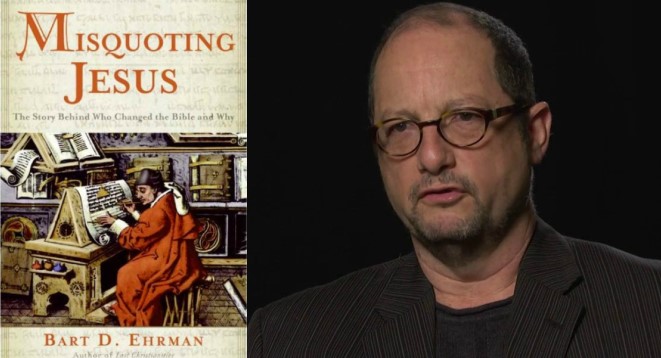
How often do we hear people “explaining” religious beliefs by stating “The Bible says so,” as if the Bible fell out of the sky, pre-translated to English by God Himself? It’s not that simple, according to an impressive and clearly-written book that should be required reading for anyone who claims to know “what the Bible says.”
Bart Ehrman’s Exploration: Who Changed the Bible and Why?
The 2005 bestseller, Misquoting Jesus, was not written by a raving atheist. Rather, it was written by a fellow who had a born-again experience in high school, then went on to attend the ultraconservative Moody Bible Institute in Chicago. Bart Ehrman didn’t stop there, however. He wanted to become an evangelical voice with credentials that would enable him to teach in secular settings. It was for this reason that he continued his education at Wheaton and, eventually, Princeton, picking up the ability to read the New Testament in its original Greek in the process.
As a result of his disciplined study, Ehrman increasingly questioned the fundamentalist approach that the “Bible is the inerrant Word of God. It contains no mistakes.” Through his studies, Ehrman determined that the Bible was not free of mistakes:
We have only error ridden copies, and the vast majority of these are centuries removed from the originals and different from them, evidently, in thousands of ways.
(Page 7). At Princeton, Ehrman learned that mistakes had been made in the copying of the New Testament over the centuries. Upon realizing this, “the floodgates opened.” In Mark 4, for example, Jesus allegedly stated that the mustard seed is “the smallest of all seeds on the earth.” Ehrman knew that this simply was not true. The more he studied the early manuscripts, the more he realized that the Bible was full of contradictions. For instance, Mark writes that Jesus was crucified the day after the Passover meal (Mark 14:12; 15:25) while John says Jesus died the day before the Passover meal (John 19:14).
Ehrman often heard that the words of the Bible were inspired. Obviously, the Bible was not originally written in English. Perhaps, suggests Ehrman, the full meaning and nuance of the New Testament could only be grasped when it was read in its original Greek (and the Old Testament could be fully appreciated only when studied in its original Hebrew) (page 6).
Because of these language barriers and the undeniable mistakes and contradictions, Ehrman realized that the Bible could not be the “fully inspired, inerrant Word of God.” Instead, it appeared to him to be a “very human book.” Human authors had originally written the text at different times and in different places to address different needs. Certainly, the Bible does not provide an an “errant guide as to how we should live. This is the shift in my own thinking that I ended up making, and to which I am now fully committed.”
How pervasive is the belief that the Bible is inerrant, that every word of the Bible is precise and true?
Occasionally I see a bumper sticker that reads: “God said it, I believe it, and that settles it.” My response is always, what if God didn’t say it? What if the book you take as giving you God’s words instead contains human words. What if the Bible doesn’t give a foolproof answer to the questions of the modern age-abortion, women’s rights, gay rights, religious and supremacy, western style democracy and the like? What if we have to figure out how to live and what to believe on our own, without setting up the Bible as a false idol–or an oracle that gives us a direct line of communication with the Almighty.
(Page 14). Ehrman continues to appreciate the Bible as an important collection of writings, but urges that it needs to be read and understood in the context of textual criticism, “a compelling and intriguing field of study of real importance not just to scholars but to everyone with an interest in the Bible.” Ehrman finds it striking that most readers of the Bible know almost nothing about textual criticism. He comments that this is not surprising, in that very few books have been written about textual criticism for a lay audience (namely, “those who know nothing about it, who don’t have the Greek and other languages necessary for the in-depth study of it who do not realize there is even any “problem” with the text).
Misquoting Jesus provides much background into how the Bible became the Bible. It happened through numerous human decisions over the centuries. For instance, the first time any Christian of record listed the 27 books of the New Testament as the books of the New Testament was 300 years after the books have been written (page 36). And those works have been radically altered over the years at the hands of the scribes “who were not only conserving scripture but also changing it.” Ehrman points out that most of the hundreds of thousands of textual changes found among the manuscripts were “completely insignificant, immaterial, of no real importance.” In short, they were innocent mistakes involving misspelling or inadvertence.
On the other hand, the very meaning of the text changed in some instances. Some Bible scholars have even concluded that it makes no sense to talk about the “original” text of the Bible. (Page 210). As a result of studying surviving Greek manuscripts of the New Testament, Ehrman concluded that we simply don’t have the original words constituting the New Testament.
Not only do we not have the originals, we don’t have the first copies of the originals. We don’t even have copies of the copies of the originals, or copies of the copies of the copies of the originals. What we have are copies made later-much later. In most instances, they are copies made many centuries later. And these copies all differ from one another, and many thousands of places . . . Possibly it is easiest to put it in comparative terms: there are more differences among our manuscripts and there are words in the New Testament.
In Misquoting Jesus Bart Ehrman spells out the ways in which several critical passages of the New Testament were changed or concocted. They are startling examples:
A.) Everyone knows the story about Jesus and the woman about to be stoned by the mob. This account is only found in John 7:53-8:12. The mob asked Jesus whether they should stone the woman (the punishment required by the Old Testament) or show her mercy. Jesus doesn’t fall for this trap. Jesus allegedly states “Let the one who is without sin among you be the first to cast a stone at her.”
The crowd dissipates out of shame. Ehrman states that this brilliant story was not originally in the Gospel of John or in any of the Gospels. “It was added by later scribes.” The story is not found in “our oldest and best manuscripts of the Gospel of John. Nor does its writing style comport with the rest of John. Most serious textual critics state that this story should not be considered part of the Bible (page 65).
B) after Jesus died, Mary Magdalene and two other women came back to the tomb to anoint the body of Jesus, according to Mark 16:1-2). They were met by a man in a white robe who told them that Jesus had been raised and was no longer there. The women fled and said nothing more to anyone out of fear (16:4-8). Everyone knows the rest of Mark’s Gospel, of course. The problem with the remainder of the story is that none of it was originally in the Gospel of Mark. It was added by a later scribe. Those additions include all of the following:
Jesus himself appeared to Mary Magdalene. She told the eleven apostles (minus Judas) about this vision, but they did not believe her. Jesus then appeared to the apostles, chastising them for failing to believe. He tells them that those who believe will be saved and those who don’t will be condemned. Then follows a critically important passage of the Bible.
And these are the signs that will accompany those who believe: they will cast out demons in my name; they will speak in new tongues; and they will take up snakes in their hands; and if they drink any poison, it will not harm them; they will place their hands upon the sick and heal them.
Jesus is then allegedly taken up into heaven and sits at the right hand of God, while the disciples go forth into the world to proclaim the Gospel in miraculous fashion.
Without the above passages (which, again, were not written by Mark) the Pentecostals lose their justification for speaking in “tongues.” And the Appalachian snake handlers have no basis for their dangerous practices.
C) John 5:7-8 is the only passage in the entire Bible “that explicitly delineates the doctrine of the Trinity (that there are three persons and God but that all three constitute a single God):
There are three that bear witness in heaven: the Father, the Word and the Spirit and these three are one; and there are three that bear witness on earth, the spirit, the water, and the blood, and these three are one.
Ehrman cites strong evidence that this Trinity passage was entirely concocted and foisted upon Erasmus by outraged theologians who needed support for their prized theological doctrine (page 81).
—
Ehrman reveals numerous other difficulties with the popular assumption that the Bible was perfectly handed down from its original written expression.
Many believers rely fervently on the King James version of the Bible, for instance. They sometimes even say “If the King James was good enough for St. Paul, it’s good enough for me.” Ehrman points out many problems with the King James version, warning that “we need to face up to the facts.”
The King James was not given by God but was a translation by a group of scholars in the early 17th century who based their rendition on a faulty Greek text.
(Page 209).
So what should we make of the Bible? Ehrman argues that the attacks of the New Testament are not simply collections of obvious, self-interpreting words. It’s the same problem we have with other important documents, such as the United States Constitution:
Texts do not simply reveal their own meanings to honest inquirers. Texts are interpreted and they are interpreted (just as they were written) by living, breathing human beings, who can make sense of texts only by explaining them in light of other other knowledge, explicating their meaning, putting the words of the text “in other words.”
(Page 217) The scribes changed the original words of the New Testament by putting them in other words.
In my experience, many people who cherry pick excerpts from the Bible as the proper way to determine what is moral are in utter denial that we don’t have accurate copies of the original writings. Most of them refuse to acknowledge that current popular versions of the Bible contain numerous discrepancies, even compared to the earliest manuscripts we do have. This is on top of the fact that their are hundreds of patent contradictions in the English version of the Bible. To most believers, none of this matters. Stay the course! In fact, in my experience most believers rarely read what the consider to be God’s own inspired word.
Ehrman’s book points out numerous troublesome issues that demand attention even assuming that the original writers of the Bible accurately reported the events described in their original writings (whatever those writings were). The elephant in the room, however, is that none of the authors of the Gospels ever claimed to witness any of the events they were reporting. Further, the extraodinary nature of Biblical claims demands extraordinary proof that ancient self-contradictory writings are simply incapable of providing, except to those of us who believe that the Bible is completely true “because it says so in the Bible.”
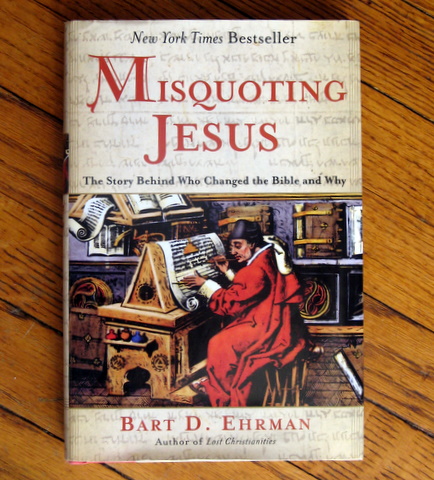
For all of those people who continue to go around clentching and thumping those Bibles they bought at Wal-Mart, and for all the rest of us who want to get the story straight, Ehrman’s Misquoting Jesus should be required reading.
[Administrator’s Note: More than 540 comments were quickly contributed to this post, making this page too long to download and display. Therefore, on March 23, 2007, I closed off new comments. Last night (February 4, 2009), I discovered a WordPress plugin that allows me to paginate comments, thereby protecting the site from the sudden and repeated load of 540 comments.
Here’s the good news, then. Anyone who has not yet had his or her say on Bart Ehrman’s book may now jump in at the original post and post a comment. That’s right! If none of the 540 comments that have come before you didn’t address an important aspect of Bart Ehrman’s book, you may now remedy that omission, right here in the comments to this original post. Godspeed. ]


Ok lets look at Physics:
Physics
1 – The first law of thermodynamics is known as the law of energy conservation. It states that energy can be converted from one form to another, but it can neither be created or destroyed. In other words, this law teaches that the universe did not create itself! Yet the Evolutionist believes that it did. Then where did the energy come from? How can it be that no more energy is being created? Genesis 2: 3 explains that God ceased creating from that day forward.
Then comes the next question: How can it be that energy cannot be destroyed? The Bible tells us in Hebrews 1: 3 that God is upholding all things by the word of his power.
1 – The second law of thermodynamics – States that every system that is left to its own devices tends to move from order to disorder. In other words, the universe is proceeding in a downward degenerating direction of decreasing organization.
Eventually the universe will die a "heat death". It will waste away to nothing.
Evolution teaches a process that continues upward, constantly becoming more orderly and improved. This is impossible.
For instance, if you leave out a pile of building material such as lumber, brick, etc. in a field where energy from the sun can reach it and you come back a few million or billion years later, would you find a building there? Hardly! What you would find would be nothing as it all would have deteriorated and gone back to dust. The Evolutionists believe just the opposite. They feel that it you leave all the components of a creature in an area where energy can reach it under the right conditions, it will become a living creature. What do you think?
The mere fact that we get old, our body breaks down and we finally die is living proof of the second law of thermodynamics. British astronomer Arthur Eddington quotes:
"If your theory is found to be against the second law of thermodynamics I can give you no hope; there is nothing for it but to collapse in deepest humiliation".
The truth of the matter is that the second law of thermodynamics was ordered by God in Gen 3: 17 – 19 and can only be changed by God (who will one day do so in Romans 8: 18 – 23).
The previous entry by "to Tina" shows lack of scientific understanding…
"Evolution violates the 2nd law of thermodynamics." WRONG!!!
This shows more a misconception about thermodynamics than about evolution. The second law of thermodynamics says, "No process is possible in which the sole result is the transfer of energy from a cooler to a hotter body." [Atkins, 1984, The Second Law, pg. 25] Now you may be scratching your head wondering what this has to do with evolution. The confusion arises when the 2nd law is phrased in another equivalent way, "The entropy of a closed system cannot decrease." Entropy is an indication of unusable energy and often (but not always!) corresponds to intuitive notions of disorder or randomness. Creationists thus misinterpret the 2nd law to say that things invariably progress from order to disorder.
However, they neglect the fact that life is not a closed system. The sun provides more than enough energy to drive things. If a mature tomato plant can have more usable energy than the seed it grew from, why should anyone expect that the next generation of tomatoes can't have more usable energy still? Creationists sometimes try to get around this by claiming that the information carried by living things lets them create order. However, not only is life irrelevant to the 2nd law, but order from disorder is common in nonliving systems, too. Snowflakes, sand dunes, tornadoes, stalactites, graded river beds, and lightning are just a few examples of order coming from disorder in nature; none require an intelligent program to achieve that order. In any nontrivial system with lots of energy flowing through it, you are almost certain to find order arising somewhere in the system. If order from disorder is supposed to violate the 2nd law of thermodynamics, why is it ubiquitous in nature?
The thermodynamics argument against evolution displays a misconception about evolution as well as about thermodynamics, since a clear understanding of how evolution works should reveal major flaws in the argument. Evolution says that organisms reproduce with only small changes between generations (after their own kind, so to speak). For example, animals might have appendages which are longer or shorter, thicker or flatter, lighter or darker than their parents. Occasionally, a change might be on the order of having four or six fingers instead of five. Once the differences appear, the theory of evolution calls for differential reproductive success. For example, maybe the animals with longer appendages survive to have more offspring than short-appendaged ones. All of these processes can be observed today. They obviously don't violate any physical laws.
"The theory of evolution says that life originated, and evolution proceeds, by random chance."
There is probably no other statement which is a better indication that the arguer doesn't understand evolution. Chance certainly plays a large part in evolution, but this argument completely ignores the fundamental role of natural selection, and selection is the very opposite of chance. Chance, in the form of mutations, provides genetic variation, which is the raw material that natural selection has to work with. From there, natural selection sorts out certain variations. Those variations which give greater reproductive success to their possessors (and chance ensures that such beneficial mutations will be inevitable) are retained, and less successful variations are weeded out. When the environment changes, or when organisms move to a different environment, different variations are selected, leading eventually to different species. Harmful mutations usually die out quickly, so they don't interfere with the process of beneficial mutations accumulating.
Nor is abiogenesis (the origin of the first life) due purely to chance. Atoms and molecules arrange themselves not purely randomly, but according to their chemical properties. In the case of carbon atoms especially, this means complex molecules are sure to form spontaneously, and these complex molecules can influence each other to create even more complex molecules. Once a molecule forms that is approximately self-replicating, natural selection will guide the formation of ever more efficient replicators. The first self-replicating object didn't need to be as complex as a modern cell or even a strand of DNA. Some self-replicating molecules are not really all that complex (as organic molecules go).
Some people still argue that it is wildly improbable for a given self-replicating molecule to form at a given point (although they usually don't state the "givens," but leave them implicit in their calculations). This is true, but there were oceans of molecules working on the problem, and no one knows how many possible self-replicating molecules could have served as the first one. A calculation of the odds of abiogenesis is worthless unless it recognizes the immense range of starting materials that the first replicator might have formed from, the probably innumerable different forms that the first replicator might have taken, and the fact that much of the construction of the replicating molecule would have been non-random to start with.
Scholar
What does conservation of mass and energy within the observable universe have to do with the generation of the universe? All observations point to all mass and energy, observable or dark, having always been present from the big bang onward. If you feel the need to say that God created the Big Bang, it's fine with me. But (s)he apparently hasn't meddled since.
The second law, entropy, could equally be stated that the complexity of the universe tends toward a maximum. "Disordered" is a lazy way of describing something too complex to easily describe. Simple metallic iron left in a field becomes a series of more complex iron-oxides. Lumber left in a field feeds colonies of many life forms as it decomposes, becoming much more complex. Order is a value judgment, whereas complexity can be measured.
Evolution does not have an "upward" except as viewed through anthropomorphic philosophy. Everything evolves: Do mountains erode upward as they evolve? Is the evolutionary process that simplified the DNA of extremophile bacteria to let them survive under their present environment "upward"? Is the loss of vision in modern cave dwelling creatures "above" their sighted ancestors?
"Evolution is only a theory; it hasn't been proved."
First, we should clarify what "evolution" means. Like so many other words, it has more than one meaning. Its strict biological definition is "a change in allele frequencies over time." By that definition, evolution is an indisputable fact. Most people seem to associate the word "evolution" mainly with common descent, the theory that all life arose from one common ancestor. Many people believe that there is enough evidence to call this a fact, too. However, common descent is still not the theory of evolution, but just a fraction of it (and a part of several quite different theories as well). The theory of evolution not only says that life evolved, it also includes mechanisms, like mutations, natural selection, and genetic drift, which go a long way towards explaining how life evolved.
Calling the theory of evolution "only a theory" is, strictly speaking, true, but the idea it tries to convey is completely wrong. The argument rests on a confusion between what "theory" means in informal usage and in a scientific context. A theory, in the scientific sense, is "a coherent group of general propositions used as principles of explanation for a class of phenomena" [Random House American College Dictionary]. The term does not imply tentativeness or lack of certainty. Generally speaking, scientific theories differ from scientific laws only in that laws can be expressed more tersely. Being a theory implies self-consistency, agreement with observations, and usefulness. (Creationism fails to be a theory mainly because of the last point; it makes few or no specific claims about what we would expect to find, so it can't be used for anything. When it does make falsifiable predictions, they prove to be false.)
Lack of proof isn't a weakness, either. On the contrary, claiming infallibility for one's conclusions is a sign of hubris. Nothing in the real world has ever been rigorously proved, or ever will be. Proof, in the mathematical sense, is possible only if you have the luxury of defining the universe you're operating in. In the real world, we must deal with levels of certainty based on observed evidence. The more and better evidence we have for something, the more certainty we assign to it; when there is enough evidence, we label the something a fact, even though it still isn't 100% certain.
What evolution has is what any good scientific claim has–evidence, and lots of it. Evolution is supported by a wide range of observations throughout the fields of genetics, anatomy, ecology, animal behavior, paleontology, and others. If you wish to challenge the theory of evolution, you must address that evidence. You must show that the evidence is either wrong or irrelevant or that it fits another theory better. Of course, to do this, you must know both the theory and the evidence.
Tell that to your preacher next time he says you aren't a monkey!
Hi to all,
Back again. Thanks to everyone who responded to my post. I sincerely appreciate it.
To "Hi Vesperian"
Thanks for your response. I am a lifelong resident of the Northeastern US and I am an avid reader of "Scientific American". I am college educated.
To be clear: I do not belief that my faith and science are mutually exclusive as many seem to. If I believe that God spoke to/through Moses, Jesus, Buddha or Mohammed, then isn't it possible that God also spoke to/through Newton, Darwin and Einstein? I have seen no convincing proof either in religious teaching or in science that God may not move through science or that science is only possible without a Creator.
I am not a believer in a fundamentalist interpretation of the Bible. I believe that the Bible is largely a metaphor to explain complex concepts to the primitive people of antiquity. I would not use the Bible as a schematic for the past, nor as a set of detailed instructions for living in the twenty-first century.
I am also not convinced that science has all of the answers. As we all know, scientific "truth" changes with advancement in knowledge and technology. What we "knew" in 1500 is vastly different than what we "know" today. Einstein overturned much of Newton as Newton overturned Aristotle. I am not convinced that science is the only avenue to knowledge and awareness. However, it is a very worthwhile pursuit, as I believe that faith is also.
I do have deep ccncerns about organized religion. Unlike science we do not like to admit to change or participate in it. Whether it is theological or scientific. Just ask Martin Luther, Copernicus or Galileo. Going back to the original premise of this blog, I do believe that the Bible has been "edited" many times to suit the agenda of the editors and not God's or the faithful. Too often scripture has been used as a tool to gain or consolidate power/authority for all too human leaders, or to achieve some end that has little to do with God. The "truth" is a precious commodity and we do ourselves a disservice if we do not seek it conscientiously and enthusiastically. Too many people seem willing to accept a "truth" doled out to them by some authority that they place all of their trust in.
By the way, this can happen in science too.
To my friend "Gatomjp"
Yes, I recall our friend's sojourn with EST well. I was also solicited to participate in some "seminars".
To your point: Yes, there is a component of a "need to belong", or a personal "void" that needs filling in any social group including organized religions. We all belong to groups of all natures. As we know, humans are social animals. We will even get together to wear togas and drink cheap beer. But that can't be the whole explanation for organized religion or religious faith. First, there are many people of faith who do not belong to an organized religion. Second, there are atheist associations. What about those? Last, we can find many non-religious groups to join to fulfill the need to belong (as our friend did).
I believe that faith is a personal journey that can be and is often shared. That sharing does not in itself always imply that the person is needy of attention or a group hug. We are always being solicited to join some group. I don't think that the religious groups in general are any worse in that respect than Triple A.
Moses, Mohammed, Jesus and John The Baptist spent loads of time in the desert all by themselves contemplating God. When they returned to talk about their experiences and ideas they were often criticized, made fun of or even ostracized by their communities. Many poets, scientists and scholars have had similar non-religious experiences of the same type. What was their motivation? My answer is that they all sought truth and enlightenment and so do many religious and non-religious people today. Please don't rule that out.
Did you know that it was once a scientific fact that mice came from dirty underwear? LOL (I'm not kidding)
Science is continually expanding and explaining Gods creation!
Where we are with science today is as to the mice of the old days when compared to where we will be in the future as science continues to show Gods design (which by the way, Hawkins will admit to).
Keep plugging away you atheistic scientists and maybe one day you will find God (visually) before its to late.
You state:
"However, not only is life irrelevant to the 2nd law, but order from disorder is common in nonliving systems, too. Snowflakes, sand dunes, tornadoes, stalactites, graded river beds, and lightning"
Ok, let's look at a snowflake! As you probrably know (because you are an expert) there are different kinds of order. some order is the product of chance and random factors, while other kinds of order can have no other explanation than intelligent design.
Specific order is simply a string of repeated information, CAT CAT CAT, for example. This is a naturally occuring kind of order and can be found in your snowflake example as well as in crystals and nylon, snad dunes, tornadoes, etc.etc.etc. (pardon the pun).
Gotta go, to bad i may have taught you something here.
Look up unspecified complexities as well as specified complexities and then you will know something about our orgins of life.
To all who cite hard scientific data to bolster their argument for or against a creator:
Your ability to spout scientific jargon does not impress me. It seems to me to be very naive to think that science can either prove or disprove the existence of god. It can't. For you atheists out there the study of science can lead you to a FEELING that there is no god. For others (see "to Tina" post above) it seems to prove quite the opposite.
What you all must admit to yourselves is that the bottom line is that your belief is a FEELING which can not, and never will be, quantified by science. Pictures from the Hubble can actually lead me to think both that the universe is a cold hard place AND that it is impossibly beautiful to have arose from nothing. My internal jury is still out on the matter.
It must be nice to be so sure either way. It must be comforting to KNOW. (sarcasm)
Gato, the fundamentalist agnositc
To Vesperiant:
I try not to rule out the seekers of truth. In fact, that is exactly who I had hoped to find here. You must admit that most of the posts here are from people not seeking new truths but instead arguing to reinforce the truths that they already hold.
Kurt Vonnegut once said that one of the most basic of human needs is the need to belong to some kind of group. The second most basic need (he added) is that the group that you belong to be somewhat exclusive and look down on all the other groups. Religion certainly fills that need very often! But the atheists on this blog have been no better. Notice how smug "Hi Vesperian" was in condescending to give you your "astronomy lesson"! What an insult! As if that proved anything other than Hi Vesperian's scientific snobbery.
"Religion" and "god" are two completely different things sometimes, as you yourself will attest. You are as much a skeptic as I am yet you still attend Catholic Mass. How can you stand it? To once again try to get back to the original topic of this blog, how do you reconcile the absurdities and contradictions of the bible and the liturgy of the mass with your belief in god?
To Tina writes: "The first law of thermodynamics…states that energy can be converted from one form to another, but it can neither be created or destroyed. In other words, this law teaches that the universe did not create itself! Yet the Evolutionist believes that it did."
Actually, evolution says nothing whatsoever about how the *Universe* was created. Evolution seeks to explain the changes over time that we see in biological species. The suggestion that evolution is flawed because it fails to explain the creation of the Universe is a strawman argument that misguided creationists try to use to discredit evolution, presumably because they cannot discredit evolution on its actual merits.
Gato, why do you keep asking questions? Are you not satisfied with your belief system? You should do some ACTUAL research and not waste our time with your bogus conclusions. According to you, a scientists' conclusions are not valid, so neither are yours. So when you say you aren't sure if God exists (agnostic), that is conceited and FLAT WRONG and much less valid than any of the scientific literature posted. It is only in YOUR mind that the confusion exists. Why do you feel the need to understand why others act the way they do? And don't say you are just CURIOUS.
Here is your first lesson on Geology, as requested by Gato…
The theory of plate tectonics has done for geology what Charles Darwin's theory of evolution did for biology. It provides geology with a comprehensive theory that explains "how the Earth works." The theory was formulated in the 1960s and 1970s as new information was obtained about the nature of the ocean floor, Earth's ancient magnetism, the distribution of volcanoes and earthquakes, the flow of heat from Earth's interior, and the worldwide distribution of plant and animal fossils.
The theory states that Earth's outermost layer, the lithosphere, is broken into 7 large, rigid pieces called plates: the African, North American, South American, Eurasian, Australian, Antarctic, and Pacific plates. Several minor plates also exist, including the Arabian, Nazca, and Philippines plates.
The plates are all moving in different directions and at different speeds (from 2 cm to 10 cm per year–about the speed at which your fingernails grow) in relationship to each other. The plates are moving around like cars in a demolition derby, which means they sometimes crash together, pull apart, or sideswipe each other. The place where the two plates meet is called a plate boundary. Boundaries have different names depending on how the two plates are moving in relationship to each other
* crashing: Convergent Boundaries,
* pulling apart: Divergent Boundaries,
* or sideswiping: Transform Boundaries
Places where plates crash or crunch together are called convergent boundaries. Plates only move a few centimeters each year, so collisions are very slow and last millions of years. Even though plate collisions take a long time, lots of interesting things happen. For example, in the drawing above, an oceanic plate has crashed into a continental plate. Looking at this drawing of two plates colliding is like looking at a single frame in a slow-motion movie of two cars crashing into each other. Just as the front ends of cars fold and bend in a collision, so do the "front ends" of colliding plates. The edge of the continental plate in the drawing has folded into a huge mountain range, while the edge of the oceanic plate has bent downward and dug deep into the Earth. A trench has formed at the bend. All that folding and bending makes rock in both plates break and slip, causing earthquakes. As the edge of the oceanic plate digs into Earth's hot interior, some of the rock in it melts. The melted rock rises up through the continental plate, causing more earthquakes on its way up, and forming volcanic eruptions where it finally reaches the surface. An example of this type of collision is found on the west coast of South America where the oceanic Nazca Plate is crashing into the continent of South America. The crash formed the Andes Mountains, the long string of volcanoes along the mountain crest, and the deep trench off the coast in the Pacific Ocean.
Divergent Boundaries
Places where plates are coming apart are called divergent boundaries. As shown in the drawing above, when Earth's brittle surface layer (the lithosphere) is pulled apart, it typically breaks along parallel faults that tilt slightly outward from each other. As the plates separate along the boundary, the block between the faults cracks and drops down into the soft, plastic interior (the asthenosphere). The sinking of the block forms a central valley called a rift. Magma (liquid rock) seeps upward to fill the cracks. In this way, new crust is formed along the boundary. Earthquakes occur along the faults, and volcanoes form where the magma reaches the surface.
Where a divergent boundary crosses the land, the rift valleys which form are typically 30 to 50 kilometers wide. Examples include the East Africa rift in Kenya and Ethiopia, and the Rio Grande rift in New Mexico. Where a divergent boundary crosses the ocean floor, the rift valley is much narrower, only a kilometer or less across, and it runs along the top of a midoceanic ridge. Oceanic ridges rise a kilometer or so above the ocean floor and form a global network tens of thousands of miles long. Examples include the Mid-Atlantic ridge and the East Pacific Rise.
Plate separation is a slow process. For example, divergence along the Mid Atlantic ridge causes the Atlantic Ocean to widen at only about 2 centimeters per year.
Say, did you ever wonder about all of the things that have ever happened on Earth and how old it really is? As it turns out, Mother Earth was a bit reluctant to let out her true age. It took us a long time to figure it out, but as near as we can tell, Mother Earth is four thousand, six hundred million years old (4,600 million = 4.6 billion), give or take a few hundred million years.
How old is that, really? It's older than your parents, or your grandparents, or even you great grandparents! It is older than anything you can see around you, like trees, buildings, or roads. It is even older than the hills, valleys, and rivers around where you live. It is so old that the world's mountains have been built up and worn down many times, the continents have wandered across the face of Earth like tumbleweeds, and plants and animals have changed many times, from amoebas to dinosaurs to people. The age of Earth is so long compared to all periods of time that we humans are familiar with, it has been given a special name: Geologic time.
The age of Earth is as vast in time as the universe is vast in space. It is not easy to really get a "feel" for 4,600 million years! One way to try to get a "feel" for how big it is, is to break the number down into smaller pieces that perhaps we can understand. Just for fun you might try the activity, "What is a Million?" Then try to think about 4,600 million!
To Gatomjp.
I agree with what you have said. It is good stuff and as far as I am concerned, it is all true.
I see religion as a mode of transportation to God. None of the religions I have examined are perfect. Like automobiles some have springs that have given out, some are outmoded, some engines sputter and some backfire quite a bit. But, as my father says, whether it is a BMW or a KIA if it gets you to where you are going on time, then who cares how pretty it is?
There is also the part of me that hopes that all religions (especially mine) will someday live up to the promise of it's Founder. Abandoning it by the side of the road does not improve either it or me. From the inside at least I speak as one who kneels when I criticize or complain about it. I would like to play a small and insignificant role (I will gladly leave the big leaps to the prophets, the sages and the Saints) in helping that change to come about, if I can.
I can stomach hypocrisy in organizations because I too am human and flawed. "Oh Lord, make me righteous in your eyes, but not today". St Augustine would have recognized my situation. We are all weak and foolish. Why should our institutions be any better than the people who comprise them? WE are the church if we really stop and think about it. However, that is not an excuse to stand still for injustice or idiocy either personally or as a group. It is just a recognition of the fact that I cannot rant about flaws in others that I possess myself. I will work with them if they will work with me.
That is my take on that.
As for the operatic liturgy and the manufactured dogmas they are simply the club rules and dues. They are almost always silly, but everybody has them. It is what seperates the Freemasons from the Knights of Columbus or the Elks from the Lions. But, hidden beneath all of the phoney claptrap are some really beautiful and glorious ideas and truths. Real gems, worth both living and dying for. That is what I am there meditate on and try to live out as best I can. To celebrate and dwell upon Jesus and the meaning of what he said and did.
I must admit that many of those in the pews with me would not agree with me even one bit, but that doesn't matter. They might even call me a "cafeteria catholic" to boot. However, I am not after their approbation I am only after my own salvation as a human being (no afterlife connotation here, but if there is one I want a seat by the window at Emeril's Heavenly Cafe). They must answer to and for themselves. I pray for them as I hope that they will pray for me.
To "Gato the snob":
Well, well. We must be getting close to something, He-who-does-not-reveal-his-name.
Am I shattering your paradigms? Are you being forced to THINK about things that you considered settled? Well, I'm sorry about that but to me life is a quest. I enjoy the journey. I don't know what the destination is (if there even is one).
When you are ready to do a little soul searching and actually discuss something you let me know.
To "Vesperian the wanna be scholar":
Your typing skills are impressive. If you'd like to ask me a question instead of plagarizing geology textbooks you know where to find me.
The scarecrow (strawman) needed a brain. What is your facination with using this terminology all the time?
You say this:
"The suggestion that evolution is flawed because it fails to explain the creation of the Universe is a strawman argument that misguided creationists try to use to discredit evolution, presumably because they cannot discredit evolution on its actual merits."
You don't have a "Lucy" bone to stand on. You ignore what you cannot explain or answer. Why not just admit that you cannot answer many of the questions asked of you about evolution? Why can't you admit that the theory is flawed? The actual merits of evolution are sporatic at best. As a concept, evolution is interesting. But as a whole, it is full of imaginative B.S.. You have a belief in something, a belief that requires faith….. Deal with it like everybody else does, because you wear a hat of shame when you act like it's full (fool) proof. It cannot be proven that one kind of species evolves into another. only species of its ownkind can evolve. Wake up from Darwins' dreamland, he did.
To Grumpy writes: "The scarecrow (strawman) needed a brain. What is your facination with using this terminology all the time?"
I have no particular fascination with this terminolggy, nor do I use it "all the time." However, creationists are *very* fond of strawman arguments, which is why it might seem like I often mention it.
To Grumpy continues: "You don’t have a “Lucy” bone to stand on. You ignore what you cannot explain or answer. Why not just admit that you cannot answer many of the questions asked of you about evolution? Why can’t you admit that the theory is flawed? The actual merits of evolution are sporatic at best. As a concept, evolution is interesting. But as a whole, it is full of imaginative B.S.."
Such is the nature of creationist attacks on evolution: long on conclusory accusations; short on supporting data.
So I can understand where you are coming from, do you believe in God or not, and if you do, how confident are you that HE exists?
Please type your response in the form of a percentage such as 90% yes you believe, or 60% percent against, etc.
I'm sorry you guys are offended by the science posts, but they are important, and true.
Scholar
I'm an agnostic. I don't know if God exists. The percentage would probably be something like 95% that I don't believe in God. Anybody who thinks there is more than a 5 percent chance of GOD existing belongs in the dark ages.
Did you know that the Holocaust was based on Christian principles? Sorry to be the one to have to tell you if you didn't. The Church released the names and records to the Nazis willingly, thus enabling the pogroms.
The Church is responsible for horrible tortures which I will spare you the gruesome details, but be assured its worse than anything you could imagine. Therefore, it is our duty, to make sure that nothing like the Inquisition, the CRUSADES, the HOLOCAUST, or BILLY GRAHAM, or VESPERIAN comes to bear.
Now, PERCENTAGES PLEASE>>>>GATO!!!! DO YOU BELIEVE IN GOD GATO and how sure are you that he exists (percentages so us scientists can understand)?
NEW YORK (Nov. 17) – The Hubble Space Telescope has shown that a mysterious form of energy first conceived by Albert Einstein, then rejected by the famous physicist as his "greatest blunder," appears to have been fueling the expansion of the universe for most of its history. This so-called "dark energy" has been pushing the universe outward for at least 9 billion years, astronomers said Thursday.
"This is the first time we have significant, discrete data from back then," said Adam Riess, a professor of astronomy at Johns Hopkins University and researcher at NASA's Space Telescope Science Institute.
He and several colleagues used the Hubble to observe 23 supernovae – exploding white dwarf stars – so distant that their light took more than half the history of the universe to reach the orbiting telescope. That means the supernovae existed when the universe was less than half its current age of approximately 13.7 billion years.
Because the physics of supernova explosions is extremely well-known, it is possible for the astronomers to gauge not just their distance, but how fast the universe was expanding at the time they went off.
The idea of dark energy was first proposed by Einstein as a means of explaining how the universe could resist collapsing under the pull of gravity. But then Edwin Hubble – the astronomer for whom the NASA telescope is named – demonstrated in 1929 that the universe is expanding, not a constant size. That led to the big-bang theory, and Einstein tossed his notion on science's scrap heap.
There it languished until 1998, when astronomers who were using supernova explosions to gauge the expansion of the universe made a shocking observation. It appeared that older supernovae, whose light had traveled a greater distance across space to reach the Hubble telescope, were receding from Earth more slowly than simple big-bang theory would predict. Nearby supernovae were receding more quickly than expected. That could only be true if some mysterious force were causing the expansion of the universe to accelerate over time.
Dark energy could be some property of space itself, which is what Einstein was thinking of when he proposed it. Or it could be something akin to an electromagnetic field pushing on the universe. And then there's the possibility that the whole thing is caused by some hitherto undiscovered wrinkle in the laws of gravity.
HMMMM….they forgot to mention God (too bad GATO)
Science writes: "Did you know that it was once a scientific fact that mice came from dirty underwear? LOL (I’m not kidding)"
That was not science at all, because it was not the product of a controlled experiment.
However, if we are going to give examples of non-science masquerading as fact, let's include a few of the church's many "facts": the earth is the center of the Universe, the earth is a perfect sphere, the sun and planets revolve around the earth, the sun and planets revolve in perfectly circular orbits, the sun is unblemished, the stars are fixed in the heavens, diseases are caused by evil spirits, diseases are caused by witches….
Science continues: "Science is continually expanding and explaining Gods creation!"
Science seeks to explain what is directly observable in nature, while religious believers blindly declare that one or more invisible gods are responsible for everything. Either group might be correct, but only the former one relies on objective evidence.
You are a better man than I, Vesperiant.
I'd also like to get the spiritual strengthening that you get from the church, but I can't stomach the Catholic Mass anymore. My inner critic is constantly judging the text. When they say "…and on the third day He rose from the dead," I want to yell out, "Yeah, RIGHT! Tell me another one!"
You can see past the mumbo-jumbo and get what you want from it. That is admirable. But I can't be a member of any group whose prerequisite for joining is the swallowing of absurdities. Not just a swallowing…a complete acceptance that tolerates no uncertainty.
I must admit it must be freeing, in a way, to give onesself over completely to a higher authority. I envy their conviction but could never do it myself.
To gatomjp,
Thanks. Well said.
Well, He may have risen on the third day. I haven't completely ruled that out. I don't have nearly as much trouble with the mystical portion of the religion as I do with the naked attempts at mind control.
Example: The Apostle's Creed which basically states that there is no salvation except through the Roman Catholic Church. THAT bugs me. It is really funny because that creed had nothing to do at all with Jesus or the apostles. It was manufactured in about 323 C.E. during the Council of Nicea as the "pledge of allegiance" to the Catholic Church. Even funnier is that this council was called into session by a non-Christian (the Emperor Constantine who only converted to Christianity on his death bed many years later) in order to "standardize" Christian doctrine so the it could be spread to the whole Roman Empire (read: so that he could control it).
This is only one small example of how the faith has been systematically perverted over the centuries to take it away from the people and bestow it on the clergy. So, if every priest died tomorrow in some tragic accident, the rest of us cannot celebrate mass, expiate our sins or even talk to God. That was a neat trick, Nespa? Maybe we can steal it back.
Bottom line is that to accomplish anything of value in this world you are going to have wade through neck deep feces(most of it supplied by folks who are "supposed" to be helping you) in order to get to your goal.
I have found my faith to be worth this particular trip up the creek.
Vesperian, please tell me what percent faith you have in God. Gato, agnostics ARE atheists by definition because they do not believe in God. You are learning quickly, I knew from the very beginning of this thread that you were not lost. What percent credibility do you give the church? Has it changed at all over your lifetime…the percentage?
Thanks, from a curious agnostic/atheist. (Remember to include the percentages in your response, if you aren't sure…please put at least a range like 10-20 percent believer for example.)