
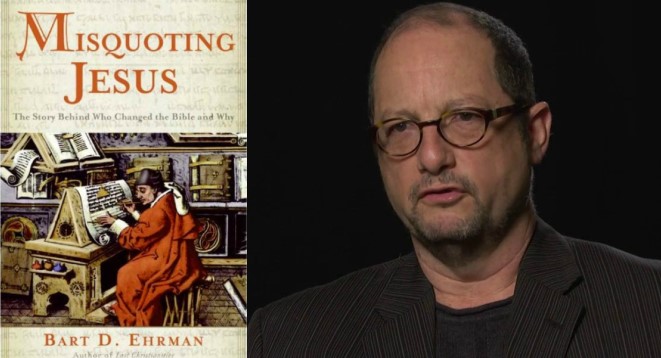
How often do we hear people “explaining” religious beliefs by stating “The Bible says so,” as if the Bible fell out of the sky, pre-translated to English by God Himself? It’s not that simple, according to an impressive and clearly-written book that should be required reading for anyone who claims to know “what the Bible says.”
Bart Ehrman’s Exploration: Who Changed the Bible and Why?
The 2005 bestseller, Misquoting Jesus, was not written by a raving atheist. Rather, it was written by a fellow who had a born-again experience in high school, then went on to attend the ultraconservative Moody Bible Institute in Chicago. Bart Ehrman didn’t stop there, however. He wanted to become an evangelical voice with credentials that would enable him to teach in secular settings. It was for this reason that he continued his education at Wheaton and, eventually, Princeton, picking up the ability to read the New Testament in its original Greek in the process.
As a result of his disciplined study, Ehrman increasingly questioned the fundamentalist approach that the “Bible is the inerrant Word of God. It contains no mistakes.” Through his studies, Ehrman determined that the Bible was not free of mistakes:
We have only error ridden copies, and the vast majority of these are centuries removed from the originals and different from them, evidently, in thousands of ways.
(Page 7). At Princeton, Ehrman learned that mistakes had been made in the copying of the New Testament over the centuries. Upon realizing this, “the floodgates opened.” In Mark 4, for example, Jesus allegedly stated that the mustard seed is “the smallest of all seeds on the earth.” Ehrman knew that this simply was not true. The more he studied the early manuscripts, the more he realized that the Bible was full of contradictions. For instance, Mark writes that Jesus was crucified the day after the Passover meal (Mark 14:12; 15:25) while John says Jesus died the day before the Passover meal (John 19:14).
Ehrman often heard that the words of the Bible were inspired. Obviously, the Bible was not originally written in English. Perhaps, suggests Ehrman, the full meaning and nuance of the New Testament could only be grasped when it was read in its original Greek (and the Old Testament could be fully appreciated only when studied in its original Hebrew) (page 6).
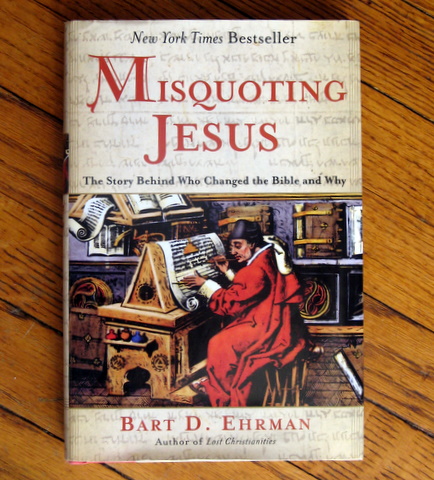
Because of these language barriers and the undeniable mistakes and contradictions, Ehrman realized that the Bible could not be the “fully inspired, inerrant Word of God.” Instead, it appeared to him to be a “very human book.” Human authors had originally written the text at different times and in different places to address different needs. Certainly, the Bible does not provide an an “errant guide as to how we should live. This is the shift in my own thinking that I ended up making, and to which I am now fully committed.”
How pervasive is the belief that the Bible is inerrant, that every word of the Bible is precise and true?
Occasionally I see a bumper sticker that reads: “God said it, I believe it, and that settles it.” My response is always, what if God didn’t say it? What if the book you take as giving you God’s words instead contains human words. What if the Bible doesn’t give a foolproof answer to the questions of the modern age-abortion, women’s rights, gay rights, religious and supremacy, western style democracy and the like? What if we have to figure out how to live and what to believe on our own, without setting up the Bible as a false idol–or an oracle that gives us a direct line of communication with the Almighty.
(Page 14). Ehrman continues to appreciate the Bible as an important collection of writings, but urges that it needs to be read and understood in the context of textual criticism, “a compelling and intriguing field of study of real importance not just to scholars but to everyone with an interest in the Bible.” Ehrman finds it striking that most readers of the Bible know almost nothing about textual criticism. He comments that this is not surprising, in that very few books have been written about textual criticism for a lay audience (namely, “those who know nothing about it, who don’t have the Greek and other languages necessary for the in-depth study of it who do not realize there is even any “problem” with the text).
Misquoting Jesus provides much background into how the Bible became the Bible. It happened through numerous human decisions over the centuries. For instance, the first time any Christian of record listed the 27 books of the New Testament as the books of the New Testament was 300 years after the books have been written (page 36). And those works have been radically altered over the years at the hands of the scribes “who were not only conserving scripture but also changing it.” Ehrman points out that most of the hundreds of thousands of textual changes found among the manuscripts were “completely insignificant, immaterial, of no real importance.” In short, they were innocent mistakes involving misspelling or inadvertence.
On the other hand, the very meaning of the text changed in some instances. Some Bible scholars have even concluded that it makes no sense to talk about the “original” text of the Bible. (Page 210). As a result of studying surviving Greek manuscripts of the New Testament, Ehrman concluded that we simply don’t have the original words constituting the New Testament.
Not only do we not have the originals, we don’t have the first copies of the originals. We don’t even have copies of the copies of the originals, or copies of the copies of the copies of the originals. What we have are copies made later-much later. In most instances, they are copies made many centuries later. And these copies all differ from one another, and many thousands of places . . . Possibly it is easiest to put it in comparative terms: there are more differences among our manuscripts and there are words in the New Testament.
In Misquoting Jesus Bart Ehrman spells out the ways in which several critical passages of the New Testament were changed or concocted. They are startling examples:
A.) Everyone knows the story about Jesus and the woman about to be stoned by the mob. This account is only found in John 7:53-8:12. The mob asked Jesus whether they should stone the woman (the punishment required by the Old Testament) or show her mercy. Jesus doesn’t fall for this trap. Jesus allegedly states “Let the one who is without sin among you be the first to cast a stone at her.”
The crowd dissipates out of shame. Ehrman states that this brilliant story was not originally in the Gospel of John or in any of the Gospels. “It was added by later scribes.” The story is not found in “our oldest and best manuscripts of the Gospel of John. Nor does its writing style comport with the rest of John. Most serious textual critics state that this story should not be considered part of the Bible (page 65).
B) after Jesus died, Mary Magdalene and two other women came back to the tomb to anoint the body of Jesus, according to Mark 16:1-2). They were met by a man in a white robe who told them that Jesus had been raised and was no longer there. The women fled and said nothing more to anyone out of fear (16:4-8). Everyone knows the rest of Mark’s Gospel, of course. The problem with the remainder of the story is that none of it was originally in the Gospel of Mark. It was added by a later scribe. Those additions include all of the following:
Jesus himself appeared to Mary Magdalene. She told the eleven apostles (minus Judas) about this vision, but they did not believe her. Jesus then appeared to the apostles, chastising them for failing to believe. He tells them that those who believe will be saved and those who don’t will be condemned. Then follows a critically important passage of the Bible.
And these are the signs that will accompany those who believe: they will cast out demons in my name; they will speak in new tongues; and they will take up snakes in their hands; and if they drink any poison, it will not harm them; they will place their hands upon the sick and heal them.
Jesus is then allegedly taken up into heaven and sits at the right hand of God, while the disciples go forth into the world to proclaim the Gospel in miraculous fashion.
Without the above passages (which, again, were not written by Mark) the Pentecostals lose their justification for speaking in “tongues.” And the Appalachian snake handlers have no basis for their dangerous practices.
C) John 5:7-8 is the only passage in the entire Bible “that explicitly delineates the doctrine of the Trinity (that there are three persons and God but that all three constitute a single God):
There are three that bear witness in heaven: the Father, the Word and the Spirit and these three are one; and there are three that bear witness on earth, the spirit, the water, and the blood, and these three are one.
Ehrman cites strong evidence that this Trinity passage was entirely concocted and foisted upon Erasmus by outraged theologians who needed support for their prized theological doctrine (page 81).
—
Ehrman reveals numerous other difficulties with the popular assumption that the Bible was perfectly handed down from its original written expression.
Many believers rely fervently on the King James version of the Bible, for instance. They sometimes even say “If the King James was good enough for St. Paul, it’s good enough for me.” Ehrman points out many problems with the King James version, warning that “we need to face up to the facts.”
The King James was not given by God but was a translation by a group of scholars in the early 17th century who based their rendition on a faulty Greek text.
(Page 209).
So what should we make of the Bible? Ehrman argues that the attacks of the New Testament are not simply collections of obvious, self-interpreting words. It’s the same problem we have with other important documents, such as the United States Constitution:
Texts do not simply reveal their own meanings to honest inquirers. Texts are interpreted and they are interpreted (just as they were written) by living, breathing human beings, who can make sense of texts only by explaining them in light of other other knowledge, explicating their meaning, putting the words of the text “in other words.”
(Page 217) The scribes changed the original words of the New Testament by putting them in other words.
In my experience, many people who cherry pick excerpts from the Bible as the proper way to determine what is moral are in utter denial that we don’t have accurate copies of the original writings. Most of them refuse to acknowledge that current popular versions of the Bible contain numerous discrepancies, even compared to the earliest manuscripts we do have. This is on top of the fact that their are hundreds of patent contradictions in the English version of the Bible. To most believers, none of this matters. Stay the course! In fact, in my experience most believers rarely read what the consider to be God’s own inspired word.
Ehrman’s book points out numerous troublesome issues that demand attention even assuming that the original writers of the Bible accurately reported the events described in their original writings (whatever those writings were). The elephant in the room, however, is that none of the authors of the Gospels ever claimed to witness any of the events they were reporting. Further, the extraodinary nature of Biblical claims demands extraordinary proof that ancient self-contradictory writings are simply incapable of providing, except to those of us who believe that the Bible is completely true “because it says so in the Bible.”
For all of those people who continue to go around clentching and thumping those Bibles they bought at Wal-Mart, and for all the rest of us who want to get the story straight, Ehrman’s Misquoting Jesus should be required reading.
[Administrator’s Note: More than 540 comments were quickly contributed to this post, making this page too long to download and display. Therefore, on March 23, 2007, I closed off new comments. Last night (February 4, 2009), I discovered a WordPress plugin that allows me to paginate comments, thereby protecting the site from the sudden and repeated load of 540 comments.
Here’s the good news, then. Anyone who has not yet had his or her say on Bart Ehrman’s book may now jump in at the original post and post a comment. That’s right! If none of the 540 comments that have come before you didn’t address an important aspect of Bart Ehrman’s book, you may now remedy that omission, right here in the comments to this original post. Godspeed. ]


To "To you who slash mnowlan":
Please please do NOT expand on that subject!! I don't mean to insult you but that post is typical of the mind-numbing, vague, unconvincing circular clap-trap that passes for intellectual conversation among thumpers.
You wrote: "They slash out at you because they believe that they really know the absolute truth of a non-existant God." Of course it is YOU who really know the absolute truth of god, right? How vain and egotistical! You don't KNOW anything, as much as it comforts you to convince yourself that you do. Thumpers regularly misuse the word "know" when what they really mean is "feel" or "believe".
By the way, I am not an atheist. It is your and (mnowlan's) egotism that I am lashing out at, not your beliefs. Go ahead, believe what you will, I am not trying to convince you otherwise as many others in this discussion have tried (unsuccessfully) to do. But don't condescend to me and say you love me and pray that I see the light when in your heart of hearts you really are savoring the feeling of being superior to the poor stupid heathens that surround you.
My question of previous posts "Would you believe Jesus' message if there were no miracles in the bible?" has been largely ignored. When an attempt has been made to answer it the response was usually vague and disappointing. Here is a private response I received from a friend who has permitted me to post it. Please notice how straightforward, sensible and smart it is…and yet he still leaves the door open for mystery.
Vesperiant wrote:
Yes, I would believe and do believe in Jesus without the miracles. Since I was a relatively young man I have always been much more captivated by what Jesus said than by what he allegedly did. Take away all of the miracles (including the resurrection) and Jesus is still the most extraordinary force/being/man who ever strode the earth in my opinion. “Love your enemies”, “Give all that you have to the poor and follow me”, “Do unto others as you would have them do unto you” and “Judge not lest ye be judged” are just a few of the very revolutionary and startling things that He said. Even twenty centuries later it still takes the breath away if you really stop and think of it.
The miracles may or may not be real. I keep my mind open on this, however I sincerely believe that Jesus was striving for a heaven here on earth NOW, and not some hypothetical future Eden. That was his challenge to us. Make a heaven here. Sadly, we always fail and so many pray for success in some afterlife. In my opinion, truly religious/spiritual people are just aware that we are (in terms of our spiritual and human potential) terrible underachievers and we try to connect with our Creator/God/Holy Spirit in order to find the strength, courage and vision to continue to improve. To do better tomorrow than we did today.
The “scientific” seem to want to believe that it is all mere biological mechanics. That there is no “natural” right or wrong (except what we as human beings artificially foist upon ourselves) or a deeper meaning to existence. They appear to think that it all just boils down to some grand formula that has no designer and no meaning. A trick question. I don’t buy that. Nor do I buy that there is a Ferrari, 70 virgins and a bowling alley in “heaven” waiting for me after my biological functions cease. Even if I do make it to Mass on Sunday.
However, I am still evolving every day praying for guidance and wisdom from God. Who knows what He will show me next?
gatomjp says: "The 'scientific' seem to want to believe that it is all mere biological mechanics. "
"Mere biological mechanics" have produce an incredibly diverse spectrum of life on our planet — a spectrum that continues to evolve before our eyes — hardly a "mere" accomplishment.
gatomjp continues: "That there is no 'natural' right or wrong (except what we as human beings artificially foist upon ourselves) or a deeper meaning to existence."
To the contrary, there obviously are natural rights and wrongs: some things naturally work (sometimes) and other things naturally don't work (sometimes).
gatomjp concludes: "They appear to think that it all just boils down to some grand formula that has no designer and no meaning."
Wrong again. Scientists have suggested no "grand formula," because none is needed. Religious followers are the ones who have suggested a "grand formula," because they are eager for the comfort it gives them.
mnowlan says: "I can admit that if I were born in India I probably would follow whatever religion my family and/or community abided by, because I would likely know no other way. But there are many who are living throughout the world in such circumstances who, when approached with the Good News of Jesus, turn away from their animistic worship and worship the one who made the cow, and us as well. They are able to see a bigger picture, rather than their own focused (limited) interpretation and turn away from other forms of worship when given a choice."
It is both ncorrect and incredibly arrogant to declare that all religions throughout the world, except Christianity, are "anamistic" and "limited."
mnowlan continues: "If I understand you correctly you (grumpypilgrim) claim that setting aside any contradiction opens the door to worship of any thing, or any 'god'. That may be true if it were up to us to define the god. The message in the Bible is that it is not up to us to define God, it is up to Him to define Him."
Your statement makes no sense. You propose to rely on the Bible, yet you ignore the many obvious contradictions it contains. In doing so, you base your spiritual knowledge on a defective document and then you propose that others do likewise.
mnowlan adds: "I believe I asked this before but why do you choose to name yourself 'grumpy'? Do you feel you are living life to the fullest? Are you optimistic? Do you have hope? I would suggest that your perspective on life is really focusing on death. You do also include the name 'pilgrim' which could mean a number of things…."
My screen name reflects my disappointment with the direction of American popular opinion and politics — a direction that is has been driven by a neocon agenda that is based on widespread incompetence, ignorance and intolerance. "Pilgrim" refers to the early European settlers of this nation: they would be very grumpy if they could see the damage their descendants have been causing to the nation they risked their lives to create.
Case in point: many early Pilgrims came to America to escape religious persecution in England. They considered religious freedom to be one of the most basic of human rights. They would be outraged to see that religious persecution has become a problem here, as well, but this time driven by Fundamentalist evangelicals who seek to force their particular version of Christianity onto everyone. Their behavior is unAmerican and borders on treasonous.
Bottom line: mnowlan would do well to stop making so many faulty presumptions about other people.
Your insults show your lack of intelligence especially when dealing with EQ. It's like the 10 year old bully that blurts, "your stupid".
Your questions are nonsensical, a type of "what if" thinking. I cannot answer this question as it does not deal with reality, your friend answered the question to get you to shut up already.
Can you answer this question: IF you were intelligent, would you also be dumb?
I believe in Jesus because I can think, see, and feel what is real and what is not real. I also believe in science, I believe in beer, and I beleive that miracles are possible with the existence of God. No God, no miracles, life, death, or existence.
You are searching, searching, searching, searching, searching, searching, and searching to the tenth power. You're a bit uptight arent you? Give yourself a vacation from thinking for a while, afterall, that's what life is right, a vacation from eternity?
If you are not an atheist, then, you are either agnostic, pantheist, panentheist, polytheist, deist, monotheist, or you are into some kind of finite godism. So, which is it? Do you care to share? HMM, cat got your tongue? It's to bad I wont find out, since I will not be returning to this boring blog.
Now you will come back with insults from your own lack of intelligence, insecurities, and fear….But no one will care because they dont even know you, but you will think they care? because you are the pot calling the kettle black when you sate this:
"Of course it is YOU who really know the absolute truth of god, right? How vain and egotistical! You don’t KNOW anything".
That by the way is actually an ignorant statement, since of course, I know that you exist, and that you are not intelligent……… 🙂
Good day to you sir (spoken with an uptight (gatomjp voice) !!!!!
To grumpypilgrim:
I seem to have touched a nerve. I would be remiss if I did not point out to you that you have misread gatomjp's postings. If you have been paying attention to gatomjp's postings you would realize that he/she is perhaps as anti-Bible as you are. His/her last posting quoted someone else's response to "gatomjp"'s latest question of believers. I'm not quite sure where gatomjp is coming from, but it most likely not from a Christian perspective. I would suggest you apologize to your comrade in arms.
I am growing weary of trying to have a conversation with you and share my perspective (without shoving it down anyone's throat). I am totally fine with allowing "other worship" to continue. I am not the one who makes the decision as to whether the worship is appropriate, God is. I choose my worship and I pray that you will not force me to stop. I will certainly not stop you. Isn't it great that we live in a country (I am assuming from your pilgrim reference that you are living in the US) that allows us the freedom to argue and continue living as we please, as long as we do not deny someone else's freedom in the process? You seem to suggest that Christianity is, at some basic level, fundamentally inclined to create oppressive attitudes amongst its members. I would suggest the opposite. I have said time and time again, Christianity is a voluntary exercise. Forcing it upon someone is contrary to its very principles. Now, are you truly interpreting this little exchange we are having as oppressive?
Now I have been trying to explain that my whole purpose for coming to this site and reading and posting and returning is because you are worth saving, even if you don't believe it. If you read gatomjp's second to last posting you will notice that he/she calls me a "egotistical" and perhaps even a "thumper". If opening up the Bible and reading from it, or stating what my interpretation of its meaning is, is described as "thumping" others, I would suggest that is hyperbole. After all, they are just words, especially to the non-believer. Or are they just words, since they evoke such an emotional response from those who purport the notion that the Bible has no real meaning in life? Why such often visceral response?
I am sorry if it is discomforting to others that I believe that God is real to me. I find comfort in this belief, not because it makes me superior. Far from it. It is because I believe that this comfort is free and available to all, simply by believing. No jumping through hoops, no intellect required, no elitist attitude necessary, nothing. Now that's love. It's unconditional, except for one condition. If you deny it. Simple. You refuse to believe and you have come up with the one condition. I recognize that denying it is like biting the hand that feeds you. Atheists would have me believe that surrendering to the God of the Bible is suicide, because they have selfishly chosen the opposite route. Isn't it the epitomy of selfishness to declare that there is only "self" and no God? I recognize that selfishness leads to division and is itself the opposite of unity. Is it crazy to turn away from selfishness?
I am happy and full of joy because I know that God loves me AND EVERYONE. Not just me. I appreciate your grumpiness pilgrim. I recognize it as a spirit who hasn't totally given up on life. I am not your enemy, though you may believe otherwise. I will not force you to do anything, just like I am not forcing you to read this. No, the real enemy is within each of us, and it is our own selfishness. It often tries to convince us that we can figure it all out and be done with it. It wants you to feed it, make it grow. How does it do that? By making you turn away from everything else and having you stare at yourself in the mirror. Implosion.
As a believer in God I believe that I can never know everything, even if I live for eternity. I am limited and I will always be limited, but I can still experience the limitless. The promise of heaven only removes one limitation, the temporal one. How's that for mystery gatomjp?
To grumpypilgrim:
Sorry, I misstated that last statement, but I sent it before I realized. Can you believe it? I am admitting to a mistake? Of course I don't know how many limitations are removed in heaven since I've never been there. I believe at least one limitation is removed. Goes to show my limited understanding. Praise God!
To mnowlan:
Thank you for pointing out my oversight in quoting from gatomjp's post. Indeed, I have not tracked gatomjp's earlier posts; however, I should not have needed to: gatomjp should have used quotation marks to delineate the material taken from Vesperiant's email.
As regards Christianity, in fact it has very often been forcibly imposed on non-Christian cultures. That is historical fact. It is also a fact that many Christians are trying to do it now in America: through school boards that are trying to force Christian prayer and creationism into public schools, through political representatives and judicial appointees who seek to restrict abortions, through election referenda that seek to undermine stem cell research, etc. Christians have even invented a name for their efforts: the culture war. I, and I would imagine most Americans, have no problem with Believers (Christian or otherwise) praying to their god(s) in the privacy of their homes and sanctuaries, but that is not what is happening. Many Christians are *exceedingly* intolerant of non-Christians and are very definitely trying to ram their narrow-minded versions of faith down everyone else's throats. I have not suggested you are among them, but I have observed that you make many invalid, insulting and self-righteous assumptions about non-Christians, which suggests to me you might lean in their direction. Frankly, I couldn't care less whom you and other people worship for spiritual salvation, as long as Believers limit their activity to worship and don't try to impose intolerant, narrow-minded beliefs onto others. Unfortunately, many Believers imagine that their god calls them to do exactly that.
To all.
I am gatomjp's friend Vesperiant and I am joining the conversation just to say a few brief things. I have enjoyed this blog immensely. I have learned a great deal from reading the communications from all points of view. It is a worthy discussion and I applaud all who take part in it.
To "to gatomjp"
I understand that you may feel insulted by my friend's attitude and questions, however I believe that you are taking it the wrong way. My friend is simply trying to get you to examine and define your reasoning. While this may appear to be insulting it is simply an attempt to understand where you are coming from. I don't think that this is insulting. I think that it shows a real interest in and respect for your views.
In my opinion, everyone on this blog is searching for something. A better understanding of life, better arguments for their point of view, a consensus or even a convert to their point of view. Searching is a noble activity whether you are searching for better scientific data or a better relationship to God. We should all treat our fellow searchers with respect regardless of their point of view. We are all on different parts on the same road.
I also respect those who feel that they know the answers to all of these weighty questions. Either through faith or through scientific research. I wish that I was among you. Sincerely. But, I find myself always looking for new scientific information and a better relationship to my God at the same time. However, when we suggest that those who take an Atheistic/scientific approach are simply "bad people" or that they are just trying to get away from religious morality it is just plain silly and rude. There are many wonderful people who call themselves atheists who live better lives than some Christians/Jews/Muslims that I know. Equally, the suggestion that people of faith are uneducated simpletons who have never read a book other than the Bible is just as silly and rude. There are many believing Christians whose IQ's and education would match or surpass anyone else's on this blog.
The questions that we are asking the answers to have very little to do with either personal IQ or morality. If you are religious then you probably believe that God speaks to us all and if you are a scientist then you probably think that the "data" speaks to us all. I would hope that both are true for everyone on this blog.
To "grumpypilgrim"
You make some excellent points. You are right in that scientists have suggested no "grand formula", but of course that is what they are all working toward. Nothing else makes sense. Understanding a portion of the scientific truth leads to other scientific truths and eventually to a schematic that potentially explains the whole. No explorer ever paddled up a river without trying to find the headwaters or "source" of the river. No religious person ever prayed to God except to ultimately seek HIM out.
While I am a big fan of both automobiles and mechanics, to me the people who create these wonderful machines are even more interesting than the cars themselves. Similarly, it is fantastic to know how a snowflake is formed from the scientific perspective. A snowflake is a beautiful thing. But, what is a an individual snowflake compared to the scientific explanation for snowstorms, global weather patterns or the religious truth of The Creator of all things? That is what I meant. I meant no disrespect to the wonder or the sophistication of nature. I think that we humans at this point in our development are all basically just children playing with Legos and trying to understand the nature of architecture. Or maybe the Architect.
Finally, whether or not a thing "works" in nature does not obviate it's value or make it right or wrong. Murder "works" in nature and yet most of us agree that it is wrong. Why?
Thanks for talking with me.
Hey grumpypilgrim:
Take it up with vesperiant! You are quoting him, not me! LOL!
To Togatomjp:
Wow, I guess he told me!
Must have struck a nerve.
I'm a Liberal Quaker, by the way. At least according to the Beliefe-O-Matic test that I took this week.
Indeed, you are correct, gatomjp! LOL! So shall it be….
Vesperiant writes: "…scientists have suggested no “grand formula”, but of course that is what they are all working toward. Nothing else makes sense."
Scientists are simply trying to understand nature and the Universe at it is, for the sake of it. The closest thing to a "grand formula" that I can think of among any of the sciences is a Unified Field Theory in physics, and even that is merely seeking to unify the four known field forces (gravity, electromagnetism, and the strong and weak nuclear forces). I am aware of no other scientists in any field who are working toward any "grand formula."
Vesperiant continues: "Murder 'works' in nature and yet most of us agree that it is wrong. Why?"
Considering that there are millions of species on our planet and that only a tiny number of these species employ murder, the suggestion that it "works" is without merit. Among those that do use it, usually it is in connection with a very specific reproduction behavior. For example, male bears will kill cubs that are not his own, because this causes the mother to soon go into heat, enabling the murderous male to father a new litter. Similar behavior is seen among some insects, for the same reason. Humans and chimps are apparently unique in that they do it in pursuit of power and territory.
Nothwithstanding this fact, that murder doesn't "work" among humans is demonstrated by the fact that virtually all human cultures on our planet condemn it, regardless of their religious or cultural traditions. Most view it as a necessary expedient — e.g., war — that has very limited utility. We consider it "wrong" because it usually carries very unpleasant social consquences. That many cultures have erected a moral framework around it merely illustrates that people are fond of co-opting existing public beliefs to legitimize their dogma.
I'd like to return to a question mnowlan directed to me a couple of days ago: "Do you [grumpypilgrim] feel you are living life to the fullest? Are you optimistic? Do you have hope? I would suggest that your perspective on life is really focusing on death."
To the contrary, it is Christians, not athiests, who are constantly focusing on death. One can hardly spend five minutes with an evangelical Believer without them mentioning it.
As regards living life to the fullest, optimism, hope, etc., my experience is that athiests certainly do live their lives to the fullest, with both hope and optimism, at least as much as, if not more than, anyone else. Unlike many religious Believers, they do not begin by imagining they are "fallen," so they need not fabricate an invisible supernatural being who will pick them up. In my view, Christians are the ones who are most often without hope and optimism — that is why they choose a religion that offers to give them these very things. And, as people such as the disgraced Reverand Haggard demonstrate, some Believers are full to the brim with hypocrisy and self-hatred, and are clearly not living their lives to the fullest.
What many Christians seem to not understand is that their belief that everyone needs to be "saved" is premised on a belief that the Genesis story is literally true; namely, that we are all "fallen." I, for one, utterly reject that premise, for a large number of reasons, some of which I have already discussed (see, for example: http://dangerousintersection.org/?p=166, http://dangerousintersection.org/?p=195 and http://dangerousintersection.org/?p=362).
Moreover, Christians also seem unaware of the fact that the Bible follows the exact same pattern as any other fictional redemption story; namely: they begin with a story about some glorious past, then they describe a tragedy that causes the destruction of that glory, then they promise some magical future where that glory is restored. This theme is one of the oldest and most-used in all of human history — both in literature and in religion. Why? Because it works. Why does it work? Because many, many people are frustrated with the lives they have, so they yearn for something that will promise them a fantasy perfect version of themselves. Christianity, like many religions, offers such a fantasy. See also http://dangerousintersection.org/?p=144.
Earlier, I praised you for your posts Gato. Well spoken and kind as you may be, at fortysomething, I think you have since proven that you are nearly as naive in terms of scientific knowledge as Mnowlan (ok sorry thats a bit too harsh). It would serve you well to do a bit more reading of current scientific literature such as JOURNALS, and stop wasting time in sunday "mass". Your friends "statement" indicates a mind jaded by immersion in Christianity.
I ADMIT that I could be wrong about GOD. (thus debunking mnowlan's latest theory)
God may indeed exist. If I was living in the 16th Century, sure I would be on my KNEES PRAYING. However, the evidence collected over the last few hundred years ALL points in the OPPOSITE direction. I am siding with the MOUNTAINS OF EVIDENCE AGAINST CHRISTIANITY!!!
The observable universe contains about 4 × 10^22 stars, organized in around 8 billion galaxies, which themselves form clusters and superclusters.
Observations suggest that the universe as we know it began around 13.7 billion years ago.
According to the big bang theory, favored by most scientists, the universe is between 10 and 20 billion years old.
The first systematic theory of the size and shape of the universe that attempted to explain observed data was constructed by Ptolemy in the second century. In this theory the solar system was thought to be the entire universe, with the earth at its center and the distant stars located just beyond the farthest planet. This belief was held until the 16th cent., when Copernicus advanced the idea that the sun, rather than the earth, is at the center of the system and that the stars are at very great distances compared to the planets. During the first part of the 20th cent., astronomers discovered that the sun is only one of billions of stars in the Milky Way galaxy and is located far from the galactic center.
Estimates of the size of the universe have been refined as methods of measuring galactic and extragalactic distances have improved. Close stellar distances were at first found by measuring a star's trigonometric parallax . A more powerful contemporary method is to analyze the light reaching the earth from an object by means of a spectroscope; the distance of a very faint object can be estimated by comparing its apparent brightness to those of similar objects at known distances. Another method depends on the fact that the universe as a whole appears to be expanding, as indicated by red shifts in the distant galaxies. Hubble's law makes it possible to estimate their distances from the speed with which they are rushing away from the earth. At present the universe is believed to be at least 10 billion light-years in diameter.
I vote GRUMPY for MAYOR!!! He is brilliant.
Grumpy says:
"Moreover, Christians also seem unaware of the fact that the Bible follows the exact same pattern as any other fictional redemption story;"
Well thank you, now we are not unaware of this as you have enlightend us!
Perhaps other man-made religions are using the patterns of the bible. Do you have examples of other religions that use this platform, and when they came into existance?
A lot of the things that you say about Christians are not factual.
You state:
"Christians are the ones who are most often without hope and optimism — that is why they choose a religion that offers to give them these very things. And, as people such as the disgraced Reverand Haggard demonstrate, some Believers are full to the brim with hypocrisy and self-hatred, and are clearly not living their lives to the fullest."
That is simply not true. It is the Christians that you encounter that are most often worried about death and worried about their hope being crushed. Most Christians would not even waste their time in this blog because they are not searching anymore. It is the Christians that you encounter that are still searching (as are you) that are the ones that have fears from doubt in their minds about their own beliefs. Doubt is a very powerful emotion that exists in all of us. Fear of the unknown. Of course many people follow Christianity because it offers them hope and comfort, but this in itself doesn't prove Christianity to be myth. That is where you're missing it. I believe that you have strong belief in what you have found to be truth, therefore, my belief in you is acurate, right? Then belief can be true in other arenas outside of what you believe to be true.
There is only one absolute truth. Either God exists, or he doesn't exist. Anything that you or I say about this absolute truth is only within what we believe. Nobody knows the absolute truth we just believe what it is by our education and experience.
I once heard an atheist tell a Christian that he believes in God because it was taught to him when he was impressionable. Are young college students not impressionable when they are taught to be atheists? Of course they are. And when we learn that something is true we stick with it until we begin to really examine agaisnt it. It is when we examine against the very thing we believe that we can actually grow in the belief or write it off as fantasy. I believe that we are an incredible evolving species, ,but I don't believe that bacteria, gases, spontaneous generation, or infinite matter through billions of years is what caused this mess we call life.
On that note: We will have to agree to disagree!
You seem like a very wise and reasonable representative of the Christian masses. I would like to recommend some reading/study in the area of astronomy. You will I learn about the billions of other galaxies, each containing billions of its own stars. I began to doubt the possibility of a "Christian" god, which had been engrained in me as part of my cultural upbringing, as a result of study. In a similar fashion, you have studied, however, the conclusions are different. Are you perhaps studying in a southern Part of the USA? Or is it possible that you focused on literature and the arts exclusively? Please enlighten us as to how your are able to mold facts from the scientific community to conform to your beliefs in "supernatural powers".
Here is your first astronomy lesson…provided via the scientific community.
The stars, gas, and dust that make up the Milky Way can be grouped into two broad stellar populations that suggest how the galaxy evolved. The spiral arms and central plane of the Milky Way contain the interstellar gas, cosmic dust, and bright young stars categorized as Population I. The halo, spaces between the spiral arms, and central core of the galaxy contain the older, less spectacular stars that are categorized as Population II. This distribution can be explained by an evolutionary model in which an enormous cloud of gas and dust began to condense to form what are now Population II stars. The remaining gas and dust then collapsed, either suddenly or in stages, into the relatively thin disk in which Population I stars were (and still are being) formed.
Like other galaxies, the Milky Way is growing by absorbing small satellite galaxies. It is currently merging with the Large and Small Magellanic Clouds, a process that will be completed in about 100 million years. In 2003 a previously unknown galaxy was found to be colliding with the Milky Way. Its distinctive red stars are slowly being pulled into the Milky Way, and the dwarf will soon lose all its structure. Called the Canis Major dwarf galaxy after the constellation in which it lies, it is about 25,000 light years away from the solar system and 42,000 light years from the center of the Milky Way. This is closer than the Sagittarius dwarf galaxy, discovered in 1994, which is also colliding with the Milky Way. Several other galaxies are also, apparently, on a collision course with the Milky Way. The biggest and most spectacular collision will be with the Andromeda Galaxy. In about 2 billion years, massive tidal gravitational effects will tear spiral arms apart and start to shred the pinwheels from the outside in. The result will be an elliptical rather than a spiral Milky Way.
Scholar
"A love letter to Grumpy" asks about redemption stories that predate the Bible. Greek tragedies — which predate the Bible by many centuries and were popular forms of entertainment because of their cathartic qualities — are full of stories about heroes who fall from grace through some moral flaw or error in judgement. In most cases, these stories end in tragedy, but some end with the redemption of the fallen hero. The stories are cathartic in that the hero — who may be either a god or a mortal, or may even have aspects of both — is made sufficiently human that the audience will identify with him, thus tapping their emotions and making the story seem real. In some cases, the stories end with the intervention of a god, who sweeps in and performs a miracle to fix the disaster and provide redemption. For more information about these topics, search keywords such as "Greek tragedy" or "deus ex machina." Bottom line: these stories were famous for the strong emotional impact they could have on an audience, many centuries before the Bible every came along.
As regards other birth-death-rebirth religions, you can find a list of more than thirty of them here: http://en.wikipedia.org/wiki/Life-death-rebirth_d….
As regards your assertion that "A lot of the things that you say about Christians are not factual," I notice you have not supported your assertion with any facts. The fact is that many Christians become Believers after they have lost all hope and optimism, so they are eager to buy into a religious myth which offers them these things. In the Western world, Christianity happens to be the religion that is most commonly available to take advantage of the situation, just as other religions are most commonly available in other parts of the world to do the same. Bottom line: Christianity is not unique in offering a redemption fantasy; it is simply the one that is most readily available to Westerners, so it is the one they most often turn to.
"A love letter to Grumpy" also writes: "There is only one absolute truth. Either God exists, or he doesn’t exist…."
Your sentence is ungrammatical. You have not stated an absolute truth, you have stated a question. Moreover, the fact that you cannot get beyond the question demonstrates that it is not an absolute truth.
As regards your statements, "Most Christians would not even waste their time in this blog because they are not searching anymore" and "And when we learn that something is true we stick with it until we begin to really examine agaisnt it. It is when we examine against the very thing we believe that we can actually grow in the belief or write it off as fantasy," I agree. Indeed, most Christians are not searching anymore and do not examine their faith in any detail. In fact, most people I know who call themselves Christian have almost no understanding of their own Bible, much less an understanding of the religious texts of other religions. This supports my argument that many Believers are people who turn to Christianity simply because it is the most readily available source of hope and optimism that will fill the corresponding voids in their lives. They are not seeking fundamental religious truth, they are seeking an easy road to self-help. People who are seeking fundamental religious truth will read a wide range of religious texts before deciding what to believe.
One final point I wish to make is that people should stop equating belief in God with belief in the Bible. As I have pointed out before, these are two very different things. Many people who are monotheists believe in neither the Bible nor Jesus.
To "to gato, once great, now fallen":
Say what?! When have I ever expounded on science in these posts? Are you confusing me with someone else…or just confused?
To "math teacher, akron" and "hi vesperian":
We all thank you for the astromomy lessons. Just what is it do you think that you are proving in the context of this discussion?
To "vesperiant":
You wrote: "My friend is simply trying to get you to examine and define your reasoning. While this may appear to be insulting it is simply an attempt to understand where you are coming from. I don’t think that this is insulting. I think that it shows a real interest in and respect for your views."
Thanks for sticking up for me buddy. You know where I'm coming from because this is a subject that you and I have explored since we were in Catholic grade school together. I guess my writing skills aren't up to the challenge because I just seem to be pissing people off when I really just seek to understand because I am fascinated.
To "grumpypilgrim" and all:
I would also like to answer mnowlan's question, “Do you feel you are living life to the fullest? Are you optimistic? Do you have hope? ", but you did it so well! Instead I would like to relate a personal anecdote about the need to believe and belong.
Many years ago a friend of mind joined "est". Do you all remember est? Founded by Werner Erhard? Maybe "joined" isn't the right word, certainly the est-ies wouldn't use it. It was a human potential movement in seminar form. You can read more about it here http://skepdic.com/est.html
Anyway, my friend (vesperiant knows him) was something of an outcast. Brainy, nerdy, but kind of strange and alone. Through his experiences in est (he attended several of the seminars) he gained self-confidence, was less "weird", found a circle of friends and a girfriend who became his wife and so on. It changed his life and he was so excited that he began to encourage me to attend one of the seminars (which ran about $600 for a single weekend, if I recall correctly). I turned him down repeatedly.
I could see what est had done for him but it didn't sound like something I needed. He would argue that no one "needs" est. Rather, if you want a full and rich life (and who wouldn't?) est will help you achieve that. Still I refused thinking that there were better things I could be doing to achieve my full and rich life than spending $600 to sit in an auditorium holding in my pee all weekend.
One night my friend invited me over to his apartment to hang out. It was an ambush. He had several other est-ies there with him and they began trying to convince me to attend an upcoming seminar. I protested once again, "I don't NEED this!" but they answered in a monotonic unison, "No one NEEDS est."
As the evening wore on each of the est-ies told me tales of lonely, isolated, damaged lives; lives that est had helped them reconstruct and rejuvenate. It seemed to me that they surely DID need est, I know my friend did! The evening went on forever but eventually they gave up. (They refused to admit that they had "failed" to convince me. It was not a word that they used. They played around a lot with semantics and would redefine words. I found that creepy.)
What became apparent to me during my attempted brainwashing (I'm kidding a bit) was the value of community and shared purpose. My friend had found a like-minded group of people who had all gone through the same kinds of trauma, had subjected themselves to a rigorous indoctrination and had come out the other end better people. It's no wonder he was excited about it and wanted to share it with all his friends! What he couldn't comprehend (and still can't to this day) was that I might not need something that he found indispensible.
I saw many parallels that night between est and the Catholic religion that I was then still in the process of examining. Not the least of which is that if someone attended a seminar, got fed up with their philosophy or tactics and stormed out they were deemed to have not "gotten it", in the same way that thumpers on this blog have prayed that we "see the light".
My point is that just because it works for YOU, or is YOUR truth, or comforts YOU, or gives YOU strength, doesn't mean it will work for me.
PALEOLITHIC PERIOD – or Old Stone Age, the earliest period of human development and the longest phase of mankind's history. It is approximately coextensive with the Pleistocene geologic epoch, beginning about 2 million years ago and ending in various places between 40,000 and 10,000 years ago, when it was succeeded by the Mesolithic period . By far the most outstanding feature of the Paleolithic period was the evolution ofthe human species from an apelike creature, or near human, to true Homo sapiens. This development was exceedingly slow and continued through the three successive divisions of the period, the Lower, Middle, and Upper Paleolithic. The most abundant remains of Paleolithic cultures are a variety of stone tools whose distinct characteristics provide the basis for a system of classification containing several toolmaking traditions or industries.
The Lower Paleolithic Period
The oldest recognizable tools made by members of the family of man are simple stone choppers, such as those discovered at Olduvai Gorge in Tanzania. These tools may have been made over 1 million years ago by Australopithecus , ancestor of modern humans. Fractured stones called eoliths have been considered the earliest tools, but it is impossible to distinguish man-made from naturally produced modifications in such stones. Lower Paleolithic stone industries of the early species of humans called Homo erectus include the Choukoutienian of China and the Clactonian, Chellean-Abbevillian, Acheulian and Levalloisian represented at various sites in Europe, Africa, and Asia, from 100,000 to 500,000 years ago. Stone tools of this period are of the core type, made by chipping the stone to form a cutting edge, or of the flake type, fashioned from fragments struck off a stone. Hand axes were the typical tool of these early hunters and food-gatherers.
The Middle Paleolithic Period
The Middle Paleolithic period includes the Mousterian culture, often associated with Neanderthal man , an early form of humans, living between 100,000 and 40,000 years ago. Neanderthal remains are often found in caves with evidence of the use of fire. Neanderthals were hunters of prehistoric mammals, and their cultural remains, though unearthed chiefly in Europe, have been found also in N Africa, Palestine, and Siberia. Stone tools of this period are of the flake tradition, and bone implements, such as needles, indicate that crudely sewn furs and skins were used as body coverings. Since the dead were painted before burial, a kind of primitive religion may have been practiced.
The Upper Paleolithic Period
In the Upper Paleolithic period Neanderthal man disappears and is replaced by a variety of Homo sapiens such as Cro-Magnon man and Grimaldi man. This, the flowering of the Paleolithic period, saw an astonishing number of human cultures, such as the Aurignacian, Gravettian, Perigordian, Solutrean, and Magdalenian, rise and develop in the Old World. The beginnings of communal hunting and extensive fishing are found here, as is the first conclusive evidence of belief systems centering on magic and the supernatural. Pit houses, the first man-made shelters, were built, sewn clothing was worn, and sculpture and painting originated. Tools were of great variety, including flint and obsidian blades and projectile points. It is probable that the people of the Aurignacian culture migrated to Europe after developing their distinctive culture elsewhere, perhaps in Asia. Their stone tools are finely worked, and they made a typical figure eight-shaped blade. They also used bone, horn, and ivory and made necklaces and other personal ornaments. They carved the so-called Venus figures, ritual statuettes of bone, and made outline drawings on cave walls.
The hunters of the Solutrean phase of the Upper Paleolithic entered Europe from the east and ousted many of their Aurignacian predecessors. The Solutrean wrought extremely fine spearheads, shaped like a laurel leaf. The wild horse was their chief quarry. The Solutrean as well as remnants of the Aurignacian were replaced by the Magdalenian, the final, and perhaps most impressive, phase of the Paleolithic period. Here artifacts reflect a society made up of communities of fishermen and reindeer hunters. Surviving Magdalenian tools, which range from tiny microliths to implements of great length and fineness, indicate an advanced technique. Weapons were highly refined and varied, the atlatl first came into use, and along the southern edge of the ice sheet boats and harpoons were developed. However, the crowning achievement of the Magdalenian was its cave paintings, the culmination of Paleolithic art .
Gato, I present information such as this to ensure that my opponents at least share some basic knowledge about science, rather than make jabs at the Church, which just seems to make them get defensive and more unreasonable. Surely you and Vespy can appreciate that.
Yay Cato (not Gato… Catos from earlier)! Well stated!
I'm a Bio major, studying to become a doctor (so I have a science-y background) and I'm an agnostic theist (which means that I acknowledge there is no evidence for EITHER side… that is atheism or theism… the addition of 'theist' means that though I acknowledge the latter, I'm inclined, thru faith, to believe there is a God… one can also being agnostic atheist, meaning the same thing except one is inclined to believe there isn't one)… I totally agree with that.
I think the Bible should just be taken as a sort of happy-life-guide type of thing… lol sort of like an ancient self-help book… religions tend to be that way… but yeah I do have a problem w/ people who rely on the specific words of the translation… in school didn't you guys do that test where you have a paragraph and filter it through 5-6 translations and translate it back to English and then look at how different your original was from the current?
Lol I love how some (not all) Christians like to "select" what they like about science as it relates to God, i.e. "I like the idea of different dimensions cuz that supports a sort of other realm for God." but then put down other theories like evolution when they're all based on the same scientific method. Lol, its like "Okay…" Sure there is variance and change, as there would be with anything but there's a lot of 'logic' and stuff behind it that's hard to deny.
Then people say that man's knowledge is foolish… if man is so stupid, then how are we expected to choose the 'correct path'? No one would choose Christianity… or rather it'd be random: 50-50, either you believe it or you don't. We don't see that either (isn't something like ~30% of the world Christian? I know there are more Muslims that Christians.).
Personally I don't think it's that big of a deal if the Bible has some errors (that is I'm talking to Christians who believe in literalism)… I mean, assuming that the earth is 6 billion years old, what does 6 BILLION years mean to a guy back in the day… I don't think there was anything back in the day that people counted in the billions. The guy coulda went… "Oh …uh… you mean like 6-7 days?" Whoever first penned/heard the word did understood it was processual… I find it interesting that creationism roughly follows the scientific history/evolution of the earth… nothing-> rocks… then rocks and water… then plants (really microbes but on land plants were first there)… (yah science ppl I know plants coevolved w/ insects) then animals then us last.
This all boils down to that whole philosophical question: "What is truth, and what is true?"
–Oh yeah also I wanted to say to someone who talked about requiring leaps of faith, but acting like that was the only way to "know"… one can do so but one can't have leaps of faith all that time… it's naive to think that… if I, for example, where to have leaps of faith all the time, what stops me from believing that the story Rumplestiltskin is a true story that once occured? I had a leap of faith there… What makes that story truer (or not) than the Bible?
–Also having the Bible's morals be black and white is kinda sad as well… I will note the oft cited Leviticus… didn't he talk about some 'crazy' stuff in the Bible… like for example about women's impurity and how they are 'dirty' during menstruation and after pregnancy… I don't think (at least I HOPE not) that Christians believe this today.
True one error doesn't make the whole book wrong, but similarly one truth (for example like Jesus' sayings… I
…actually, Christianity has the largest following, then Islam, then traditional Chinese.
You might enjoy broadening your studies to include some classes like geology, astronomy, anthropology, physics, and statistics. At that point you will have a better understanding why the "college graduates" have a much lower belief in "the supernatural" than the "biology students".
Another great place to look is Sociology, which explores the DIRECT CAUSAL link between culture and religion.
(Rumpelstiltskin btw)
Gato,
I am familiar with Erhard, and know somebody who has taken one of his classes. Obviously he has tapped into something…but you and I agree that it isn't for everybody, especially if you already feel whole.
In terms of choosing whether to believe in God or not, I don't really see too much room for middle ground. When a question arises in my mind, I have begun to look toward science for the answer rather than toward praying or spiritual endeavors. It works well for me…and I think it would be worth your consideration (*thumps encyclopedia*). On the other hand, there is the Bible, which offers salvation to many, but has begun to lose its credibility in today's highly (as compared to the Enlightenment era) scientific environment. I believe that science DOES have all the answers and that we are all better off LEARNING rather than PRAYING.
When I was a biology student, I believed in God. After completing my degree, I have decided otherwise, based on scientific evidence.
Tina is a hypocrite. She is no better than the BIBLE thumpers… "Christians like to “select” what they like about science as it relates to God".
But Tina you are doing the same thing by not taking a broader selection of classes to study. It is possible (because some fools indeed do it) to make the concept of "God" agree with a single discipline such as "biology" or "anatomy", but much harder to fathom when you add the "other" sciences on top. A great place to start is by reading about the Hubble telescope and the images of deep space. Here is a link to some beautiful pictures and explanations of our universe to get your mind working on a higher plane, and out of the brainwashed doldrums of the religious.
http://hubblesite.org/gallery/