
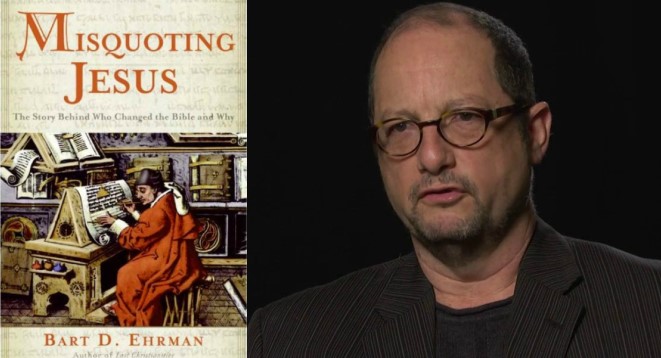
How often do we hear people “explaining” religious beliefs by stating “The Bible says so,” as if the Bible fell out of the sky, pre-translated to English by God Himself? It’s not that simple, according to an impressive and clearly-written book that should be required reading for anyone who claims to know “what the Bible says.”
Bart Ehrman’s Exploration: Who Changed the Bible and Why?
The 2005 bestseller, Misquoting Jesus, was not written by a raving atheist. Rather, it was written by a fellow who had a born-again experience in high school, then went on to attend the ultraconservative Moody Bible Institute in Chicago. Bart Ehrman didn’t stop there, however. He wanted to become an evangelical voice with credentials that would enable him to teach in secular settings. It was for this reason that he continued his education at Wheaton and, eventually, Princeton, picking up the ability to read the New Testament in its original Greek in the process.
As a result of his disciplined study, Ehrman increasingly questioned the fundamentalist approach that the “Bible is the inerrant Word of God. It contains no mistakes.” Through his studies, Ehrman determined that the Bible was not free of mistakes:
We have only error ridden copies, and the vast majority of these are centuries removed from the originals and different from them, evidently, in thousands of ways.
(Page 7). At Princeton, Ehrman learned that mistakes had been made in the copying of the New Testament over the centuries. Upon realizing this, “the floodgates opened.” In Mark 4, for example, Jesus allegedly stated that the mustard seed is “the smallest of all seeds on the earth.” Ehrman knew that this simply was not true. The more he studied the early manuscripts, the more he realized that the Bible was full of contradictions. For instance, Mark writes that Jesus was crucified the day after the Passover meal (Mark 14:12; 15:25) while John says Jesus died the day before the Passover meal (John 19:14).
Ehrman often heard that the words of the Bible were inspired. Obviously, the Bible was not originally written in English. Perhaps, suggests Ehrman, the full meaning and nuance of the New Testament could only be grasped when it was read in its original Greek (and the Old Testament could be fully appreciated only when studied in its original Hebrew) (page 6).
Because of these language barriers and the undeniable mistakes and contradictions, Ehrman realized that the Bible could not be the “fully inspired, inerrant Word of God.” Instead, it appeared to him to be a “very human book.” Human authors had originally written the text at different times and in different places to address different needs. Certainly, the Bible does not provide an an “errant guide as to how we should live. This is the shift in my own thinking that I ended up making, and to which I am now fully committed.”
How pervasive is the belief that the Bible is inerrant, that every word of the Bible is precise and true?
Occasionally I see a bumper sticker that reads: “God said it, I believe it, and that settles it.” My response is always, what if God didn’t say it? What if the book you take as giving you God’s words instead contains human words. What if the Bible doesn’t give a foolproof answer to the questions of the modern age-abortion, women’s rights, gay rights, religious and supremacy, western style democracy and the like? What if we have to figure out how to live and what to believe on our own, without setting up the Bible as a false idol–or an oracle that gives us a direct line of communication with the Almighty.
(Page 14). Ehrman continues to appreciate the Bible as an important collection of writings, but urges that it needs to be read and understood in the context of textual criticism, “a compelling and intriguing field of study of real importance not just to scholars but to everyone with an interest in the Bible.” Ehrman finds it striking that most readers of the Bible know almost nothing about textual criticism. He comments that this is not surprising, in that very few books have been written about textual criticism for a lay audience (namely, “those who know nothing about it, who don’t have the Greek and other languages necessary for the in-depth study of it who do not realize there is even any “problem” with the text).
Misquoting Jesus provides much background into how the Bible became the Bible. It happened through numerous human decisions over the centuries. For instance, the first time any Christian of record listed the 27 books of the New Testament as the books of the New Testament was 300 years after the books have been written (page 36). And those works have been radically altered over the years at the hands of the scribes “who were not only conserving scripture but also changing it.” Ehrman points out that most of the hundreds of thousands of textual changes found among the manuscripts were “completely insignificant, immaterial, of no real importance.” In short, they were innocent mistakes involving misspelling or inadvertence.
On the other hand, the very meaning of the text changed in some instances. Some Bible scholars have even concluded that it makes no sense to talk about the “original” text of the Bible. (Page 210). As a result of studying surviving Greek manuscripts of the New Testament, Ehrman concluded that we simply don’t have the original words constituting the New Testament.
Not only do we not have the originals, we don’t have the first copies of the originals. We don’t even have copies of the copies of the originals, or copies of the copies of the copies of the originals. What we have are copies made later-much later. In most instances, they are copies made many centuries later. And these copies all differ from one another, and many thousands of places . . . Possibly it is easiest to put it in comparative terms: there are more differences among our manuscripts and there are words in the New Testament.
In Misquoting Jesus Bart Ehrman spells out the ways in which several critical passages of the New Testament were changed or concocted. They are startling examples:
A.) Everyone knows the story about Jesus and the woman about to be stoned by the mob. This account is only found in John 7:53-8:12. The mob asked Jesus whether they should stone the woman (the punishment required by the Old Testament) or show her mercy. Jesus doesn’t fall for this trap. Jesus allegedly states “Let the one who is without sin among you be the first to cast a stone at her.”
The crowd dissipates out of shame. Ehrman states that this brilliant story was not originally in the Gospel of John or in any of the Gospels. “It was added by later scribes.” The story is not found in “our oldest and best manuscripts of the Gospel of John. Nor does its writing style comport with the rest of John. Most serious textual critics state that this story should not be considered part of the Bible (page 65).
B) after Jesus died, Mary Magdalene and two other women came back to the tomb to anoint the body of Jesus, according to Mark 16:1-2). They were met by a man in a white robe who told them that Jesus had been raised and was no longer there. The women fled and said nothing more to anyone out of fear (16:4-8). Everyone knows the rest of Mark’s Gospel, of course. The problem with the remainder of the story is that none of it was originally in the Gospel of Mark. It was added by a later scribe. Those additions include all of the following:
Jesus himself appeared to Mary Magdalene. She told the eleven apostles (minus Judas) about this vision, but they did not believe her. Jesus then appeared to the apostles, chastising them for failing to believe. He tells them that those who believe will be saved and those who don’t will be condemned. Then follows a critically important passage of the Bible.
And these are the signs that will accompany those who believe: they will cast out demons in my name; they will speak in new tongues; and they will take up snakes in their hands; and if they drink any poison, it will not harm them; they will place their hands upon the sick and heal them.
Jesus is then allegedly taken up into heaven and sits at the right hand of God, while the disciples go forth into the world to proclaim the Gospel in miraculous fashion.
Without the above passages (which, again, were not written by Mark) the Pentecostals lose their justification for speaking in “tongues.” And the Appalachian snake handlers have no basis for their dangerous practices.
C) John 5:7-8 is the only passage in the entire Bible “that explicitly delineates the doctrine of the Trinity (that there are three persons and God but that all three constitute a single God):
There are three that bear witness in heaven: the Father, the Word and the Spirit and these three are one; and there are three that bear witness on earth, the spirit, the water, and the blood, and these three are one.
Ehrman cites strong evidence that this Trinity passage was entirely concocted and foisted upon Erasmus by outraged theologians who needed support for their prized theological doctrine (page 81).
—
Ehrman reveals numerous other difficulties with the popular assumption that the Bible was perfectly handed down from its original written expression.
Many believers rely fervently on the King James version of the Bible, for instance. They sometimes even say “If the King James was good enough for St. Paul, it’s good enough for me.” Ehrman points out many problems with the King James version, warning that “we need to face up to the facts.”
The King James was not given by God but was a translation by a group of scholars in the early 17th century who based their rendition on a faulty Greek text.
(Page 209).
So what should we make of the Bible? Ehrman argues that the attacks of the New Testament are not simply collections of obvious, self-interpreting words. It’s the same problem we have with other important documents, such as the United States Constitution:
Texts do not simply reveal their own meanings to honest inquirers. Texts are interpreted and they are interpreted (just as they were written) by living, breathing human beings, who can make sense of texts only by explaining them in light of other other knowledge, explicating their meaning, putting the words of the text “in other words.”
(Page 217) The scribes changed the original words of the New Testament by putting them in other words.
In my experience, many people who cherry pick excerpts from the Bible as the proper way to determine what is moral are in utter denial that we don’t have accurate copies of the original writings. Most of them refuse to acknowledge that current popular versions of the Bible contain numerous discrepancies, even compared to the earliest manuscripts we do have. This is on top of the fact that their are hundreds of patent contradictions in the English version of the Bible. To most believers, none of this matters. Stay the course! In fact, in my experience most believers rarely read what the consider to be God’s own inspired word.
Ehrman’s book points out numerous troublesome issues that demand attention even assuming that the original writers of the Bible accurately reported the events described in their original writings (whatever those writings were). The elephant in the room, however, is that none of the authors of the Gospels ever claimed to witness any of the events they were reporting. Further, the extraodinary nature of Biblical claims demands extraordinary proof that ancient self-contradictory writings are simply incapable of providing, except to those of us who believe that the Bible is completely true “because it says so in the Bible.”
For all of those people who continue to go around clentching and thumping those Bibles they bought at Wal-Mart, and for all the rest of us who want to get the story straight, Ehrman’s Misquoting Jesus should be required reading.
[Administrator’s Note: More than 540 comments were quickly contributed to this post, making this page too long to download and display. Therefore, on March 23, 2007, I closed off new comments. Last night (February 4, 2009), I discovered a WordPress plugin that allows me to paginate comments, thereby protecting the site from the sudden and repeated load of 540 comments.
Here’s the good news, then. Anyone who has not yet had his or her say on Bart Ehrman’s book may now jump in at the original post and post a comment. That’s right! If none of the 540 comments that have come before you didn’t address an important aspect of Bart Ehrman’s book, you may now remedy that omission, right here in the comments to this original post. Godspeed. ]


Hi Grumpy,
the biggest mistake that you are making is that you put God on a level of probablility. Can God not operate outside of probability. Is probability perfect? I dont think so since this would be contradictory. God is perfect, thus probability is a human expression of trying to understand what is not perfect. You are looking at everything in a very blind way when it comes to God (which you must do since you are open-minded). Seeing is believeing right? I am sure you would agree. So then you are saying that you can dictate how God would function in our world. It is not probable that you could do that, being that you are not God. 🙂
mnowlan writes: "grumpypilgrim implies that Christians have Hitleresque attitudes?!"
That's not true. I merely pointed out the *historical fact* that Hitler had Christianesque attitudes. He appears to have sincerely believed he was doing God's work. I say "sincerely," because he was raised Catholic, he was an altarboy in his youth, and he wrote about his Christian faith well into his adult years. These are historical facts. Thus, to suggest that he "faked his belief in God" is contrary to available historical evidence. This does not mean all Christians have Hitleresque attitudes, nor did my comment imply that they do. But it does support my argument that if Christianity “causes people to presume that they alone should dictate moral or spiritual values, then it is a very, very bad thing.” Mnowlan has not addressed that assertion.
In fact, mnowlan has not addressed virtually any of my assertions, which is not only disappointing, but also causes me to wonder if s/he has subjected her/his faith to any significant self-examination. Mnowlan is obviously passionate about his/her faith, but seems to not have much framework behind the facade. That's not to suggest it isn't there, but simply that it does not penetrate mnowlan's writing.
Also, I have never (to my knowledge) misspelled mnowlan's screen name, nor suggested that mnowlan is uneducated. Mistaken certainly, misguided perhaps, but not uneducated.
As regards the abortion issue, mnowlan uses "pro-choice" and "pro-abortion" interchangeably, even though these are obviously two VERY different things. To suggest they are equivalent is a lie, but, sadly, it is a lie used by many Christians to distort the truth and slander pro-choice supporters. Its purpose is to create alienation and polarization. It does nothing but undermine thoughtful debate about the issue, which is both a disservice to our society and a sin to mnowlan's own God.
So Grumpy you hase managed to avoid my quetions to you and refer to mnowlan as he/she. Did you not follow the discussion enough to know that mnowlan (he) is married and his wife (she) is very knowledable in the area of evolution?
Tell you what, after you eat another can of spaghettios, come back on and address my questions!!!!!
Good day to you sir….
To Grumpy says: "So Grumpy you hase managed to avoid my quetions to you…." (sic)
I've gone back and read your previous comment, but could find no questions to which you seemed to expect an answer. Mostly, it was just a rant. What were your questions?
You cite interesting statistics…which may indeed be correct. ""you would know about .01% of all the information contained in that library. The numbers here can be performed using your own math since you are a above average genius. So there is still 99.99% ""
However, the implications are not what you might think…
The libraries and universities agree with eachother, so you can multiply the .01% by 3500 (# of universities) and you get 35%. So really, you present a strawman arguement (pretty good try though).
And, I have done some thinking, and I decided I would like to believe in GOD now, after having read the posts of the creationists. However, my common sense just wont let me accept it. Sure I would like to believe in a "benevolent overseer", but it my EDUCATED mind just wont allow it. No matter how many strawman arguements I see, EVIDENCE is how I operate ever since I studied and received my degrees in science.
THERE IS NOTHING YOU CAN TYPE OR SAY THAT WILL MAKE GOD EXIST (for me)>>>I WILL NEED TO SEE SOME PROOF IN A SCIENTIFIC JOURNAL THAT EVOLUTION OR THE BIG BANG THEORY IS WRONG, BECAUSE THESE DIRECTLY CONTRADICT ALL PREVIOUS RELIGIOUS ARGUEMENTS OF CREATION BY A HIGHER POWER…IDIOTS (i say that because i love all living things and want them to be as smart as us scientists). If you want to continue to believe in God, that is wonderful for you, but to me, it would be LYING, something which I am not willing to do.
VIVA ATHEIST!!!!!!!! MOTHER NATURE IS MY GOD!!!!!!I DONT NEED NO STINKING BIBLE KORAN VISHNU EASTER BUNNY SEA SCROLL!!! period
To grumpypilgrim:
My apologies for lumping you together with others who responded as well. Your comments have been some of the more civil of the bunch. You were not the one who misspelled my screen name. You have consistently identified yourself, while others, if you care to read back, have responded to my postings with less than mature responses. It is now difficult to remember which of your comments I responded to. I may have not answered many of your issues directly, though I did respond to your interpretation of the poisonous tree being placed in the garden and your asking what kind of God would place such a thing in the immediate vicinity of a human He knew would eat it any way. If you care to look back I stated that the poison was our disobedience and it was inside of us already. You can read back at my entire response if you care to. I also did respond to your cold, cold world theory with a bit of discussion on my choice to be joyful, even though this fallen world spites me. Many of my previous postings may not have been directly responding to an issue which you initiated, but I did make every attempt to respond back to you when you responded to the content, select as it was, from my postings. My point to you is that the position that there is no God is as much as demonstration of faith as the belief that there is God. Many of the others spewing and spouting off on this site have refused to acknowledge that they are running on limited information with their conclusions. I have admitted I may be wrong in my beliefs but I choose to believe anyway. Can you have the courage to make the same claim? If you find it impossible to believe you may be wrong than your arrogance has consumed you. I believe we are nothing without God. Our nothingness when turned in on itself, implodes into death. When our nothingness meets the everythingness of God, we become something. I believe that most who refuse to see God are simply failing to see the forest for the trees.
Your previous postings were seemingly linking Christianity with the direction that Hitler took it. I would submit to you that while Hitler may have outwardly professed some faith expression, as "sincere" as it may have appeared, that inwardly he was always dark. It is the difference between appearance and substance. One can go to church every day of one's life and never know God in their heart. One can learn the mechanics of religious expression and yet never have a spiritual encounter. The outward ritual has become the expression that people equate with religion and Christianity. Where God is truly at work is on the inside of us, where we can't see.
Adults who force other adults to do something they do not wish to do are not Christians (children are a different story since they must be taught the difference between right and wrong). The adults who force others are individuals with evil hearts that put on the mask of Christianity to hide behind, because they know they can reach the most vulnerable positions if they feign the likeness of a trusting soul. Now defending the innocent cannot be equated with evil. To stop an evil intent from being perpetrated is an act of sacrifice and of love. Shooting down a person, who has a machine gun and killed already, and is pointing the weapon at others, is preserving the lives of those in the line of fire.
Now I would guess that you have not had a personal encounter with God, given your beliefs and discussions above. Can you deny that others have experienced God, simply because you have not? Or are you trying to suggest that we are misinterpreting our experiences? How about we all agree to allow each of us to interpret our own experiences and choose the direction we wish to go? Or do you not trust a Christian to hold such a position? That eventually they will use God as a bludgeon? I am trusting that God will set the record straight for you soon but until He does I must allow you to have your own opinions. I wish you joy and peace, on the inside. I believe God does to. Is that so bad?
Why would you want to kill a baby mnowlan?..thats just sick. Even if someone were raped, it's God's will, they were meant to have that baby, rape or not, and that rapist is G-d's chosen father. Thats what happened to mary, she was raped, and didnt want to tell anyone, thus the "immaculate conception" and Jesus. Don't try and say you don't believe in Jesus if you are a true Christian, and deny the fact that the Lord created us in His image. The bible IS the word of G-d. Joseph was a rapist. Mary…. not virgin. ONE only needs to read the ORIGINAL TEXTS.
CHOICE IS WHAT GOD WANTS DO NOT DISOBEY HIM!!!!
Your local museum will have evidence of evolution in the form of fossils by which you can see for yourself the progressions. Also, mnowlan, you keep spelling the word "waste" wrong, making me suspect that you are fat with a big "waist" to match your imagination.
I was lucky enough to grow up near the Smithsonian Institution, and have indeed visited the museums numerous times. (at first because I was curious about whether we really came from monkeys). The exhibits are great, they show the intricate changes in anatomical structures and explain how we got from "cavemen" to "townhouseman". By refuting evolution, you are refuting the validity of America's Museums as well as its highest educational institutions such as Harvard, Yale, MIT, Berkeley, and also the countless INTERNATIONAL science organizations. Just want you to know what you are up against, and why it is so easy for us to debunk ANY claims against evolution. Whereas, you need to manufacture any of your "evidence" and generally address questions posed to you with hyperbole and ambiguity and my personal favorite, the "strawman".
""Seeing is believeing right? I am sure you would agree.""
I can't speak for Grumpy, but as a scientist and Christian, I strongly disagree. Seeing is not believing (note the corrected spelling) for a scientist, in fact, seeing is just the beginning. Seeing 200 times, and researching and re-testing and then submitting to peer review, allowing for them to test and submit results, have the results evaluated with statistics, THEN and ONLY THEN believing, now we are talking science. So it seems you missed a few steps in "seeing is believEing". Nice try strawman.
All religions are transparent. If you had been born into a different culture, you'd have a different religion. Religion is directly related to geographical location and environment. Therefore, Christianity is a scam.
Atheists do not rely on FAITH, they are able to see through the facade of the Church. Atheists ARE willing to change our beliefs, and in fact, most used to believe in some sort of religion. Obviously I can't stop you from typing the words "atheists rely on faith", just let it be known that we disagree. Atheists rely on facts to make decisions. If you want to call us Science/Nature worshippers, that is closer to the truth, but is really just you trying to make sense of YOUR belief system.
To mnowlan:
Your apology is accepted. Thank you.
I agree with your statement, "…the position that there is no God is as much as demonstration of faith as the belief that there is God." However, I draw a distinction between belief in a god (or gods) and belief in the God described in the Bible. Clearly, there are many things about our Universe that we do not understand, including whether or not there are forms of life and higher intelligence that are utterly beyond our comprehension. Different cultures call these unknowables by different names: "God," "the Great Spirit," "Buddha," "Shiva," "Zeus," etc. Indeed, who can say whether or not they exist?
However, the god of the Bible has a very specific biography, and that biography *is* open to criticism. When I (and many others) examine the Bible with even the tiniest amount of skepticism, I find stories that are:
a) self-contradictory (e.g., that God is murderous yet loving, omniscient yet foolish, omnipotent yet powerless, etc.);
b) ridiculous (e.g., that a god-man was born to a virgin, that mere belief in this god-man guarantees eternal salvation in a magical place, that God would create a god-man to communicate a message that God could have communicated directly, etc.); and
c) unscientific (e.g., that our planet is 6000 years old, that Adam and Eve were spontaneously created in a magical garden of talking animals, that millions of species of animals survived on an Ark for 40 days and 40 nights and then repopulated our entire planet during the last 4500 years, etc.).
In fact, the only way to accept that the god of the Bible exists is by diverting one's attention away from a very large quantity of contrary evidence. Why do people do this? Many do it because their parents and their community demand that they do it, so they do it for their own social and physical survival. (It is no secret that Christianity has spread largely via military and political conquest.) Many others do it because they have encountered some unexplainable experience in life (e.g., surviving a great hardship), which causes them to suspend rational judgment. (It is also no secret that humans are notoriously superstitious and that post-traumatic stress can induce all sorts of delusional thinking.)
In sum, belief in god(s) is a leap of faith, but belief in God (of the Bible) is a leap of irrationality…a leap that virtually no one would take were there not others (or hard circumstances) pushing the person to jump.
As mentioned above, There are many vastly different religions and cultures. It is safe to assume that there are people who were born into, lived their life, and died all within their particular culture. Only exposed to that way of life and never introduced to the christian God. Sure there missionaries who go to third world countries but they are not allowed everywhere.
You can't assume that the christian God has influenced "all mandkind" It may seem that way in the middle of the USA, but it just isn't the case over the globe. If you were born and raised in Iran, you would believe that Islam is the correct religion and would want to spread it across the world. A persons belief as to what is truly correct is largely based upon their location, how they were raised, etc. Which are all influenced by worldly circumstances.
If there is one "correct" religion then all the others must be false. So that begs the question, which one is correct?
If there is no "correct" religion are you willing to devote all of the energy in your life to a religion because you "happened" to be born in middle America where christianity is the majority. I am just trying to understand a person's devotion to do so.
——–
I also want to know why people who are pushing their views on religion typically use such far fetched analogies to get their point across. Jumping into a shark tank, GM radio band? Come on, I think a dose of reality is needed. Also, using such analogies to "dumb it down" for the masses is pretty much just insulting the listeners' intelligence. I have sat in many Sunday morning services to see the same method used over and over and over again. Pastors are trying to turn on that "uh huh – I totally understand" switch in people using such broad examples in which to influence as many people as possible.
Id observes: "If there is one “correct” religion then all the others must be false. So that begs the question, which one is correct?"
I believe the answer is that the correct religion is the one that each person happens to believe in, because that is the one that uniquely comforts him or her. Conveniently, each religion reinforces this sense of uniqueness by teaching that it, alone, is the One True Religion, and that its members, alone, are the sole chosen people of God. In this sense, each religion is as good as any other. Unfortunately, when followers of a given religion start to believe that their religion actually is the One True Religion, life can become quite unpleasant for everyone else.
Does anybody else realize that EVERYONE is an atheist? If you don't believe in Poseidon, Zeus, and Aphrodite then you are an ATHEIST. Christians are indeed Atheists because they have ruled out these and other "Gods".
To grumpypilgrim:
This conversation has been great. As I have said before I hope that you are faced with a supernatural experience that you cannot explain away, because I believe that is the only way that God is going to convince you who He is. You have yet to admit of even the possibility that you may be wrong, because in your mind there is such overwhelming evidence that contradicts the God of the Bible.
If you notice, I am being very careful not to allow the Creation to define the Creator, as most of your arguments are based. There may be contradictions from a human perspective, but I believe that God transcends those appearances of contradiction. For example, I believe that God knows the spiritual "health" (for lack of a better term) of each human being. I believe that He also knows what all the choices in our lives are going to be, before we make them. Now, hang with me, believing that, I think that God knows who is going to choose His salvation and who is not. He doesn't make the choice for us. If He knows that certain individuals are "rotten to the core" so to speak and will always refuse His offer, then they are already dead in His eyes, such as Sodom and Gomorrah. If you are talking about modern day deaths that appear gruesome (physically) or appear to be particularly "cruel", I look at suffering as a spiritual strengthener. It can also be the means at which God gets us to turn to Him. If we remain physically healthy all of our lives, then we think that we are our own keeper and the tendency is to forget about God. Now it may not seem loving to do such things, but I look at it as tough love. If it gets an otherwise rotten individual to repent, then that's a good thing, for the repenter. Now I am not saying all suffering is for this purpose. I guess what I am trying to say is that we can't see or know all the reasons why things happen and therefore cannot judge them as contradictory, at face value.
Extremely interesting article and discussions here. I can sympathize with a lot that is being expressed here on this page. Thanks to each of you for contributing to the conversation.
If anyone is interested in another take on things (or perhaps reading an echo of their own thoughts) pick up "The New Revelations" by Neale Donald Walsh or maybe "Home With God".
Regardless of your take on the actual "source" of the material in those books I think the material itself is worth your consideration.
Peace,
JD
To mnowlan:
I have also enjoyed our discussion, though of course for reasons that differ from yours. It is good we each take away things we find helpful.
As regards my being faced with "a supernatural experience that [I] cannot explain away, because…that is the only way that God is going to convince [me] who He is," as I have previously stated, such experiences are commonplace to *everyone*, regardless of our spiritual beliefs or prayers. Accordingly, there is no good reason to attribute them to the divine intervention of some invisible supernatural entity; they are simply inherent properties of our existence. Believers simply choose to anthropomorphize these experiences by imagining that a human-like god causes them, something that I find excessively ego-centric.
You also suggest that, "There may be contradictions from a human perspective, but I believe that God transcends those appearances of contradiction." I find such excuses utterly ridiculous, because they would propose that we ignore *any* amount of contradiction. If the standards by which we judge whether or not any gods exist are that loose, then we could equally apply them to any god at all: Zeus, the Flying Spaghetti Monster, or even the god mnowlan or the god grumpypilgrim. My post about Christian selection bias (http://dangerousintersection.org/?p=449) discusses this in more detail.
In sum, the Bible requires its followers to adopt all sorts of absurd beliefs concerning human existence, as well as all sorts of even more absurd excuses for the many contradictions that result from those absurd beliefs. Against this mountain of absurdities, we have a naturalistic explanation for human existence that contains virtually no absurdities, but that lacks the pleasing comforts that the Bible offers; e.g., a divine "meaning" to our existence (but see http://dangerousintersection.org/?p=362) and a pleasant life-after-death fantasy. What I find significant is that there is basically just one very logical naturalistic explanation, whereas there are tens of thousands of wildly different, wildly irrational supernatural ones. Why anyone would reject the former and select one of the latter (and then try to convince others that the one selected is somehow superior to all the others in any significant way) is simply beyond my comprehension.
I believe the answer is lack of empathy. The ability to put oneself in another's shoes, completely, as if you were actually that person. In sociology class is where I learned that there are about 30,000 other religions than Christianity. The wise instructor posed the question to us…If you were born in India, would you worship cows? Many of us laughed and said no, but by the end of the semester, we all agreed that if we had been born in India, we would indeed be likely to worship cows. The cow has been critical to the Indian culture for thousands of years for all elements of survival (not just for food) thus, the folklore and the culture/religion undoubtedly portray the cow in a sacred light. Cow=God.
So, mnowlan and affiliated preachers are really just too focused on themselves, and are unable to empathize with other cultures.
Scholar (not a sermon, just a thought) 😉
ps…I think Hitler lacked empathy
Thoughts from a friend (a fellow atheist),
My argument against God was that the universe seemed so cruel and unjust. But how had I gotten this idea of just and unjust? A man does not call a line crooked unless he has some idea of a straight line. What was I comparing this universe with when I called it unjust? If the whole show was bad and senseless from A to Z, so to speak, why did I, who was supposed to be part of the show, find myself in such violent reaction against it? A man feals wet when he falls into the water, because man is not a water animal: a fish would not feel wet. Of course I could have given up my idea of justice by saying it was but a private idea of my own. But if I did that, then my argument against God collapsed too — for the argument depended on saying that the world was really unjust, not simply that it did not happen to please my private fancies. Thus in the very act of trying to prove that God did not exist — in other words, that the whole of reality was senseless — I found I was forced to assume that one part of reality — namely my idea of justice — was full of sense. Consequently atheism turns out to be too simple. If the whole universe has no meaning, we should never have found out that it has no meaning: just as, if there were no light in the universe and therefore no creatures with eyes, we should never know it was dark. Dark would be without meaning.
Everything is controlled by God. The air you breath, the food you eat, the mountains, the oceans, the heavens. God's will acts in mysterious ways, but it definately exists. I beleive that all our thoughts are monitored and recorded by God and we will all face Judgement. I feel sorry for you atheists who won't make it into Heaven because you don't beleive in God. To say that we "evolved" from a baboon is downright crazy. God made all the creatures, it says so right in the FIRST CHAPTER of the bible! If you don't beleive the bible, than you are just fooling yourself. If you notice, I am being very careful not to allow the Creation to define the Creator, as most of your arguments are based. Their may be contradictions from a human perspective, but I beleive that God transcends those appearances of contradiction. God controls all of our thoughts, just ask HIM and he will tell you. Thank you all, and may God Bless.
To grumpypilgrim and the following tagger (Scholar?):
I can admit that if I were born in India I probably would follow whatever religion my family and/or community abided by, because I would likely know no other way. But there are many who are living throughout the world in such circumstances who, when approached with the Good News of Jesus, turn away from their animistic worship and worship the one who made the cow, and us as well. They are able to see a bigger picture, rather than their own focused (limited) interpretation and turn away from other forms of worship when given a choice. I am not saying that all who are given the choice choose Jesus, obviously not.
Now it may be wishful thinking to believe that there is an eternal life after this earthly one, but I would argue that it is not ego-centric in the manner that it is delivered by God in the Bible. If anything it is the opposite. To experience this life we are instructed by Jesus to die to ourselves. We are to turn away from seeking selfish pleasures, in whatever form they take. We cannot achieve this eternal life, but must accept it for what it is, a gift to all from God. This negates all individual strivings that exalt the individual at the expense of another. You can't take it away from someone else. You can't earn it, because earning it means that you are attempting to claim control of the gift without receiving it.
If you look back at the Bible there are numerous stories of God putting down man's exaltation of himself, to show the individual that the "one" is not more important than the "other".
If I understand you correctly you (grumpypilgrim) claim that setting aside any contradiction opens the door to worship of any thing, or any "god". That may be true if it were up to us to define the god. The message in the Bible is that it is not up to us to define God, it is up to Him to define Him. The Bible itself exemplifies the authority of Life coming from outside of our control. All our problems come from our vain attempts to seize control over that which is not ours to control. In doing so we isolate ourselves. Life is about integration and connection and spirit.
With all of your logical conclusions you have yet to admit even the possibility that YOU may be wrong, which is telling to me. I believe I asked this before but why do you choose to name yourself "grumpy"? Do you feel you are living life to the fullest? Are you optimistic? Do you have hope? I would suggest that your perspective on life is really focusing on death. You do also include the name "pilgrim" which could mean a number of things. Either you feel you are on a journey to somewhere, or perhaps it is because you feel alone. Perhaps that is why you are grumpy. I know that I am never alone. You may suggest that it is an indication of some multiple personality disorder, but you will see, someday, it is not.
Many wise Christians, when confronted with the GOOD NEWS OF ATHEISM, do the right thing and put their egocentric CHRISTIAN beliefs where they belong, IN THE TRASH!!!!!!!!
Mnowlan, your posts are too long and self-absorbed for me to read critically. You are obviously brainwashed by your Church (kudos to them for a job well done). One day you will admit that you are wrong about Christianity being "the One True" religion. Thanks, and may "God" bless you. (God being a figment of your imagination of course).
Froggy75
The Great Christian Scholar Mnowlan Writes:
"It may be wishful thinking to beleive that there is an eternal life after this earthly one, but I would argue that it is not ego-centric in the manner that it is delivered by God in the Bible.
I beleive that He also knows what all the choices in our lives are going to be, before we make them. Now, hang with me, beleiving that, I think that God knows who is going to choose His salvation and who is not. He doesn’t make the choice for us. He knows that certain individuals are “rotten to the core” so to speak."
Atheist Response:
I have “good Christian” values, however I do not believe in God anymore.
Here are a few links which provide the basis of my decision against a Creator.
http://www.becominghuman.org/
http://www.britannica.com/ebc/article-9367530
Genetic evidence points to an evolutionary divergence between the lineages of humans and the great apes on the African continent 8–5 million years ago (mya). The earliest fossils considered to be remains of hominins (members of the human lineage) date to at least 4 mya in Africa; they are classified as genus Australopithecus. The next major evolutionary stage, Homo habilis, inhabited sub-Saharan Africa about 2–1.5 mya. Homo habilis appears to have been supplanted by a taller and more humanlike species, Homo erectus, which lived from c. 1,700,000 to 200,000 years ago, gradually migrating into Asia and parts of Europe. Between c. 600,000 and 200,000 years ago, Homo heidelbergensis, sometimes called archaic Homo sapiens, lived in Africa, Europe, and perhaps parts of Asia. Having features resembling those of both H. erectus and modern humans, H. heidelbergensis may have been an ancestor of modern humans and also of the Neanderthals (H. neanderthalensis), who inhabited Europe and western Asia from c. 200,000 to 28,000 years ago. Fully modern humans (H. sapiens) seem to have emerged in Africa only c. 150,000 years ago, perhaps having descended directly from H. erectus or from an intermediate species such as H. heidelbergensis.
The message in the Bible is that it is not up to us to define God, it is up to Him to define Him. The Bible itself exemplifies the authority of Life coming from outside of our control. All our problems come from our vain attempts to seize control over that which is not ours to control. In doing so we isolate ourselves. Life is about integration and connection and spirit.
I hope this helps you in your journey Mnowlan, someday you will see through the charade. May your imaginary God bless you until you realize the TRUTH, at which point may you live long and prosper (in lieu of Heaven, another myth to which you seem to still cling).
I just finished reading the last post by Mnowlan, WHAT a CRACKPOT!!! He obviously has voices in his head, poor misguided sole.
"You may suggest that it is an indication of some multiple personality disorder, but you will see, someday, it is not."—mnowlan
okay buddy, tell the voices to behave til then
🙂
Hey brother,
I admire your attempts to show love to an unloving crowd. They slash out at you because they believe that they really know the absolute truth of a non-existant God. Remember that the bible teahes us that if you are truly a christian then the world will hate you. Again, the bible showing accuracy.
An atheist should remember this simple fact the nest time they are at the grocery store:
In charge of the checkout counter is death itself. After your selection is made, you pay with your life. Whether there is anything outside the exit door and what happens there is the big question.
Everything that comes into existence owes its existence to something else.
Fact: Information is communication between minds.
Specific order — is simply a string of repeated information, CAT CAT CAT, for example. This is a naturally occurring kind of order and can be found in things like crystals, nylon, or snowflakes.
Unspecified complexities — are non-repetative and random. They are also naturally occurring. Things like the sound of howling wind and the shape of a rock are good examples.
Specified complexities — are non-repetative and non-random. They are not naturally occuring. In contrast to the howling wind and the shape of a rock, examples of specified complexities would be music or a statue. Even the sentence you are reading right now is an example of specifically complex order. The way we recognize a specified complexity is if it is contingent. Contingency is the chief characteristic of information. A rocks shape is determined by the laws of nature that are brought to bear on it by its circumstances. there are no other possibilities for its shape. However, a statue can be any shape its sculpter wants it to be. It is not determined, it is contingent. If you were asked, "is there any information on this page?" what would your answer be? If you answered "no" then you are correct; there is no information on this or any other page in the world. The only things on this page are squiggles of ink (albeit specifically ordered). The point I am trying to make is that information exists because God exists. I can expand on this, but my family comes first and they are in want of me.
Please let me know if you would like for me to expand on this subject as I can and will.
If not,
have a great evening!