Jonathan Haidt Describes Today’s Conservatives and Liberals

I've closely followed the writings of Jonathan Haidt. His conclusions are closely tied to scientific findings. He crosscuts the current American political divide. He is hopeful that we will find our way as a country.

In this recent article at The Atlantic, "Jonathan Haidt Is Trying to Heal America’s Divisions: The psychologist shares his thoughts on the pandemic, polarization, and politics," Haidt explains what has gone wrong with many of those who consider themselves to be liberals and conservatives. What they have in common is authoritarianism populism:

Haidt laments the state of contemporary American politics, believing that on both the right and the left we’re seeing populism that responds to real problems but in illiberal ways. “On the right,” he said, “the populism there is really explicitly xenophobic and often explicitly racist … I think we see strands of populism on the right that are authoritarian, that I would say are incompatible with a tolerant, pluralistic, open democracy.”

Looking in the other direction, Haidt says, “we’ve messed up the word liberal and we’ve used it to just mean ‘left.’ I’ve always thought of myself as a liberal, in the John Stuart Mill sense. I believe in a society that is structured to give individuals the maximum freedom to construct lives that they want to live. We use a minimum of constraint, we value openness, creativity, individual rights. We try hard to maximize religious liberty, economic liberty, liberty of conscience, freedom of speech. That’s my ideal of a society, and that’s why I call myself a liberal.”

But on the left, Haidt said, “there’s been a movement that has made something else sacred, that has not focused on liberty, but that is focused instead on oppression and victimhood and victimization. And once you get into a framework of seeing your fellow citizens as good versus evil based on their group, it’s kind of a mirror image of the authoritarian populism on the right. Any movement that is assigning moral value to people just by looking at them is a movement I want no part of.”

Haidt went on: “I think this is a very important point for us to all keep in mind, that left and right in this country are not necessarily liberal and conservative anymore. On the left, it’s really clear that there are elements that many of us consider to be very illiberal; and on the right, it’s hard to see how Trump and many of his supporters are conservatives who have any link whatsoever to Edmund Burke. It’s very hard for me to see that. You know, I would love to live in a country with true liberals and true conservatives that engage with each other. That, I think, is a very productive disagreement. But it’s the illiberalism on each side that is making our politics so ugly, I believe.”

The key quote from the passage above: "Any movement that is assigning moral value to people just by looking at them is a movement I want no part of.” This is a modern version of MLK's classic advice that is scorned by many modern day "liberals": "I have a dream that my four little children will one day live in a nation where they will not be judged by the color of their skin, but by the content of their character. Why has this beautiful sentiment become so difficult today?

Continue ReadingJonathan Haidt Describes Today’s Conservatives and Liberals

Darrin Patrick’s Final Sermon: Life is Precious and Fleeting

A friend of mine, Darrin Patrick, was a pastor of a St. Louis Church called "The Journey." He died suddenly two days ago. The Post-Dispatch reports this: [N]o official cause of death has been released. The gunshot wound appeared to be self-inflicted; foul play is not suspected." I don't know anything further than this cryptic account.

I hadn't seen Darrin for several years, but I could have tried harder to connect with him again. That's one of the crazy things that life does, right? You don't make enough effort and then, suddenly, it's too late. This is not the first time this has happened to me. Perhaps this was Darrin's last sermon: life is truly precious and fleeting and you need to seize the day and make real efforts to maintain your connections to your people. He would likely add that it is critically important to be creative in those connections, because it was a significant part of his mission to support artists and writers.

When we last visited, Darrin spoke highly of his wife Amie and their kids, but I hadn't met them. Yesterday, Amie posted a sad sweet announcement on his FB page, and I just posted a short comment, which I will paste below. Mine was the 918th comment to her announcement. For another glimpse at what an unusual and innovative person Darrin was, check out this post at Dangerous Intersection.  In fact, I'm going to spoil it: I would bet you don't know of any other pastor who invited an atheist to discuss skepticism in front of hundreds of parishioners as part of a church service.

Amie, you and I have never met, but I am one of the many people touched by Darrin. By no means am I the sort of person that would be expected to fit into Darrin's flock, but I suspect that Darrin was surrounded by such people. He challenged me and I challenged him back and that's how he wanted it. That's because he was a real person, filled with intelligence, good-heartedness and energy but also nuance. I'm so sorry for your loss. Please know that I will miss him too. He changed me for the better and that's the bottom line.

Continue ReadingDarrin Patrick’s Final Sermon: Life is Precious and Fleeting

God, the Cartoon Version

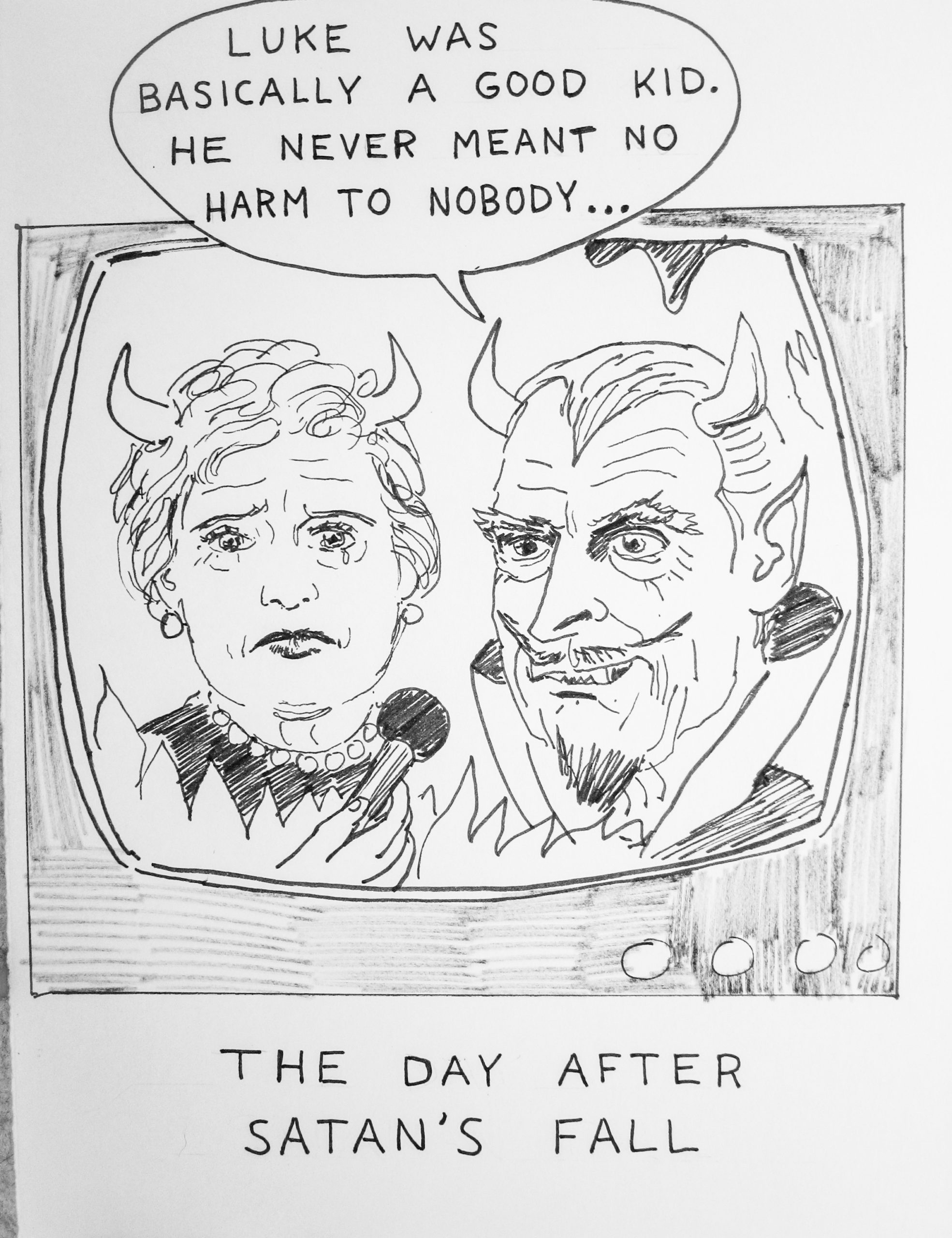
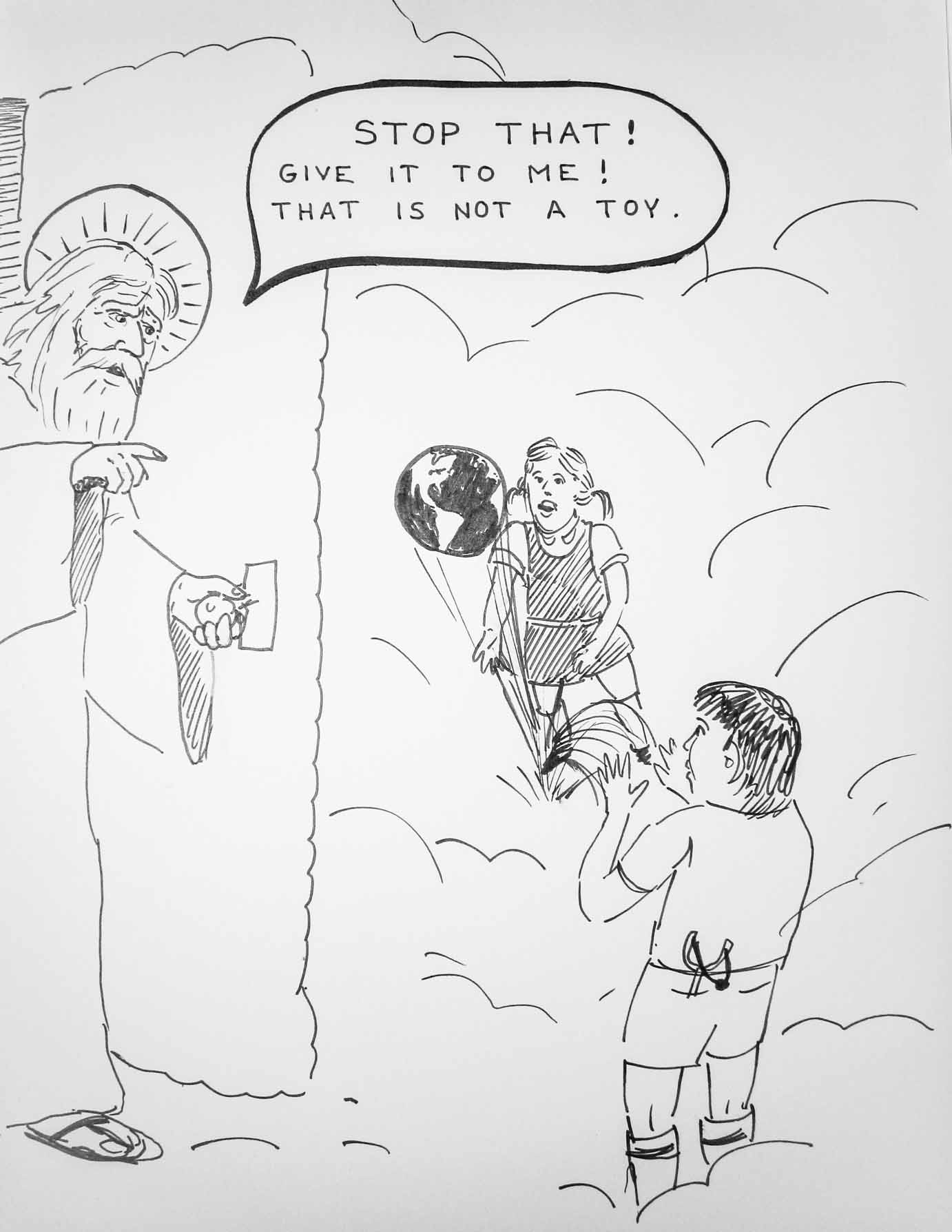
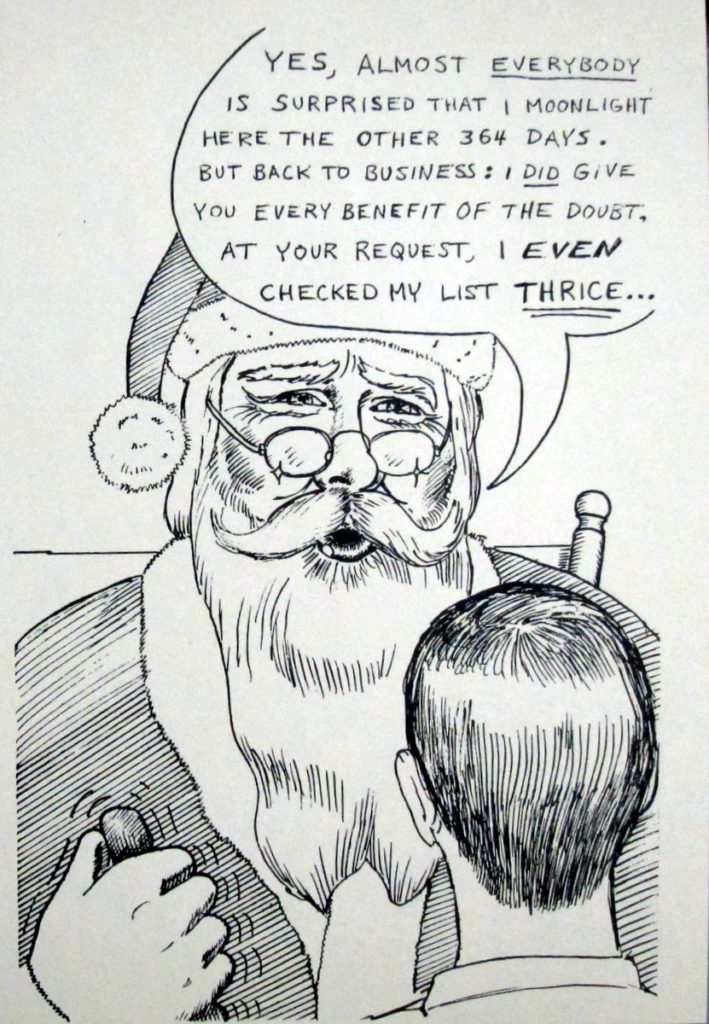
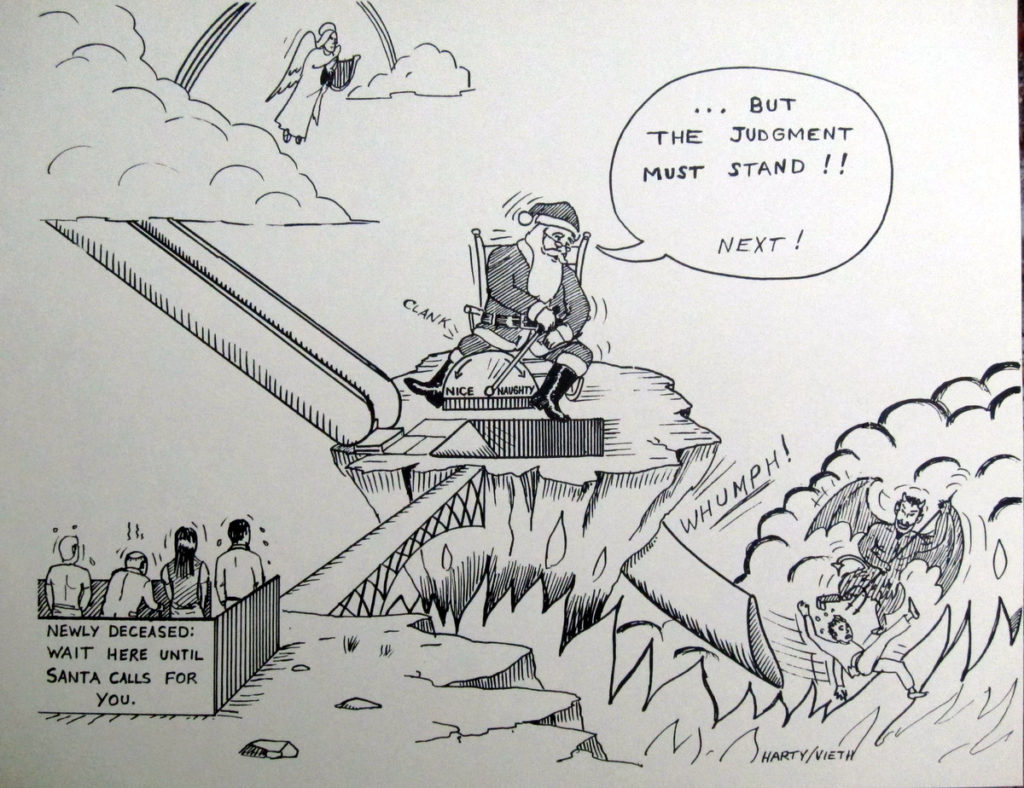
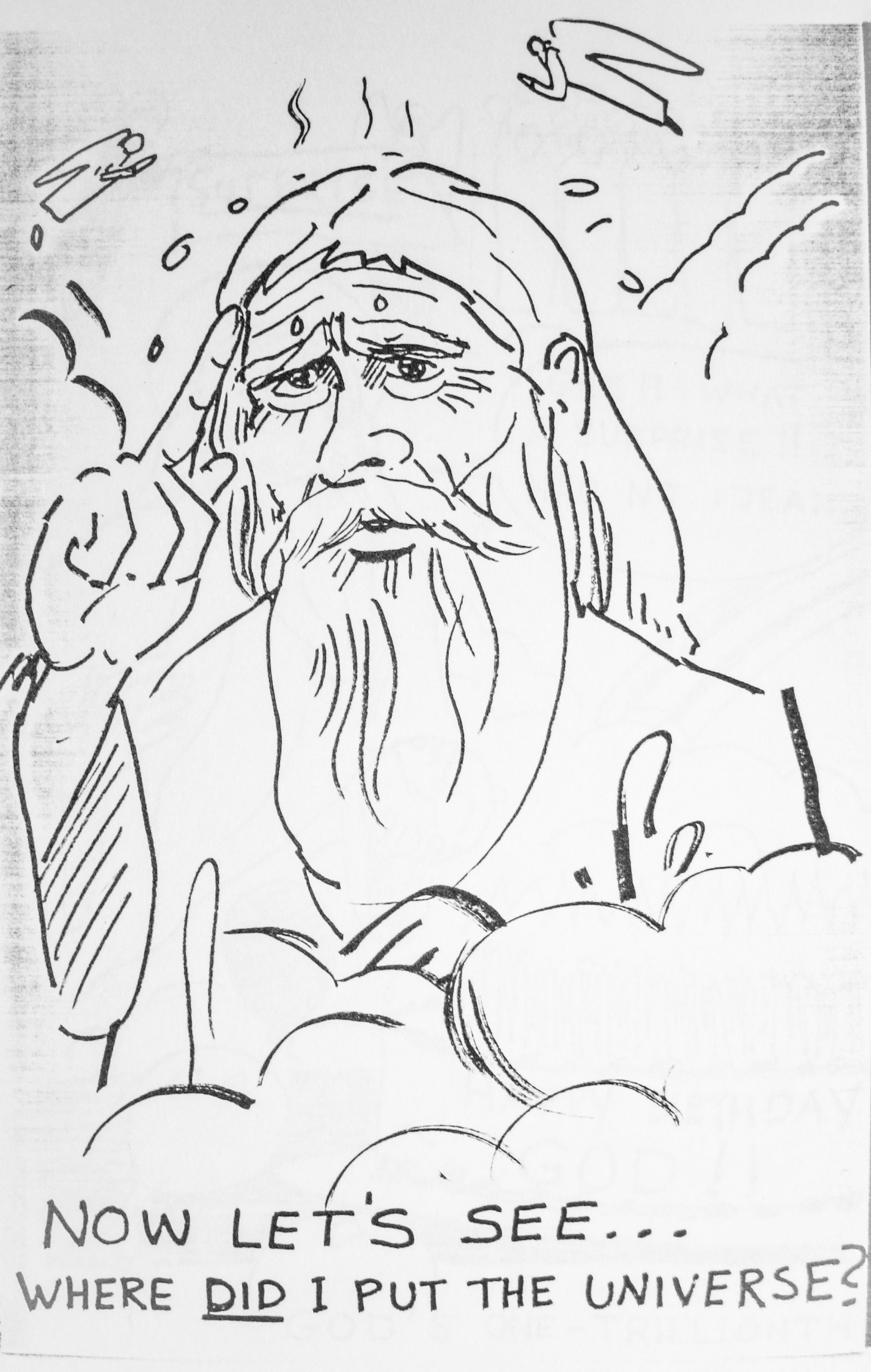
Back in the 1970s, I went to high school with Mike Harty at Mercy High School in St. Louis, a co-ed Catholic school. We hit it off immediately back then and we remain good friends today. One thing I enjoyed and admired about Mike is his ability to draw. After high school, as young adults, we periodically got together to draw cartoons. I threw a lot of bad ideas his way and he tried to make them funny. We tried to get them published by several newspapers and syndicates, but we weren't successful.

We've kept those cartoons and I recently pulled them out of mothballs. As I looked at them yesterday, I found that about half of them still seemed funny to me. Yesterday I called Mike and we agreed to risk yet more public rejection/humiliation by publishing some of these cartoons on my website, Dangerous Intersection as well as featuring some of them on FB. We'll publish these in six small batches, starting this this group on the topic of God. I smile as I look at these because Mike has always been religious and I have never been, yet we both enjoyed batting around these ideas. We hope you enjoy some of these too.

One of our two-panel Christmas Cards focused on the related topic of eschatology:

Here is a gallery of our other cartoons on the topic of God:

[More . . . ]

Continue ReadingGod, the Cartoon Version

Parents, Plants and Darwin’s Dangerous Idea

Life has been too good to me recently, filling me with more upbeat energy than usual. That type of good fortune can make it difficult to sit still and concentrate on my work, so yesterday I took my monkey-mind for a brisk walk to the Missouri Botanical Garden. I then meditated while sitting on a park bench in front of a huge tree. I didn’t know that this big tree would trigger vivid thoughts about my parents and my attraction to dangerous ideas.

My dad was an engineer who designed weapons of war for McDonnell-Douglas. Now deceased, he was proud of his ability to analyze problems and to come up with answers, even when he was considering life’s heaviest mysteries. He also embraced many of the pat answers offered by his religion and repeatedly tried to shame me into accepting them, which led to the extremely strained relationship I had with him.

My mom is very much alive and, at age 87, she still lives independently. She did not work outside of the home, was not hardened by the outside world, and was not comfortable challenging the arguments and lectures my dad launched from his seat at the family kitchen table. Far from those dinnertime arguments between her husband and her teenage son, however, she allowed her mind to freely explore ideas based on a rather unfettered sense of curiosity. My mom often asked me simple questions around the house, not realizing that simple questions would be the ones most likely to challenge my comforting inner narratives and presumptions. Simple questions can even be dangerous.

Friedrich Nietzsche recognized that truth is dangerous and that it took courage to determine what is true. Are you willing to question your most basic beliefs? For Nietzsche, real philosophizing was a demanding and dangerous endeavor that many people simply cannot endure.

From her perspective, my mom simply asked questions about things that seemed interesting, like “What is time?” Or “Is more always better?” Or “What if the beliefs of Buddhism are correct?” To this day, she looks puzzled whenever I thank her for being such a free-thinker (which she was, well before that term became popular). Regardless, her dangerous questions took root in me and they prepared me to appreciate many of the extraordinary aspects of life’s “ordinary” things. Her questions were probably a big reason why I majored in philosophy and psychology and, ultimately, created my website, Dangerous Intersection. [More . . . ]

Continue ReadingParents, Plants and Darwin’s Dangerous Idea

Bertrand Russell Tossed me a Life Preserver in 1943, Before I Was Born

As a 17-year old boy, I was incredibly lucky to find a book by Bertrand Russell at the local public library.  This was a key time in my development--I was skeptical about many things back then, but I felt alone. The people in my life were earnestly telling me things about life, politics and religion that didn't make any sense to me and discussions with them mostly resulted only in strange and condescending lectures.

I remember the joy and relief I felt when I first started reading the first paragraph of Russell's 1943 essay, "AN OUTLINE OF INTELLECTUAL RUBBISH," which was a chapter in a book I found at the library.

Man is a rational animal-so at least I have been told. Throughout a long life, I have looked diligently for evidence in favour of this statement, but so far I have not had the good fortune to come across it, though I have searched in many countries spread over three continents. On the contrary, I have seen the world plunging continually further into madness. I have seen great nations, formerly leaders of civilization, led astray by preachers of bombastic nonsense. I have seen cruelty, persecution, and superstition increasing by leaps and bounds, until we have almost reached the point where praise of rationality is held to mark a man as an old fogy regrettably surviving from a bygone age. All this is depressing, but gloom is a useless emotion. In order to escape from it, I have been driven to study the past with more attention than I had formerly given to it, and have found, as Erasmus found, that folly is perennial and yet the human race has survived. The follies of our own times are easier to bear when they are seen against the background of past follies. In what follows I shall mix the sillinesses of our day with those of former centuries. Perhaps the result may help in seeing our own times in perspective, and as not much worse than other ages that our ancestors lived through without ultimate disaster.


Russell's full essay is much longer than this excerpt and it is filled with many other pointed observations, permeated throughout with Russell's wry sense of humor. Until the teenaged version of me saw this essay, I thought I was alone in my skepticism. That's a difficult place to be trapped for a teenager. This was in the 1970's, long before the Internet. I sometimes wondered whether there was something wrong with me. I didn't think so, but when I would express doubts about religion, for example, everyone else got quiet and started to look nervous The only exception was my mother, who often had the courage to ask simple questions. As I am writing this article, my mother is a vibrant and independent-living 87 year old.  How lucky I am in that regard, too. I sometimes thank her for her unbridled curiosity and "blame" her for the fact that I became somewhat subversive.  She laughs and says she doesn't know what I'm talking about.

Reading this essay was a joyride for the 17-year old version of me. I discovered that I was not alone. I learned that it is critically important to speak up, even when you are the only one in the room taking a controversial position. When I first read Russell's essay, I learned that I was not crazy. This was the beginning of a whole new way of thinking for me, and it gave me the courage to take stronger stands on my own against things that made no sense to me.

Continue ReadingBertrand Russell Tossed me a Life Preserver in 1943, Before I Was Born