
What it means to feel certain: review of “On Being Certain”

Consider these words of George W. Bush, spoken in Rome, in 2001

“I know what I believe. I will continue to articulate what I believe and what I believe — I believe what I believe is right.”

This is not an isolated case. These sorts of fact-free assertions occur all the time. Consider another example, this one a hypothetical. Assume that you overhear some guy claiming that homeopathic medicine [or fill in the blank with your own favorite snake oil treatment] is effective and powerful. Because you suspect that he doesn’t have his facts right or that his reasoning is unreliable or invalid, you speak up and question his statement. He responds by saying something like the following:

I’m certain I am correct. I’m absolutely sure that I’m right. I have no doubts about this.

Despite the many claims of certainty that we hear, we often remain unconvinced, and for good reason. There’s a saying, “Show, don’t tell.” Show me the facts so that I myself can see whether I am certain. Don’t just tell me that you’re certain. Nonetheless, people constantly make claims that are based on inner feels of certainty, quite often wild and unsubstantiated claims about politics and religion, as well as claims about science, history or just about everything else.

People often use such claims that they have a “feeling of certainty” as bootstraps to convince themselves that they are even more certain than they actually are, thereby completely dispensing for the need for meticulous …

Share

Continue ReadingWhat it means to feel certain: review of “On Being Certain”

Has Earl Doherty proved that Jesus did not really walk on earth?

On several prior posts, I’ve referred to Earl Doherty’s extensive website, Jesus Puzzle. I’ve visited Doherty’s site numerous times. I’ve pulled out a Bible and double-checked the passages he cites, especially those of the Epistles, the only Christian writings that were written during the 40 years subsequent to the alleged death of Jesus. I’ve admired Doherty’s writing for many reasons. He readily admits where he is engaging in speculation or where guesswork is involved. On the other hand, where he claims to have strong arguments, he backs up his claims with citations.

Doherty’s main conclusion is that the existence of Christiantity was not based on an historical Jesus. Rather, it was based on a mythological Jesus:

“Jesus” (Yeshua) is a Hebrew name meaning Savior, strictly speaking “Yahweh Saves.” At the beginning of Christianity it refers not to the name of a human individual but (like the term Logos) to a concept: a divine, spiritual figure who is the mediator of God’s salvation. “Christ,” the Greek translation of the Hebrew “Messiah,” is also a concept, meaning the Anointed One of God (though enriched by much additional connotation). In certain sectarian circles across the Empire, which included both Jews and gentiles, these names would have enjoyed a broad range of usage. Belief in some form of spiritual Anointed Savior—Christ Jesus—was in the air. Paul and the Jerusalem brotherhood were simply one strand of this widespread phenomenon, although an important and eventually very influential one. Later, in a myth-making process of its …

Share

Continue ReadingHas Earl Doherty proved that Jesus did not really walk on earth?

Why Choose Naturalist Explanations Over Biblical Creation?

Discussions in the comment sections of many posts on this site chaotically tend toward the strange attractor of one generally off-topic issue: Why does Creation/Evolution seem correct to you? It is usually a discussion between Creationists who believe that the scientific conclusions are based on faith, and Naturalists who believe that the Scientific Method is best tool ever invented to extract sense from chaos.

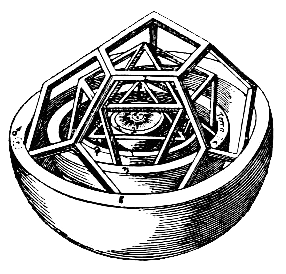
Kepler's UniverseIn the beginning, Natural Philosophers (now called Scientists) in the West all believed in the Bible. Bishop Ussher gave the final word on the age of the universe according to the Bible in the early 1600’s, and the Church had all the answers. But then the idea emerged that one can actually test Aristotelian conclusions (purely rational and based on “what everybody knows”) with observations. Copernicus demonstrated with careful observation and applied math around 1600 that only the moon itself orbited the Earth, and all the other planets circled the Sun. The church accepted this, as a philosophical observation, irrelevant to the place of Man in the Universe. Then Galileo made a gadfly of himself by publishing popular books mocking the Pope for publicly continuing in the preaching of Geocentrism when it was clear, with the aid of a telescope, that not only did the planets orbit the sun, but that some of those planets had moons of their own. Many moons, placed where Man couldn’t even see them without modern technology.

Well, it just snowballed from there. Newton, a devout Christian, developed math in …

Share

Continue ReadingWhy Choose Naturalist Explanations Over Biblical Creation?

Bill Maher talks about Religulous with Jon Stewart

Bill Maher talks about his new movie, Religulous, with Jon Stewart starting at about 8:50 minute mark of this video. I haven't seen the movie yet, but Maher has apparently centered his movie around his asking of simple questions that are often not asked of Believers.   He refers to…

Continue ReadingBill Maher talks about Religulous with Jon Stewart

Why institute a blog comment policy that prohibits preaching?

Here at Dangerous Intersection, I recently instituted a new wrinkle to the commenting policy. The new policy prohibits comments to the extent that they constitute "preaching." It goes against my grain to censor. I want conversations at the site to be vigorous and from the heart, even when they get…

Continue ReadingWhy institute a blog comment policy that prohibits preaching?