
Why Choose Naturalist Explanations Over Biblical Creation?
October 8th, 2008 by Dan KlarmannDiscussions in the comment sections of many posts on this site chaotically tend toward the strange attractor of one generally off-topic issue: Why does Creation/Evolution seem correct to you? It is usually a discussion between Creationists who believe that the scientific conclusions are based on faith, and Naturalists who believe that the Scientific Method is best tool ever invented to extract sense from chaos.
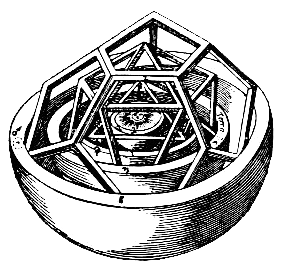
In the beginning, Natural Philosophers (now called Scientists) in the West all believed in the Bible. Bishop Ussher gave the final word on the age of the universe according to the Bible in the early 1600’s, and the Church had all the answers. But then the idea emerged that one can actually test Aristotelian conclusions (purely rational and based on “what everybody knows”) with observations. Copernicus demonstrated with careful observation and applied math around 1600 that only the moon itself orbited the Earth, and all the other planets circled the Sun. The church accepted this, as a philosophical observation, irrelevant to the place of Man in the Universe. Then Galileo made a gadfly of himself by publishing popular books mocking the Pope for publicly continuing in the preaching of Geocentrism when it was clear, with the aid of a telescope, that not only did the planets orbit the sun, but that some of those planets had moons of their own. Many moons, placed where Man couldn’t even see them without modern technology.
Well, it just snowballed from there. Newton, a devout Christian, developed math in the late 17th century that accurately modeled the behavior of pretty much everything that man could observe at the time (the Laws of Motion). And those models showed how things naturally happen, without need for divine intervention.
Then in the mid-19th century, J.C. Maxwell developed similar rules to explain electromagnetism (light, electricity, radio, etc). Discovery after discovery kept challenging the universally held beliefs in many areas. Gravity wasn’t related to nor caused by sin. Demons didn’t cause disease. The basic elements weren’t Earth, Air, Fire and Water. Air was a complex substance, but caloric and phlogiston weren’t. The planet and the universe steadily got wider and older and more complex as more and more evidence collected by true believers forced them to acknowledge that nature is as it is, and not how interpretations of the ancient texts described it.
By the 1700’s, many Christians were becoming Deists; they believed in an omnipotent Creator, but not in the meddling and insecure deity portrayed by most western religions. God as a watchmaker, who wound up the universe, and then sat back to watch it play out.
By the start of the 20th Century, there was a problem. The Universe (what we now call our galaxy) was only measured to be 100,000 light years across, yet every measure of geology pointed to many millions –hundreds of millions by some measures– of years of history on the Earth. How could the Earth be orders of magnitude older than the universe? Then came General Relativity, quasars, and the red shift. Suddenly the universe exploded out to billions of years across/old. And then quantum and then nuclear theory led to unstable isotopes being used as accurate clocks. The planet rose to billions of years old, too. When we brought samples back from the moon, they indicated the same age as Earthly rocks. Conflict resolved.
But there is still a small group of people who hold tight to the 17th century interpretation of a literal Genesis story. This movement emerged in the United States after the Scopes Trial in the 1920’s, depending on the idea that a Young Earth precludes the principle that species could have evolved; there wasn’t enough time. Odd schools of thought therefore emerge (Flood Geology, Intellignet Design, etc), that try to sound scientific, yet not actually using that methodology developed centuries ago.
We see comments saying that “old Earth” evidence is only found because the discoverers believe in it. They didn’t always. Most of the earlier and still useful evidence of the age of the Earth was found by those who didn’t initially believe in their own results. And when they did, they had to fight ridicule before the disbelieving community. It is the method that prevailed, not the authority of the discoverer. Nor are convincing arguments much good against the method. Scientists are often wrong. Very often. The scientific method records these wrong results so that they can be checked. And they are. And eventually and asymptotically, the correct ideas are refined and prevail.
Unfortunately, the public only sees the tip of the science iceberg. There are big, splashy announcements of bold ideas. Like Cold Fusion. That was a case when would-be discoverers did an end run around the method and announced to the public before their results could be independently checked. A quiet retraction was printed when the dozens of labs that should have been contacted first, demonstrated universally that the first announcement was based on a procedural error. But research continues. That they didn’t demonstrate something new does not imply that there is nothing new to be discovered.
I blame the media. Remember Halley’s comet? The previous time around, it was a gaudy show. In the 1980’s most astronomers said that it might be visible. The media covered it as the show of the century, assuming that it would be the same show. Technically, it was the same show. But this time we only had partially obstructed nosebleed seats, rather than right on the gridiron. Actual scientists knew this, but their story wasn’t newsworthy. When it turned out to be exactly what the scientists said, the public blamed the scientists for misleading them.
Science is portrayed to the public as a mixture of magic and authority. It is neither. It is a process whereby thousands of brilliant and highly trained competitors are all trying to prove each other wrong, or to come up with a new twist. After a generation or two of consistently and universally failing to prove that something is wrong, then it becomes provisionally accepted: A “theory”. Then it continues to be tested. Nothing is accepted on authority. Rarely is something revolutionary accepted within a decade of its announcement.

Einstein wasn’t correct about relativity because he was Einstein. He was correct because many experiments and observations failed to prove him wrong, and that his ideas led to other subsequently proven ideas. The same went for Newton, Maxwell, Bohr, Feynman, Hawking, and so on. Up-and-comers are always re-testing the earlier theories using newer methods. Under the sedate public image, real science is contentious and messy.
Finally, science is all about “how”. Religion or faith may cover “why”, for those who need it. The problem comes when unqualified observers (who sometimes have credentials to state otherwise) with a philosophical axe to grind revisit long-discredited arguments and claim them as new discoveries. They dun researchers for refusing to look at their “new evidence”, but neglect to review the existing literature, or to run the standard tests themselves. They just make claims that sound reasonable. Anyone who knows the history of 20th century discovery knows that common sense reasonableness does not match reality beyond the everyday scale of experience. And modern instruments measure far beyond that realm.
To (finally) sum this up. The question comes down to: Do you believe in the Scientific Method and its results, or in the principle that unless it agrees with a particular minority interpretation of The Bible, it is wrong?

October 8th, 2008 at 2:13 pm
Seems clear to me. So how do you explain someone like Erik B? How can he ignore all this evidence?
October 8th, 2008 at 4:21 pm
Karl: What do you mean by a "Uniformitarian"? It generally means that the laws of nature that we now observe are assumed to have been the same in the past. Consistent. Every observation ever made supports this view.
What if the laws of nature were different, or arbitrarily and temporarily suspended? There would be evidence. If you modify any of the so-called constants, our solar system and world would not be as we have them. It takes too long to reach a new equilibrium and we would see the results.
Pick a law of nature, any of the six basic ratios (read Just Six Numbers : The Deep Forces that Shape the Universe) on which everything depends, and pick a time to change it’s value and then another to change it back. Run the model of the galaxy/solar system/planet for that time under that new assumption, and see what happens. You’d notice the effects today (mostly with everyone dead). Change the initial conditions any way you want to try to keep us alive. If the laws had been changed, they’d leave a mark.
I’ve never heard of anyone trying to debunk Flood Geology by comparing it to a tsunami. It is posed as a magical materialization of an improbable amount of water followed by an equally magical disappearance. Ignoring the magical aspect and given that framework, certain sedimentary and tectonic hypotheses can be posed, and tested. Can be, have been, always fail.
The appearance and disappearance of all that water is another issue, too easy to debunk. The hovering ice/water/vapor layer hypothesis is silly for too many reasons, like transparency and potential vs. kinetic energy issues. Subterranean steam caverns are just as silly.
October 8th, 2008 at 4:57 pm
The quote that I posted was from the notebooks of Leonardo da Vinci. Sorry if I confused the topic further. I used it as an example of the kind of questions that people started asking when they had the leisure and inclination to think about where fossils come from, not as some kind of authoritative source on geology.
What would a non-naturalistic science look like? What would be its methodology?
October 8th, 2008 at 4:58 pm
Silly Dan! You don’t think that God is smart enough to wipe away his fingerprints?
October 8th, 2008 at 8:52 pm
The question is more aptly put epistemologically as to whether the actual workings of science which are fairly unquestioned by even young earth creationists can be stripped of their value ladden inferences and interpretations.
When this is done a supermajority will not question the facts of science. It’s when some scientists superimpose value systems (which they do not call value systems) with assumed true premsies that can not ever be fully proven that science has been wrong in the past and will be wrong again in the future.
If the facts of science are really objective facts how could anyone prove them wrong? Likewise what would be the point in thinking they could be proven wrong? When inferences and interpretations are elevated to the same position as directly proven observational laws, science has lost sight of its own biases.
The scopes trial that you mention was indeed pivotal because a secular court was asked in a three ring circus environment to decide from particulars if a freedom from religion climate could be established for the teaching of science. This gave science models and theories precedence over other value systems and since this time you will be hard pressed to find any university trained scientist who truely gets the point. Science laws and patterns do not prove theories and models. Models and theories have to be accepted on faith just as much as anyother religion with its tenents and doctrine.
The issue is whether or not a model or a theory, that really could be wrong, either knowingly or unknowingly actually eliminates the rest of the philospohical competetion by claiming objectivity and utilitarian principles. This is a logical house of cards ready to be toppled, fighting every step of the way against someone exposing the premises that are not facts but beliefs.
October 9th, 2008 at 6:29 am
Karl: Philosophically speaking, any theory produced by science could be wrong. Just as Quantum Theory demonstrates that the Golden Gate Bridge could suddenly materialize intact in Beijing. But the odds are quite low.
Science is all about the odds. The models (theories, laws) of science are all about figuring what is likely to happen, or to have happened. Science is based on, “Never mind what they think; look at this!” The only consistent doctrine of science is, “Oh, yeah? Prove it!”
All observation is conjecture. Your mind perceives a cloud because the photons traveling from the sun via certain dense clusters of atoms of airborne water trigger different reactions in molecules in cells in your eye than do photons that traveled via less dense distributions. Those molecules cause a cascade of other molecular reactions that eventually reach your optic nerve as a series of electrochemical pulses that represent differences in intensity across a spatial field of cells. Those signals go through several stages of processing in specific parts of your brain so that eventually (milliseconds later) you can compare to previous experience and recognize, “cloud”.
That it is a cloud is a theory that your mind developed over years from previous and never violated observations. It might not really be a cloud. Clouds may never have existed in the past. But the way to bet when your eye perceives the pattern that you have always called a cloud, is that it is a cloud.
The Scopes trial did nothing for science other than allow it to be displayed in biology classrooms. Science doesn’t care about either civil or divine law, except when practitioners of the latter use the former to try to stop discovery.
October 9th, 2008 at 7:33 am
Mike writes:—”Seems clear to me. So how do you explain someone like Erik B? How can he ignore all this evidence?”
People like Erik assume that we (being scientific materialists) have simply misinterpreted everything.
Galileo, when asked about those times when the Bible and his work seemed to conflict, replied that when his science (note: his science) contradicted Scripture, he assumed he had misinterpreted the Bible. There are a couple of ways to look at this, one being that he may have read as literal sections that ought to be seen as purely metaphorical, the other being that he simply did not comprehend the manner in which what he had read could be true. Discussing this with a friend who is a devout Christian recently, he gave the for instance of Joshua stopping the sun. Obviously that didn’t happen. But it doesn’t render that passage false in a literary sense—time slows in the personal perception of someone highly adrenalized. It is well-documented. If that scene had appeared in a novel by, say, Walter Scott, we’d know at once that he was being deeply metaphorical—the sun didn’t stand still in the sky, it stood still for Joshua.
People like Erik have opted not to see it that way because it leads to one conclusion that I believe (my opinion) that is intolerable—that humans are not the pinnacle of creation, that we are, in fact, replaceable, and probably will be. Deep down, I believe the literalist reaction to scripture is a bone-deep denial of this possibility.
Secondarily, it makes the universe a much scarier place.
October 9th, 2008 at 7:42 am
Young Earth Creationists employ the introduction of Miracle to explain certains things. Evolution aside, the fact that we receive light from stars tens of billions of light years away strikes me as ample evidence that things are much older than they claim. This may come across as simplistic, and I have seen some fascinating mental acrobatics performed to explain how a universe only six thousand years old can possibly contain stars the light of which took multiple tens of thousands of years to get here. There is a simple macro artifact which establishes that the time required for something like biological evolution to work is there. One might argue that those stars aren’t really “there” or that god somehow forced the light to travel faster than its own top speed (thereby deceiving us—but only with the light of stars that without technology we couldn’t see anyway, so what would be the point?) or the devil did it to confuse us or….
All such explanations rely on some species of magic.
Ultimately, though, the question comes down to a very simple—What difference does it really make?
October 9th, 2008 at 2:35 pm
Mark, I think you are right on target.
A lot of creationists outright dismiss evolution, because of the connection to lower or “non-blessed” life forms. They say “We’re special, ’cause god made us this way.”
Religion serves the purpose of providing comfort to those that fear the unknowable. Answers are developed based on what can be observed, that satisfy the need to know enough to allow the average citizen to go about daily life without worrying about the moon falling out of the sky and crushing him in his sleep.
However, while religion poses plausible explanations for these questions, scientific methodology finds a way to test its answers and to adapt the answers to fit the results of those tests. As science gradually supersedes the religious explanations of the natural world, it has slowly eroded the foundations of religion, and that is the threat felt by fundamentalists. If they accept science that disagrees with their established beliefs, Then they must admit that their religion in not infallible, that the beliefs they have adopted from the religion may not be true, and that scares them.
October 9th, 2008 at 8:08 pm
I can imagine my reaction to proof of God. Anyone who grew up with speculative (”science”) fiction has read numerous cases of God showing his hand to skeptical scientists. Try Hoyle’s “The Black Cloud“.
This is in response to Mike and Grumpy from over here, trying to move the conversation to this more appropriate topic.
October 9th, 2008 at 10:27 pm
I am responding to Mike and Grumpy over here, in response to Dan’s herding.
With respect Mike, I think Grumpy is grumpily making an important point about methodology here. Karl and Erik seem to be saying “We don’t trust scientific conclusions because they may be disproved or modified.” Dan and Grumpy are saying “We trust scientific conclusions because they can be disproved or modified.” That’s an important distinction.
The amount of dogmatism (pun intended) with which those views are put forward, and the ability or inability to imagine a subjective counter-reality, probably have more to do with personality or temperament.
The distinction Grumpy makes between explanations for speciation vs. origin of life is also important. That’s why many religious believers, including possibly the majority of Christians (Catholics, liberal Protestants, Eastern Orthodox) have no trouble accepting evolution and an old Earth. Active promoters of Creation Science all belong to a narrow range of evangelical Protestant sects, or else conservative Islam. (Hmmm, is there a trend there?) I don’t think it’s true, as Niklaus claims, that all religions see “explanation of the natural world” as their “foundation.”
Lastly, it’s all about power, isn’t it? Should anyone be able to believe and say anything they want about the origins of life? Yes, I think. Should they be allowed to teach it to children as science? In a private school? In a public school? Should “alternative” explanations for the Grand Canyon be posted by the national park service? Should universities accept Creationist biology courses as fulfilling their entrance requirements? That’s where it all gets dicey. In these arguments I think creationism illicitly assumes the mantle of authority of science, without submitting to the discipline of science.
I think both religion and science, as human institutions, have faults. In both areas, in all areas of life, we can be misled when we forget how much we don’t know.
October 9th, 2008 at 11:15 pm
Mark says:
OK, but look at this another way. Who was the lawyer for the creationist side in the “Scopes” trial? William Jennings Bryan, the great populist orator and politician. While populism is now sometimes used almost as an epithet, in the late 19th century the Populist Party had a truly progressive platform in favor small farmers and working folks. They were for public ownership of railroads and utilities, direct election of Senators, and against financial monopolies and government policies that benefited only the wealthy. In fact a lot of their platform was taken up and finally achieved by the Progressives in the Democratic party.
Secondly, the political idea that “all men are created equal” can be traced to the religious idea that “all men are created in the image and likeness of God.” So the idea that people are in fact animals, combined with ideas of social Darwinism, could be seen to threaten the idea of the worth of the individual, especially for those who keenly felt their economic disadvantages.
Thirdly, creationism hardened into ideology in the era of the red scare, then Cold War. So the example of atheistic Communism, which treated people as animals, was always there as an object lesson for God-fearing Americans.
I’m not defending these conclusions or portrayals, but just suggestion that behind the self-aggrandizement you see, there may be a legitimate concern about the dignity and worth of the individual that needs to be addressed.
And hiding behind this layer there are darker fears. Even before the theory of evolution, people talked about “the animal nature” in humans. Certain races were always seen as closer to animals. If common descent from apes had been postulated only for non-whites, I’m sure it would have gained widespread acceptance much earlier.
Of course evolution supporters also used the theory to justify racism too. In fact I have an old atlas which pictures “The Five Principal Races of Man” next to an orang-utang so you’ll be sure to get the point. And why does EVERY graphic of the human evolution end in a white male?
October 10th, 2008 at 7:00 am
Vicki,
William Jennings Bryant allowed that Evolution was acceptable as long as it did not include Man. Human beings had to be seen as distinct, as “special”, in his view because, he suggested, including us would undermine morality. This is an argument we see parroted today by some hardcore fundies, that somehow by accepting Evolution even for human beings there is no basis for morality any longer. This is patent nonsense, of course, but there you have it.
As to your remarks about science in response to Grumpy, I find it interesting that folks who refuse to trust science—because it can be disproven—turn to a superstition, which can’t be proven, especially a superstition that has at its core no obligation to actually DO anything, that in fact must not do anything lest it damage “faith” by suggesting that it can be proven. After all, if god actually acted in the world according to materialist principles, no doubt some of what he/she/it would do would just piss off the faithful. Safer, then, to have a non-acting, non-interfering god that “works in mysterious ways” rather than something hidden behind a curtain that might be pulled back. Functionally, they end up relying on Nothing while condemning something that has utility.
October 10th, 2008 at 7:01 am
“And why does EVERY graphic of the human evolution end in a white male?”
Because white males are the BEST chartmakers!
October 10th, 2008 at 7:03 am
Dan, Vicki, Mark, Grumpy, Mike, et al: Thank you for this eloquent discussion. This is really good stuff. I think that it is peeling back something that has lurked in the background to many of science versus religion debates: that there is a strong emotional component to (many? all?) explanations. Many people would resist, stating that truth is objective, rigorous, straightforward. Various writers have convinced me that the emotions are the foundation for the split we see so often where the science community offers buckets of replicable experimental results and predictions while an opposing group works hard to ignore that evidence. Ironically, the non-science folks usually deconstruct the evidence–applying hyper-skepticism–to such an extent that nothing at all is certain, which functions as a great leveler. Then they stroll through the wreckage mini-creators of their own equal-opportunity world views. As a footnote, they add (in violation of their hyper-skepticism) that a sentient, caring, eternal, omniscient, omnipotent spirit who just happened to intervene into the physical world at, of all possible places, Earth (!), exists and, indeed, “He” “explains” “everything.”
[BTW, Science isn't the only area where emotions overwhelm objectivity.]
I’ve often written about Johnson and Lakoff, Andy Clark, Antonio Damasio and others who warn us that we need to take embodied cognition seriously. It’s not thoughts all the way down. Eventually we get to all that gooey stuff that seems to have an awful lot to do with our ability to think. I am also finding strongly detailed analysis in the writings of Carl Craver, of whom I’ve also written.
I will sketch out a story about (of all things!) ball lightning in a separate post, my illustration of the power of explanations that are entirely devoid of supporting facts. I will also write at length about Robert Burton’s new book on what it means to be “certain.”
I do think this particular post and discussion is a solid summary of much that has come before, regarding human scientific endeavors, as well as our discussions at this site.
October 10th, 2008 at 8:24 am
Vicki’s most excellent point:
I just wanted to highlight it.
October 10th, 2008 at 8:33 am
Dan & Vicki: The above quote by Vicki was my favorite too. Hits the nail on the head.
October 10th, 2008 at 10:52 am
Science is often corrupted by politicians.
On occasion, it becomes expedient to favor an unproven and untested theory when political goals are served. When this occurs, politics trumps science for a while. The theory is accepted as fact, when it may not be, and any research that opposes that particular theory is dismissed as inherently wrong because they do not support the politically designated theory. Often the theory shifts to a religions explanation.
There are numerous examples throughout history of this. One of the best examples is related to the discovery of AIDS.
AIDS was first noticed in the early 1970s. It was a medical mystery. However, as more cases began to show up, a certain demographic developed. AIDS initially appeared to affect heroin users, homosexuals, and Haitians. George Carlin remarked that he would stop doing anything that started with the letter “H”. Preachers began proclaiming AIDS was “God’s punishment for their wicked ways” and to avoid alienating the religious part of the public as well as the homophobes, AIDS research received little funding for about 10 years.
We did not know that AIDS was causes by a virus. We did not know that AIDS had an incubation period of several years. We did not know exactly how AIDS was transmitted. While we sat ignoring the problem for 10 years, it was spreading in epidemic proportions.
I see a similar pattern emerging concerning the cause of global warming. I think the politicians and media have prematurely settled on the anthrogenic co2 theory as a single and immutable explanation for the climate change. There are many and more pressing reasons to wean our societies off of fossil fuels as the major source of energy. My concern is that by locking in to a single theory and rejecting all others, we may very well be standing on the railroad bridge watching for the train to come from the north, while it is rapidly approaching from the south.
The nature of the scientific method is not that it is infallible, but that when it fails to account for the real world, it “learns” from its mistakes.
October 10th, 2008 at 6:54 pm
Since the discussion that began in the post titled “Deep Water Effects on Radioactivity” has moved to this post, I’ll join in here.
I agree with those of you who think Vicki hit the nail on the head with her observation:
“Karl and Erik seem to be saying “We don’t trust scientific conclusions
because they may be disproved or modified.” Dan and Grumpy are
saying “We trust scientific conclusions because they can be disproved
or modified.” That’s an important distinction.”
Indeed so. Basically, it boils down to whether you place your faith in myth, superstition, dreams, visions, etc., (which Karl labels “the sacred”) or in the scientific method. I choose the latter, mainly because it is the only methodology that has been demonstrated to consistently give correct answers to questions about our natural world. We can think of it this way: religion-based “proofs” consist of first deciding what one’s preferred holy book declares to be the correct explanation, and then searching for facts that confirm that explanation while arbitrarily rejecting facts that contradict that explanation. The scientific method inverts that process — it begins with the facts (all of them) and then seeks to find an explanation which incorporates them. Religion (at least, Christianity) fits the facts to the theory; science fits the theory to the facts.
An example of this difference is George Bush’s decision to invade Iraq. First, he decided to invade, then he picked the facts to fit his decision. As with religion, his problem was not necessarily that his facts were wrong, his problem was that his methodology was fundamentally defective.
Keep in mind that this is not necessarily a problem for religion when religion is dealing with spiritual matters — questions such as “What is the purpose of my life?” or “Where do I go after I die?” For such questions, the scientific method won’t necessarily provide superior answers compared to other methods. However, when we ask questions about the natural world, the scientific method clearly is superior to anything else our species has yet encountered. Trouble is, many religious believers make no distinction between spiritual questions and scientific questions, so they apply the wrong methodology to the latter.
October 11th, 2008 at 6:39 am
Science is all about the odds. The models (theories, laws) of science are all about figuring what is likely to happen, or to have happened. Science is based on, “Never mind what they think; look at this!” The only consistent doctrine of science is, “Oh, yeah? Prove it!”
October 11th, 2008 at 6:56 am
I quoted Dan’s statement because it can be used by either side of the Naturalists and Creationist’s debate. What rised to levels of proof is also based upon the foundation of the premises one is willing to think as more reasonable.
Naturalists claim to hold to no other source of knowledge besides those of science. This is not true. Science has no basis of determining the value of anything. It does have the ability to attempt to stiffle all discussion however about things claimed not to be scientific.
October 11th, 2008 at 7:06 am
Grumpypilgrim wrote: “Basically, it boils down to whether you place your faith in myth, superstition, dreams, visions, etc., … or in the scientific method. I choose the latter, mainly because it is the only methodology that has been demonstrated to consistently give correct answers to questions about our natural world.”
There is a bit of circular logic in this statement, specifically the assertion that, “I trust the scientific method because it gives the correct answers, and I get the correct answers because I use the scientific method.” How do you verify your definition of “correct”?
Grumpypilgrim again: “… religion-based “proofs” consist of first deciding what one’s preferred holy book declares to be the correct explanation, and then searching for facts that confirm that explanation while arbitrarily rejecting facts that contradict that explanation. ”
I argue that this is the natural approach for humans, and that an ordered, logical approach requires discipline that is learned, not innate. I offer an example: On April 19, 1995, I was in Oklahoma City. It was a breezy, warm morning, and we had propped open the large steel factory door near my cubicle at work, to allow some air to flow through the building. It was fairly common for the wind to slam that door shut.
A little after 9:00 that morning, one of the loudest sounds I’ve ever heard shook the whole building. My coworkers and I, stunned and confused, wondered what could have caused such a huge noise. Our addled minds searched for anything that could explain it. Ultimately we decided that the wind had slammed the door shut again, even though, from our own experience, we knew that it didn’t even BEGIN to explain what we had experienced. But it gave our minds something to grab onto, and that provided great solace at the time. The fact that, upon investigation, we found that the door WAS actually closed was all the verification that we needed.
Now, here’s the big difference between scientific method and religious proof: when we read the news on the Internet about the bombing downtown, we immediately realized that it was a far better explanation for what we had experienced than the slamming door, and substituted that for our previous conclusion.
October 11th, 2008 at 9:07 am
Karl: I disagree with "Science has no basis of determining the value of anything." Science uses objective instruments to determine the value of things. Distance, mass, charge, rates of change, and so on are measured by devices that don’t care about the philosophies of those who created them nor of those who use them. Species drift genetically at a measurable rate. So do tectonic plates. So do stars and planets. The occasional extreme events that undeniably exist and arguably cause speciation are statistically predictable, based on measurements.
“Science” only stifles public discussion by urging limits on teaching anti-scientific conclusions posed as science. No one says that you cannot teach the dozens of competing popular creation stories in philosophy classes. If you cannot measure it nor use it to make verifiable predictions, then it isn’t science.
Non scientific philosophies don’t use measurement, don’t make precise predictions, and do adhere to predetermined conclusions no matter what the evidence. Nowhere in Creationism do they say, “Never mind what the Bible says, look at the evidence”. It always comes back to the ancient lore.
An energy company that explored using the precepts of Flood Geology to find coal, oil, or gas would quickly go broke.
October 11th, 2008 at 10:40 am
grumpy pilgrim states:
The scientific method inverts that process — it begins with the facts (all of them) and then seeks to find an explanation which incorporates them.
What a prideful assumption to make, as if science will never discover anything knew, or ever be shown to have some of its presumed facts to be in error. New facts are added to the picture, often from those who on purpose contradict the presumed truth of the existing facts.
And you accuse the creationists to be holding to something they willing admit is sacred. Please get off your high horse and bring the discussion back to an awareness of the falibility of either system based upon the truth of the basic premises.
Naturalists don’t do their science in a vacuum which can presume infallibility. That’s an unwillingness to admit possible bias.
October 11th, 2008 at 10:51 am
Dan asks:
Karl: What do you mean by a “Uniformitarian”? It generally means that the laws of nature that we now observe are assumed to have been the same in the past. Consistent. Every observation ever made supports this view.
Uniformtarian principles leave out the apparent catastrophic evidences and try to gloss over what they really mean by disjointing them into unconnectable timeframes.
I have no problem with the laws of physics, chemistry, quantum mechanics, relativity or even genetic variation.
I take great exception to those who claim that the current processes have to have been in operation for time frames that are well beyond reasonable measurement. Any calculation beyond the time frame of recorded human history assumes too much uniformitarian philosphy to ever be fool proof.
More and more geologic evidence is emerging for catastrphism than any university geology department wants to discuss. They simply wave their hand and insist that there is no need to try to connect any of the dots.
October 11th, 2008 at 11:36 am
Karl seems to willfully ignore all the links we provide. Uniformitarianism is about process, not state. Asteroid collisions, gamma bursts, vulcanism, oceanic sulfur bursts, ice ages, and other already-known catastrophic events are part of uniformitarian theory. How big does a catastrophic event have to be for you to claim that we are ignoring it?
Human written history is a fraction of known modern human time on this Earth. Cities existed long before writing was invented. Why is something written more to be believed than something measured? Measures like magnetic field precession, alpha track accumulation, air composition ratios in ice, and so on are continuous records that far predate written history. If something had changed in the laws of physics, violating uniformitarianism, then it would have left marks. Much like how the uniformly changing seasons leave annual marks in trees, sediments, and glaciers. So we can look at these records to see when a summer was missing, or an ice age occurred, or any other non-uniformity.
As for “all the facts”. I’m sure that Grumpy meant it in the scientific sense of “every observation and test made so far” rather than in the absolutist faith-based sense of “everything that can be known”.
Again, we trust scientific conclusions because they can be proven false, yet never have. Every conclusion by science is considered tentative, with an unspoken, “unless something new turns up”. It is only in the media that science is presented as authority.
Trained observers are only a certain percentage sure that the sun will rise tomorrow. But will gladly put money on the odds. Like James Randi. If anyone on the planet had the power of miracles, then Randi would pay up.
October 11th, 2008 at 11:45 am
Dan stated
Karl: I disagree with “Science has no basis of determining the value of anything.”
This is where I would disgree over what you define as “a value.” Numerical value is just one such type of value that is based upon other such ideas as beauty, artistry, personal experience, or any other philosophical perspecteive such as economics or utilitarian beleifs. One must choose either consciously or subconsciously what “value” or values you are going to associate with some human experience or sentiment or the numbers have very little connection with reality.
Some people choose willingly what they “value.” Others subconsciously believe something that they try to say is objective reality but is really far from that. Human’s are not capable of total objectivity, or is present company to be excluded?
Anything that you can debate endlessly means objectivity has not been achieved. A judge can claim to make a decesion in a case but that decesion is normally based upon tje judge’s predisposition and how the interpretation of the presumed objective facts have been presented and considered.
Trying to decide a matter of science by a majority of consensus leaves the true facts ignoring the minority report.
October 11th, 2008 at 1:17 pm
Karl: Attacking Uniformitarian principles would seem to run counter to Occam’s Razor. I realize that Occam’s Razor doesn’t actually prove Uniformitarian principles, but (to me), it suggests to me that I should put the burden of persuasion on those who insist that the laws of physics or geology etc are sometimes suspended willy nilly.
I’m curious: Other than in areas where your religious beliefs are concerned, do you think that the laws of nature are not uniformly applied throughout the universe?
October 11th, 2008 at 2:25 pm
Science is not based on consensus. Consensus results from every competing skeptic individually checking the evidence, and then coming to the same conclusion in spite of preconceptions.
It is important to the process that there be skeptics. Every once in a while, one of them produces an improvement to existing theory, and incrementally changing it. But each generation produces smaller changes to any given theory; philosophically asymptotic.
October 11th, 2008 at 2:43 pm
"Value", as Karl points out, is as slippery a term as Truth, Theory, or Fact. These words mean different things to different disciplines. In science (the paradigm whose definitions I unconsciously assume) “Value” means measurement. But what is the human value of 65 miles per hour or 10 rads per second? It depends on the context and the observer. Either can be deadly. Either can mean prosperity. Either can inspire admiration or dread.
In economics or social utility, the value of things can be measured statistically. In philosophy, value is a personal decision. F’rinstance, what is the value of gold? Some people believe that it has some inherent economic or spiritual value. Anthropologists know that gold is just a metal; one that only gained a popular luster when populations became dense enough to support a non-productive ruling class that would exchange things to possess it. But because this event was prehistoric, most people think that this yellow, heavy metal has some value beyond the economic maxim that the value of a thing is precisely what that thing will bring in exchange.
Science is all about the measurements.
October 11th, 2008 at 3:39 pm
Erich asked:
I’m curious: Other than in areas where your religious beliefs are concerned, do you think that the laws of nature are not uniformly applied throughout the universe?
I believe the basic laws and patterns of the physical world in the environment of the earth are actually very consistent, are invariant and are not ever suspended willy nilly. I believe that there are manifestations of these laws to such degrees in nature that are not seen in operation except on rare occasions. These conditions and observations only come into focus when the small typical cyclical variations in physical forces, energy or beliefs that currrently exist are supassed by what is commonly called the supernatural or the supranatural.
The limits of our understandable world can be exceeded by either the supernatural or the supranatural. For the lack of a better term these are grossly unexpected and unheard of observations that would be called by science, unscientific or even miraculous. While flat out unusual and not at all very common, these are not beyond the control of the designer of the universe.
As long as the physical world exists, I do not think the laws of nature will ever be null and void, but I do not believe that any of us has ever witnessed the conditions where the laws of nature were ever put to the test as they were in the time of the world wide flood.
Those who doubt the power of belief systems in shaping man’s interactions with the world as well as with other people are oblivious to well documented atrocities caused by people who thought their beliefs needed to eliminate the competetion no matter what that might mean. Darfur comes to mind at the moment. If any of you think George Bush is an ignoramous, go meet a Muslim terrorist who would kill entire provinces to enforce what they saw as a superior belief system.
As for other parts of the universe, it has already been demonstrated in the pioneer anomoly that outside of our solar system either the speed of light is changing, the shape of space is not as we think, or our perceptions of how these are related is not clear.
I do not dislike science, I teach the structure and function of matter, energy, and the physical laws governing their interactions. I do not teach that the observations and applications of these commonly seen laws have never been superceeded by the supernatural or the supra-natural conditions where these laws were pushed beyond everyday common experience.
Anyone who claims that there was never a universal world wide flood, or that there has been steady gradual slow changes to our earth’s surface over billions of years does so willingly from a vested interest. The flood is historical in man’s recorded history. Those who scoff at a world wide flood choose to do so and can not be convinced by any evidence otherwise.
October 11th, 2008 at 4:28 pm
Dan writes:
Science is all about the measurements.
Karl responds: This is absolutey correct. There would be no need to consider odds and probabilities if this were the case. The problems of interpretation arise over possible “what if” scenarios that extrapolate through attempted calculations into the distant past or future.
Dan recently just wrote: Science is all about the odds.
There a potential new jeopardy category “odds and measurements.”
Sorry I couldn’t resist.
When extrapolations are taken into places were they lack certitude science does become a matter of odds which are often confused with measurements. Calculations are not measurements. These calculations stem from models that have presuppositions which resist being falsified.
Many errors have been discovered in radiometric dating but the errors are rejected as problems in the samples not with the methodology. Many adjustments are made to the methodology to circumvent the need to reconsider the presumtions upon which the model is based. This is why the technician is never encouraged to run a double blind test without a hint as to where the sample came from and what the potential expectations concerning the findings might be.
Anyone’s odds will say if they play the lottery long enough they will win. Unfortunately, most people will need to play from the grave to win.
October 11th, 2008 at 4:58 pm
Karl: Thank you for answering my question about Occam’s Razor.
I’m interested in knowing more about your world view, and I don’t want to be presumptuous. I’m assuming that you believe that on those rare moments when the laws of nature are suspended, that this is not a moment of randomness. Rather, it is a moment when a sentient God has chosen to intervene directly and specifically. In short, I’m assuming that it is your belief that there is a sentient and purposeful God who suspended the ordinary laws of nature during the flood in order to carry out his holy mission. Do I understand your viewpoint correctly?
October 11th, 2008 at 6:38 pm
Erich,
I thought I made myself clear, but I’ll try to state it again.
I do not believe that the laws of nature were suspended. The extreme events that occurred took the existing world and nearly destroyed it used the same laws basic laws that currently exist.
The miracle was that the world was taken to the very brink of total annihilation but was kept from total destruction. Land animals and man only survived because of the sentient caring warning that God gave to Noah. The events were drastic physical changes based upon existing laws in nature.
The miracle was that the ark was preserved throught the violent changes to the earth’s upper mantle, crust and topography.
I do not call the destruction the act of a caring God. I call that the decision of just God with no other recourse. I call the preservation of both man and animals a miracle. If the ark had not been built, and kept from the violence on the earth’s surface, no land animals would have survived.
October 11th, 2008 at 6:52 pm
Karl wrote, “What a prideful assumption to make, as if science will never discover anything knew, or ever be shown to have some of its presumed facts to be in error….”
Nowhere did I say or suggest the things you are reading into my comment.
Karl continues, “Please get off your high horse and bring the discussion back to an awareness of the falibility of either system based upon the truth of the basic premises.”
Again, nowhere did I say or suggest the things you are reading into my comment.
And still Karl continues, “Naturalists don’t do their science in a vacuum which can presume infallibility. That’s an unwillingness to admit possible bias.”
And, again, nowhere did I say or suggest the things you are reading into my comment. Karl, please stop making so many strawman arguments to try to avoid addressing my actual points. Nowhere have I suggested that science is infallible; I merely said it is better than any other method yet found (including the dogmatic method that you use).
October 11th, 2008 at 7:13 pm
Edgar observes, “There is a bit of circular logic in this statement, specifically the assertion that, “I trust the scientific method because it gives the correct answers, and I get the correct answers because I use the scientific method.” How do you verify your definition of “correct”?”
I disagree that it is circular logic, mainly because I don’t think your paraphrase correctly captures what I said. I asserted that the scientific method “is the only methodology that has been demonstrated to consistently give correct answers to questions about our natural world.” Plainly, we can verify many, many correct answers without using the scientific method to do so. For example, we don’t need the scientific method to confirm that men landed on the moon and returned safely to earth, or that a bridge we have built has not fallen down, or that the new batteries we put into our flashlight really do make it work. Yes, we do have to use some minimal level of inquiry to confirm such things — and yes, we might call such inquiries a form of the scientific method, but I would not put it the way that you have; viz., “I get the correct answers because I use the scientific method.” We get correct answers because we can readily see that they are correct. The correctness is self-evident and undeniable.
October 11th, 2008 at 7:46 pm
Dan wrote, “Nowhere in Creationism do they say, “Never mind what the Bible says, look at the evidence”.”
Dan’s observation nicely illustrates another point I want to add to this discussion. I’ve been talking about the difference between the scientific method (which looks for a theory that fits the facts) and the theological method (which looks for facts that fit a particular religious doctrine). In science, new facts often yield new insights about old theories or, sometimes, even entirely new theories. When this happens, it is a *surprise* to those who have made the discovery. By contrast, when the inquiry begins with the outcome (i.e., a religious doctrine derived from some holy book), there is no possibility for surprise to occur: inquiry consists merely of looking for evidence that supports the (mandated) outcome and suppressing all contrary evidence.
Of course, there are many other defects in the theological method, including: (i) determining whose holy book to use as the source of All True Knowledge and (ii) determining whose interpretation of that holy book to use as the source of All True Knowledge. For example, consider the following. One person reads the Bible and declares that the earth is 6,000 years old. A second person reads the Bible and declares that the earth is 10,000 years old. A third person reads the Bible and declares that it says nothing definite about the age of the earth. A fourth person reads the Bible and declares that it is a sin to discuss the age of the earth. A fifth person reads the Bible and declares that the Bible has only one true interpretation. Do you see the problem here? Wars have been fought over theological disputes even less important than these.
October 11th, 2008 at 9:09 pm
grumpy wrote: “…finding proof that there is a god, finding proof that the god-of-the-Bible exists, and finding proof that the Bible accurately describes the nature of our universe, are three completely different things. From your queries, it is unclear to me which of these issues you are concerned about.”
I don’t care. Pick whichever one you want.
October 12th, 2008 at 5:25 am
Grumpypilgrim wrote: “we don’t need the scientific method to confirm that men landed on the moon and returned safely to earth, or that a bridge we have built has not fallen down, or that the new batteries we put into our flashlight really do make it work.”
Grumpy, you and I generally agree on things, and I, in fact, agree with the substance of your assertion, but not your defense. The (admittedly simplistic) examples that you offered are so terribly subject to misinterpretation as to render them useless. For example, few have directly observed the moon landings, and given our proven ability to “fake” dinosaurs walking on Earth (Jurassic Park), how can we possibly accept moon landings as fact? Certainly one can deduce, through logic, that the animation technology to fake that did not exist in 1969, but that same kind of logic was used in the past to deduce that people were possessed by demons. How can we know for sure?
Grumpypilgrim: “We get correct answers because we can readily see that they are correct. The correctness is self-evident and undeniable.”
This time let us turn to your argument about batteries and flashlights: What is to say that the act of replacing the batteries did not jar loose a stuck switch? In this case you hypothesized beforehand that the cause of the malfunction was dead batteries, function returned after you replaced the batteries, so you have concluded from the self-evident and undeniable results that your hypothesis was correct even though it was not.
This is the basis for all superstition.
Again, I do not disagree with your point of view; I disagree with your arguments for it. If I can think of any better arguments, I will post them.
October 12th, 2008 at 6:06 am
Grumpypilgrim says:
I merely said it is better than any other method yet found (including the dogmatic method that you use).
Karl says: I’m sorry to have to get you to tell me I’m wrong about my assessments because I can’t get a discussion otherwise.
I understand that you prefer the methodology you use. I’m just trying to eliminate all other avenues for why you prefer it since you won’t answer the question without appealing to the supposed authority of the methodology. The same type of claim to authority you claim holy writ makes. Any appeal to authority be it holy writ or a methodology are both value ladden constructs in the human mind. Claim all you want that one is more “objective” than the other but they both conatin a degree or measure of subjectivity as well.
I believe the methodology works well in many many cases, but not in as many cases and the extent to which it is attempted to be applied. The methodology can be shown to have flaws and even though the methodolgy doesn’t like dents in its armor, they are still there.
October 12th, 2008 at 6:52 am
Dan asked: How big does a catastrophic event have to be for you to claim that we are ignoring it?
Well lets start with the major one that raises the hair on the back of the neck of most university geologists - the world wide flood recorded not in just the Bible, but which is apart of the historical accounts of a large number of cultures. This flood more than likely included nearly all of the catastrophies you mention separately, and then some more as well. The miracle wasn’t that the water appeared from nowhere. The miracle was that we are still here to discuss what really may have happened.
October 12th, 2008 at 8:37 am
There is no physical evidence of a world wide flood. There are scattered flood stories from many cultures world-wide, but they all are placed at different times and with different stories about who, why, and how many times. Try this set, or this group. Also, there are cultures that have no such story. Did they forget about it, yet still remember earlier events as more important?
There is much physical evidence for the series of ice ages. There is much physical evidence for the dinosaur killer. There is some physical evidence for the moon-maker incident. We have discovered Thera, a possible candidate for the Sodom and Gomorrah incident. But no geological record indicating a world wide deluge. None.
If you have access to such evidence, please inform us, and the geological community. As I have said many times to Karl, “Your Nobel Prize is waiting”.
October 12th, 2008 at 8:45 am
Karl doesn’t seem to know what statistics are used for. They are a measurement tool. It is a mathematical system that can accurately determine the likely result from a known set of parameters based on a diverse set of precise measurements of an imprecise phenomenon.
The odds of winning the lottery yield a negative average increase of value to all players. This is a simple and easily proven statistic.
The odds of a particular nucleus decaying in a particular interval is not a useful number, however well it can be calculated. However, the odds of a certain time elapsing before a certain percentage of nuclei decay is a useful number. And completely accurate.
Although one can easily lie with statistics to the innumerate public, it is harder to fool those who know what this measuring tool is good for and how to wield it.
October 12th, 2008 at 1:01 pm
I have said before the evidence is assumed to not be there because the time frames of preference have ruled it out. The enormity of the event has been spread out over millenia by those who believe they can extrapolate to time frames that never existed, and in so doing they supply the supposed statistcs and probabilities a crude launching point to provide the possibility for nearly anything to have happened, except for one huge inter-related event that would leave the facts greatly changed.
If you keep the events isolated they will never be considered as even being capable of being connected.
There is evidence on both sides of the issue. If you refuse to acknowledge that their could very well be evidence for a global flood that could smack you in the face and because you choose to interpret the actual physical records by your preferred methodology with it preferred premises you will not give even an a casual consideration of the idea.
I’ll offer many evidences if you will read them. Here is the first one.
Reason 1. The trilobite eye may seem to be an odd place to begin, but its very place and existence in the fossil record challenges the conventional “Geologic Time Scale.” Viewed as among the earliest forms of life, the trilobite has eyes that are super-super-super complex. Riccardo Levi-Setti was professor of physics and director of the Enrico Fermi Institute at the University of Chicago. He was also a research associate at the Field Museum of Natural History. His beautiful book, Trilobites, published by The University of Chicago Press, contains these words: “Among the remains of early life on earth, the fossil record we find buried in ancient sedimentary rocks bears evidence of an extraordinary group of marine creature, the trilobites. The position of these invertebrates in the evolution of the animal kingdom is extraordinary because of their early ascent to a high level of functional complexity, described in fascinating detail by their persistent and ubiquitous fossil remains. Trilobites could see their immediate environment with amazingly sophisticated optical devices in the form of large composite eyes, the first use of optics coupled with sensory perception in nature. As a unique feat in the history of life, their eye lenses were shaped to correct for optical aberrations, with design identical to that proposed (quite independently of any knowledge of trilobites) by Descartes and Huygens. … When we humans construct optical elements, we sometimes cement together two lenses that have different refractive indices, as a means of correcting particular lens defects. In fact, this optical doublet is a device so typically associated with human invention that its discovery in trilobites comes as something of a shock. The realization that trilobites developed and used such devices half a billion years ago makes the shock even greater. And a final discovery–that the refracting interface between the two lens elements in a trilobite’s eye was designed in accordance with optical constructions worked out by Descartes and Huygens in the mid-seventeenth century–borders on sheer science fiction.”
Continuing, “By comparing the shape of the aspheric lens exit surfaces constructed by Huygens and Descartes with the two lens structures identified by Clarkson … little doubt remains that trilobites utilized the properties of Cartesian Ovals more than 400 million years before the seventeenth-century masters discovered the principle. … The design of the trilobite’s eye lens could well qualify for a patent disclosure.”
Some evolutionists probably would say, “That’s okay; trilobites evolved eyes from eyeless trilobites,” but this does not seem to take into account the following. In his book, Bringing Fossils to Life: An Introduction to Paleobiology (McGraw-Hill), Donald R. Prothero wrote: “Trilobites as a whole remained constructed on the same archetypal plan defined in the earliest Cambrian, and, especially after the Early Ordovician, changes of real significance remained surprising low.” He also wrote, “Another common trend is the reduction and loss of eyes, which happened independently in several clades.” Loss of eyes does not account for how the eyes got there to begin with.
In summary, super-complex trilobite eyes existed at the beginning of the so-called evolutionary process. There was “surprisingly low” change (Prothero), and what existed “borders on sheer science fiction” (Levi-Setti).
This is one of many such evidences that I’m sure means very little to you, but which enables me to say I’m do not ignore data. I look into it. I am familiar with both sides of the issue as I’m sure you are somewhat as well. I do not ignore your links. I just don’t believe the scientific evidence is overwhelming on the side of the athiestic naturalists.
October 12th, 2008 at 5:17 pm
Karl, I’m confused. Exactly of what are you saying that the trilobite eye is evidence? Sure, the eye evolved many times, independently. Compare the physiological and genetic structures of the eyes of arachnids, cephalopods, fish, and insects, for example. Trilobites are another separate example. The several million year period known as the Cambrian Explosion produced many genera to fill empty ecological niches. But few that have modern descendants. As you trace the descent of various classes of animals, you see most features change in some way. Including eyes. Meanwhile, the extinction event that did in the trilobites left no trilobite descendants. btw: Fish (our currently presumed ancestors) didn’t yet exist in the Cambrian era.
So why is this particular evolution of an eye somehow evidence of anything we’ve been talking about?
October 12th, 2008 at 6:02 pm
Karl writes, “I understand that you prefer the methodology you use. I’m just trying to eliminate all other avenues for why you prefer it since you won’t answer the question without appealing to the supposed authority of the methodology. The same type of claim to authority you claim holy writ makes. Any appeal to authority be it holy writ or a methodology are both value ladden constructs in the human mind. Claim all you want that one is more “objective” than the other but they both conatin a degree or measure of subjectivity as well.”
Karl, none of your observations alters the truth of what I stated: the scientific method is demonstrably the best (most valid, most accurate…choose your own metric) method we have yet found to answer questions about our world.
Karl continues, “I believe the methodology works well in many many cases, but not in as many cases and the extent to which it is attempted to be applied. The methodology can be shown to have flaws and even though the methodolgy doesn’t like dents in its armor, they are still there.”
Again, as I have already stated, no one is claiming the scientific method is flawless or infallible. It is simply better than any other method yet discovered. In particular, it is better than any method yet found in any religion on our planet.
I find it interesting that in the entire 2,000 year history of Christianity, there has yet to be *any* valid study demonstrating that prayer works, that faith healing occurs, that the earth is 6,000 or 10,000 years old…,or, indeed, that *any* of the extraordinary claims that the Bible makes about events in this world are valid. One would think that if Christian doctrine were actually true or that if the Bible really were an infallible source of knowledge, someone would have proven it by now. But the fact is that no one has. Indeed, if we hold all other factors equal, people who call themselves “Christians” don’t live longer than non-Christians, they don’t recover from disease faster or at a higher rate, they don’t get better grades, they don’t have fewer divorces…,in sum, there appears to be virtually no statistical difference between Christians and non-Christians when it comes to anything we can measure.
October 12th, 2008 at 6:27 pm
Responding to Edgar’s comment, it seems to me that we have a choice: we can speculate forever about whether or not we can ever believe anything — was the moon landing faked, did our flashlight have a flakey switch, were invisible dwarves holding up the bridge — or we can take at least some things at face value: people did land on the moon and return to earth because the scientific method (e.g., Newton’s laws) worked; the flashlight batteries really were bad because we used the scientific method to verify they were bad (e.g., we tested them in many other devices until we could find no other reason for the flashlight to not work); the bridge stayed up not because of invisible helpers but because the scientific method worked (e.g., stress analysis gave us the equations). Could all of what we experience be an illusion, or the result of some ongoing continuous miracle by an invisible divine deity, or the consequence of our being trapped in The Matrix? Sure, but we have no *evidence* of this, and we *do* have evidence that the scientific method gives us answers to questions that we have been unable to answer by any other means. Accordingly, until someone demonstrates that our existence is something other than what it appears to be — the natural result of millions of years of undirected evolution — I’ll continue to put my bet with the scientific method, notwithstanding the fact that people such as Karl continue to prefer ancient myth and superstition.
October 12th, 2008 at 6:37 pm
By the way, speaking of ancient myth and superstition, here are some questions for Karl: you say you put all of your faith in the book of Genesis, but can you prove who physically wrote the book of Genesis and prove by what method(s) he, she or they acquired the stories it contains? Can you prove that the book of Genesis is not merely the codification of ancient pagan superstitions, conveniently pre-packaged and attributed to Moses merely to give them the air of authenticity?
October 12th, 2008 at 7:10 pm
Here are a few more little thoughts for the day. In the U.S.A., east of the Mississippi River, lies a range of mountains called the Appalachians. In the U.S.A., west of the Mississippi River, lies a range of mountains called the Rockies. Morphologically, the Appalachians are relatively low and rounded, while the Rockies are relatively high and jagged. Based on this morphological difference, we infer that the Appalachians have had more time to erode than have the Rockies; i.e., the Appalachians are older than the Rockies. And, when rocks from both mountain ranges are tested to see how old they are, tests indicate that the Appalachians are, indeed, older than the Rockies. However, Young Earth Creationists declare that all mountain ranges on our planet are the same age. If so, then why do the Appalachians and Rockies look so different from each other, and why do tests of the rocks confirm that the mountains which look older are older?
Here’s another question. The Hawaiian islands form a line. At one end of the line is an island with active volcanoes. The other islands have no active volcanoes and, like the mountain ranges mentioned above, contain morphological evidence that they are older than the island that has active volcanoes. Curiously, tests of the rocks on the islands indicate that the islands do not have random ages nor do they have the same age as each other. Rather, as you go from one island to the next along the archipelago, the rocks get older and older as you go farther and farther from the island that has active volcanoes, suggesting that the islands were not all formed at the same time but, instead, were formed sequentially over a very long span of time. Using the Young Earth Creationism notion of how our planet was created, explain these findings.
October 12th, 2008 at 7:52 pm
Grumpy: The answer to your first and second hypotheticals is the same: The Mountain Fairy made it that way and you are not to question the wisdom of The Mountain Fairy.
October 12th, 2008 at 9:05 pm
Mark:
Back to our friend W.J.Bryant and his reluctance to accept evolution for humans.
How would you re-phrase the concept of all humans being made in the “image and likeness of god” and therefore in some sense having an intrinsic value? Or is it not important, should we accept that an individual can only have utilitarian value?
I remember you and Dan deciding in some other comment thread that it was OK to work on space travel to preserve the human race, even if it meant that certain other human groups would starve to death.
This question is related in my mind to that.
October 13th, 2008 at 6:23 am
First the connection of the trilobite eye to flood evidence.
The more complex eye of the trilobite appears in the Cambrian explosion without traces of other even closely related trilobites with any kind of developing eyes. Trilobites with developing eyes are not found in the Cambrian, they are found in the Early Ordovician without eyes altogether, this is one way the sediments ages are categorically differentiated.
“Use it or loose it,” certainly didn’t apply here. The feature was apparently waning and then lost millions of years after it should have been a significant advantage to this species. Eyes appear without antecedents and then they vanish for some apparent non-adaptive reason.
“Trilobites as a whole remained constructed on the same archetypal plan defined in the earliest Cambrian, and, especially after the Early Ordovician, changes of real significance remained surprising low.”
The species’ eye features seem to appear out of no where and then the supposed advantage of eyes for these older species either was never acheived by the other clades, which are not present in the earliest rocks or was lost somewhere along the way of many millons of years. Even though trilobites in general stayed fairly unchanged except for this one significant feature.
This is apparently the reverse of natural selection and apative radiation, unless the eyes had little if any significance to the creature’s survival to begin with. Why would a complex optical ability appear so suddenly yet not be longer lasting than it was?
A world wide flood with the near total destruction of the earth’s surface could explain how these originally complexly designed archetypes of life forms in general could have existed along side of their less complexly designed clades in different locations that were inundated and buried at fairly close time periods under varying flood conditions.
I stated you would not agree that this is evidence to you because apparent randomness in an extinct species would help explain why it became extinct to begin with. I point out the “de-evolution” over millions of years as puzzling to the principles of natural selection.
To me, it is an example of how these evidences could just as easily be used to show how a flood could explain the same fossil records, to me the second is a more scientific rationale. To you, the evidence only describes a scenario with millions of years between them. To me, the evidence decribes a catastrophic event that manifested itself in varying ways at differing locations across the earth’s surface.
Not all places of the earth’s surface were simply covered by water. There was catacylism after cataclyism of varying nature and proportion during this over a year long event. I believe there was at least one huge cataclysmic impact from an asteroid that triggered the start of these events.
Its amazing how the Genesis Flood is actually the best descriptive single year plus a bit more recorded anywhere in the Old Testament.
Only the life of Christ in the New Testament has more details concerning a single year’s historical timeline.
I understand why the sediments are separated by millions of years by evolutionists. I also understand that this is not the only way to interpret the evidence.
Lets go back to what certitude is really all about. Something pushes the naturalist’s evidence from being plausible into the realm of greater certitude. The evidence is interpreted in a chosen framework, it does not just speak for itself.
October 13th, 2008 at 6:44 am
Grumpypilgrim, again I am not here to argue against your point of view, I am here to point out some of the fallacies that you employ to defend it.
First you said,
“… we don’t need the scientific method to confirm that men landed on the moon and returned safely to earth, or that a bridge we have built has not fallen down, or that the new batteries we put into our flashlight really do make it work,”
and then you said,
“… we can take at least some things at face value: people did land on the moon and return to earth because the scientific method … worked; the flashlight batteries really were bad because we used the scientific method to verify they were bad …”
Well, either we need the scientific method to verify these, or we don’t.
The fact is, ANY definition of Truth carries with it some level of assumption, of “tak(ing) at least some things at face value”. It is always a matter of degree and of interpretation. In many ways it is exemplified by philosophical questions like, “If dogs have four legs, and you encounter a three-legged canine, is it still a dog?” For the faithful, the evidence agrees with the Biblical description WELL ENOUGH for them to satisfy their definition of Truth. For the scientific, much more evidence is required before their definition of Truth is satisfied. And even then, it’s still a judgment call. Always.
October 13th, 2008 at 7:06 am
Grumpy asks:
Can you prove who physically wrote the book of Genesis and prove by what method(s) he, she or they acquired the stories it contains?
There is internal evidence (the tablet theory) that points to specific individuals (patriarchs) that did record their individual details in written form which were kept together, collated and unified by Moses into similarly constructed accounts with parallel literary forms. The phrase “these are the generations of” appears to be the division point between each successive patriarch’s contributions.
The only material which is really open to non-human direct observational history is Genesis one and the start of chapter two where Adam himself would have had no direct observational physical knowledge and that material must have been given to Adam or Moses or some other patriarch by direct revelation from God himself.
I do not speak lightly when I say that Genesis 1 and 2 are potentially of the nature of collective revelation, not unlike what other religions claim to have received from sources that are beyond everyday human experience.
I’m sure Moses didn’t casually put together a story and then assume God would add His blessing to it. Moses is describes as having had numerous direct supernatural interactions with the God of Abraham, Issac and Jacob. Moses was both a researcher and a montheist. He was trained in the schools of the Egyptians. The Hebrews would have kept their records passed along from patriarch to patriarch and Moses would also have had potentially the best of the scientific knowledge of his day at his disposal.
The most important of all documentation would have been what came directly through the flood aboard the Ark from Noah and his offspring. This is partially why the the ark of the covenant was given its name. The only reliable information concerning the preflood history of man had to have come through those who had both physical and oral histories of those events.
I believe no other history of man except the Hebrews kept the link with the preflood world in a way that could be as reliable as theirs was.
The words of Moses were also to be kept in the new “ark” to preserve the real historical content and theological point of view so it wouldn’t be corrupted.
Other faiths like Islam attempt to bridge off of the Hebrew lineage, but none of them directly links together as does the Hebrew’s account of Genesis. Islam claims to use Genesis but they seem to embellish and even contradict it in places.
October 13th, 2008 at 7:20 am
As for the apparent ages of the mountains on North America. Rock material is rock material, either it was formed under water or it wasn’t.
I hold that the Appalacians may have only been high hills before the flood or they would have formed very early on during the flood year and been eroded for next to a full year. The rocky mountains would have formed during the end of the flood year as the flood waters were receeding and large plate tectonics were under way.
Here is my second evidence for a world wide flood.
Reason 2. Marine fossils by the billions exist in rock that are far above sea level. If this were an isolated phenomenon, then one might consider that some fossils were lifted by tectonic forces from sea level to much above sea level. The preponderance of fossils all over the earth and high above sea level, however, points to a world-wide cataclysmic event, not to many individual local occurrences. Examples include higher layers of the Grand Canyon and the Himalayas.
In addition, tt is not only that marine fossils are found at high elevations all over the earth, but that all fossils of every stripe (marine and otherwise) were quickly buried. Fossils in many places around the earth show massive evidence of rapid burial. If it is not the tons of herring fossils of the Green River formation, it is the billions of nautiloids of the Redwall Limestone. If it is not dinosaur bones in close proximity to one another in North America, it is dinosaur fossils in China, Argentina, etc.
These were catastorphic events, not slow gradualism.
October 13th, 2008 at 10:05 am
Karl: We don’t disagree that there were both local and global cataclysms. Just that the particular one that you keep trying to affirm presents no evidence. Zero. Many cultures had 500-year floods that seemed to them to be global because it destroyed everything they knew everywhere they’d been.
Please point out where in the Noah narrative it talks about other cataclysmic characteristics that year besides rising and falling water.
If fossils were all created by a single event, why are only certain types fossils found in specific locations? Trilobites, as you brought up, exist only in one particular layer, everywhere in the world. Never in a lower layer. Never in a higher layer. Note: Lower and higher in comparison to adjacent contiguous layers, not by current altitude.
Why are no fish, mammals, birds, or reptiles ever found with trilobites or vice versa? Didn’t all these creatures die at the same time and worldwide? Why did the flood kill and fossilize so many more water dwelling creatures than land animals?
You cite the Grand Canyon, but ignore the strata far above its rim, visible on the surface to the north. How does a flood explain the staggered diagonal strata below the horizontal strata near the base of the canyon? They were clearly formed, hardened, eroded, tilted, and then again buried.

(Buy the Poster)
October 13th, 2008 at 2:05 pm
Noah’s descriptions include at least these additional items in addition to 40 days and 40 nights of rain.
The only eyewitness evidence Noah witnessed was from the window of the ark or the sounds he heard. There was however a definite change in the the ground water patterns before and after the flood. Noah definitely detected a marked decrease in geothermal activity from the start of the flood to 150 days into the flood.
Upon day one the fountains of the great deep burst open. (Genesis 7:11)
These same fountains of the deep were closed off after 150 days. (Genesis 8:2)
My commentary - to know that the fountains had shut down something visible must have been witnessed, or the roughness of the ride must have smoothed out. The rains which were now not as steady as they had been for 40 days and forty nights were restrained as well.
Also a wind was present after 150 days. So a temperature difference can be seen as the natural scientific explanation for a strong wind (Genesis 8:1)
The ark comes to rest upon a mountain but other mountains are not seen for several more days as either more waters receed or as the mountains are pushed higher.
In total the flood lasted at least 371 days when Noah finally was confident that the earth was safe to walk upon and some plants had started to grow once again.
There was obvious much that happened to the earth that Noah was not an eye-witness to. Much like other geological historians, much of this we can only interject with a degree of proneness to error.
October 13th, 2008 at 3:01 pm
Dan asked:
If fossils were all created by a single event, why are only certain types fossils found in specific locations? Trilobites, as you brought up, exist only in one particular layer, everywhere in the world. Never in a lower layer. Never in a higher layer. Note: Lower and higher in comparison to adjacent contiguous layers, not by current altitude.
This single event had a progression of events. I believe one of the first steps was the impact at Chixculub that shattered apart the single land mass and started the near total destruction of the pre-flood world.
This first impact would have flash fried nearly everything organic along the southerly approach of the impact site and for a large distance north as well. The spray from the impact crater would have vaporized organic life leaving the trilobites and other shelled creatures with little if any other detectable organics still present. This is why the trilobites and other shelled organism are so abundant in these limestone layers. This impactor vaporized organics and turned them into salts that became limestone upon re-hydration with the waters of the flood.
btw- Lots wife not only looked back at Sodom and Gomorrah, her heart wasn’t set on escaping and she couldnt bear to see the towns destroyed, she was slow in making the journey and was hit by a blast of energy that vaporized her into salt as well.
Limestone is not turned into cement unless it is recooked by tremendous temperatire to break the bonds of hydration. Once the materials are then allowed to reabsorb water they become like limestone again and can harden right back again. The minerals that have formed the purest limestone formations with fossils across the globe must have had there beginning in tremendous heat and then subsequent rehydration and either rapid or more gradual depositions. Fossils require rapid depositions.
As for the Grand Canyon’s tilted layers. I believe most of the formation of the Grand Canyon was actually from the tremendous drainage while the sediments were still water ladden. This would mean that the canyon once at a boundary between the ocean and the land mass it was draining.
There are canyons similar to it at the end of the other large rivers where these rivers meet the ocean. Most of this erosion is into the continental shelfs. This would mean that this region was once at the boundary of the ocean and the land during the latter stages of the flood.
Once the majority of the sediments had been washed away and then started to harden its a wonder that more of the land didn’t shift than just these sections. Materials with water dissolved in them do change density when the water is drained from them and they further compact and harden into positions Pressures on the land masses must have been unequal as the waters steadily both eroded and dropped in elevation.
October 13th, 2008 at 4:35 pm
Edgar observes, “The fact is, ANY definition of Truth carries with it some level of assumption, of “tak(ing) at least some things at face value”. It is always a matter of degree and of interpretation.”
I would take this observation one step further. Consider the flashlight battery example we previously discussed. My flashlight doesn’t work, so I replace the batteries and discover that the flashlight now works. However, as you mentioned, my flashlight might have had some other problem that ‘fixed itself’ when I replaced the batteries. Accordingly, I want to check to see if the batteries really are bad. So, I put the batteries into another (previously working) flashlight and observe that the batteries don’t work in that flashlight, either. Then, I put the batteries into another (previously working) device, and find that the batteries still don’t work. Then I measure the voltage on the batteries using my trusty (?) digital multimeter, and find that the batteries show voltages that are far below normal. I would argue that, at some point, I have performed so many tests on the batteries that by far the most rational explanation for my flashlight to not work is that the batteries are dead. This doesn’t mean the flashlight doesn’t have a flakey switch, merely that I have found the most rational cause of its failure to work.
October 13th, 2008 at 6:32 pm
Karl writes, “I do not speak lightly when I say that Genesis 1 and 2 are potentially of the nature of collective revelation, not unlike what other religions claim to have received from sources that are beyond everyday human experience.”
Ah, so, the stories in Genesis upon which you put your faith, and from which you denounce all of evolutionary science, are stories written by people entirely unknown to you — people who have unknown intelligence, unknown mental stability and unknown gullibility. Indeed, for all you know, they might have been superstitious pagans, or village idiots, or teenagers stoned out of their minds on hallucinogenic mushrooms, or merely popular storytellers who entertained their village neighbors with tales of fanciful fiction.
October 13th, 2008 at 6:45 pm
So what does the broken flashlight have to do with naturalists explanations of geological history?
Problem identification is a key component of doing applied science.
Do naturalists really think they are solving the riddles of the past by their interpretations of materials present today?
Thinking you’ve fixed a flashlight that was broken in the past can’t be done in the present. You may beleive you can come to the rescue of that broken flashlight in the past, but unless the present operation of flashlight presumes that flashlights have always been built under the same principles, with the same design and patterns and that the reason for knowing the purpose and functioning of the device meant the thing was actually broken in the past and that it was in need of being rescued from its nonfunctioning status. Did broken mean the same thing then as it does now?
Of course energy is needed to make a light shine. What am I missing?
October 13th, 2008 at 7:15 pm
Karl: Please review a high school chemistry for the difference between concrete and quicklime. Learn the physical effect on complex crystalline structures (such as shells) of quickly heating them to the lime sublimation point. Hint: They explode, losing most of their original shape. Now try it on a freshly killed shellfish (even more destructive).
Visit a crematorium to discuss the effect of heat on a human body, and the way that a heat-dehydrated body actually looks. Hint: Nothing like a pillar of salt.
Then review elementary fluid dynamics to remember the uniformity of pressure under a layer of fluid such as water. Also consider the differential shear behavior under fluid flow of a suspension (like new sediment layers) and dry matrix (like hardened sedimentary rocks).
Please demonstrate how a single deluge situation creates distinct layers of alternating densities (not sorted by weight or size), then tilts some of them, cracking and sliding them with sharp boundaries, then erodes their edges, then adds more layers of alternating densities, and then cuts narrow channels through the soft sludge, then elevates parts of this wet mass thousands of feet without it running downhill.
Then you may know why we laugh at your last response. Note: None of these detractions assumes anything about the age of the Earth.
October 13th, 2008 at 7:27 pm
Grumpy seems to think that Genesis 1 and 2 qualify as the work of the village idiots.
I do not have to place unwarranted faith in assumptions of billions of year of meaningless purpose to life.
I don’t need to know exactly how Adam passed along his information to Seth who passed his along to Noah who passed it along eventually to Abraham, Issac and Jacob who brought the material to Egypt where it was all eventually included in Moses compliation.
All you are concerned about is how the special revelation concerning Genesis 1 and 2 got approved by Moses as the authorized edition. I can’t answer you that one, but I’ll stand by my belief that it gets the picture more closely than the theory of evolution does when it attemts to leave out
at bear minumum the principles of intelligent design.
Grumpy is entitled to his opinion. I’m entitled to mine.
There is the difference between someone with a flair for authoritative pronouncements and one who states where his bias lies and what bias he chooses to hang his thought process upon. There are issues of origins that will never be answered by science, I accept that and choose what is the most historical and philosophically in line with my thought process.
Sorry grumpy but you won’t get me to start preaching at you like Eric did.
Grumpy sounds a little bit like an authoritarian who likes to point out what others have already said about themselves. I’ve admitted where what I believe can’t be proven either historically or scientifically, but I can live with the consequences of being wrong, that’s built into my worldview already. I will contuniue to believe that I can have faith in these two chapters because the rest of the Bible fits my worldview just fine.
And, oh by the way. Evolution’s historical evidence is on more shifting ground than the first two chapters of Genesis are scientifically.
Evolution has evolved to the point where there is no point to discussing if it has any meaning for anyone but the atheist anyway. Even the theistic evolutionist are being mowed over by the atheistic naturalists.