
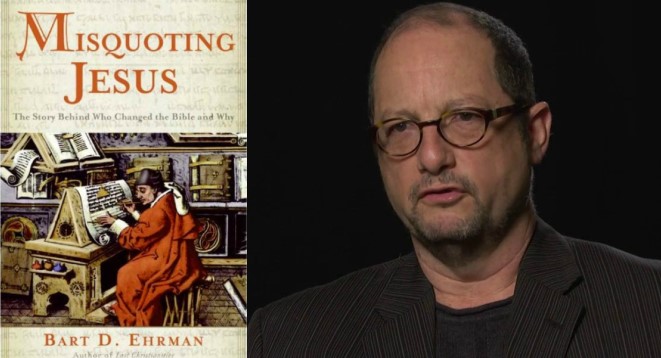
How often do we hear people “explaining” religious beliefs by stating “The Bible says so,” as if the Bible fell out of the sky, pre-translated to English by God Himself? It’s not that simple, according to an impressive and clearly-written book that should be required reading for anyone who claims to know “what the Bible says.”
Bart Ehrman’s Exploration: Who Changed the Bible and Why?
The 2005 bestseller, Misquoting Jesus, was not written by a raving atheist. Rather, it was written by a fellow who had a born-again experience in high school, then went on to attend the ultraconservative Moody Bible Institute in Chicago. Bart Ehrman didn’t stop there, however. He wanted to become an evangelical voice with credentials that would enable him to teach in secular settings. It was for this reason that he continued his education at Wheaton and, eventually, Princeton, picking up the ability to read the New Testament in its original Greek in the process.
As a result of his disciplined study, Ehrman increasingly questioned the fundamentalist approach that the “Bible is the inerrant Word of God. It contains no mistakes.” Through his studies, Ehrman determined that the Bible was not free of mistakes:
We have only error ridden copies, and the vast majority of these are centuries removed from the originals and different from them, evidently, in thousands of ways.
(Page 7). At Princeton, Ehrman learned that mistakes had been made in the copying of the New Testament over the centuries. Upon realizing this, “the floodgates opened.” In Mark 4, for example, Jesus allegedly stated that the mustard seed is “the smallest of all seeds on the earth.” Ehrman knew that this simply was not true. The more he studied the early manuscripts, the more he realized that the Bible was full of contradictions. For instance, Mark writes that Jesus was crucified the day after the Passover meal (Mark 14:12; 15:25) while John says Jesus died the day before the Passover meal (John 19:14).
Ehrman often heard that the words of the Bible were inspired. Obviously, the Bible was not originally written in English. Perhaps, suggests Ehrman, the full meaning and nuance of the New Testament could only be grasped when it was read in its original Greek (and the Old Testament could be fully appreciated only when studied in its original Hebrew) (page 6).
Because of these language barriers and the undeniable mistakes and contradictions, Ehrman realized that the Bible could not be the “fully inspired, inerrant Word of God.” Instead, it appeared to him to be a “very human book.” Human authors had originally written the text at different times and in different places to address different needs. Certainly, the Bible does not provide an an “errant guide as to how we should live. This is the shift in my own thinking that I ended up making, and to which I am now fully committed.”
How pervasive is the belief that the Bible is inerrant, that every word of the Bible is precise and true?
Occasionally I see a bumper sticker that reads: “God said it, I believe it, and that settles it.” My response is always, what if God didn’t say it? What if the book you take as giving you God’s words instead contains human words. What if the Bible doesn’t give a foolproof answer to the questions of the modern age-abortion, women’s rights, gay rights, religious and supremacy, western style democracy and the like? What if we have to figure out how to live and what to believe on our own, without setting up the Bible as a false idol–or an oracle that gives us a direct line of communication with the Almighty.
(Page 14). Ehrman continues to appreciate the Bible as an important collection of writings, but urges that it needs to be read and understood in the context of textual criticism, “a compelling and intriguing field of study of real importance not just to scholars but to everyone with an interest in the Bible.” Ehrman finds it striking that most readers of the Bible know almost nothing about textual criticism. He comments that this is not surprising, in that very few books have been written about textual criticism for a lay audience (namely, “those who know nothing about it, who don’t have the Greek and other languages necessary for the in-depth study of it who do not realize there is even any “problem” with the text).
Misquoting Jesus provides much background into how the Bible became the Bible. It happened through numerous human decisions over the centuries. For instance, the first time any Christian of record listed the 27 books of the New Testament as the books of the New Testament was 300 years after the books have been written (page 36). And those works have been radically altered over the years at the hands of the scribes “who were not only conserving scripture but also changing it.” Ehrman points out that most of the hundreds of thousands of textual changes found among the manuscripts were “completely insignificant, immaterial, of no real importance.” In short, they were innocent mistakes involving misspelling or inadvertence.
On the other hand, the very meaning of the text changed in some instances. Some Bible scholars have even concluded that it makes no sense to talk about the “original” text of the Bible. (Page 210). As a result of studying surviving Greek manuscripts of the New Testament, Ehrman concluded that we simply don’t have the original words constituting the New Testament.
Not only do we not have the originals, we don’t have the first copies of the originals. We don’t even have copies of the copies of the originals, or copies of the copies of the copies of the originals. What we have are copies made later-much later. In most instances, they are copies made many centuries later. And these copies all differ from one another, and many thousands of places . . . Possibly it is easiest to put it in comparative terms: there are more differences among our manuscripts and there are words in the New Testament.
In Misquoting Jesus Bart Ehrman spells out the ways in which several critical passages of the New Testament were changed or concocted. They are startling examples:
A.) Everyone knows the story about Jesus and the woman about to be stoned by the mob. This account is only found in John 7:53-8:12. The mob asked Jesus whether they should stone the woman (the punishment required by the Old Testament) or show her mercy. Jesus doesn’t fall for this trap. Jesus allegedly states “Let the one who is without sin among you be the first to cast a stone at her.”
The crowd dissipates out of shame. Ehrman states that this brilliant story was not originally in the Gospel of John or in any of the Gospels. “It was added by later scribes.” The story is not found in “our oldest and best manuscripts of the Gospel of John. Nor does its writing style comport with the rest of John. Most serious textual critics state that this story should not be considered part of the Bible (page 65).
B) after Jesus died, Mary Magdalene and two other women came back to the tomb to anoint the body of Jesus, according to Mark 16:1-2). They were met by a man in a white robe who told them that Jesus had been raised and was no longer there. The women fled and said nothing more to anyone out of fear (16:4-8). Everyone knows the rest of Mark’s Gospel, of course. The problem with the remainder of the story is that none of it was originally in the Gospel of Mark. It was added by a later scribe. Those additions include all of the following:
Jesus himself appeared to Mary Magdalene. She told the eleven apostles (minus Judas) about this vision, but they did not believe her. Jesus then appeared to the apostles, chastising them for failing to believe. He tells them that those who believe will be saved and those who don’t will be condemned. Then follows a critically important passage of the Bible.
And these are the signs that will accompany those who believe: they will cast out demons in my name; they will speak in new tongues; and they will take up snakes in their hands; and if they drink any poison, it will not harm them; they will place their hands upon the sick and heal them.
Jesus is then allegedly taken up into heaven and sits at the right hand of God, while the disciples go forth into the world to proclaim the Gospel in miraculous fashion.
Without the above passages (which, again, were not written by Mark) the Pentecostals lose their justification for speaking in “tongues.” And the Appalachian snake handlers have no basis for their dangerous practices.
C) John 5:7-8 is the only passage in the entire Bible “that explicitly delineates the doctrine of the Trinity (that there are three persons and God but that all three constitute a single God):
There are three that bear witness in heaven: the Father, the Word and the Spirit and these three are one; and there are three that bear witness on earth, the spirit, the water, and the blood, and these three are one.
Ehrman cites strong evidence that this Trinity passage was entirely concocted and foisted upon Erasmus by outraged theologians who needed support for their prized theological doctrine (page 81).
—
Ehrman reveals numerous other difficulties with the popular assumption that the Bible was perfectly handed down from its original written expression.
Many believers rely fervently on the King James version of the Bible, for instance. They sometimes even say “If the King James was good enough for St. Paul, it’s good enough for me.” Ehrman points out many problems with the King James version, warning that “we need to face up to the facts.”
The King James was not given by God but was a translation by a group of scholars in the early 17th century who based their rendition on a faulty Greek text.
(Page 209).
So what should we make of the Bible? Ehrman argues that the attacks of the New Testament are not simply collections of obvious, self-interpreting words. It’s the same problem we have with other important documents, such as the United States Constitution:
Texts do not simply reveal their own meanings to honest inquirers. Texts are interpreted and they are interpreted (just as they were written) by living, breathing human beings, who can make sense of texts only by explaining them in light of other other knowledge, explicating their meaning, putting the words of the text “in other words.”
(Page 217) The scribes changed the original words of the New Testament by putting them in other words.
In my experience, many people who cherry pick excerpts from the Bible as the proper way to determine what is moral are in utter denial that we don’t have accurate copies of the original writings. Most of them refuse to acknowledge that current popular versions of the Bible contain numerous discrepancies, even compared to the earliest manuscripts we do have. This is on top of the fact that their are hundreds of patent contradictions in the English version of the Bible. To most believers, none of this matters. Stay the course! In fact, in my experience most believers rarely read what the consider to be God’s own inspired word.
Ehrman’s book points out numerous troublesome issues that demand attention even assuming that the original writers of the Bible accurately reported the events described in their original writings (whatever those writings were). The elephant in the room, however, is that none of the authors of the Gospels ever claimed to witness any of the events they were reporting. Further, the extraodinary nature of Biblical claims demands extraordinary proof that ancient self-contradictory writings are simply incapable of providing, except to those of us who believe that the Bible is completely true “because it says so in the Bible.”
For all of those people who continue to go around clentching and thumping those Bibles they bought at Wal-Mart, and for all the rest of us who want to get the story straight, Ehrman’s Misquoting Jesus should be required reading.
[Administrator’s Note: More than 540 comments were quickly contributed to this post, making this page too long to download and display. Therefore, on March 23, 2007, I closed off new comments. Last night (February 4, 2009), I discovered a WordPress plugin that allows me to paginate comments, thereby protecting the site from the sudden and repeated load of 540 comments.
Here’s the good news, then. Anyone who has not yet had his or her say on Bart Ehrman’s book may now jump in at the original post and post a comment. That’s right! If none of the 540 comments that have come before you didn’t address an important aspect of Bart Ehrman’s book, you may now remedy that omission, right here in the comments to this original post. Godspeed. ]


For "WOW":
"The one thing you forgot to mention however, is that Science is also a religion that requires faith."
That is incorrect. As I stated above, faith consists of belief beyond what the evidence supports. Science contains no such thing, and rather, requires solid evidence for all of its claims if they are to be accepted. No reputable scientist has ever encouraged his colleagues to just take his new hypothesis on faith. Instead, he encourages them to test it, and to accept it as true only if it passes those tests. Religious people, on the other hand, usually consider it a sin to put their beliefs to any sort of test.
"Well, your right he was born in Bethlehem, so unless these guys were as intelligent as the rugrats, I doubt they pulled off that one. How about the people who crucified Christ, were they in on it too?"
Probably not. On the other hand, the people who wrote the story were. How do you know the authors of the New Testament didn't just scan the Old Testament, determine what prophecies any would-be messiah would have to fulfill, and write down their story to confirm to that? For all we know, Jesus died in a different way than crucifixion, or may not have even existed at all.
"Why are Atheists so into disproving Christianity. Do Christians live a bad life?"
Fundamentalist Christians pose a threat to the well-being of humanity. To name just one example, an alarmingly large number of Christian politicians in power literally believe that the end of the world is coming soon and will be foreshadowed by war in Israel. Accordingly, they oppose any effort to promote peace in the Middle East because that would interfere with God's divine plan for the destruction of the world. I oppose these and other dangerous beliefs, and these beliefs cannot be effectively overcome without showing that they are false.
Gatomjp Says:
"So there MUST be a very strong NEED to believe despite all of the common sense that undermines the veracity of the bible. Where does this need come from?"
Ahh, the singular question that perhaps is the heart of the reason religion exists. What is the basic human need for it, what is it that drives every known culture to create their own gods…One of THE most important questions of this age. I applaud your insight, sir. I wonder if you'd care to share your conclusions?
Hi, The end all of knowledge
Can't come up with anything more creative than that?? You've been ripped off.
Dude, smoke another doobie, use your mummy wrap as paper, and keep dwelling in educated La La Land……
Eat lots of garlic before you die and the worms wont eat you!!!
WOW…….the ignorance is lively tonight!~!
"With the end of the world at hand"
Where do you get your information? If you answer is the bible, scriptures, or any other fiction, please don't respond…
"the main concern should be if you believe in love"
How exactly does love have to do with your god(s)? Are you stating that if you don't believe in your god(s) you can't love? What of other cultures with different religions, can they not love because the don't believe in your god(s)?
Hi Mekongcola,
You are absolutely right! Love is everything. My fictional bible as you put it (which is entirely your right to an opinion) is full of love. God says that he is love and this is why he gave his son, because of his love for a fallen world.
Man, I know how much this sounds like gibberish to you.
here is a quote from napoleon about love:
"I know men and I tell you that Jesus Christ is no mere man. Between Him and every other person in the world there is no possible term of comparison. Alexander, Caesar, Charlemagne, and I have founded empires. But on what did we rest the creation of our genius? Upon force. Jesus Christ founded His empire upon love; and at this hour millions of men would die for Him." –Napoleon
I never heard anybody in this blog, say that you had to believe in their God in order to have, nkow, or understand love. Love is a free gift from God whether you believe in Him or not. You obviously have an agenda to state such things. I dont say that to put you down, but to show you that you that even by accusing somebody in your post, are you showing love?
Hi Ebonmuse,
You state this:
"That is incorrect. As I stated above, faith consists of belief beyond what the evidence supports. Science contains no such thing, and rather, requires solid evidence for all of its claims if they are to be accepted. No reputable scientist has ever encouraged his colleagues to just take his new hypothesis on faith. Instead, he encourages them to test it, and to accept it as true only if it passes those tests. Religious people, on the other hand, usually consider it a sin to put their beliefs to any sort of test."
Listen dude, you are absolutely correct! What I meant to say is that atheism is a religion which requires faith, not science. But a lot of people put science and atheism together as though they are cousins or close brothers or something. Science is in the bible as well.
You said:
"Probably not. On the other hand, the people who wrote the story were. How do you know the authors of the New Testament didn’t just scan the Old Testament, determine what prophecies any would-be messiah would have to fulfill, and write down their story to confirm to that? For all we know, Jesus died in a different way than crucifixion, or may not have even existed at all."
You are totally speculating from an overly creative imagination. The fact that you say "how do you know", We don't know dude. I believe and you don't. No big deal. Opinions are opinions. I can admit when I make a mistake, can you? I am not afraid of the apparent contradictions in the bible, in fact, they breathe more life in the truth of the bible for me. The bible was written by man, what Christian would deny that? Maybe an ignorant one. Enough with the "what if" thinking though, because your starting to make up stuff when you do that.
You state:
"Fundamentalist Christians pose a threat to the well-being of humanity. To name just one example, an alarmingly large number of Christian politicians in power literally believe that the end of the world is coming soon and will be foreshadowed by war in Israel. Accordingly, they oppose any effort to promote peace in the Middle East because that would interfere with God’s divine plan for the destruction of the world. I oppose these and other dangerous beliefs, and these beliefs cannot be effectively overcome without showing that they are false."
That is all entirely opinion that you try to pass on as fact. WOW! I'll tell you what, if Israel ever falls as a nation, I will be in this thread posting right along with you with hard facts against the bible. If someone you loved died in the Twin Towers then you would have a different thought about what we are trying to do in the middle east (and if that really did happen to you, I am sorry). I think that our government had made a mistake, but, now they have to fix it, they cant just ignore what has happend. Why do you live in a country in which you do not like the politicians in power? Why do you live in a nation in which 80% of it's population is Christian. You are putting down the very people that built this great nation "under God". Our Forefathers were Christians that instilled Christian principals so that our nation would become as great as it is. I guess this is all just a fairytale to you as well??? You say the word false like you are some sort of god??????????? WOW.
Well it looks like the Scientists have won this argument, WOW is the only one still trying to reason away the truth. I can't really sum it up better than Dawkins himself "
"As long as we accept the principle that religious faith must be respected simply because it is religious faith, it is hard to withhold respect from the faith of Osama bin Laden and the suicide bombers," Dawkins writes. "The alternative, one so transparent that it should need no urging, is to abandon the principle of automatic respect for religious faith. This is one reason why I do everything in my power to warn people against faith itself, not just against so-called 'extremist' faith."
I agree totally with Dawkins.
Undeucated scholar, you say that you used to believe in G-d. Then howcome you no longer do? G-d is part of all of us, no matter what you belive. I support WOW, he has obviosly done the reserch.
"As long as we accept the principle that religious faith must be respected simply because it is religious faith, it is hard to withhold respect from the faith of Osama bin Laden and the suicide bombers," Dawkins writes. "The alternative, one so transparent that it should need no urging, is to abandon the principle of automatic respect for religious faith. This is one reason why I do everything in my power to warn people against faith itself, not just against so-called 'extremist' faith."
Any true Christian would no longer be reading this threads.
I dont know who to belieive now. That guy WOW has a point…Napoleon was WAY ahead of his time. And on the same token hand, the encylopedia is wrong about LOTS of stuff (like the holocaust). Ya i guess I have sseen the light, I believlevee in god now. Thanks WOW.
"Blessed is he who in the name of the Lord shepperd the weak thourgh the vally of darkeness for , he is tryuly his birothers keeper."
To "WOW":
Atheism is not a religion. It is nothing more than the refusal to accept claims for which there is insufficient evidence. Do you have a positive faith that there are no such creatures as unicorns, or do you simply choose to withhold belief in unicorns until evidence for their existence is provided?
"You are totally speculating from an overly creative imagination."
And you believe in a book that contains stories of talking snakes, men walking on water, and two of every species of animal surviving a planetary flood in a wooden boat.
"The fact that you say “how do you know”, We don’t know dude. I believe and you don’t. No big deal. Opinions are opinions."
All opinions are not created equal. You were talking before about the odds of someone fulfilling the Old Testament's prophecies by chance as 1 in 10^17, and when I point out this obvious counterargument, all of a sudden it's just your opinion and you don't know whether the gospel story is true or not? Either you have sufficient reason to believe or you don't.
"I think that our government had made a mistake, but, now they have to fix it, they cant just ignore what has happend."
I was not talking about the war in Iraq. I was referring to the Israeli/Palestinian conflict, which is a huge source of continuing enmity in the Muslim world and among al-Qaeda and which evangelical Christians in our government are causing to continue. The so-called "Christian Zionist" movement, which counts most of today's religious right as members, opposes any effort to create a Palestinian state or to restrict Israel from taking all the land it wants for its own people, because they believe that is contrary to the Bible. When Yitzhak Rabin was assassinated, these people went on TV and called it God's punishment on him for seeking peace with the Palestinians.
"You are putting down the very people that built this great nation “under God”. "
"Under God" did not become the country's motto until the McCarthy era. Our original motto, which seems to have served us perfectly well for 150 or so years, was "E Pluribus Unum", which means "Out of Many, One".
"Our Forefathers were Christians that instilled Christian principals so that our nation would become as great as it is."
Please list some of these alleged Christian principles. When I think of the principles that make America great – democracy, separation of powers, a bill of rights, free speech, separation of church and state – I see none of them in the Bible, whose preferred model of government is a divine-right absolutist monarchy where one person has all the power and makes all the rules. That is the very thing America's founding generation was rebelling against.
What a fascinating conversation we have going here! I love it!
For WOW:
WOW, you are SO defensive! This conversation must have touched a nerve. Please PUT DOWN THE BIBLE AND STEP SLOWLY AWAY (I say that jokingly, like a cop in the movies) and please answer the very simple (and yet not so simple) question I have put to you.
Why do you need to believe?
For Ray:
You too Ray. You didn't tell me YOUR reasons for believing, only the punishment for not believing. Is that the only reason you believe? Because you will get "in trouble" with god if you don't? Would you begin to sin if you became convinced there was no god.
For Mekongcola:
I will share my thoughts soon. I want to hear from those true believers out there first. But as usual I am getting the same kind of answers I always get when I ask this question. Much justification and bible quoting and little soul-searching. What do you think Mekongcola? Where does this all come from? Why would someone defend these stories so vehemently…sometimes with their life?
Wow writes: "If God was to give us all of mans creative inventions, then we would not be a fallen world. The key is that we are fallen and we deserve death, and death we will surely arrive to before you know it. Jesus offered the cure for death."
As regards our "fallen world," let's consider the Tree of Knowledge that God planted “in the middle of the garden of Eden,” intermingled with other trees “that were pleasing to the eye and good for food” (see Genesis 2:8 through 3:6). God placed no fence or other barrier around the Tree of Knowledge, and filled it with appealing fruit that “was good for food and pleasing to the eye.” He then told Adam, “you must not eat from the tree of the knowledge of good and evil, for when you eat of it or touch it you will surely die.”
Let's look at this objectively. God created a Tree of Instant Death, planted it in the middle of the garden of Eden, filled it with attractive fruit that was good for food and pleasing to the eye, placed no fence around it, gave it an enticing name ("the tree of the knowledge of good and evil"), gave Adam and Eve curiosity and a desire to gain wisdom, indicated that the tree was a source of wisdom, and then merely told Adam and Eve not to eat of it or touch it. God went *out of His way* to create a deadly hazard that He knew would appeal to Adam and Eve, He did everything possible to make the tree appealing to Adam and Eve, He waved this deadly hazard right in their faces, and now He punishes all of humanity for doing exactly what He should have prevented in the first place.
If a parent today were to do to her children what God did to His children in the Garden of Eden, that parent would be considered criminally negligent and would be prosecuted for murder. Yet Christians like Wow jump to God's defense and claim that "God is love" and "we are fallen and we deserve death." What a load of crap. Human parents do more to prevent their children from playing with matches than God did to prevent His children from touching the Tree of Instant Death, yet Wow thinks we should all fall on our knees and worship this irresponsible, criminally negligent God, and mindlessly chant that He is a god of infinite wisdom and infinite love because, if we don't, then this "infinitely loving" God just might damn us to hell for all eternity. What nonsense. Even fish do more to protect their nests from danger than God did to protect the lives of His children in the Garden of Eden.
To gatomjp:
It sounds like you are soul searching as well, and perhaps you do not feel the "need". I am a believer that God came to Earth as Jesus and took physical form to give His Creation a clear message and example about His intent for His Creation. But I was once a major skeptic as well, before I became a believer. I was raised in an empty ritualistic Catholic background and quickly became convinced (by my own ego) that I was going to decide what was right and looked at everything, from new age to Eastern religions.
The "need to believe" that you refer to is not something easily explained. It's almost like asking someone why their favorite food is their favorite (poor analogy). But there is a difference in why we believe rather than why we "need" to believe. My best explanation is that God made us to be with Him, yet our sinfulness separates us from God (the very source of life), but our sin also creates a void that only God can fill. A life lived without God becomes emptier and emptier, and so our thirst (need) for real life becomes more noticeable to us. Maybe you're familiar with the claim in the Bible that Jesus (God in the flesh) is the vine and we are the branches. If you know horticulture you'll know that a branch from a grape vine will "live" for some time after it is cut off, but it will eventually wither and die. Now the branch can be regrafted back into the vine and again be alive and grow. I believe we have been given a very special gift, the ability to see what life is like without God here on Earth. I also believe that we cannot attain our way back to God, but that He is the only one who can regraft us back in. Knowing what "life" was like before I believed and what it is like now I have a unique perspective and I can tell you that life with the God who loves me and made me is the only way to go.
Knowing myself that only God can convince you I cannot make you believe (He doesn't want to make you believe either, but gives you a choice). At certain times in my life any evangelical approach would have been spurned. But after my sister died I really began asking the hard questions, and God knew I was ready. I pray that you will be ready soon, before your soul forgets that it is thirsty for God.
To Ray:
I was actually quite interested in checking out one of the links you attached, especially the ariel.com site. I was looking forward to hearing your response to my post. With this in mind, I clicked the site, and was immediately disappointed. After reading just the motto of the site, I clicked off in disgust.
I think it's an insult to my intelligence, especially after the content of what I've posted, to connect a link to a site that, in their very motto, claims to be a site for evangelicizing Jews. When I saw this, I just shook my head. It actually made me a little angry, especially after how I described how no self-respecting Jew would ever convert. In history, when faced with the option of conversion or death, a Jew would rather die.
One of the things that infuriates most Jews is organizations like "Jews for Jesus", and other evangelical organizations intent on converting Jews to Christianity. In fact, many of the responses in my posts taking issue with some of the falsehoods in the New Testament came from anti-missionary sites like Jews for Judaism. Fact is, there is no such thing as a "Jew For Jesus", since once you accept Jesus as the Messiah, YOU CEASE TO BE A JEW.
Your efforts here should be towards discourse and conversation, not converting people to your own faith.
The problem remains that Jesus claimed to be the JEWISH messiah, yet didn't fulfill the required prophecy. If he claimed to be the messiah for gentiles, we wouldn't have cared!
The problem remains that the framers of the New Testament wrote it after Jesus was already dead, and retroactively try to change the prophecy of the Messiah to make it fit, and prophecy, by its very nature, comes BEFORE the event. Duh, that's what MAKES it prophetic.
If you look at the Rabbi's and Jewish scholars of the time, they rejected Jesus as the Messiah TO A MAN. Not a single one bought it. Why? Because Jesus was a rebel? Nah: it was because he didn't fulfill any of the necessary details.
I'll wait for a response that comes from you, since I remain more curious about your own personal response, but even though I will find it distasteful, I'll even check out that site more thoroughly, if only to find the most effecient ways to puncture holes through the innaccurate proofs contained therein. But, please, in the future, don't attach links to evangelical sites that want to bring Jews to Christianity; that's just wrong.
Ray says, "All these things have been answered over and over and over again. Here is a short list of some websites for your review…."
Actually, those websites don't appear to "answer" anything; they contain articles written by people who have no scientific backgrounds and who write about their lack of scientific understanding.
Nearly all of those websites contains an on-line store, however.
To mnowlan:
Beautifully put! A wonderful, moving answer. Thank you. I am soul searching as you can tell, and will till the day that I die.
Here's what always perplexed me, because I often feel the way you describe…why is it necessary to accept the unbelievable in order to gain oneness with god? Why can't it be as plain as you've stated? I still think that those bible "stories" were invented by men and that true communion with god needs no miracles.
Grumpy:
Your words:
"Let’s look at this objectively. God created a Tree of Instant Death, planted it in the middle of the garden of Eden, filled it with attractive fruit that was good for food and pleasing to the eye, placed no fence around it, gave it an enticing name (”the tree of the knowledge of good and evil”), gave Adam and Eve curiosity and a desire to gain wisdom, indicated that the tree was a source of wisdom, and then merely told Adam and Eve not to eat of it or touch it. God went *out of His way* to create a deadly hazard that He knew would appeal to Adam and Eve, He did everything possible to make the tree appealing to Adam and Eve, He waved this deadly hazard right in their faces, and now He punishes all of humanity for doing exactly what He should have prevented in the first place."
You fail to realize that your mind is not Gods mind. You can't think the way God thinks. Can you create a human being with free will. God created man with free will so He had to intall the value of choice in man. This is what the Garden of Eden was for. Did you ever think of that perspective, or do you always simply go by what your brain can conceive at the moment? You do not have the smarts to even begin to understand what you are talking about because you use human logic. I'm not putting you down, just stating the obvious, that if you were created, how do you expect to think like God?
You think like man, and this is why you put your faith in man.
EbonMuse:
You state:
Please list some of these alleged Christian principles. When I think of the principles that make America great – democracy, separation of powers, a bill of rights, free speech, separation of church and state – I see none of them in the Bible, whose preferred model of government is a divine-right absolutist monarchy where one person has all the power and makes all the rules. That is the very thing America’s founding generation was rebelling against.
All right Mr. atheist know-it-all. Here are a few people that you poop on with your words, shame on you.
THE MEN WHO BUILT OUR COUNTRY SAY:
"Don't let anyone
claim to be a true American. Don't let them claim the tribute of
American patriotism if they ever attempt to remove religion from
politics." George Washington's farewell address
John Adams wrote:
"Our Constitution was made only for a moral and religious people. It is wholly inadequate to the government of any other."
"We have no government armed with power capable of contending with passions unbridled by morality and religion."
"Religion & virtue are the only foundations, not only of republicanism and of all free government, but of social felicity under all governments and in all the combinations of human society."
"Statesmen, my dear sir, may plan and speculate for liberty, but it is religion and morality alone, which can establish the principles upon which freedom can securely stand."
Thomas Jefferson, the man "blamed" for the wall of separation between church and state said:
"I have always said, and will always say, that the studious perusal of the sacred volume will make us better citizens."
"And can the liberties of a nation be thought secure when we have removed their only firm basis, a conviction in the minds of the people that these liberties are the gift of God? That they are not to be violated but with His wrath? Indeed, I tremble for my country when I reflect that God is just: that His justice cannot sleep forever."
"No power over the freedom of religion . . .[is] delegated to the United States by the Constitution."
"Of all the systems of morality, ancient or modern, which have come under my observation, none appears to me so pure as that of Jesus."
"I am a Christian, in the only sense in which he wished any one to be; sincerely attached to his doctrines, in preference to all others; ascribing to himself every human excellence; and believing he never claimed any other." Letter to Benjamin Rush, April 21, 1803
Abraham Lincoln:
"Unless the great God who assisted [President Washington], shall be with me and aid me, I must fail. But if the same omniscient mind, and Almighty arm, that directed and protected him, shall guide and support me, I shall not fail … Let us pray that the God of our fathers may not forsake us now."
Woodrow Wilson:
"America was born a Christian nation. America was born to exemplify that devotion to the elements of righteousness which are derived from the revelations of the Holy Scripture."
Did the Founding Fathers Believe Christianity Was the Basis of American Government?
Do you think our Founding Fathers believed in God and founded America as a Christian nation? The Supreme Court answered this question in 1892 and cited fifty historical examples to prove America was indeed a Christian nation. These are just a few:
Governor Bradford, in writing of the Pilgrims` landing, describes their first act: "Being thus arrived in a good harbor and brought safe to land, they fell upon their knees and blessed the God of heaven…."
The New England Charter, signed by King James 1, confirmed the goal of the first settlers to be: "to advance the enlargement of Christian religion, to the glory of God Almighty."
The goal of government based on Scripture was affirmed by individual counties, such as is found in the Rhode Island Charter of 1683, which begins: "We submit our persons, lives and estates unto our Lord Jesus Christ, the King of kings and Lord of lords and to all those perfect and most absolute laws of His given us in His holy Word."
Benjamin Franklin stood and addressed the Continental Congress with these words: "In the beginning of the contest with Britain, when we were sensible of danger, we had daily prayers in this room for divine protection. Our prayers, sir, were heard and they were graciously answered. All of us who were engaged in the struggle must have observed frequent instances of a superintending Providence in our favor….Have we now forgotten this powerful friend? Or do we imagine we no longer need His assistance?
I have lived, sir, a long time, and the longer I live, the more convincing proofs I see of this truth: that God governs in the affairs of man. And if a sparrow cannot fall to the ground without His notice, is it probable that an empire can rise without His aid?"
George Washington, in his inaugural address to Congress as the first president of the nation stated: "No people can be bound to acknowledge and adore the invisible hand which conducts the affairs of men more than the people of the United States. Every step by which they have advanced to the character of an independent nation seems to have been distinguished by some token of providential agency…."
One of George Washington`s first official acts was the first Thanksgiving proclamation, which reads, "Whereas, it is the duty of all nations to acknowledge the providence of Almighty God, to obey His will, to be grateful for His benefits, and humbly implore His protection and favor…" It goes on to call the nation to thankfulness to Almighty God.
Thomas Jefferson said: "Indeed, I tremble for my country when I reflect that God is just, and that His justice cannot sleep forever."
President John Quincy Adams: "The first and almost the only book deserving of universal attention is the Bible."
Andrew Jackson: "Go to the Scriptures…the joyful promises it contains will be a balsam to all your troubles."
From President Abraham Lincoln`s Proclamation for a National Day of Fasting, Humiliation, and Prayer, April 30, 1863: "We have been the recipients of the choicest bounties of heaven. We have been preserved, these many years, in peace and prosperity. We have grown in numbers, wealth and power, as no other nation has ever grown.
But we have forgotten God. We have forgotten the gracious hand which preserved us in peace, and multiplied and enriched and strengthened us; and we have vainly imagined, in the deceitfulness of our hearts, that all these blessings were produced by some superior wisdom and virtue of our own. Intoxicated with undroken success, we have become too self- sufficient to feel the necessity of redeeming and preserving grace, too proud to pray to the God that made us! It behooves us, then, to humble ourselves before the offended Power, to confess our national sins, and to pray for clemency and forgiveness."
The Supreme Court Decision 1892—Church of the Holy Trinity Vs. The United States: "Our laws and our institutions must necessarily be based upon and embody the teachings of The Redeemer of mankind. It is impossible that it should be otherwise; and in this sense and to this extent our civilization and our institutions are emphatically Christian….This is a religious people. This is historically true."
President Woodrow Wilson: "…the Bible…is the one supreme source of revelation of the meaning of life, the nature of God and spiritual nature and need of men. It is the only guide of life which really leads the spirit in the way of peace and salvation."
In spite of these statements, many people today say that the Founding Fathers never intended for religious principles to be part of public life or public affairs. They add: Doesn`t being a Christian nation really threaten pluralism? Interestingly, the Founding Fathers discuss that and they felt that it enhanced it.
Patrick Henery made a very clear statement: "It cannot be emphasized too often or too strongly that this great nation was founded not by religionists but by Christians; not on religions but on the gospel of Jesus Christ….It is for this reason that people of other faiths have been afforded asylum, prosperity and freedom of worship here."
It must be concluded that our Founding Fathers did believe in God and founded America as a Christian nation.
I was hoping the links I left would suffice for those searching. However it seems personal responses are still required by a few of you. Please bear with me as I answer your points. First of all, lets start with:
Gatomjp you wrote: "You too Ray. You didn’t tell me YOUR reasons for believing, only the punishment for not believing. Is that the only reason you believe? Because you will get “in trouble” with god if you don’t? Would you begin to sin if you became convinced there was no god."
Almost as far back as I can remember, I KNEW there is a God. Don't ask me how I knew, but I knew. Please note, I don't THINK there is a God, I KNOW there is a God. Perhaps it was a combination of a christian upbringing reinforced with external and internal evidences. Although other christians better than myself were formerly atheists (C.S.Lewis comes to mind).
Let's take, for example, your mind. You have thoughts, feelings, loves. They are not a result of "evolution". How about poetry and song. Consider the creation, countless stars, diverse life on earth. All are organized with a pattern particular to themselves. Once you think about all these things, you must realize this is not all by chance.
How about your eyes. This could not be a product of "evolution". All parts of the eyes are required to fully function. Or the "simple" cell that we found out is not so simple.
Let's take some of the most universal things taken for granted: water and light. Science still doesn't fully understand them.
Now lets look at some internals. You know inherently there is a difference between right and wrong. This is called a conscience. When a judge let's a criminal off the hook with no penalty, you cry "hey, that's not right!". There are abstracts such as honor, goodwill, duty and love.
If you spend time seriously considering everything, you can only come to the conclusion there is a source to all these things.
As far as "punishment" as you stated it:
If you ignore the law of gravity and scream out "I HATE THIS LAW AND I'LL JUST IGNORE IT"! You then run off a ten story building in rebellion. You end up a crumpled mass. This "punishment" was self-inflicted. Like it or not, there are laws set in place. To disregard them is to place yourself in jeopardy.
You ask "Would you begin to sin if you became convinced there was no god?". I've learned that hypotheticals are usually non-existant, meant only to side-track the issue. But to answer anyway, if there is no God, then there is no sin.
1Jo 3:4 tells us:
" Whosoever committeth sin transgresseth also the law: for sin is the transgression of the law".
In conclusion to you Gatomjp:
You are His creation. He made you for fellowship.
Rev. 4:11 says "…. thou hast created all things, and for thy pleasure they are and were created."
You have been created for God's pleasure. You are the object of His love. He does not force you, that is why you have free will to reject Him. Actions and inactions have consequences.
For anyone who has actually been reading this whole thread…I have been posting under various names…
Educated Scholar, Undecated Scholar, Recent Graduate, True Christian (which I am NOT), The End of All Knowledge, Billy the Kid, and PandaBear32, BOW DOWN WOW, WHOA, Dick Dawkins, Previously Un-Educated Scholar. I think that is all of them.
Anyway, the only rational conclusion is that NO GOD EXISTS. I guess I am of the elite group who (through rigorous, open-minded study) am able to put the brainwashing aside and look at the facts with an adult mind.
I admit, I was lucky enough to be raised by parents who put VALUE in education. Sure, I had Sunday school like most of you crazies (WOW this means you and your kind), but my parents also exposed me to other schools of thought. In fact, I am technically(by blood) half Jewish and half Christian, celebrated Hannukah and Christmas my whole life (double presents, yay 🙂 . The end result is me being able to think for myself, take a step back, and look at the evidence presented. Here is a bit more knowledge to whet your appetite to slay the DEMONS of the BIBLE…
Of the 65,000 distinct religions practiced on Earth, over half of them believe in multiple dieties (that means more than 1 GOD). 99 percent of the religions are tied to the CULTURE in which they are practiced. Religion is a CULTURAL PHENOMENA, teach that to your children rather than blindly teaching them what you were FORCE FED in SUNDAY SCHOOL@!!!!@#!@!!!
To Resident Jew:
The reason I put Ariel.org is because of Arnold Fruchtenbaum is very honest and open. He has no agenda other than Bible analysis as regards to the Jew. This is his focus – his love for his fellow Jews. You may find his biography interesting. Check it out at:
http://www.ariel.org/bioagf.htm
Also he is eminently more qualified in these matters than myself. You can email him any question you have – no charge (although it may take a few weeks to get a response, since he is typically overloaded). I can try to give you answers, be he can certainly do a better job.
You stated:
"If you look at the Rabbi’s and Jewish scholars of the time, they rejected Jesus as the
Messiah TO A MAN. Not a single one bought it."
This is incorrect. For example, Nicodemus (John 3:1), Simeon (Luke 2:25), Joseph (Mark 15:42) to name a few.
Which prophecies do you speak of that Jesus did not fulfill? Please be specific.
For: Educated Scholar, Undecated Scholar, Recent Graduate, True Christian (which I am NOT), The End of All Knowledge, Billy the Kid, and PandaBear32, BOW DOWN WOW, WHOA, Dick Dawkins, Previously Un-Educated Scholar. I think that is all of them.
Dude, your mind is like a volcano on the beach filled with black and white confetti. This is your rational attitude. Kind of like if two face had no idea what he looked like because he could never see himself.
You pat yourself on the back 5 times in your post….WOW…lol…. maybe more..
BTW, I didnt go to sunday school because my parent (one) didnt go. Correction, I went on easter and christmas and hated it. I did however start going to church in high school, but then stopped going for about five years through college (liked to party), and then realized that I wanted to start to go to church, but still dont go every sunday. You know nothing about me dude and you act like you have me all figured out as you say, "I had Sunday school like most of you crazies (WOW this means you and your kind),".
Did your education teach you to be ignorant like this??? It is certainly not the attitude of someone with an open mind.
You are a clutter of confusion man. There is so much more going on here than you even remotely realize and you prove this with your postings. Well dude, you have free will and you practice it!!!! But can you escape death? No, nobody can. So I guess all of this is just us shooting the sh-t for a while while we exist. Our lives are like the morning mist, were here for a little while, and then were gone.
It makes no difference to me how you live your life, or what you believe, or who you do, or what you are, or when you fart, or why you exist. I am a real person, not some brainwashed idiot. I can call you brainwashed just the same man. When are you going to realize that it's all an opinion, but with an absolute truth. Nobody knows for certain what the "TRUTH" is. perhaps we will know when we die, or maybe we won't.
Here is the bottom line:
You and I are in the same boat and both wondering who will be next to walk the plank.
Have a geat journey!!
To Ray:
Thanks for your response. Very thought provoking. Although I noticed that you couldn't help yourself from quoting the bible. That's okay, the rest of your response was well worth the read. Please remember that I think that the bible is a faulty work of man so I skip over bible quotes. As far as I'm concerned they come from a tainted source and prove nothing…ever. So we must keep our discourse "man to man".
A few thoughts:
I very much respect your feeling that there is a creating force in the universe. I look at the complexity of the world around me and feel that way too, much of the time.
You write: "You know inherently there is a difference between right and wrong. There are abstracts such as honor, goodwill, duty and love."
ABSOLUTELY!! I agree whole heartedly! With or without a deity I feel that these abstracts exist and we are born knowing them.
HOWEVER, none of this has anything do to with the "nonsense" (please excuse my use of that word again) that was invented in order for simpler people in a simpler time to understand and accept the teachings of a great man.
My main point throughout this entire discussion has been that the teachings of the great man we call Jesus have been twisted and perverted and OBSCURED with the fanciful mumbo-jumbo that people of a different time needed in order to accept his authority. Jesus' lessons are good and true even if he was never the son of god nor rose from the dead nor performed a single miracle. I don't NEED any of that to recognize that if we all followed his most basic lesson "Love one another", we would have heaven on earth.
So why do people insist on buying all the crapola that goes along with a trust in the bible? Why do you NEED to believe all the supernatural stuff if you have always KNOWN in your heart of god's love for you? That's what I find hard to understand.
For WOW:
Have you decided to ignore my question?
You raise a valid point in that "this all could not have happened by chance".
Unfortunately you are mistaken in using this as arguement against science, likely because of a lack of adequate knowledge. The foundations of evolution and natural selection INDEED CONTRADICT your statement. The fact is that it DIDN'T happen by chance, life is continuously spawning and changing here on earth. The fittest animals survive.
…Natural selection is a guided process, guided not by any higher power, but simply by which genes survive and which genes don't survive. That's a non-random process. The animals that are best at whatever they do-hunting, flying, fishing, swimming, digging-whatever the species does, the individuals that are best at it are the ones that pass on the genes. It's because of this non-random process that lions are so good at hunting, antelopes so good at running away from lions, and fish are so good at swimming. God has no say in it (if there was one, which I assure you there is NOT), and HE does not deserve or get any respect from me, in fact, I must stoop to the level of a moron to even consider the idea of a greater power.
Wow argues, "You fail to realize that your mind is not Gods mind. You can’t think the way God thinks. Can you create a human being with free will. God created man with free will so He had to intall the value of choice in man. This is what the Garden of Eden was for. Did you ever think of that perspective, or do you always simply go by what your brain can conceive at the moment? You do not have the smarts to even begin to understand what you are talking about because you use human logic."
Actually, I, long ago, considered and rejected the perspective you describe. The fact that my mind "is not God's mind" does not prevent me from recognizing that God's *behavior* was grossly negligent in putting the Tree of Instant Death in the middle of the Garden of Eden and dressing it up to make it inviting to Adam and Eve. Your argument is that we cannot condemn criminally negligent *behavior* because we are not of the same mind as the criminal, but that's just nonsense. We condemn criminally negligent behavior all the time without understanding why it was done. Indeed, my mind is not my neighbor's mind, but this would not prevent me, or anyone else in my neighborhood, from condemning him for putting a Tree of Instant Death in the middle of his garden, hanging appealing (but poisonous) fruit on it, telling the neighborhood kids to play there but to not eat the fruit, and then laying blame on the kids when one of them eats the fruit and dies. Anyone with a brain in his head would condemn such behavior, and rightfully so, regardless of what was going on inside the mind of the person who did it.
And speaking of the mind of God, you claim that I "can't think the way God thinks" but, two sentences later, you presume that you can do exactly that yourself: "God created man with free will so He had to intall the value of choice in man." Sorry, but if I "can't think the way God thinks," than neither can you.
Your argument about free will is equally ridiculous. Neither Adam nor Eve had ever seen death before, so how could they have possibly understood God's warning that they would "surely die" if they ate the fruit? In order to exercise their "free will," they would have needed to understand the consequences, but the Bible contains no evidence that they did. To the contrary, when the talking serpent told them they would *not* die by eating the fruit, they had no effective rebuttal, so they obviously did not truly understand God's warning. Had they understood God's warning, they would have been able to reject the talking serpent's claim.
BTW, speaking of the talking serpent, why did God not install a fence around the Garden of Eden to keep talking serpents out? Oops, it looks like God was grossly negligent about that, too.
So, to sum up your argument, you're saying that fish do more to protect their offspring than our infinitely wise, infinitely loving God did to protect His children, but that's OK because God wanted us to have free will that we were too ignorant to use properly. Tell me: if an adult deliberately puts poison-laced candy in front of a child, and tells the child to not eat the candy because "he will surely die," is it proper to blame the child for eating the candy, or should we blame the adult for creating the dangerous situation and trusting the child to exercise his "free will?" Somehow, I just can't picture your argument working in a court of law, human or otherwise.
Speaking of human law, here are a two more questions:
1) If we don't use human logic to understand these issues, then what sort of logic should we use? If we are supposed to exercise the "free will" that your God supposedly gave us, then isn't our human logic our best (indeed, our only) tool for doing so?
2) Where in Genesis does it say, as you claim, that the purpose of the Garden of Eden was to install the value of choice in man? My reading of Genesis indicates that God created His garden first and then created Adam because He wanted a gardener.