
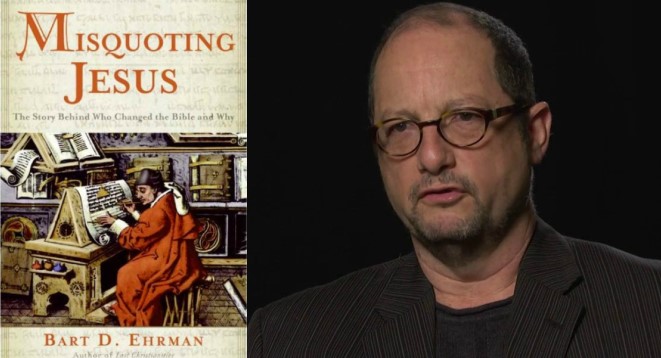
How often do we hear people “explaining” religious beliefs by stating “The Bible says so,” as if the Bible fell out of the sky, pre-translated to English by God Himself? It’s not that simple, according to an impressive and clearly-written book that should be required reading for anyone who claims to know “what the Bible says.”
Bart Ehrman’s Exploration: Who Changed the Bible and Why?
The 2005 bestseller, Misquoting Jesus, was not written by a raving atheist. Rather, it was written by a fellow who had a born-again experience in high school, then went on to attend the ultraconservative Moody Bible Institute in Chicago. Bart Ehrman didn’t stop there, however. He wanted to become an evangelical voice with credentials that would enable him to teach in secular settings. It was for this reason that he continued his education at Wheaton and, eventually, Princeton, picking up the ability to read the New Testament in its original Greek in the process.
As a result of his disciplined study, Ehrman increasingly questioned the fundamentalist approach that the “Bible is the inerrant Word of God. It contains no mistakes.” Through his studies, Ehrman determined that the Bible was not free of mistakes:
We have only error ridden copies, and the vast majority of these are centuries removed from the originals and different from them, evidently, in thousands of ways.
(Page 7). At Princeton, Ehrman learned that mistakes had been made in the copying of the New Testament over the centuries. Upon realizing this, “the floodgates opened.” In Mark 4, for example, Jesus allegedly stated that the mustard seed is “the smallest of all seeds on the earth.” Ehrman knew that this simply was not true. The more he studied the early manuscripts, the more he realized that the Bible was full of contradictions. For instance, Mark writes that Jesus was crucified the day after the Passover meal (Mark 14:12; 15:25) while John says Jesus died the day before the Passover meal (John 19:14).
Ehrman often heard that the words of the Bible were inspired. Obviously, the Bible was not originally written in English. Perhaps, suggests Ehrman, the full meaning and nuance of the New Testament could only be grasped when it was read in its original Greek (and the Old Testament could be fully appreciated only when studied in its original Hebrew) (page 6).
Because of these language barriers and the undeniable mistakes and contradictions, Ehrman realized that the Bible could not be the “fully inspired, inerrant Word of God.” Instead, it appeared to him to be a “very human book.” Human authors had originally written the text at different times and in different places to address different needs. Certainly, the Bible does not provide an an “errant guide as to how we should live. This is the shift in my own thinking that I ended up making, and to which I am now fully committed.”
How pervasive is the belief that the Bible is inerrant, that every word of the Bible is precise and true?
Occasionally I see a bumper sticker that reads: “God said it, I believe it, and that settles it.” My response is always, what if God didn’t say it? What if the book you take as giving you God’s words instead contains human words. What if the Bible doesn’t give a foolproof answer to the questions of the modern age-abortion, women’s rights, gay rights, religious and supremacy, western style democracy and the like? What if we have to figure out how to live and what to believe on our own, without setting up the Bible as a false idol–or an oracle that gives us a direct line of communication with the Almighty.
(Page 14). Ehrman continues to appreciate the Bible as an important collection of writings, but urges that it needs to be read and understood in the context of textual criticism, “a compelling and intriguing field of study of real importance not just to scholars but to everyone with an interest in the Bible.” Ehrman finds it striking that most readers of the Bible know almost nothing about textual criticism. He comments that this is not surprising, in that very few books have been written about textual criticism for a lay audience (namely, “those who know nothing about it, who don’t have the Greek and other languages necessary for the in-depth study of it who do not realize there is even any “problem” with the text).
Misquoting Jesus provides much background into how the Bible became the Bible. It happened through numerous human decisions over the centuries. For instance, the first time any Christian of record listed the 27 books of the New Testament as the books of the New Testament was 300 years after the books have been written (page 36). And those works have been radically altered over the years at the hands of the scribes “who were not only conserving scripture but also changing it.” Ehrman points out that most of the hundreds of thousands of textual changes found among the manuscripts were “completely insignificant, immaterial, of no real importance.” In short, they were innocent mistakes involving misspelling or inadvertence.
On the other hand, the very meaning of the text changed in some instances. Some Bible scholars have even concluded that it makes no sense to talk about the “original” text of the Bible. (Page 210). As a result of studying surviving Greek manuscripts of the New Testament, Ehrman concluded that we simply don’t have the original words constituting the New Testament.
Not only do we not have the originals, we don’t have the first copies of the originals. We don’t even have copies of the copies of the originals, or copies of the copies of the copies of the originals. What we have are copies made later-much later. In most instances, they are copies made many centuries later. And these copies all differ from one another, and many thousands of places . . . Possibly it is easiest to put it in comparative terms: there are more differences among our manuscripts and there are words in the New Testament.
In Misquoting Jesus Bart Ehrman spells out the ways in which several critical passages of the New Testament were changed or concocted. They are startling examples:
A.) Everyone knows the story about Jesus and the woman about to be stoned by the mob. This account is only found in John 7:53-8:12. The mob asked Jesus whether they should stone the woman (the punishment required by the Old Testament) or show her mercy. Jesus doesn’t fall for this trap. Jesus allegedly states “Let the one who is without sin among you be the first to cast a stone at her.”
The crowd dissipates out of shame. Ehrman states that this brilliant story was not originally in the Gospel of John or in any of the Gospels. “It was added by later scribes.” The story is not found in “our oldest and best manuscripts of the Gospel of John. Nor does its writing style comport with the rest of John. Most serious textual critics state that this story should not be considered part of the Bible (page 65).
B) after Jesus died, Mary Magdalene and two other women came back to the tomb to anoint the body of Jesus, according to Mark 16:1-2). They were met by a man in a white robe who told them that Jesus had been raised and was no longer there. The women fled and said nothing more to anyone out of fear (16:4-8). Everyone knows the rest of Mark’s Gospel, of course. The problem with the remainder of the story is that none of it was originally in the Gospel of Mark. It was added by a later scribe. Those additions include all of the following:
Jesus himself appeared to Mary Magdalene. She told the eleven apostles (minus Judas) about this vision, but they did not believe her. Jesus then appeared to the apostles, chastising them for failing to believe. He tells them that those who believe will be saved and those who don’t will be condemned. Then follows a critically important passage of the Bible.
And these are the signs that will accompany those who believe: they will cast out demons in my name; they will speak in new tongues; and they will take up snakes in their hands; and if they drink any poison, it will not harm them; they will place their hands upon the sick and heal them.
Jesus is then allegedly taken up into heaven and sits at the right hand of God, while the disciples go forth into the world to proclaim the Gospel in miraculous fashion.
Without the above passages (which, again, were not written by Mark) the Pentecostals lose their justification for speaking in “tongues.” And the Appalachian snake handlers have no basis for their dangerous practices.
C) John 5:7-8 is the only passage in the entire Bible “that explicitly delineates the doctrine of the Trinity (that there are three persons and God but that all three constitute a single God):
There are three that bear witness in heaven: the Father, the Word and the Spirit and these three are one; and there are three that bear witness on earth, the spirit, the water, and the blood, and these three are one.
Ehrman cites strong evidence that this Trinity passage was entirely concocted and foisted upon Erasmus by outraged theologians who needed support for their prized theological doctrine (page 81).
—
Ehrman reveals numerous other difficulties with the popular assumption that the Bible was perfectly handed down from its original written expression.
Many believers rely fervently on the King James version of the Bible, for instance. They sometimes even say “If the King James was good enough for St. Paul, it’s good enough for me.” Ehrman points out many problems with the King James version, warning that “we need to face up to the facts.”
The King James was not given by God but was a translation by a group of scholars in the early 17th century who based their rendition on a faulty Greek text.
(Page 209).
So what should we make of the Bible? Ehrman argues that the attacks of the New Testament are not simply collections of obvious, self-interpreting words. It’s the same problem we have with other important documents, such as the United States Constitution:
Texts do not simply reveal their own meanings to honest inquirers. Texts are interpreted and they are interpreted (just as they were written) by living, breathing human beings, who can make sense of texts only by explaining them in light of other other knowledge, explicating their meaning, putting the words of the text “in other words.”
(Page 217) The scribes changed the original words of the New Testament by putting them in other words.
In my experience, many people who cherry pick excerpts from the Bible as the proper way to determine what is moral are in utter denial that we don’t have accurate copies of the original writings. Most of them refuse to acknowledge that current popular versions of the Bible contain numerous discrepancies, even compared to the earliest manuscripts we do have. This is on top of the fact that their are hundreds of patent contradictions in the English version of the Bible. To most believers, none of this matters. Stay the course! In fact, in my experience most believers rarely read what the consider to be God’s own inspired word.
Ehrman’s book points out numerous troublesome issues that demand attention even assuming that the original writers of the Bible accurately reported the events described in their original writings (whatever those writings were). The elephant in the room, however, is that none of the authors of the Gospels ever claimed to witness any of the events they were reporting. Further, the extraodinary nature of Biblical claims demands extraordinary proof that ancient self-contradictory writings are simply incapable of providing, except to those of us who believe that the Bible is completely true “because it says so in the Bible.”
For all of those people who continue to go around clentching and thumping those Bibles they bought at Wal-Mart, and for all the rest of us who want to get the story straight, Ehrman’s Misquoting Jesus should be required reading.
[Administrator’s Note: More than 540 comments were quickly contributed to this post, making this page too long to download and display. Therefore, on March 23, 2007, I closed off new comments. Last night (February 4, 2009), I discovered a WordPress plugin that allows me to paginate comments, thereby protecting the site from the sudden and repeated load of 540 comments.
Here’s the good news, then. Anyone who has not yet had his or her say on Bart Ehrman’s book may now jump in at the original post and post a comment. That’s right! If none of the 540 comments that have come before you didn’t address an important aspect of Bart Ehrman’s book, you may now remedy that omission, right here in the comments to this original post. Godspeed. ]


I feel like singing when I read your posts. Thanks for the info about the fundamentalists and the ties to southern slave states, explains a lot about people like KOK and "friend" (maybe should change name to KKK). Would you mind sharing a bit more about your educational highlights, or discoveries which helped you throw away the false belief system which is prescribed by the BIBLE?
The real story is not the misinterpretations so much as the flat inventions; for example the devil or SAtan, lucifer etc, who was invented hundreds of years after the death of Christ. A good book if anyone wants to know about this is available online in out-of-priint or used book websites and it is called 'SEX in HISTORY' by G Rattray Taylor. I got my copy at http://www.alibris.com It refers to all the scholarly works above and more. the inventions that come about in the scriptures over the passing of time are obvious, but they are placed in historical perspective regards the insane asylum that was medieval Europe. Believe it or not humanity is progressing and more not less tolerance is possible if we can get over this current bump (hopefully last most desperate gasp?) of fundamentalism.
The Bible is magic the truth is within it but as Jesus said very few can hear it… you can study the thing til you're blind and you can wave it on TV til your arm falls off but if you cant hear the magic truth you dont get it, and that truth is available to all humans even those never exposed to the bible…. it lives WITHIN the bible IN SPITE of the fake Christians who claim ownership of salvation AND it lives WITHOUT the bible. It's name is Christ but it has a thousand other names, and a thousand other faces.
If all the Bibles iin the world by some strange happenstance were dissolved into dust… would the Holy Spirit not still live?
Since you ask about DNA…you should know that we evolved from the same ancestors as the Chimpanzee. HOOO HOOO AAAAA AAAA BANANAS YUM *scratches monkey balls*. (My impression of you 5 million years ago)
An international team of 67 scientists, led by a top genome researcher in Seattle, may have moved us a few steps closer toward figuring out precisely what in the genetic code makes us human — or, at least, not chimpanzees.
"By comparing the human and chimp genomes, we can see the process of evolution clearly in the changes (in DNA) since we diverged from our common ancestor," said Robert Waterston, director of genome sciences at the University of Washington and lead author of a report on the project in today's edition of the journal Nature.
Niki Desautels / P-I
UW researchers Evan Eichler, left, and Robert Waterson co-authored a new paper analyzing the chimpanzee genome. The photo in the background depicts Port, a chimpanzee at the Gombe National Park in Tanzania.
Humans and chimps each have some 3 billion base units of DNA in their genomes, differing by only 1.2 percent when compared in this way. Other methods of comparison estimate a genetic difference of at most 4 percent.
….An earlier study of a British family with an inherited, severe deficit in speech discovered the cause of the disorder — an altered form of FOXP2.
"It turns out chimps have the same (genetic) sequence as that family with the speech deficit," Waterston said. Comparing the human and chimp genomes, he said, shows that the speech-friendly form of FOXP2 really took hold in humans some 150,000 years ago.
"That gene went through a selective sweep," said Evan Eichler, a co-author and top genome scientist who recently joined Waterston at the UW. That's genome-speak, Eichler explained, for saying that those humans who got the chatty form of FOXP2 went on a reproductive binge and overwhelmed those who remained genetically at a loss for words.
The researchers, known as the Chimpanzee Sequencing and Analysis Consortium, took the human genome sequence — a first draft of it was completed in 2001 — and compared it with the 3 billion bits of DNA obtained from a blood sample taken from a chimp named Clint at Emory University's Yerkes National Primate Research Center in Atlanta.
The scientists did find differences. Out of the 3 billion units of DNA, the human-chimp comparison revealed some 35 million simple changes, or mutations, in the single units of the overall sequence. They also found about 5 million additions to or subtractions from the genome involving chunks of DNA sequence.
"We can use these to identify evolutionary events," Waterston said. The changes, he said, also help point them toward the exact sequence of the common ancestor. And of the 25,000 genes both species have, only about 580 genes appear to have undergone the kind of "positive selection" seen with FOXP2. Many are likely to be critical in differentiating the two primate species, he said.
"Despite the article's technical content, the team led by Waterston concludes with an urgent plea to improve conservation efforts for chimpanzees in the wild as well as to create better protections for chimps in captivity.
The Nature report written by the UW scientist and his team ends: "We hope that elaborating how few differences separate our species will broaden recognition of our duty to these extraordinary primates who stand as our siblings in the family of life"
A good website which explores our origins is http://www.becominghuman.org
Also, for a knowledge base on questions about creation/evolution go to http://www.talkorigins.org
Please do not post again until you have explored, in detail, each of these websites.
DNA provides the basic codes that each plant and animal is made according to. The evolutionists' problem is the fact that DNA (deoxyribonucleic acid) has such complicated codes and locks each type of creature into its own pattern. Because of this, it would be impossible for evolution (which is the origin of species and change across species) to occur.
Inside every cell in your body is a microscopic ball. Inside it is a coiled six-foot strip of code! It is your DNA code, the primary code for your entire body. The whole thing is amazing.
In the center of each cell is a nucleus, and, among the complicated things in it, are 23 pairs of chromosomes. These are the strips, and on them are genes. They are like beads on a chain. Each gene has a large number of DNA units. There are about 60 thousand billion (60,000 x 1,000,000,000) cells in your body! Each one has your complete code. This code fixes your physical characteristics; it is your gene pool. All the data in each code set is equivalent to an unabridged dictionary.
It is clear that only a super mind could make all this! God made you; you did not make yourself. Seawater did not slosh around and do it
Friend
DNA is not the result of an accident. The mathematical possibilities that all this intertwining of codes and processors could come together by accident—is totally impossible. That is what the experts tell us.
For example, we are told that the information content of the gene in its complexity must be as great as the enzyme it controls. Yet just one medium-sized protein will consist of about 300 amino acids! That protein was made by a DNA gene, which would have to have about 1,000 nucleotides in its chain. Since there are four kinds of nucleotides in a single DNA chain, one with 1,000 links could exist in 41000 different forms. —That is 4 followed by a thousand zeros!
Yet all this complexity is required to make the simplest living creature.
Everything had to be in place at once from the beginning. Whether it be a one-celled or a multi-celled creature, all the cellular functions had to be there from the start.—pp. 17-18.
Goley's machine. A communications engineer tried to figure the odds for bringing a non-living organism with few parts (only 1,500) up to the point of being able to reproduce itself. Requiring 1,500 right choices from the beginning, he found there was only one chance in 10450 that there could be success. That is 1 followed by 450 zeros.
Yet there are only 1080 particles in all the universe!—pp. 18, 20.
Too many nucleotides. Actually, there are too many nucleotides in DNA for Goley's machine! There are 5,375 nucleotides in the DNA of an extremely small bacterial virus (theta-x-174). There are about 3 million nucleotides in a single cell bacteria. There are over 3 billion nucleotides in the DNA of a mammalian cell. (People and most animals are mammals.)
A "nucleotide" is a complex chemical structure composed of certain chemicals. Each one of the thousands in your DNA cells are aligned sequentially in a very specific order! Imagine 3 billion complicated chemical links, each one of which has to be in a precisely correct sequence!—p. 20.
Not possible by chance. The possibility that a pile of sand or a mud puddle could make any living creature—is totally remote. It just could not happen.
The truth is that something totally impossible can never happen. If I throw a book into the air, it will never change into a live pigeon, never.
The evolutionary error is that, if something is totally impossible, it will eventually happen, if given enough time. Accepting such an error is self-deception in the extreme.
To KOK:
My IQ is 139 and I too have a degree, but then again, I'm not the one bragging, just responding.
You say God is in my MIND. What is a mind, is it the information in a brain? Where did that information come from? Chance, Chance, do you wanna dance?
Christian fundamentalist?? The only thing fundamental is your knowledge of things.
Public Library? If you take all of the books that were written by scholars and well accepted authorities, and compared all the knowledge available in text then you would realize that you know, maybe, .01% of that knowledge. Is it possible that God is floating around in the 99.99% of the knowledge that you dont have?
Gosh, cant believe there is so much time with people to discuss something written by a bunch of illiterates over thousands of years, who thought that the earth was flat..
Just my two cents worth. Maybe not even that. For those of us that believe in God and the bible, why spend so much time and energy trying to get others to believe as we do? I know that we are supposed to love one another, and if we love we of course dont want anyone to suffer the damnation that the unsaved will suffer, but the bible doesnt state that we are to argue and convince others, simply to state the facts as we know them and leave it to the Holy Spirit and the persons own free will to determine the outcome. Of course we have an obligation to know the bible as well as we can and to be able to answer peoples questions as best as we can. There are top scientists in every major university and in most fields of study in the United States that believe in a creator, all with high IQ's and critical thinking skills, so belief in a creator isnt delegated to the ranks of the ignorant. Some might want to claim the apparent lack of numbers in highly educated believers without understanding the reasons so many have had to remain in the closet, so to speak, to have enabled them to reach the higher levels of their proffessions. There could be volumes written here to defend the faith, borrowing from scholars alluded to, but it all comes down to each persons desire to know the truth for themselves, and how much they need to know to have some confidence and comfort in their beliefs. None of us will know with a certainty outside of our faith in what we believe in as to which side of the debate is right. There are so many interesting arguments and theories out there that could be discussed and used in defense of either argument, but some people will never have the answers that they need to make a decision. The argument here seems to be is the bible entirely accurate. Is it relevant. I havent been convinced by Ehrman or anyone else that it is so inaccurate that it can be disregarded. I feel there is evil in this world. I believe in the precepts the bible represents. If there is no God, why not live like the animals do, wherein the strongest rule? Kill and take what we want from all others unless the other person or persons can stop us. Take their women and children and animals and money and property and anything else we want. At least kill the criminals, like drug dealers and such. Then maybe the lazy, the unproductive people, then maybe the unhealthy and aged that are using up resources. Man wants rules and law and order yet rails against them like a baby confined to its crib. People like to blame God for all bad things that happen, but if there isnt a God, what are the reasons for the evil in the world? Bad things still would happen. Bad environment? Bad upbringing? Mental illness? Then if any of these are true, why cant they still be true if there is a God? Why does God have to make everything right for everybody? If there is no God, then there probably isnt any evil either. Who are you then going to blame all of the evil on? What is the cause of all the bad things that happen? Circumstance and happenchance? The bible as a whole is full of accurate, proven prophesy and history and how can anyone argue against it's guidlines for living a healthy satisfying life? Even if some things may seem unreasonable to us doesnt make it so. We think as babies that because our hand gets slapped for trying to stick our fingers in a light socket or run with scissors that our parents are mean. When we are teens the punishment for breaking rules seem harsh and unfair. As adults we think we know better than the boss and try and get away with whatever we can, and that his guidlines are unreasonable. Just because we think that we know better doesnt mean that we actually do. Just because there are some supposed discepencies in the bible doesnt make it invaluable or change the basic principles at all. The supposed added or changed text doesnt anywhere contradict the bible's stance as a whole for living a moral, honest, life of integrity,love and character, guided by a faith in God and a willingness to serve him by doing so. Nowhere can the supposed changes or inaccuracies be twisted enough to now be able to say the bible is for gay lifestyles or abortion or dishonesty or faithlessness. When all is said and done, just as the bible tells us,the world itself proves there is a God. The complexity of the universe and the creatures in it as well as the laws governing it all point to a creator. From anatomy and physics to geology and astronomy. The more we learn the more apparent there is a creator. Some people still supposedly believe that the earth is flat, or that man has never been to the moon. Just because they have theories doesnt make it true. There is also plenty of proof of Jesus, and for the belief in the message that he preached from then all the way up until now. Enough for now. I have to go……..
Friend says, "…we must assume that animate life is more complex than inanimate objects, thus, It would take even more chance for animate life to evolve, then for a floppy disc, or a watch, to evolve."
I reply: Animate life is self-organizing, inanimate objects are not; therefore, we would expect animate life to have a much greater "chance" of evolving to become "more complex than inanimate objects."
Dan Klarman wrote to Friend:
"Does anyone remember that his particular post was about a book about the early transcriptions and translations of the New Testament?"
I agree! That is a much more interesting discussion than the endless evolution debate, which will never prove anything. I'd like to repost my question which no one seems to want to answer. If I get no response I'll say g'bye to y'all. It was fun.
Would you believe Jesus’ message of redemption and life after death if there were no miracles in the bible?
To all who continue to argue:
I rest in Jesus' words, "It is finished". His work on the cross is the ultimate expression of Love and forgiveness and I cannot add to it, only point to it. I pray that the Love of Christ will become present in your lives so that you cannot deny Him. If that offends unbelievers then that is your problems. I want you all to know the salvation and freedom that comes from His Love. If wanting you all to know Love and peace is offensive, so be it. I won't/can't make you love Him. There is assurance that this life isn't all there is, but in order to experience Life you must embrace the God who loved us all so much that He sent His Son to take our punishment. Refuse to acknowledge Him and you sentence yourself.
To Gatomjp – Sorry I "misdiagnosed" you. Thankfully the ultimate physician who is God knows how to reach you and I'll leave it to Him from here on out.
To grumpypilgrim – You're selective responses are astounding. I addressed some of your main issues yet you ignored my responses and chose to respond to one perceived "chink" in my armor. My reference to God creating a universe that appears millions of years old was proclaimed as heretical! By you! I guess you will probably ignore this response too, but I'll still try since I know that God hasn't given up on you either. The reference to the earth being older than 6000 years is not heretical. There is enough uncertainty even in the Bible on this matter to protect me. To God a day is as a thousand years and a thousand years as a day. His Creation in six days could be counted much much longer in "earth" years, but time does not contain Him. The length of time is not the matter, at least to me. For all who fixate on the age of the earth being billions of years old, and using it to justify the lack of credibility of the Bible, I feel sorry for you (not in an arrogant way, but a true sadness for your soul's apparent destination, which is not in my control). You are looking to rocks and bones to tell you about life. I look to the One who created this life He gave me (and you) for strength and sustenance and guidance, not rocks. If that is self-delusional then so be it. I am filled with joy and I'd rather enjoy life than believe in your cold, cold world theory any day, and you can't make me believe otherwise by pointing to the rocks.
If you even knew what IQ was, you would know that a score of 139 means that your must be more intelligent than 99.99 percent of people (3.9 standard deviations). Well we all know that isnt true. Even Einstein wasnt that smart (hawking probably yes).
But since we are still learning our STATISTICS, you should know that people who finish GRADUATE school are less than HALF AS LIKELY to believe in CREATION than average americans.
And among SCIENTISTS the number who believe in CREATION is NIL.
lend me your ears…
Here are some examples of the so called "missing links" which our FRIENDS seem eager to deny.
When the famous skeleton of an early human ancestor known as Lucy was discovered in Africa in the 1970s, scientists asked: Where did she come from?
Now, fossils found in the same region are providing solid answers, researchers have announced.
Lucy is a 3.5-foot-tall (1.1-meter-tall) adult skeleton that belongs to an early human ancestor, or hominid, known as Australopithecus afarensis.
The species lived between 3 million and 3.6 million years ago and is widely considered an ancestor of modern humans.
The new fossils are from the most primitive species of Australopithecus, known as Australopithecus anamensis. The remains date to about 4.1 million years ago, according to Tim White, a biologist at the University of California, Berkeley.
White co-directed the team that discovered the new fossils in Ethiopia (map) in a region of the Afar desert known as the Middle Awash.
The team says the newly discovered fossils are a no-longer-missing link between early and later forms of Australopithecus and to a more primitive hominid known as Ardipithecus.
"What the new discovery does is very nicely fill this gap between the earliest of the Lucy species at 3.6 million years and the older [human ancestor] Ardipithecus ramidus, which is dated at 4.4 million years," White said.
The new fossil find consists mainly of jawbone fragments, upper and lower teeth, and a thigh bone.
The fossils are described in today's issue of the journal Nature.
nice post, here is another new discovery of a transitional "missing link" species which helps to debunk "creation"
Scientists Call Fish Fossil the 'Missing Link'
By JOHN NOBLE WILFORD
Published: April 5, 2006
Scientists have discovered fossils of a 375 million-year-old fish, a large scaly creature not seen before, that they say is a long-sought "missing link" in the evolution of some fishes from water to a life walking on four limbs on land.
University of Chicago
A model of the 375 million-year-old fish, which exhibits changes that anticipate the emergence of land animals.
In addition to confirming elements of a major transition in evolution, the fossils are widely seen by scientists as a powerful rebuttal to religious creationists, who hold a literal biblical view on the origins and development of life.
Several well-preserved skeletons of the fossil fish were uncovered in sediments of former stream beds in the Canadian Arctic, 600 miles from the North Pole, it is being reported on Thursday in the journal Nature. The skeletons have the fins and scales and other attributes of a giant fish, four to nine feet long.
But on closer examination, scientists found telling anatomical traits of a transitional creature, a fish that is still a fish but exhibiting changes that anticipate the emergence of land animals — a predecessor thus of amphibians, reptiles and dinosaurs, mammals and eventually humans.
The scientists described evidence in the forward fins of limbs in the making. There are the beginnings of digits, proto-wrists, elbows and shoulders. The fish also had a flat skull resembling a crocodile's, a neck, ribs and other parts that were similar to four-legged land animals known as tetrapods.
The discovering scientists called the fossils the most compelling examples yet of an animal that was at the cusp of the fish-tetrapod transition. The fish has been named Tiktaalik roseae, at the suggestion of elders of Canada's Nunavut Territory. Tiktaalik (pronounced tic-TAH-lick) means "large shallow water fish."
In two reports in Thursday's issue of the journal Nature, the science team led by Neil H. Shubin of the University of Chicago wrote, "The origin of limbs probably involved the elaboration and proliferation of features already present in the fins of fish such as Tiktaalik."
Dr. Shubin, an evolutionary biologist, let himself go in an interview. "It's a really amazing remarkable intermediate fossil — it's like, holy cow," he enthused.
Two other paleontologists, commenting on the find in a separate article in the journal, said that a few other transitional fish had been previously discovered from approximately the same Late Devonian time period, 385 million to 359 million years ago. But Tiktaalik is so clearly an intermediate "link between fishes and land vertebrates," they said, that it "might in time become as much an evolutionary icon as the proto-bird Archaeopteryx," which bridged the gap between reptiles, probably dinosaurs, and today's birds.
The writers, Erik Ahlberg of Uppsala University in Sweden and Jennifer A. Clack of the University of Cambridge in England, are often viewed as rivals to Dr. Shubin's team in the search for intermediate species in the evolution from fish to the first animals to colonize land.
In a statement by the Science Museum of London, where casts of the fossils will be on view, Dr. Clack said the fish "confirms everything we thought and also tells us about the order in which certain changes were made."
H. Richard Lane, director of paleobiology at the National Science Foundation, said in a statement, "These exciting discoveries are providing fossil 'Rosetta Stones' for a deeper understanding of this evolutionary milestone — fish to land-roaming tetrapods."
The science foundation and the National Geographic Society were among the financial supporters of the research. Besides Dr. Shubin, the principal discoverers were Edward B. Daeschler of the Academy of Natural Sciences in Philadelphia and Farish A. Jenkins Jr., a Harvard evolutionary biologist.
Michael J. Novacek, a paleontologist at the American Museum of Natural History in Manhattan, who was not involved in the research, said: "Based on what we already know, we have a very strong reason to think tetrapods evolved from lineages of fishes. This may be a critical phase in that transition that we haven't had before. A good fossil cuts through a lot of scientific argument."
While Dr. Shubin's team played down the fossil's significance in the raging debate over Darwinian theory, which is opposed mainly by some conservative Christians in the United States, other scientists were not so reticent. They said this should undercut the creationists' argument that there is no evidence in the fossil record of one kind of creature becoming another kind.
One creationist Web site (emporium.turnpike.net/C/cs/evid1.htm) declares that "there are no transitional forms," adding: "For example, not a single fossil with part fins part feet has been found. And this is true between every major plant and animal kind."
Dave writes: "I feel there is evil in this world. I believe in the precepts the bible represents. If there is no God, why not live like the animals do, wherein the strongest rule? Kill and take what we want from all others unless the other person or persons can stop us. Take their women and children and animals and money and property and anything else we want."
There is a big hole in Dave's argument: the other animals on our planet — especially the other mammals — *don't* slaughter each other for territory, food, mating partners, etc., the way humans do. Yes, other animals do engage in brutal fights over territory, food, mating partners, etc., but these fights almost *never* result in the death of one of the participants, and when they do, it is usually by accident. Moreover, obviously, no other animal on our planet has invented weapons of mass destruction solely for the purpose of slaughtering others of its own kind.
Thus, when Dave asks, "If there is no God, why not live like the animals do…?", I would answer: if God has caused humans to depart from living like the animals do, then God has done us an enormous disservice.
Dave continues: "What is the cause of all the bad things that happen?"
Which of the following two answers makes more sense:
1) There is an supernatural devil living in a flaming pit who sends invisible evil spirits to cause bad things to happen to good people; or
2) As the human animal's primate brain evolved, it developed the ability to make and use tools (just as the fossil record indicates) but, unfortunately, this ability rapidly developed in the direction of making and using tools for killing each other and the human animal's primate brain is still struggling to evolve the self-restraint needed to refrain from using them?
Before you choose one of the above two answers, consider the following: although the other animals on our planet don't slaughter each other over territory, food, mating partners, etc., the way humans do, there is one that does: the chimpanzee — the animal that is genetically and behaviorally closest to humans. Groups of chimps have been seen, in nature, deliberately attacking and murdering members of their own species — behavior that would obviously be consistent with answer 2) above, but would not seem to fit with answer 1).
BTW, chimpanzees have also been observed practicing what could be described as religious rites; for example: "Jane Goodall was the first to observe and record behavior suggestive of ritual among a group of chimpanzees. During an electrical storm, after running down a hill screaming and waving a branch, each chimpanzee would climb back up to repeat the performance. The group continued this until the electrical storm had passed. Had an anthropologist observed the same phenomena while studying a tribe of humans, she would have recognized it as a religious rite." (http://www.primatefreedom.com/chimpanzees/index.html). Maybe the evolution of higher brain function in primates carries with it the seeds for ritual behavior…which then produces a need to explain such behavior…which then produces organized religion.
To: To Grumpy Pilgrim:
Your response: " (maybe should change name to KKK)".
This post says it all about you. Highly ignornat and self absorbed.
My question has been ignored.
Once again I am astonished to see how all people want to do is argue creationism vs evolution, an argument that we KNOW by now will never change anyone's mind one iota. And yet you all continue to write post after post about Darwin and divine inspiration and carbon dating and the Word of God and missing links as if any of that can prove or disprove the existence of a creator. It can't. It's a dead-end discussion.
I am disappointed. I had hoped to send this discussion in a different direction. One of self-exploration and discovery, not name-calling and scientific minutia. I wanted to strip away long held assumptions and think about this topic in a fresh way.
As I have observed many times in similar conversations, most people from both schools of thought are so narrow in their focus that they don't fully understand what it is I am asking or they are unwilling to set aside their strongly held beliefs long enough to dive into their own reasons for believing them.
Maybe it's me, maybe I'm the only one who is interested in discovering WHY we believe the unbelieveable.
To: KOK 139 iq…nice try
You have no idea who I am or what my education involves, yet you fail to believe that I have an IQ of 139.
You probably didn't believe that your mom gave birth to you until you actually saw the video, and even then……………?
You are chained up in your own mind, and lost from the hope of reality.
Bummer………………………
by the way KOK 139 iq…nice try:
Einstein never took an IQ test. How do you know how smart he is?
Oh ya, you know everything…………………….
YOU ARE LOST
To Gatomjp:
I'll answer you question. You asked:
"Would you believe Jesus’ message of redemption and life after death if there were no miracles in the bible?"
No. Nor do I believe it with the miracles.
Two counter questions: one, redemption from what?
the other, if life is a gift, why spend it worrying about what comes after?
Gatomjp:
You are definitely NOT the only one who is interested in why people believe the unbelieveable. I think it an extremely interesting phenomenon.
The hard part, though, is defining the unbelieveable. There are things I consider totally unbelievable that others think true and what is more, believable. For example, from a recent post of mine: I think it unbelieveable that an omnipotent creator that hears every prayer and can grant or deny anything asked, cast mountains into the sea, etc., cannot be heard unless the hearer first believes. Others have no problem believing that, so they don't understand why I wonder why.
To Grumpy Pilgrim asks: "Would you [grumpypilgrim] mind sharing a bit more about your educational highlights, or discoveries which helped you throw away the false belief system which is prescribed by the BIBLE?"
Although I once studied the Bible in detail, I am now mainly using: (a) the Internet (to gather primary source information about the Bible's contents and its origins) and (b) various religious television channels (to gather primary source information about how different Christian sects interpret the Bible). What I've learned amazes me. Not only is the Bible itself full of contradictions (see, for example: http://www.skepticsannotatedbible.com/), but the way some people interpret the Bible is laughably nonsensical (see, for example, this blog's other posts about religion: http://dangerousintersection.org/?cat=3).
One lesson I've learned is that hard-core Believers will try to presume things to be true that they cannot possibly know to be true and that the rest of their beliefs are built upon this foundation of myths; therefore, challenging their initial "truths" will quickly collapse their entire argument. Not only is this technique very effective for exposing their mythical beliefs for what they are, but Believers are often puzzled by how to respond, no doubt because neither they nor their close acquaintances make a habit of questioning their faith in this manner. Many Believers seem to swallow whatever they hear in church, without even bothering to consider whether it contradicts reason, common sense or even other things they have previously heard in church. Usually, this is not a problem for the rest of society, but when Believers try to impose their mythology on the rest of society — using it as a basis for irrational legislation, for example — it becomes a problem that must be addressed.
To Gatomjp (and Deb):
OK, I've thought this was my last post but this stuff is rather interesting to read over occasionally. It is also interesting to see how unbelievers test the believers' beliefs. Usually the questioning is indicative of more than curiosity, but I'll attempt to entertain you with my ramblings, and won't try and psychoanalyze you any further. Why do people believe the unbelievable? I love dissecting things, including questions. The "why" portion of this question presupposes a reason or a foundation for believing. Also the "unbelievable" portion of the question presupposes that what is believed can't be believed, or shouldn't be believed. Well aside from me I'm sure that these things you presuppose as unbelievable are believable, because they are believed by so many. If they were truly unbelievable, then no one would believe them, right?
Now, to get to the "why" of why people believe what you claim is unbelievable. Can't explain it. Just like I can't prove God exists, I just believe it. Now I know that's frightening to someone who has to see in order to believe, but that's the way it is with faith. Now for Deb, if you think that God should prove His existence every second of every day, I would say that He does, because we are still here, living, breathing, enjoying Creation. Should He prove Himself to you the way you want Him to? No, because then you would be dictating the methods of communication and action. God doesn't answer to you. You are subordinate to His will. He chooses to show His design in the things we see every day, flowers, leaves, trees, people, the stars,…everything. He chooses to Love you, in spite of your unbelief. He chose to come to earth as Jesus and show us how He is God. If you're not willing to let Him be God, then it will affect your life, not His. He doesn't need us, but we certainly need Him. To respond to your comment about the hearer having to believe first before hearing is nonsense. God has been speaking to you all your life, you just refuse to listen. I thought the same way you did before I believed. I now realize that God was doing things in my life all along, I was just too selfish (focused on myself) to see it. In other words our blindness is self-imposed. Here's another hard one for you. I couldn't free myself from my own blindness. God had to choose to reveal Himself to me before I could hear, to show me yet again that He is in control, not me. It seems impossible to accept, but it is not, because people do accept it. I hope you all do one day.