
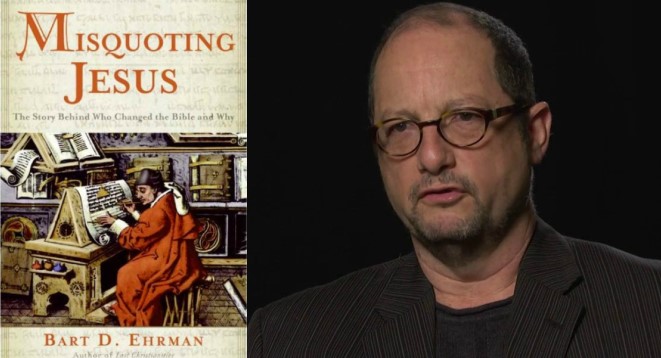
How often do we hear people “explaining” religious beliefs by stating “The Bible says so,” as if the Bible fell out of the sky, pre-translated to English by God Himself? It’s not that simple, according to an impressive and clearly-written book that should be required reading for anyone who claims to know “what the Bible says.”
Bart Ehrman’s Exploration: Who Changed the Bible and Why?
The 2005 bestseller, Misquoting Jesus, was not written by a raving atheist. Rather, it was written by a fellow who had a born-again experience in high school, then went on to attend the ultraconservative Moody Bible Institute in Chicago. Bart Ehrman didn’t stop there, however. He wanted to become an evangelical voice with credentials that would enable him to teach in secular settings. It was for this reason that he continued his education at Wheaton and, eventually, Princeton, picking up the ability to read the New Testament in its original Greek in the process.
As a result of his disciplined study, Ehrman increasingly questioned the fundamentalist approach that the “Bible is the inerrant Word of God. It contains no mistakes.” Through his studies, Ehrman determined that the Bible was not free of mistakes:
We have only error ridden copies, and the vast majority of these are centuries removed from the originals and different from them, evidently, in thousands of ways.
(Page 7). At Princeton, Ehrman learned that mistakes had been made in the copying of the New Testament over the centuries. Upon realizing this, “the floodgates opened.” In Mark 4, for example, Jesus allegedly stated that the mustard seed is “the smallest of all seeds on the earth.” Ehrman knew that this simply was not true. The more he studied the early manuscripts, the more he realized that the Bible was full of contradictions. For instance, Mark writes that Jesus was crucified the day after the Passover meal (Mark 14:12; 15:25) while John says Jesus died the day before the Passover meal (John 19:14).
Ehrman often heard that the words of the Bible were inspired. Obviously, the Bible was not originally written in English. Perhaps, suggests Ehrman, the full meaning and nuance of the New Testament could only be grasped when it was read in its original Greek (and the Old Testament could be fully appreciated only when studied in its original Hebrew) (page 6).
Because of these language barriers and the undeniable mistakes and contradictions, Ehrman realized that the Bible could not be the “fully inspired, inerrant Word of God.” Instead, it appeared to him to be a “very human book.” Human authors had originally written the text at different times and in different places to address different needs. Certainly, the Bible does not provide an an “errant guide as to how we should live. This is the shift in my own thinking that I ended up making, and to which I am now fully committed.”
How pervasive is the belief that the Bible is inerrant, that every word of the Bible is precise and true?
Occasionally I see a bumper sticker that reads: “God said it, I believe it, and that settles it.” My response is always, what if God didn’t say it? What if the book you take as giving you God’s words instead contains human words. What if the Bible doesn’t give a foolproof answer to the questions of the modern age-abortion, women’s rights, gay rights, religious and supremacy, western style democracy and the like? What if we have to figure out how to live and what to believe on our own, without setting up the Bible as a false idol–or an oracle that gives us a direct line of communication with the Almighty.
(Page 14). Ehrman continues to appreciate the Bible as an important collection of writings, but urges that it needs to be read and understood in the context of textual criticism, “a compelling and intriguing field of study of real importance not just to scholars but to everyone with an interest in the Bible.” Ehrman finds it striking that most readers of the Bible know almost nothing about textual criticism. He comments that this is not surprising, in that very few books have been written about textual criticism for a lay audience (namely, “those who know nothing about it, who don’t have the Greek and other languages necessary for the in-depth study of it who do not realize there is even any “problem” with the text).
Misquoting Jesus provides much background into how the Bible became the Bible. It happened through numerous human decisions over the centuries. For instance, the first time any Christian of record listed the 27 books of the New Testament as the books of the New Testament was 300 years after the books have been written (page 36). And those works have been radically altered over the years at the hands of the scribes “who were not only conserving scripture but also changing it.” Ehrman points out that most of the hundreds of thousands of textual changes found among the manuscripts were “completely insignificant, immaterial, of no real importance.” In short, they were innocent mistakes involving misspelling or inadvertence.
On the other hand, the very meaning of the text changed in some instances. Some Bible scholars have even concluded that it makes no sense to talk about the “original” text of the Bible. (Page 210). As a result of studying surviving Greek manuscripts of the New Testament, Ehrman concluded that we simply don’t have the original words constituting the New Testament.
Not only do we not have the originals, we don’t have the first copies of the originals. We don’t even have copies of the copies of the originals, or copies of the copies of the copies of the originals. What we have are copies made later-much later. In most instances, they are copies made many centuries later. And these copies all differ from one another, and many thousands of places . . . Possibly it is easiest to put it in comparative terms: there are more differences among our manuscripts and there are words in the New Testament.
In Misquoting Jesus Bart Ehrman spells out the ways in which several critical passages of the New Testament were changed or concocted. They are startling examples:
A.) Everyone knows the story about Jesus and the woman about to be stoned by the mob. This account is only found in John 7:53-8:12. The mob asked Jesus whether they should stone the woman (the punishment required by the Old Testament) or show her mercy. Jesus doesn’t fall for this trap. Jesus allegedly states “Let the one who is without sin among you be the first to cast a stone at her.”
The crowd dissipates out of shame. Ehrman states that this brilliant story was not originally in the Gospel of John or in any of the Gospels. “It was added by later scribes.” The story is not found in “our oldest and best manuscripts of the Gospel of John. Nor does its writing style comport with the rest of John. Most serious textual critics state that this story should not be considered part of the Bible (page 65).
B) after Jesus died, Mary Magdalene and two other women came back to the tomb to anoint the body of Jesus, according to Mark 16:1-2). They were met by a man in a white robe who told them that Jesus had been raised and was no longer there. The women fled and said nothing more to anyone out of fear (16:4-8). Everyone knows the rest of Mark’s Gospel, of course. The problem with the remainder of the story is that none of it was originally in the Gospel of Mark. It was added by a later scribe. Those additions include all of the following:
Jesus himself appeared to Mary Magdalene. She told the eleven apostles (minus Judas) about this vision, but they did not believe her. Jesus then appeared to the apostles, chastising them for failing to believe. He tells them that those who believe will be saved and those who don’t will be condemned. Then follows a critically important passage of the Bible.
And these are the signs that will accompany those who believe: they will cast out demons in my name; they will speak in new tongues; and they will take up snakes in their hands; and if they drink any poison, it will not harm them; they will place their hands upon the sick and heal them.
Jesus is then allegedly taken up into heaven and sits at the right hand of God, while the disciples go forth into the world to proclaim the Gospel in miraculous fashion.
Without the above passages (which, again, were not written by Mark) the Pentecostals lose their justification for speaking in “tongues.” And the Appalachian snake handlers have no basis for their dangerous practices.
C) John 5:7-8 is the only passage in the entire Bible “that explicitly delineates the doctrine of the Trinity (that there are three persons and God but that all three constitute a single God):
There are three that bear witness in heaven: the Father, the Word and the Spirit and these three are one; and there are three that bear witness on earth, the spirit, the water, and the blood, and these three are one.
Ehrman cites strong evidence that this Trinity passage was entirely concocted and foisted upon Erasmus by outraged theologians who needed support for their prized theological doctrine (page 81).
—
Ehrman reveals numerous other difficulties with the popular assumption that the Bible was perfectly handed down from its original written expression.
Many believers rely fervently on the King James version of the Bible, for instance. They sometimes even say “If the King James was good enough for St. Paul, it’s good enough for me.” Ehrman points out many problems with the King James version, warning that “we need to face up to the facts.”
The King James was not given by God but was a translation by a group of scholars in the early 17th century who based their rendition on a faulty Greek text.
(Page 209).
So what should we make of the Bible? Ehrman argues that the attacks of the New Testament are not simply collections of obvious, self-interpreting words. It’s the same problem we have with other important documents, such as the United States Constitution:
Texts do not simply reveal their own meanings to honest inquirers. Texts are interpreted and they are interpreted (just as they were written) by living, breathing human beings, who can make sense of texts only by explaining them in light of other other knowledge, explicating their meaning, putting the words of the text “in other words.”
(Page 217) The scribes changed the original words of the New Testament by putting them in other words.
In my experience, many people who cherry pick excerpts from the Bible as the proper way to determine what is moral are in utter denial that we don’t have accurate copies of the original writings. Most of them refuse to acknowledge that current popular versions of the Bible contain numerous discrepancies, even compared to the earliest manuscripts we do have. This is on top of the fact that their are hundreds of patent contradictions in the English version of the Bible. To most believers, none of this matters. Stay the course! In fact, in my experience most believers rarely read what the consider to be God’s own inspired word.
Ehrman’s book points out numerous troublesome issues that demand attention even assuming that the original writers of the Bible accurately reported the events described in their original writings (whatever those writings were). The elephant in the room, however, is that none of the authors of the Gospels ever claimed to witness any of the events they were reporting. Further, the extraodinary nature of Biblical claims demands extraordinary proof that ancient self-contradictory writings are simply incapable of providing, except to those of us who believe that the Bible is completely true “because it says so in the Bible.”
For all of those people who continue to go around clentching and thumping those Bibles they bought at Wal-Mart, and for all the rest of us who want to get the story straight, Ehrman’s Misquoting Jesus should be required reading.
[Administrator’s Note: More than 540 comments were quickly contributed to this post, making this page too long to download and display. Therefore, on March 23, 2007, I closed off new comments. Last night (February 4, 2009), I discovered a WordPress plugin that allows me to paginate comments, thereby protecting the site from the sudden and repeated load of 540 comments.
Here’s the good news, then. Anyone who has not yet had his or her say on Bart Ehrman’s book may now jump in at the original post and post a comment. That’s right! If none of the 540 comments that have come before you didn’t address an important aspect of Bart Ehrman’s book, you may now remedy that omission, right here in the comments to this original post. Godspeed. ]


i agree Dan, but it (evolution) does poke some holes in the major religions, and for me, enough so that I am willing to take the leap and say that god does not exist (however, its really like 99.9 percent that i dont believe in god,) thus i live my life accordingly, meaning that I follow principles which I believe to be right and just.
To; Open-minded
You state:
"Blah Blah, I am trying to teach folks like you a little something about reality, thats all. I see the misguided folks posting in here, and my heart tells me to help them."
I am going to go out on a limb and assume that by "heart" you are talking about emotion and not your organ? So does Science have feeling? Did emotion evolve and is it part of the evolutionary process, and if so, can you prove it?
Does evolution create? Does eveolution have thought? Is evolution a god. Perhaps the God I call Christ is the same God that you call evolution, afterall God does go by many names.
For generations, man has used written documentation to express current events for future generations to use to advance. Are you telling me that the bible is full of many men that lie? If so, that's cool man. Opinion but cool.
The bible says that God put man above all other creatures. here is a good question. Answer this for me:
If you have a baby and leave the hostpitol and then drop your baby off in the middle of the forest, will it survive? Why?
But I guess there was an exception in the beginning of what evolution created?
I think that the first being was created by something (God) maybe and was cared for?
Just a thought.
But stay open-minded for the thought!!!!!!!!
The Torah remains the True Word of GOD and standard for life. It is a mystical book with deep, profound and mystical teachings. Christianity and Islam are later inventions by men. They are copycat religions, they may boast that they are superior to Judaism but they are not. The teachings of Christianity are merely interpretations of the Torah by greek and roman philosophers to save there empires. It is the same with Islam. Christianity and Islam are thieves and robbers, they do not have the truth. Judaism is the Truth. Muhammad was not a true prophet he was a wicked immoral blasphemer. God does have a son and his name is Jacob.( Israel) There is a lot of money involved in religion and therefore a lot of motivation for these later copycat religions to pursue there goals to dominate the world, 10% of all wealth in the world is a mighty strong incentive is it not. Im sure your all happy with your tinpot religions and your 5 cents worth of GOD but you will never have what I have.
To Dan Klarmann and following atheists…………..???????????
You said:
"I don’t accept that the (provable) truth of evolution proves that God does not exist. It simply means that no supernatural interference is necessary (nor likely) to be involved in our origins.
Consider the principle of God-the-watchmaker. Some undetectable (scientifically unnecessary) entity started the whole shebang and then just sat back to watch it progress. It cannot be disproved. But this (unlikely) entity does not resemble the micro-managing, insecure God of any western Holy Book."
The god is named "Spinoza". It is a god who created this whole thing, but he is not a personal God, rather he is a creator that creates in the same manner we would create a movie, "for our enjoyment and the enjoyment of others. This is what Einstein believed in, oh my god Dan, your a genius???LOL Really though, this is what Einstein and Steven Hawkins believes.
Perhaps Spinoza has a life expantancy of 10 billion years and then dies. Maybe god has only so many years, like us. Afterall, a fly only lives seven days, thus our 80 years is an eternity to the fly (if it was to understand our life table). Perhaps we do not understand the life table of god??? And our life in comparison to god is like the fly to us.
OR, maybe I am just very creative (like the men who wrote the bible?)
The only problem I have with this is the fact that the bible was written by 40 different men of all walks of life i.e. doctors, fishermen, politicians, priests, etc…. It was also written over a 1600 year period in three different languages!!!!!!!!!!!!!!! thats incredible, I mean look at what we have accomplished over the last 100 years. And men our going to hold true to the authority of the word of God written through imperfect man (which is what accounts for any apparent contradictions written in the bible)? I cant believe that because what makes more sense is that these men were speaking "TRUTH".
And why did so many prophesies come true? Sure, man could have just made these prophesies come to life, Since, naturally prophesies can only be prophetic if the prophesy comes before the event. But even here, who (what group of people) are really going to take the time to fullfill over 400 prophesies? Especially, since they would have to be atheists to begin with, since they know it is not true if they are making it up. Would you do that as an atheist? Then why should they?
To say that God doesn't exist is as equally a faith, religion, and personal belief, as saying that he does exist.
No one Knows!!!!!!!!!!!!
In a recent book based on Carl Sagan's 1985 lectures, Sagan asks this question: Why didn't the Bible include any dramatic and provable truths such as this one: "Mars is a rusty place with volcanoes?" In this thread we've heard several claims that early Bible prophecies have been dramatically proven true. Whenever I look at lists of these alleged prophecies, I am yet to be impressed at the clarity or the provability of such prophecies. These usually go something like this: Something [bad/good] will happen someday and some group of people will [be blessed/rised up/be destroyed]. Big deal. I'll make that prediction every day and, with a little imagination, I'll always be proven true. See The Varieties of Scientific Experience.
The bible predicts events in the same way Nostradamus did. Easy to interpret any way you want.
Perhaps it would help "No One Knows" to read the actual writings of <a target="_blank" title="Wiki SPinoza" href="http://en.wikipedia.org/wiki/Baruch_Spinoza">Baruch/Benedictus/Bento Spinoza. Or even a clear summary of them. I'd never heard of a God going by that name before this blog.
Prophesies are always put in vague terms to ensure their realization. Prophets (those who cite future events, prophecies) are not all stuck in the far past, they exist today. But we call them Psychics.
Maybe the New Testament can be pinned down to 40 authors. The Torah was anthologized from hundreds of sources by unknown editors about 400 years after the time of Moses.
I grew up in the company of physicists. I haven't personally met Einstein or Hawking, but I have spent time with Nobel winners and others who have. I've also read more of these follows' writings than the average because I study the history of discovery as well as keeping up with the latest. I have a copy of the classic Eleventh Edition of the Britannica, in which Einstein wrote the columns on subjects in which he was the expert. I think I have a reasonable understanding of the metaphysical outlook of these gents.
"No one knows" is the agnostic creed. It is scientifically correct. My personal faith is that no God is necessary to explain anything, so I'll keep my chips on he/she/they don't exist, and let it ride.
To Dan
You state:
"My personal faith is that no God is necessary to explain anything, so I’ll keep my chips on he/she/they don’t exist, and let it ride."
Well at least you've admitted that your chips are stale, when you say, "My personal faith". This proves that your theory of evolution requires faith. Good for you, that's a start!!!!!!!!!!
Tell all the Sci-Fi guys hi for me!!!
Take Care,
NOK
To Hi Gato:
Please read me more carefully. I never said there was a god. I never said there wasn't one. I don't care one way or the other. I am more interested in human nature, that's why I asked the question "Why do you need to believe?" I often assume there is a god for the sake of argument. There might be!
To mnowlan (and Friend):
I visit the site because this topic fascinates me. Thank you for your concern and your attempt to psychoanalize me. You are WAY off base with this one. You can press as hard as you want, I'll answer any question you propose. There is no childhood trauma. I use lower case and feminine merely to signal to you that I do not subscribe to any preexisting notions.
I'm sure you and Friend are sincere when you say you care for me and my journey but don't you see how condescending your tone is? You are assuming that you are right and I am wrong. You don't KNOW that, you believe it, which is a different thing entirely. Your well-intentioned message comes off as insulting. That is something that I'm not sure true believers realize when involved in a discussion like this.
Throughout this discussion I have never meant to suggest that what you believe is wrong. I have only been seeking to understand WHY someone would choose to believe such stories. I am not concerned with proving or disproving anything in the bible or evolutionary theory. I couldn't care less.
Next question!
Belief in no-god requires the faith that 99.999% certainty is practically equivalent to certainty. Those are odds that I'll bet my soul on. I assume as axioms that Occam's Razor is applicable to the issue, and that dis-believing in one more God than the hundreds of Gods that the next fellow dis-believes in, is a valid world view.
As with my belief in the theories of gravity, chemistry, atomics, electromagnetism and so on, my belief in evolution is reinforced by observation, experimentation, and understanding of math, geology, genetics, astronomy, information theory, basic and advanced biology, anthropology, etc.
Well before the Scopes trial, no one in any field of science had any reasonable doubt about the basic theory of evolution. For the subsequent eight decades, only more decimal places of certainty have been added on to that as more and more details of the theory get proven.
My point was that there are plenty of people of deep Christian faith, actual believers in God, the Trinity, and salvation through Jesus, that accept and understand the role of evolution in our formation. They just don't buy into that peculiar politically strong American Fundamentalist minority that think that any scientific contradiction of any detail of any section of their translation of the post-Latin version of their Holy Book is an attack on their faith. I.E: Evolution does not imply Atheism. Neither (as it turned out) did Heliocentrism, although it was hotly fought by Christians its time.
To Gatomjp and friends:
You state:
"Your well-intentioned message comes off as insulting. That is something that I’m not sure true believers realize when involved in a discussion like this."
How do Christians not realize this when the bible says repeatedly that Christians will be hated by the world. If you are not of Christ, then you are of the "World".
If you feel insulted by our sentiments, then your natural recourse would be hate (anybodies would).
Answer me this: How did information come into existense. Information is non-matter???????
All of the information that I know of i.e. floppy disk, disk, cd, dvd, doesnt have any weight exept for the device its in. A programmer had to incorporate the information onto the disk. Humans are a device which holds information. But who formatted the human disc?? if you throw a floppy disc into the ocean, then you believe that chance will fill it with information. That, to me, is the fairytale.
a molecule in our DNA has information stored in it. One molecule can hold the information of a 1000 books of 500 pages in length.
how do you account for this??
Dan Klarmann:
Mr. education:
Answer me one question?
Using the theory of evolution, in 150 or less words, Explain how information comes into the picture? I am referring to the information that is in the molecules of the DNA?
http://www.direct.ca/trinity/origin2.html
To Friend:
I'm sorry Friend. I'm not quite sure why this would be your followup question to my response to you. It seems that you are still trying to get me involved in the god/no god debate. I don't care one way or the other because I accept that there may or may not be a god. It is a useless debate that will prove nothing nor change anyone's mind one little bit.
I am more interested in your motiviations for believing in the unbelieveable whether it be true or not.
In the exact same way that you and mnowlan had an awakening and finally saw the truth, so did I become aware of the truth as I see it. For me it seems fundamental that the miraculous stories about Jesus were made up. I feel that in my bones as deeply as you feel the opposite and I don't believe it will reduce my chances of getting into heaven, if there is one.
BUT, and this is the important point…I AM NOT TRYING TO CHANGE YOUR MIND. I am trying to understand it because a staunch belief in something that I consider clearly false is fascinating to me.
I apologize if that is insulting to you because I know it sounds that way but that's as clear as I can state my intentions.
To answer your question about where did information come from…I don't know. It doesn't make a difference to me.
New question for anyone who is interested:
Would you believe Jesus' message of redemption and life after death if there were no miracles in the bible?
In other words…is it required that Jesus be born of a virgin, walked on water, and rose from the dead (among many others) for us to accept his message of hope? If he was just a mortal teacher who was executed, would his words hold no weight?
Friend,
After you've had at least one semester of formal information theory (which usually follows a couple of years of calculus), then I might attempt to explain in 150 words how the complex information level in modern DNA predictably evolved from its simpler predecessor proteins.
Until you have the basic language necessary to discuss a topic, it necessarily is discussed by waving hands and building thousand-word metaphors that are all-too-vulnerable to poking holes. All metaphors are weaker than actually knowing a subject.
I've read and watched plenty of material attempting to debunk evolution (including the Canadian link you provided). It all boils down to quotes out of context, intentional misinterpretations of the metaphors used to try to quickly explain complex subjects to a lay audience, and snide references to long-abandoned dead-end theories as though these were part of the current understanding.
For example, Watson and Crick denouncing the pre-scientific theory of spontaneous generation of life has nothing to do with the observable process of self-replicating proteins that can (and did) lead to DNA, much as your linked page would like us to believe.
Sound bites are great to sway a mass audience, but they do nothing to further understanding. That is why scientists are warned not to debate Creationists in public forums. It can take an hour to explain to a lay audience what the (obvious to scientists) fallacies are in a short, apparently reasonable, viscerally convincing attack on some aspect of what has been considered a solidly proven theory by 99.99+% of scientists for over 150 years (The numbers were as low as the 80's in the generation before Darwin).
Dan Klarmann:
Here is your answer to my question:
"complex information level in modern DNA predictably evolved from its simpler predecessor proteins." I didnt need all the other BS.
And where did the simpler predecessor proteins come from and so forth?
Your answer is a copout. And you claim 99.99+ percent. You dont have an ameba to stand on.
Give me some non-metaphoric website explaining your stance. Let me determine whether or not I am intelligent enough to understand your theory. Don't decide for me, Isn't that mathematical error?
Friend: just as an analogy, take a long look at crystal growth (which includes snow flakes). You see there apparently ordered, patterned representations–information, if you will–which develop according to understandable mathematical principles. Yet it is something which happens without any "intelligent" intervention. Certain aspects of nature come together in certain ways because they can do no other (electro-chemical reactions, covalent bonding, lattice adhesion, and so forth). Information is one of the easiest aspects of the resultant configurations to find and comprehend.
Now look at the DNA molecule, which is a lovely, naturally-occuring structure that develops from the same or similar principles. Couldn't be simpler.
Dan says, "My point was that there are plenty of people of deep Christian faith, actual believers in God, the Trinity, and salvation through Jesus, that accept and understand the role of evolution in our formation."
Indeed, the last two popes both accepted evolution, and they certainly seem to be people of deep Christian faith, actual believers in God, the Trinity and salvation through Jesus (notwithstanding the fact that some Protestant sects consider popes to all be anti-Christs).
Opposition to evolution comes primarily from Fundamentalist Baptists, a Christian sect that was founded in the 19th century, and grew in the early 20th century, specifically to attack evolution. They were repelled by the notion that their ancestors might have swung from trees — a belief perhaps influenced by their belief that African-Americans *did* have ancestors who swung from trees (it is probably no coincidence that Fundamentalism is headquartered in America's former slave states) — so they adopted a rigid belief that the Bible is infallible.
What is interesting is that they try to impose their extreme religious beliefs on others through secular legislation. According to a report I recently heard on PBS television, Baptists moved into the southern states because their minority status in the north put them on the receiving end of unfavorable secular legislation. When they became the majority in the South, they adopted the same repressive practices, gradually becoming more repressive as their numbers and political influence grew. The result is what we see today: people who proclaim the power of God, but who nevertheless heavily rely on secular power to achieve their goals…with opposition to evolution being one such battleground. They try to appeal to popular opinion because they know they have no support from science.
Friend writes: "if you throw a floppy disc into the ocean, then you believe that chance will fill it with information. That, to me, is the fairytale."
Well, it depends upon what you mean by "information." A floppy disc thrown into the ocean could pick up stray magetic fields (i.e., from our planet) which might appear to be "information" to someone.
I've noticed that creationists are always using *inanimate* objects as analogies to *animate* life on our planet. Friend uses a floppy disc thrown into an ocean; others suggest a wristwatch found on a beach: "if you find a wristwatch on a beach, then you must conclude there was a creator…." They ignore the fact that animate life self-replicates and evolves, whereas inanimate objects do neither of these two things. Thus, the analogy between them that creationists use is invalid — indeed, absurd. Of course, creationists ignore this fact because the analogy gives them a useful strawman.
Grumpy:
If what you say in this statement:
"They ignore the fact that animate life self-replicates and evolves, whereas inanimate objects do neither of these two things."
Is true. Then we must assume that animate life is more complex than inanimate objects, thus, It would take even more chance for animate life to evolve, then for a floppy disc, or a watch, to evolve.
Your twist on things will only work for the simpletons of evolution.
Does anyone remember that his particular post was about a book about the early transcriptions and translations of the New Testament?
We have plenty of posts about evolution (or at least referring to it) on this site. Maybe this thread could be continued at one of those: http://dangerousintersection.org/?cat=2
But, what do I know?
Carry on …
To Dan Klarmann:
You state:
LOL, just kidding!!!!!!!! I here ya though. At the end of the day, I enjoy reading yours and others posts!!!!! And I really do understand why you believe the way you do. I just feel that it is hard for an atheist to understand how I believe because they have never truly done the research of Christianity with an open mind.
The original post about early translations are not on this website to shake the faith of the Christian, nor to one up the atheist, but to further understand the development of an amazing best selling book of little books, "The Bible".
Have a great evening!
Later,
Friend
You guys should be ashamed. Christianity is based on FAITH. Enlitenment will only come if you accept Him into your life. Trying to disprove His exisitence is futile. The bible says that you should beleive His word and Only his word. If He says the earth is not millions of years old, than so be it. You are waisting your time if you beleive otherwise.
I agree with Friend…Christianity is the WORD. All other religions such as Islam and Judaism and Agnostic need to get with the PROGRAM!!!
KOK,
I have read your post and found you lack critical thinking skills. Continue to ask questions and you will discover that GOD is in your MIND. Atheism, however you want to portray it, is what I BELIEVE. FYI my SAT score was 1300 and my IQ is about 125. I used to believe in God because that what I was taught when I was young and impressionable like you. Through higher learning and REPEATED confrontation with evidence against the existence of GOD I will also "put my chips ALL-IN" that HE is Bull CRAP.
LET IT BE HEARD THAT WE SCIENTISTS WILL SIT IDLY BY AND LISTEN TO CHRISTIAN NAIVITY LIKE "KOK"
I think it is time for you to stand up and choose. You are bright enough to join the ranks of the ENLIGHTENED. Over the years, you have asked the right questions and learned how improbable the idea of "a higher power" is.
Do not feel threatened by the Christian fundamentalists posting here, they are asking the right questions too, I must urge THEM however to find their answers in the Public Library or University rather than the Church. (this goes for All RELIGIONS). Surely you are BRIGHT enough to see that these fundamentalists mean us HARM, they are the ones trying to OUTLAW abortion, stifle research on brain cells, and worst of all, promote naive thinking by accepting a PATCHWORK OF ANCIENT SCRIBBLING (the stinky rotten bible).