What's more interesting? War or Peace?
I ran a query on Google Trends, and you could probably have predicted that war is far more interesting than peace. Here's the graph that resulted:
War is always more interesting that peace. That's how we are wired. We find conflict so interesting that the news media creates conflict when there isn't any naturally occurring. We are have thus become a society addicted to conflict, the more the better, it seems. Thus, with media reinforcing our dark urges to be entertained by violence, we have become a war-mongering society. In this post, I called our addiction "Conflict Pornography."
Everyone knows the War on Drugs has failed. It's time to step out of our comfort zones, acknowledge the truth -- and challenge our leaders ... and ourselves ... to change.
Consider the consequences of drug prohibition today: 500,000 people incarcerated in U.S. prisons and jails for nonviolent drug-law violations; 1.8 million drug arrests last year; tens of billions of taxpayer dollars expended annually to fund a drug war that 76% of Americans say has failed; millions now marked for life as former drug felons; many thousands dying each year from drug overdoses that have more to do with prohibitionist policies than the drugs themselves, and tens of thousands more needlessly infected with AIDS and Hepatitis C because those same policies undermine and block responsible public-health policies.
Truthout has published a recap of what the invasion of Iraq has brought to the United States:
We are still shocked. We were never awed. We have not adjusted. The senseless waste of our blood and treasure, our honor and our reputation continue. Operation Enduring Freedom and Operation Iraqi Freedom - the latter unleashed seven years ago today - have morphed into a single Operation Enduring Occupation, set to bankrupt this country financially as well as morally, to destroy our own security as it has that of the over 31 million people who populate Iraq and 32 million people of Afghanistan. . . . Of course, the loss of our troops (over 4,200 dead and 30,000 wounded) and treasure (three trillion dollars according to economics Nobel laureate Joseph Stiglitz), the perversion of our language, the mangling of our laws, the broken bodies and tortured brains of our veterans really bear no comparison with the suffering we have inflicted on the citizens of Iraq.
President Obama has recently announced that he will allocate $8 billion ($4 billion each year, over two years) to develop a new system of high-speed passenger rail service. This is an excellent idea. The new rail lines will be created within 10 geographical corridors ranging from 100 to 600 miles long.
Note, however, that the high-speed rail line system will be an extremely expensive project, and that the $8 billion bill will need to be paid by 138 million tax-paying Americans. Dividing the $8 billion cost by the number of taxpayers, we can see that, on average, each taxpayer will pay almost $60 ($30 per year, for two years) to support this massive new high-speed rail service.
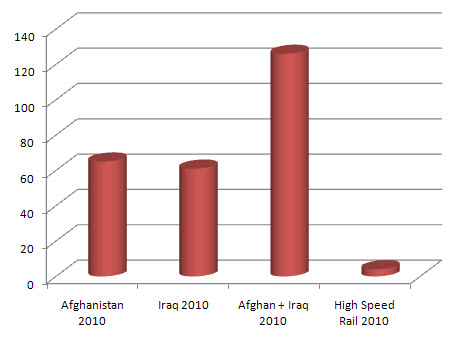
Again, this high-speed rail project will cost an immense amount of money. Consider, though, how small this pile of rail money looks when compared to the amount of money we are wasting in the "wars" in Iraq and Afghanistan. For 2009, the United States spent approximately $87 billion for Iraq and $47 billion for Afghanistan. The fiscal 2010 budget requests $65 billion for Afghanistan operations and $61 billion for Iraq. the cost of these two "wars" together is $126 billion for 2010.
Compare these expenditures on a bar chart:
This video by LEAP (Law Enforcement Against Prohibition) is well worth watching, especially by those who claim to support the "War on Drugs." The many hundreds of law enforcement officials who belong to LEAP agree that what we have is not a "War on Drugs," but prohibition, rampant social destruction and corruption.
But won't people start using a lot more drugs if they are legalized? Not likely, based on the "Holland effect": Legalizing marijuana in The Netherlands has lessened its appeal: Per-capita consumption is only half what it is in the United States. "They have succeeded in making marijuana boring," according to James Gray, an Orange County Superior Court judge for 20 years.
Check out the 12-minute mark of the above video for shocking statistics on institutionalized racism.
As one of the police officers states, legalization is not about promoting drugs. It's about stopping the violence. Once we legalize, then we can go about our work to discourage the destructive use of drugs, just like we did with cigarettes. 50% percent of adult smokers have given up that habit in the past ten years thanks to education. We cut the use of nicotine in half without telling our police to kick down doors and slap handcuffs onto smokers.
Judge Gray indicates that ending the "war on drugs" is the "single most important thing we could do" to improve our urban neighborhoods.
What is the war on drugs? According to one of the speakers in the above video, it's "sixty nine billion dollars per year down the rat hole." I agree. The "War on Drugs" should be renamed the "Inject Violence Into Neighborhoods Project." It is immoral and senseless. And finally, there is good reason to believe that the momentum has changed (based on many things, including Denver's legalization of marijuana). Large numbers of Americans are starting to question this insane "War."
Judge Gray makes the point that legalizing marijuana is NOT condoning it. In the following talk (Oct 28, 2009), he gives a long litany of additional reasons for regulating and controlling marijuana. The biggest reason for legalizing is the the present system endangers children:
For much more important information, see the home page of LEAP.

 War is always more interesting that peace. That's how we are wired. We find conflict so interesting that the news media creates conflict when there isn't any naturally occurring. We are have thus become a society addicted to conflict, the more the better, it seems. Thus, with media reinforcing our dark urges to be entertained by violence, we have become a war-mongering society. In this post, I called our addiction "Conflict Pornography."