
Obama Administration continues Bush tradition of free market fundamentalism

William Black was a guest on Bill Moyers Journal yesterday. The conversation was lively and informative, including detailed discussion regarding "liar's loans" (In a liar's loan, the mortgage company doesn't require any verified information from the borrower about the borrower's income, employment, job history or assets). Black indicates that even after all that has come to light regarding the financial collapse, our politicians refuse to use the "F word," fraud. Why? Because too many politicians (and businesses) simply don't believe in fraud. That is the hallmark of free market fundamentalism. To make matters worse, Barack Obama refuses to utter the word "fraud" from his bully pulpit. Nor does Eric Holder or anyone from the Obama Administration:

WILLIAM K. BLACK They can't even get themselves to use the word "fraud."

There's a huge part that is economic ideology. And neoclassical economists don't believe that fraud can exist. I mean, they just flat out -- the leading textbook in corporate law from law and economics perspective by Easterbrook and Fischel, says -- I'll get pretty close to exact quotation. "A rule against fraud is neither necessary nor particularly important." Right?

Notice how extreme that statement is. We don't need laws. We don't need an FBI. We don't need a justice department. We don't even need rules like the SEC. The markets cleanse themselves automatically and prevent all frauds. This is a spectacularly naïve thing. There is enormous ideological content. And it fits with class. And it fits with political contributions.

Do you want to look at these seemingly respectable huge financial institutions, which are your leading political contributors as crooks?

But can't we insist that suspect businesses be audited to determining whether they are committing fraud? Not based on a long sordid track record regarding prestigious accounting firms:

BILL MOYERS: Isn't the accounting firm supposed to report this, once they learn from somebody like him that there's fraud going on?

WILLIAM K. BLACK Yes, they're supposed to be the most important gatekeeper. They're supposed to be independent. They're supposed to be ultra-professional. But they have an enormous problem, and it's compensation. And that is, the way you rise to power within one of these big four accounting firms is by being a rainmaker, bringing in the big clients.

And so, every single one of these major frauds we call control frauds in the financial sphere has been-- their weapon of choice has been accounting. And every single one, for many years, was able to get what we call clean opinions from one of the most prestigious audit firms in the world, while they were massively fraudulent and deeply insolvent.

BILL MOYERS: I read an essay last night where you describe what you call a criminogenic environment. What is a criminogenic environment?
Continue ReadingObama Administration continues Bush tradition of free market fundamentalism

What Healthcare Reform REALLY Does For Us

In an historic vote late Saturday evening, the US House passed into law the Patient Protection and Affordable Care Act on a mostly party line vote of 219-212. The Act will be made into law (the bill passed by the US Senate 60-39) upon signature by President Obama. On Tuesday, March 23, 2010, President Obama signed the bill into law in a ceremony attended by members of Congress, the US Senate, staff and an 11-year old advocate of healthcare reform who had lost his mother to cancer. There’s been a lot of confusion and misinformation spread about the bill as to what it contains and when certain aspects of the legislation go into effect. The terms of the new law were discussed in impressive clarity by Rachel Maddow and Barney Frank. See also, this article from the New York Times. As of March 23, 2010, consumers will be entitled to the following: - Tax credits go to small businesses for buying health insurance for their employees, and; - The so-called “doughnut hole” for seniors under Medicare Part D (drug) coverage is going; if you’ve reached the total for 2009, you will be immediately sent a rebate check of $250.00, and; - Pre-existing conditions will no longer be allowed for denials of health insurance coverage on new policies issued, and; - States will be required to maintain their existing Medicaid and children’s health insurance coverage based on policies currently in effect. While states can expand their programs, they are not allowed to cut back on eligibility and are not allowed to put in place any paperwork requirements that would make it harder for people to sign up for coverage, and; Freestanding birth centers” are now eligible for Medicaid payments, and; - Another provision that appears to take effect right away is an expansion of Medicare to cover certain victims of “environmental health hazards,” which was aimed specifically at the town of Libby, Mont. - A requirement that the secretary of health and human services establish criteria “for determining whether health insurance issuers and employment-based health plans have discouraged an individual from remaining enrolled in prior coverage based on that individual’s health status.” On April 23, 2010, - The secretary of health and human services must post on the Internet “a list of the authorities provided to the secretary under this act.” In June, 2010, - High Risk Insurance pools open to cover those with any pre-existing conditions (June 1, 2010),; and - The Secretary of HHS must “develop a standardized format to be used for the presentation of information relating to coverage” — so that consumers have a more understandable way of comparing health benefits — like medical, surgical, hospital and prescription drug coverage — offered by private insurers (June 23, 2010). On September 23, 2010, - Children may not be excluded from any coverage because of pre-existing conditions, and; - Insurers will not be allowed to deny coverage because you get sick (so called “rescissions”), and; - No more lifetime limits on coverage or benefits allowed, and; - Children are covered under your policy, if you want, until age 26. [more . . . ]

Continue ReadingWhat Healthcare Reform REALLY Does For Us

The so-called interview

I'm having a difficult time believing that FOX calls this an interview. The elephant in the room is that FOX and much of its audience want to believe that everything would be OK without any sort of health care reform. That assumption seemed to be driving the questioning. In the past few months, though, I've been meeting more and more people who are going without health insurance, which can lead to tragic foreclosures and bankruptcies. This situation is not tenable. With regard to this frustrating interview, I do find some fault with President Barack Obama too. He's claims both that we know what's in the bill and that we'll someday see what's in the bill. And he speaks as though there is going to be a meaningful comment period. I'll be watching to see how many hours tick by after passage of this bill, before the bill is rammed home at the White House. We'll see how much input the citizens will have. And from what we suspect, the Obama bill will apparently be a huge gift to corporations that are gaming the health care system. But you wouldn't know any of this based on the questions by this hack interviewer. We desperately need to reform the health care system, though I think that most of that work, and much of the sacrifices will need to be incurred by individual Americans. The national debate thus frustrates me because it is, I think, fundamentally dishonest. We, the People need to take far better care of their bodies and quit expecting our (incredibly talented) health care professionals to bail us out of problems we create with our terrible eating habits and sedentary lifestyles. And we might need to better understand that more high-tech medicine does not necessarily lead to better for real-life health and mortality rates. Americans are dreaming to think that they can pay less and get the same or more of the same type of healthcare that they are currently consuming. Something's gotta give. Maybe a lot of things gotta give. Mostly, we need meaningful exchanges of information in order to improve health care delivery. We need civilized debate and straight talk. This "interview" was pathetic--I do put most of the blame on the shallow-minded sputtering "interviewer," who came equipped mostly with barking points, rather than any interest in developing useful ideas. This session should be shown in journalism schools a an example of how not to conduct an interview. I'd never seen Bret Baier until this interview. I'd bet that he never again gets a chance to conduct any high profile interview. I really have to wonder about his objective going in, other than a dozen barking points.

Continue ReadingThe so-called interview

Why financial reform will never happen

President Obama, 1/29/09:

...when I saw an article today indicating that Wall Street bankers had given themselves $20 billion worth of bonuses -- the same amount of bonuses as they gave themselves in 2004 -- at a time when most of these institutions were teetering on collapse and they are asking for taxpayers to help sustain them, and when taxpayers find themselves in the difficult position that if they don't provide help that the entire system could come down on top of our heads -- that is the height of irresponsibility. It is shameful.
President Obama, 1/14/10:
As we all know, our country has endured the deepest recession we've faced in generations. And much of the turmoil was caused by irresponsibility on the part of banks and financial institutions. Firms took reckless risks in pursuit of short-term profits and soaring bonuses, triggering a financial crisis that nearly pulled the economy into a second Great Depression. ... My commitment is to recover every single dime the American people are owed. And my determination to achieve this goal is only heightened when I see reports of massive profits and obscene bonuses at some of the very firms who owe their continued existence to the American people -- folks who have not been made whole, and who continue to face real hardship in this recession. We want our money back, and we're going to get it. And that's why I'm proposing a Financial Crisis Responsibility Fee to be imposed on major financial firms until the American people are fully compensated for the extraordinary assistance they provided to Wall Street. If these companies are in good enough shape to afford massive bonuses, they are surely in good enough shape to afford paying back every penny to taxpayers.
New York Times, 2/7/10:
Just two years after Mr. Obama helped his party pull in record Wall Street contributions — $89 million from the securities and investment business, according to the nonpartisan Center for Responsive Politics — some of his biggest supporters, like Mr. Dimon, have become the industry’s chief lobbyists against his regulatory agenda. Republicans are rushing to capitalize on what they call Wall Street’s “buyer’s remorse” with the Democrats. And industry executives and lobbyists are warning Democrats that if Mr. Obama keeps attacking Wall Street “fat cats,” they may fight back by withholding their cash. ... Though Wall Street has long been a major source of Democratic campaign money (alongside Hollywood and Silicon Valley), Mr. Obama built unusually direct ties to his contributors there. ... Wall Street lobbyists say the financial industry’s big Democratic donors help ensure that their arguments reach the ears of the president and Congress. White House visitors’ logs show dozens of meetings with big Wall Street fund-raisers, including Gary D. Cohn, a president of Goldman Sachs; Mr. Dimon of JPMorgan Chase; and Robert Wolf, the chief of the American division of the Swiss bank UBS, who has also played golf, had lunch and watched July 4 fireworks with the president.
Bloomberg News, 2/10/10:
President Barack Obama said he doesn’t “begrudge” the $17 million bonus awarded to JPMorgan Chase & Co. Chief Executive Officer Jamie Dimon or the $9 million issued to Goldman Sachs Group Inc. CEO Lloyd Blankfein, noting that some athletes take home more pay. The president, speaking in an interview, said in response to a question that while $17 million is “an extraordinary amount of money” for Main Street, “there are some baseball players who are making more than that and don’t get to the World Series either, so I’m shocked by that as well.” “I know both those guys; they are very savvy businessmen,” Obama said in the interview yesterday in the Oval Office with Bloomberg BusinessWeek, which will appear on newsstands Friday. “I, like most of the American people, don’t begrudge people success or wealth. That is part of the free- market system.” Obama sought to combat perceptions that his administration is anti-business and trumpeted the influence corporate leaders have had on his economic policies. He plans to reiterate that message when he speaks to the Business Roundtable, which represents the heads of many of the biggest U.S. companies, on Feb. 24 in Washington.
Any questions? And are trillion-dollar bailouts for these firms also a part of our "free-market system"?

Continue ReadingWhy financial reform will never happen

Cost of our new high-speed trains is dwarfed by the tax dollars we waste in our Afghanistan and Iraq “wars.”

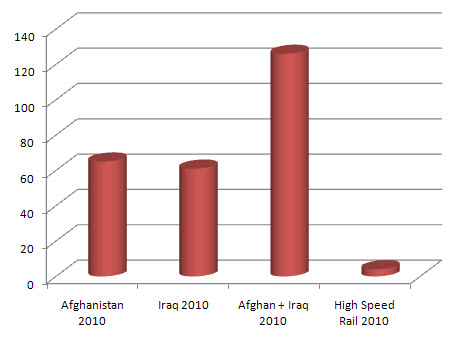
President Obama has recently announced that he will allocate $8 billion ($4 billion each year, over two years) to develop a new system of high-speed passenger rail service. This is an excellent idea. The new rail lines will be created within 10 geographical corridors ranging from 100 to 600 miles long. Note, however, that the high-speed rail line system will be an extremely expensive project, and that the $8 billion bill will need to be paid by 138 million tax-paying Americans. Dividing the $8 billion cost by the number of taxpayers, we can see that, on average, each taxpayer will pay almost $60 ($30 per year, for two years) to support this massive new high-speed rail service. Again, this high-speed rail project will cost an immense amount of money. Consider, though, how small this pile of rail money looks when compared to the amount of money we are wasting in the "wars" in Iraq and Afghanistan. For 2009, the United States spent approximately $87 billion for Iraq and $47 billion for Afghanistan. The fiscal 2010 budget requests $65 billion for Afghanistan operations and $61 billion for Iraq. the cost of these two "wars" together is $126 billion for 2010. Compare these expenditures on a bar chart: Graph by Erich Vieth

Continue ReadingCost of our new high-speed trains is dwarfed by the tax dollars we waste in our Afghanistan and Iraq “wars.”