Depends Who Said It
Fun little street experiment. Statements about Iran are bad because Trump said them. But actually, Hillary Clinton and Kamala Harris said them. Ooops. Too late to retract the venom.
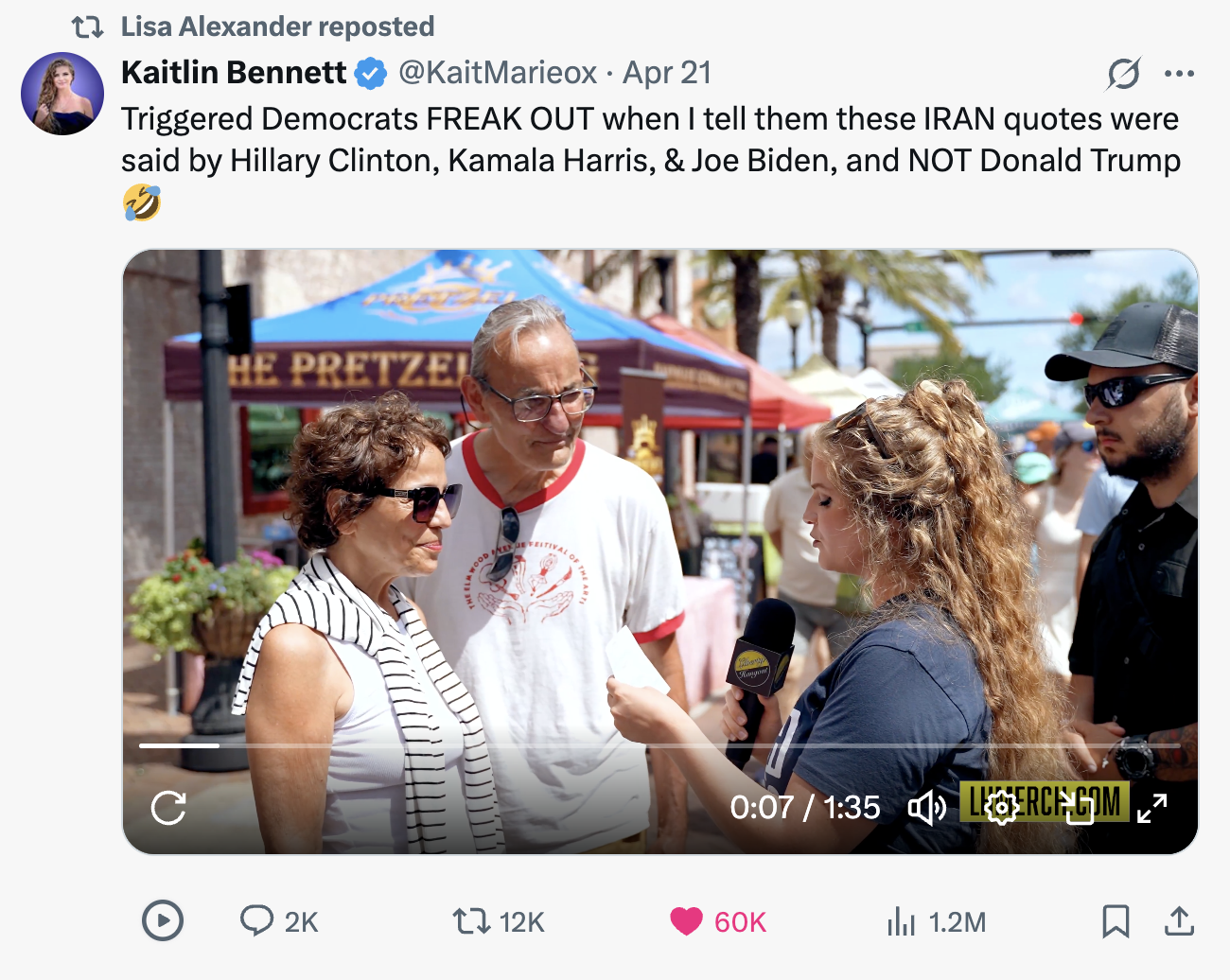

Fun little street experiment. Statements about Iran are bad because Trump said them. But actually, Hillary Clinton and Kamala Harris said them. Ooops. Too late to retract the venom.
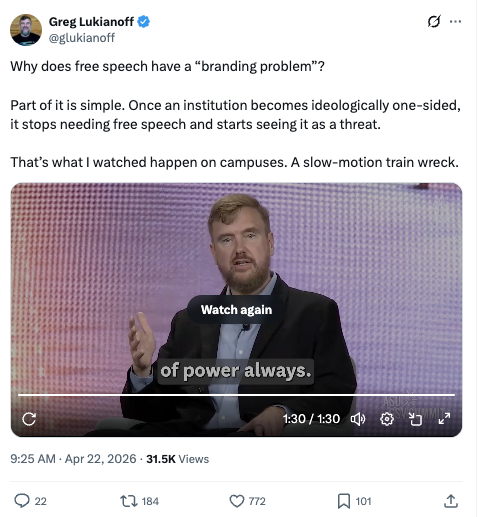
Q: "I'm really curious to hear from you why you think free speech has the branding issue that you know it tends to have, and why for young people, there's this perception that you know is warped. "
Greg Lukianoff: "This is probably a rough thing to say in a group full of educators, but I do think that a lot of the quote, unquote, branding issue with freedom of speech came out of K through PhD. When I was working at the ACLU back in 1999 I could see something happening, what I called the slow motion train wreck on college campuses in particular. We qualified for public assistance when I was a kid, and then I ended up at a place like Stanford Law School. And this was definitely a very weird experience for me, and it was the first time I really ran into kids who were pretty mediocre, a little ambivalent about freedom of speech. Working Class liberals were very pro freedom of speech. I thought that's what made a liberal, a liberal. But it was only when I started meeting more upper class people who came from, you know, the 1% and tended to go to the fanciest schools, that I started really running into this very anti liberal kind of idea, and that's a very typical dynamic that essentially, once your politics become a super majority of an institution--you want free speech when you're the minority, because free speech protects minority opinions. You don't need it to protect the majority. The popular vote protects the majority power. And in higher ed, there was this intentional, clear shift that free speech started being problematized partially because the people in charge of higher ed kind of thought, well, if I'm the one deciding what will get you punished and what won't, I can be trusted with that. And that's the temptation of power always."
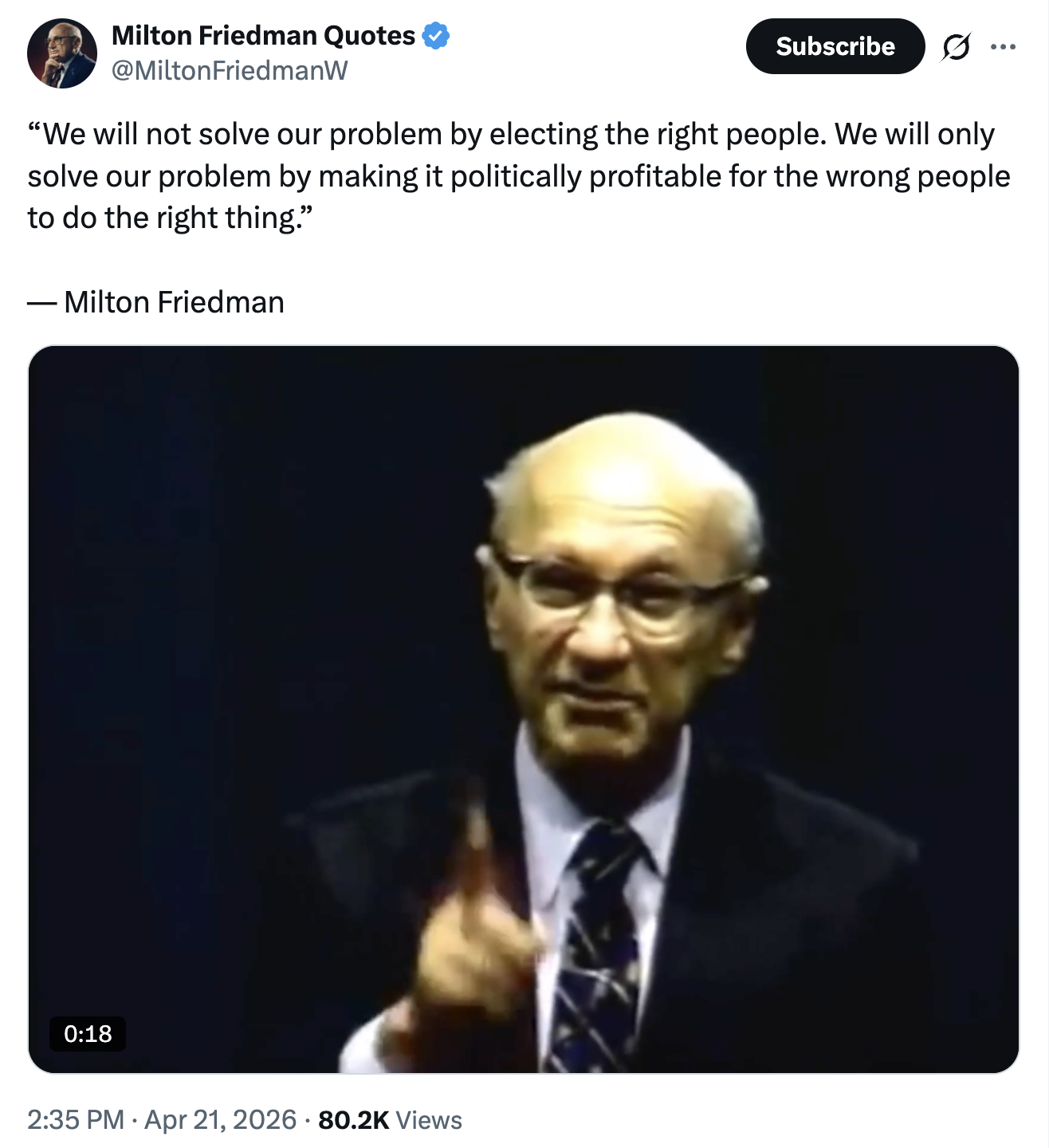
“We will not solve our problem by electing the right people. We will only solve our problem by making it politically profitable for the wrong people to do the right thing.”
— Milton Friedman
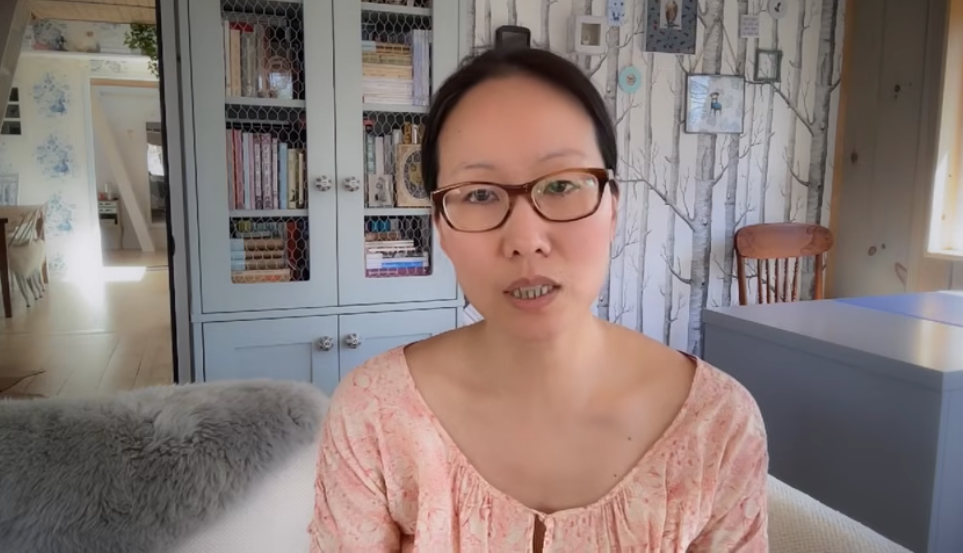
Joomi Kim has put together this excellent in which she explains why has gone wrong with Modernism. She makes several references to The Decline & Fall of Western Art, by Brendan Heard.
Rabbitt Malone has recently written an article on vaccines and autism: Neuroscience, Vaccines, and Autism: "What Science Actually Says and Doesn’t Say: An honest look at vaccine biology, autism research, and a hypothesis that may offer real hope for families of nonspeaking children."
He sums up the current situation:
WHERE THE QUESTION REMAINS GENUINELY OPENRegressive autism is different. Roughly 20 to 30 percent of autistic children appear to develop typically and then lose skills, often language and social engagement, somewhere between 12 and 24 months of age. This regression is real, documented, and poorly understood. Its timing does overlap with the vaccine schedule. And it is worth saying plainly: the parents who report watching their child change in the days and weeks following vaccination are not, as a group, confused or misremembering. Regression happens. The timing they describe is real. The unresolved scientific question is not whether the regression occurred but what caused it.
This distinction matters. For too long, the response from the medical establishment has been to challenge the parents’ account rather than to engage the mechanism. That is not good science, and it has damaged trust in ways that will take a long time to repair. The honest position is to acknowledge the reported pattern, take it seriously as an observation, and invest in the research needed to understand it.
Autistic brains, examined postmortem, show neuroinflammatory signatures, activated microglia, elevated cytokines, and white matter abnormalities [4,5]. These findings are consistent with what you might expect from microvascular injury, though they almost certainly have other explanations as well. The point is not that vaccines caused these findings, but that the brain biology of autism involves immune and vascular components that researchers are still working to understand.
We do not fully understand regressive autism. Ruling out postnatal contributions on political rather than scientific grounds would itself be a failure of honest inquiry.
The most credible narrow claim, and it is narrow, is that in a subgroup of children with underlying immune or metabolic vulnerabilities, a strong immune activation event, possibly including vaccination, could act as a trigger for neurological regression in children already on a susceptible developmental trajectory. This has not been demonstrated. It has not been ruled out.