
Daniel Dennett discusses closeted atheist preachers

Philosopher Daniel Dennett discusses closeted atheist preachers in this excellent one-hour video in which he undertakes a "reverse engineering of religion." At about the 20-minute mark Dennett focuses on the works of Bart Ehrman and Jack Good (The Dishonest Church). Dennett points out that Good is outraged by the conspiracy by preachers to keep accurate information from the laity, who "can't handle" the information. Per Dennett, seminarians work hard to devise clever ways to avoid divulging the full truth about the Bible. (minute 24). How did it come to this? Dennett addresses this at minute 25. Dennett quotes Donald Hebb: "If it's not worth doing, then it's not worth doing well." He focuses the question to this: Who needs theologians? His answer: Those preachers who want to avoid being candid with their parishioners. "Theologians are religions' spinmeisters." At minute 29, Dennett recites the "Canons of Good Spin." Two examples: "It has to relieve skepticism without arousing curiosity" and "It should seem profound." These principles can be summed up with Dennett's neologism "deepities." (minute 31). These are statements that seem to be true only because they are ill-formed, and they have two readings. One is true but trivial, and the other is false but would be earth-shaking if true. Examples are given up through the remainder of the video, including a Karen Armstrong assertion at minute 43. Theologians are like magicians, and the concept of "deepities" allows one to see the card up the magician's sleeve. More on Karen Armstrong's evasions at minute 45, including attacks on theologians who, cornered, suggest that existence is not an important attribute of "God." Dennett racks it all up to a belief-in-God-meme. These evasions of theologians are reasons without reasoners. They are the result of unreasoning processes. The "cunning" is in the institutions themselves. These sorts of pseudo-explanations result from "a conspiracy without a mastermind."
Continue ReadingDaniel Dennett discusses closeted atheist preachers

Three questions

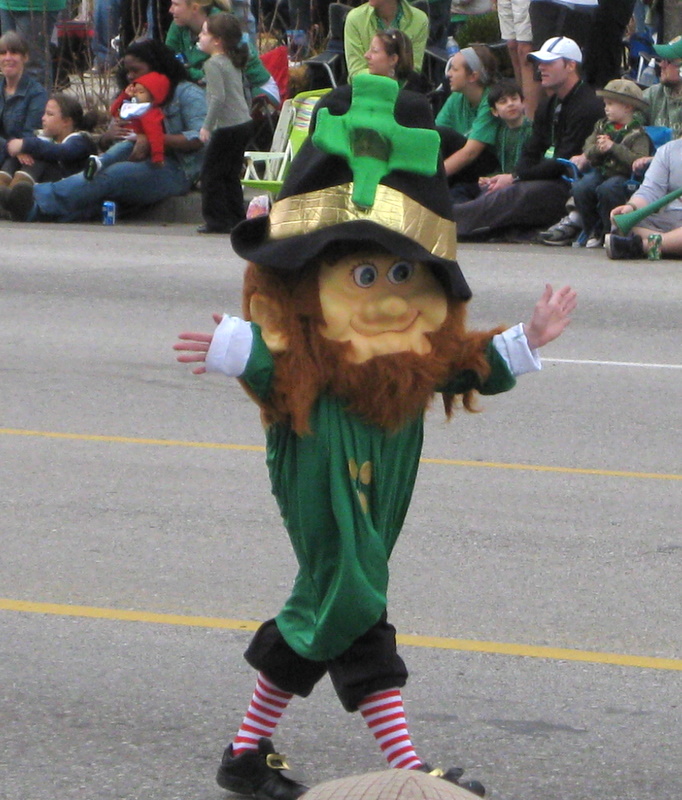
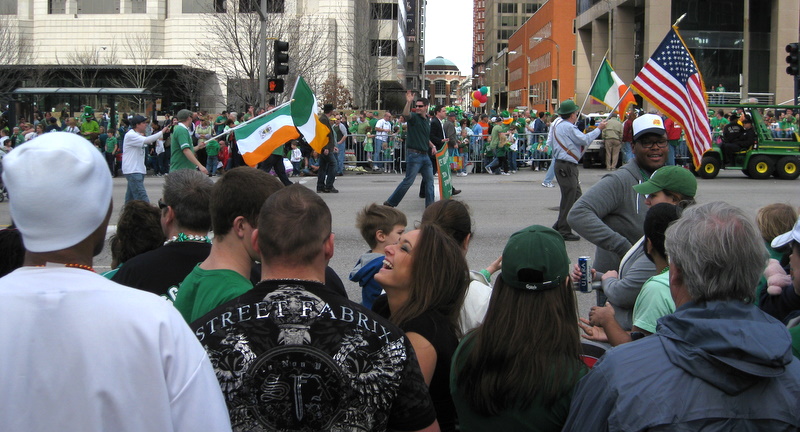
Yesterday, I was trying to get some work done in a tall office building in downtown Saint Louis. In the early afternoon, I was distracted by lots of crowd noise and drum beating outside. It was March 12, which somehow means that it was time for the downtown Saint Patrick's Day parade (St. Louis also has an annual Hibernian parade on March 17). I decided to grab my camera and go down to street level to see things up close. I'm posting a dozen photos with this article. I'm somewhat of a introverted non-drinking semi-misanthrope, which gives me a special perspective whenever people gather for merriment. Whenever I notice great energy being funneled into big social gatherings, I am immune to being swept up myself. Some would consider the way I am to be a curse, but I disagree. On these occasions I put on my armchair-anthropologist hat and I enjoy the opportunity to get to work. I ponder why it is that human animals so often burn such energy for reasons that almost always escape me. For instance, at Christmas time, very little of the energy is spend pondering Jesus. On the forth of July, very few Americans seriously consider whether we are better off not being part of the British Empire. We are people of food, drink, presents, fireworks and being groupish. We are also prolific excuse-makers. How would a first rate scientist or historian size up yesterday's big parade? I believe that the answer is instructive regarding the issues raised here and here). [More . . . ]

Continue ReadingThree questions

How We Got Here: The Debate II

To continue... The Whiskey Rebellion more or less blew up in Alexander Hamilton’s face. The tax he pushed through congress on whiskey that triggered the entire affair was shortly thereafter repealed and it was a while before the federal government tried to impose internal taxes. One of the stated goals of the revolution was to end taxation without representation, but in practical terms this meant an end to taxation, period. The federal government used tariffs and land sales to pay off the debt incurred by the revolutionary war. Jefferson’s purchase of Louisiana was still done by a combination of the two plus borrowing. Generally, tariffs were kept low, to encourage volume of trade. Some high tariffs were employed in the 1820s and 1830s as protectionist measures to level the field with Britain, which was in the midst of its “workshop of the world” period. The South hated these tariffs because it raised the price of manufactures and shipping, which impacted on their trade which was almost entirely agricultural. It was different in the states. Property taxes early became a source of state revenue. The definition of “property” for the purposes of such taxes stretched far beyond the bounds we would recognize or accept today and under Jackson came to include just about anything a person owned. Local reaction to such impositions varied by city and state, but rarely rose to the level of rebellion. Federal internal taxes did not come into play until the Civil War. The need to raise revenue in huge amounts and quickly necessitated the creation of the first income tax, among others, including a vast array of excise taxes and licensing. There were special corporate taxes, stamp taxes for legal documents, and inheritance taxes. Most of these were phased out after the Civil War. Interestingly, the Republicans—a new party formed just before the Civil War which became the second national party, supplanting the archaic Whigs—kept two elements of the new tax system: high tariffs and taxes on liquor and tobacco. High tariffs were protectionist measures. The excises on liquor and tobacco were not greatly challenged because they coincided with the growing Temperance Movement, which was becoming politically significant. [More . . . ]

Continue ReadingHow We Got Here: The Debate II