Babies Crying After Not Getting Hurt
Fascinating humor video that might be illustrating a deep psychological principle. How often is victimhood not about getting hurt?


Fascinating humor video that might be illustrating a deep psychological principle. How often is victimhood not about getting hurt?
Alan Sokal discusses "sex is assigned at birth" as Exhibit A on how well-intentioned science can run off the rails when it fails to put facts first. His article at The Critic is titled: "Woke invades the sciences: The intrusion of irrational ideology is distorting and censoring science."
Fast forward four decades. Now the entire American medical establishment, from the American Medical Association and the American Academy of Pediatrics to the American Psychological Association and the American Psychiatric Association and even the Centers for Disease Control and Prevention, insists that sex — as in male or female — is, in the AAP’s words, “an assignment that is made at birth”. What could this mean?
What are the indisputable facts?
The facts about sex are straightforward, and are taught in any half-decent high-school course in biology. Nearly all animals, as well as many plants, reproduce sexually. In almost all sexually reproducing multicellular species this occurs by combining a large gamete, called an ovum (or egg), with a small gamete, called a sperm. Though some (“hermaphrodite”) plants and animals produce both ova and sperm, there are no hermaphrodite mammalian species. In mammals, each individual produces only one kind of gamete. Those individuals that produce (relatively few) ova are called female; those that produce (large numbers of) sperm are called male. Whether a mammal embryo develops into a male or a female is determined (at least when things go right, which is nearly all the time) by a pair of sex chromosomes: XX for females, XY for males. In short, sex in all animals is defined by gamete size; sex in all mammals is determined by sex chromosomes; and there are two and only two sexes: male and female.
I've had this discussion with several people who want to claim that there are more than two sexes (or that sex is "fluid") "because some people are intersex." This is an extraordinarily misguided claim because only a tiny percentage of people who claim to be transgender have intersex conditions. The same is true of the general population. Very few people have intersex conditions:
For sure, quirks of mutation or prenatal development may leave some individuals unable to produce viable gametes at all. But an infertile individual with a Y chromosome is still male, just as a one-legged person remains a full member of our bipedal species.Much is speciously made of the fact that a very few humans are born with chromosomal patterns other than XX and XY. The most common, Klinefelter syndrome (XXY), occurs in about 0.1 per cent of live births; these individuals are anatomically male, though often infertile. Some extremely rare conditions, such as de la Chapelle syndrome (0.003 per cent) and Swyer syndrome (0.0005 per cent), arguably fall outside the standard male/female classification. Even so, the sexual divide is an exceedingly clear binary, as binary as any distinction you can find in biology.
See also, this article on intersex, pointing to the work of biologist Colin Wright. Consequently, almost all newborn babies are obviously male or female. It's the same whether we are talking about human animals, dog, cats or any other mammal.
A baby’s name is assigned at birth; no one doubts that. But a baby’s sex is not “assigned”; it is determined at conception and is then observed at birth, first by examination of the external genital organs, and then, in cases of doubt, by chromosomal analysis[1]. Of course, any observation can be erroneous, and in rare cases the sex reported on the birth certificate is inaccurate and needs to be subsequently corrected. But the fallibility of observation does not change the fact that what is being observed — a person’s sex — is an objective biological reality, just like their blood group or fingerprint pattern, not something that is “assigned”. The medical associations’ pronouncements are social constructivism gone amok — this time about a subject that has been more-or-less accurately understood by humans (albeit without all the scientific details) ever since the beginning of our species. Sex, unlike quarks, is not subtle.
How can all of these formerly prestigious medical organizations suddenly (at the same time) forget the basic facts regarding sex?
The cause is evidently political. The medical establishment’s new-found reluctance to speak honestly about biological reality — and its insouciance in speaking dishonestly about it — presumably stems from a laudable desire to defend the human rights of transgender people. But while the goal is praiseworthy, the chosen method is misguided. Protecting transgender people from discrimination and harassment does not require pretending that sex is merely “assigned”.
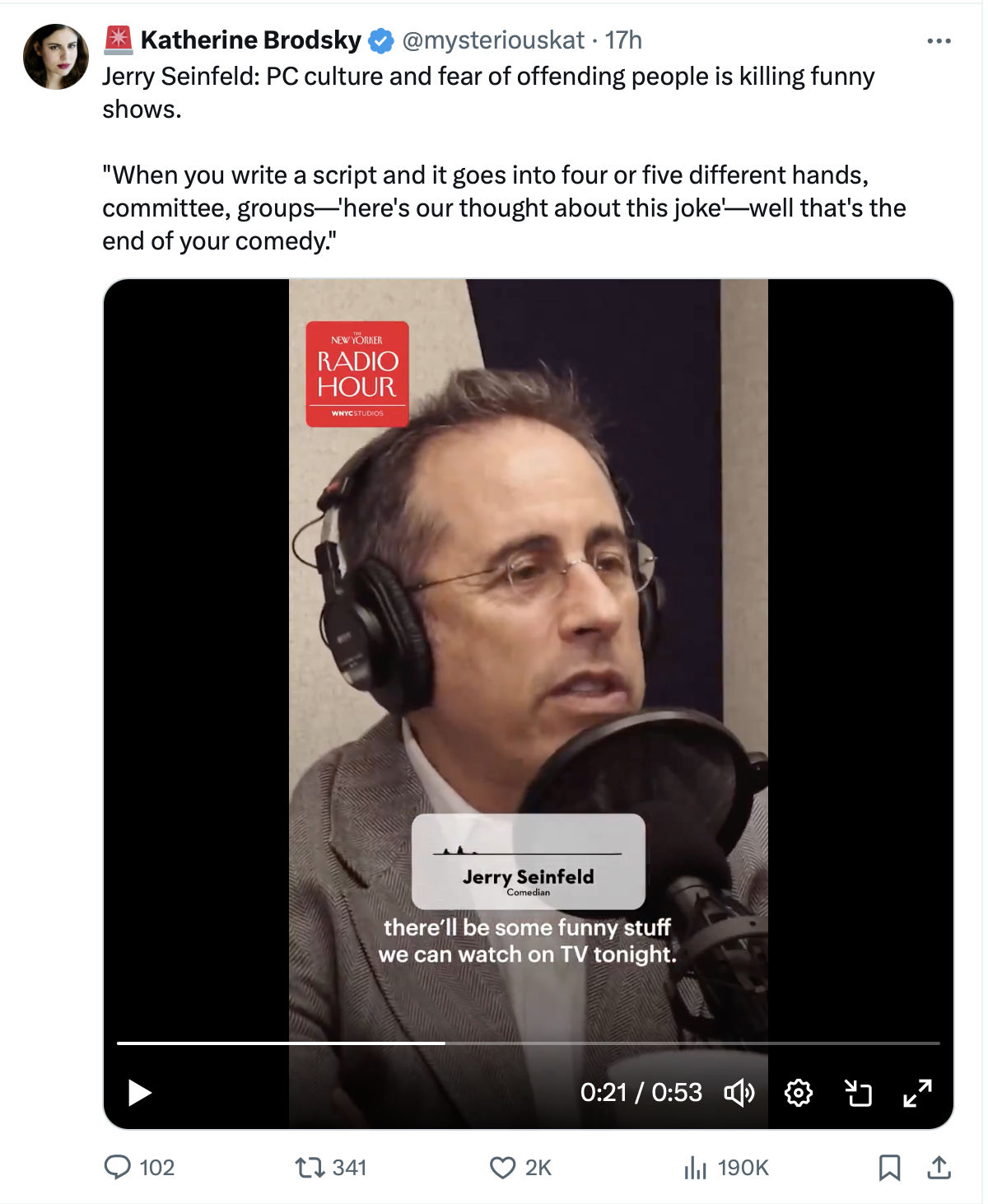
Jerry Seinfeld bemoans Hollywood's lack of comedy in light of cancel culture, political correctness and woke culture:
I just finished watching "Can We Take a Joke: When Outrage and Comedy Collide" (2016). Awesome documentary for those who understand the importance of free speech and who are concerned about the future of comedy.