
Parents Support Transgendered Child

An eight-year-old child in Omaha, Nebraska, the middle of three boys, has told his parents throughout his life that he is a she. Since he learned to talk, he has said, daily, that he is really a girl. His parents have come to believe him, and are letting him begin the next school term in a new school, as a girl, with a new name. Ben-turned-Katie will not be allowed back in his Catholic elementary school. According to the priest in the parish, since the Catholic Church believes a person is born one gender and cannot change, his appearance at school would lead to too many questions and cause discomfort for the other children. It might, of course. Certainly it would raise all kinds of questions, yes. Hard questions, the kind that parents aren't sure how to answer. My guess is, though, that if the school called in an expert on the subject and held an assembly in which the child's situation is explained in brief and concrete terms and the other children were allowed to ask any questions they had, parents were allowed to attend, etc., the issue could be handled and put to rest. Children that age are amazingly accepting, and what a wonderful life lesson it could be. That is how it would be handled in our school - or similarly, somehow - one of the many reasons we are there. In watching the video, I was struck by the dedication of these parents to their child. I am so relieved, on Katie's behalf, that she has this kind of support. In conservative Nebraska, this can't be easy. I wish them well, and thank them for being the kind of parents every kid deserves to have. Unconditional love at its finest.
Continue ReadingParents Support Transgendered Child

Held Hostage by Health Care

A physician friend of mine sent me a link to a piece written by Dr. Marcia Angell about why Congress should consider a single-payer system and suggestions as to how it could be implemented. Dr. Angell is a senior lecturer in social medicine at Harvard Medical School and a former editor-in-chief of the New England Journal of Medicine. I can only hope that, even though she was not invited to speak in front of Congress, Pres. Obama and the Congress see her words and incorporate this into their discussion.

Continue ReadingHeld Hostage by Health Care

Hear the story about all of our stuff

In The Story of Stuff, Annie Leonard tells us that all of our "stuff" is part of a linear system that is clashing with our finite planet. Her video is extremely popular (5.5 million views) and easy to follow. Here's a short description from her site:

From its extraction through sale, use and disposal, all the stuff in our lives affects communities at home and abroad, yet most of this is hidden from view. The Story of Stuff is a 20-minute, fast-paced, fact-filled look at the underside of our production and consumption patterns. The Story of Stuff exposes the connections between a huge number of environmental and social issues, and calls us together to create a more sustainable and just world. It'll teach you something, it'll make you laugh, and it just may change the way you look at all the stuff in your life forever.

What are the main problems? We are externalizing costs, so that we are oblivious to the damages we are causing around the world when we buy so much of the stuff that we are buying. We are running out of resources. Her stats from the United States are especially troubling because we are so very much living beyond our means. We generating huge heaps of waste. We are using energy + contaminated products to promulgate toxic products and untested products. One of the highest concentrations of toxic food substances has become human breast milk. 200,000 people move from their resource-exhausted long-time communities into crowded cities, many of them slums. And consider that 99% of the stuff we run through our economic system is trash within 6 months. This is not an accident, either. It is long-time government and industry policy that we should shop and consume. We shop three to four times as much as Europeans. Which, again, leads to disposal problems. For every trash can full of waste we throw away there were 70 trash cans of waste produced to make that one can of waste. Incredible. Many DI related posts can be found here. Further, listen to Daniel Goleman's description of the basic problem and the solution in his interview with Daniel Goleman.

Continue ReadingHear the story about all of our stuff

Not Ready to Meet their Maker?

Reading through my back issues of the Economist, I came across this article from March. According to a study published in the Journal of the American Medical Association religious people seem curiously unwilling and unready to die. According to the study, by Andrea Phelps and her colleagues at the Dana-Farber Cancer Institute in Boston, religious people seem to use their faith simply to cope with the pain and degradation involved in treatment, and that they are more willing to experiment with more aggressive treatments, even though such treatment rarely makes much difference to the outcome or their life expectancy.

Dr Phelps and her team followed the last months of 345 cancer patients. The participants were not asked directly how religious they were but, rather, about how they used any religious belief they had to cope with difficult situations by, for example, “seeking God’s love and care”. The score from this questionnaire was compared with their requests for such things as the use of mechanical ventilation to keep them alive and resuscitation to bring them back from the dead.
According to the study, three times as many 'religious' people requested aggressive life extension measures (mechanical ventilation and resuscitation) versus the least religious. I would expect that the religious would be happy to eventually 'meet their maker' - but I suppose this is yet another aspect of the cognitive dissonance we find among religion and it's adherents.

Continue ReadingNot Ready to Meet their Maker?

Ballpark food lighting up our Pleistocene taste buds.

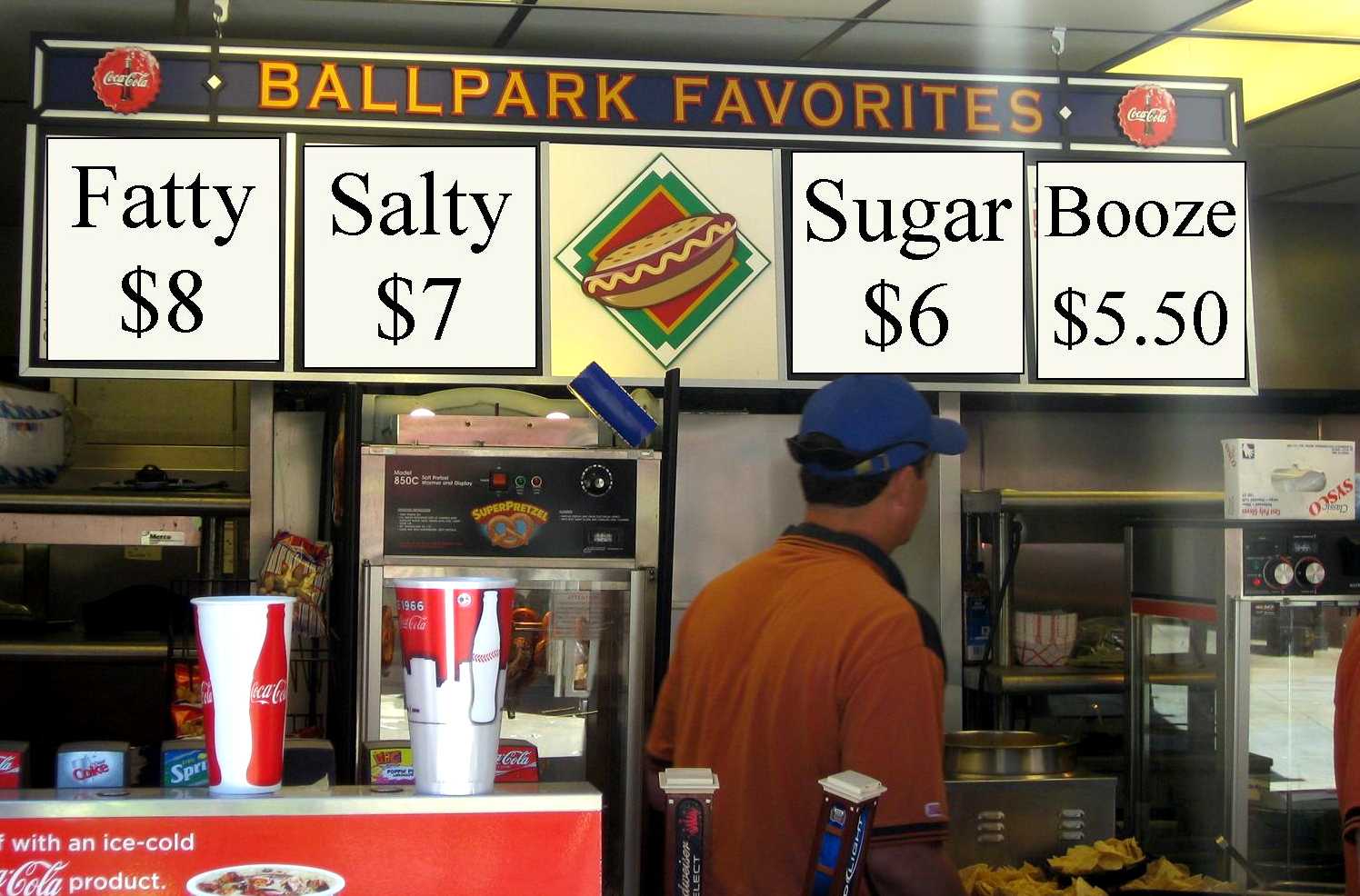
What is it about ballpark food that makes it so delicious? I think that these new truth-in-marketing signs at the ballpark pretty well sum it up. Photo (etc) by Erich Vieth These stadium food vendors truly excel in offering superstimuli for our not-ready-for-modern-times stomachs and eyes. What should we do about this mismatch between our pleistocene cravings and our modern abilities to pump out this life-shortening quality-of-life-diminishing fare? That's the question raised by Dr. David Kessler, former Commissioner of the FDA:

Fifty years ago, the tobacco industry, confronted with the evidence that smoking causes cancer, decided to deny the science and deceive the American public. Now, we know that highly palatable foods—sugar, fat, salt—are highly reinforcing and can activate the reward center of the brain. For many people, that activation is sustained when they're cued. They have such a hard time controlling their eating because they're constantly being bombarded—their brain is constantly being activated.

For decades the food industry was able to argue, "We're just giving consumers what they want." Now we know that giving them highly salient stimuli is activating their brains. The question becomes what do they do now?

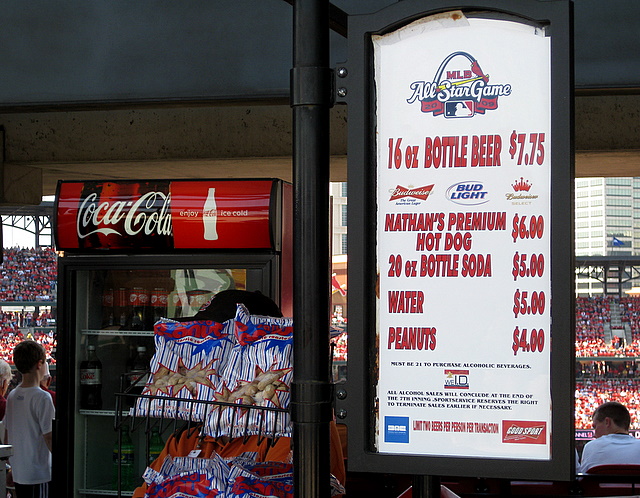
When I say "superstimulus, I mean it. I can't believe how many obese people I recently saw at the stadium. Half of them wore Albert Pujols jerseys, but none of them looked like Albert Pujols. Now, while we're still discussing stadium food, here's an untouched photo clearly demonstrating that the world is almost out of fresh water. After all, there's no other explanation for why anyone would pay twice as much for 20 ounces of drinking water than for a gallon of refined gasoline. image by Erich Vieth I can just imagine the conversation: Child: Daddy, can I have a few sips of water? Father: Billy, how many times have I told you that we can't afford to drink water!

Continue ReadingBallpark food lighting up our Pleistocene taste buds.