
More Lessons from National Geographic

I do love National Geographic. If you don't read it each month, you should! The January 2010 edition of National Geographic is loaded with articles that will transport you all over the world. You can learn about a sublime Scottish island, you can learn of the bionic limbs in cochlear implants, and you can learn how the clown fish is imperiled in the wake of the movie "Nemo." I'd like to report on two other articles today. The first one is about the island nation of Singapore, which achieved independence from the British in 1963. How did Singapore become modern-day Singapore, where the per capita income for its 3.7 million citizens is better than that of many Western countries? it's an exceedingly clean city where 90% of households own their own home. Its unemployment rate is only 3%. All of this was the plan long ago. Lee Kuan Yew, who has been officially or unofficially in charge of the country for more than 40 years. He was educated in London, and then came back home to make English the official language of Singapore--he also had a business plan and it paid off well. He is a hardliner in many ways, including cracking down on governmental corruption "until it disappeared." Now that sounds like a good idea. Consider, also, that anyone dropping even a cigarette butt or a candy wrapper in Singapore can be fined $200. If you are caught a second time, you will be sentenced to walk around picking up other people's trash. Now there's another good idea. Why do we tolerate people who dump their trash in public areas in America? Tthe Government of Singapore works very hard to make sure that its own citizens live outstanding moral lives. There is a new casino going up in Singapore, and the casino will roll out the red rug for foreign visitors (so that Singapore will make money off of them), but the casino charges a $70 fee to people from Singapore to discourage them from gambling. The National Geographic indicates that Singapore's population control program is "overly successful." Despite bonuses being offered by the government for having babies, the Singapore birth rate is at less than replacement value. It seems that they are too busy working. "Singapore's have less intercourse than almost any other country on earth" An influx of immigrants keep the population from shrinking, allowing the plant to continue: "giddy financial growth fueling never ending construction and consumerism." -- A separate article called "restless spirits" explores the beliefs many Chinese people have with regard to an afterlife. There is a lot of good information here. I found it interesting that among the valuables (such as a bottle of alcohol or a pack of cigarettes) some Chinese people have included "paper grave money for use in the afterlife, the bills bearing a watermark that said,'The Bank of Heaven Co., Ltd..'" I also learned that many Chinese believe that their their ancestors took on bureaucratic duties. They keep the dead busy in Chinese heaven! Back in the Shang dynasty (more than 1000 years ago), the Chinese sacrificed human victims to placate the ancestors. More than 1,200 sacrificial pits have been found, most of these containing human remains. Some of the inscriptions found in the graves indicate that the Chinese were asking their dead ancestors to make offerings of their own to even higher order powers. This article is full of interesting insights about Chinese police regarding the afterlife. I placed the NG links for the above articles. Beware, though, that the online versions of the articles are abridged versions of the print versions.
Continue ReadingMore Lessons from National Geographic

Niece in Africa

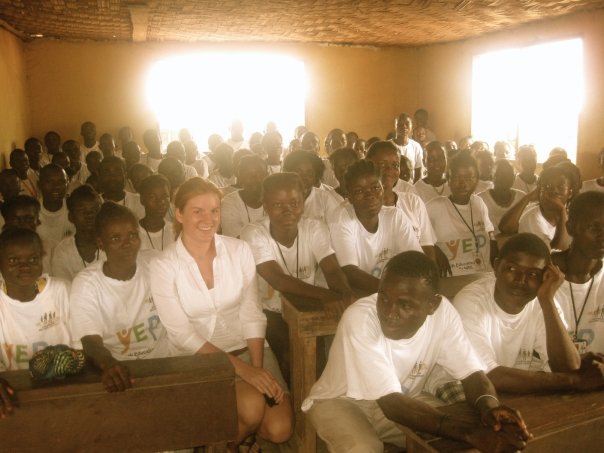
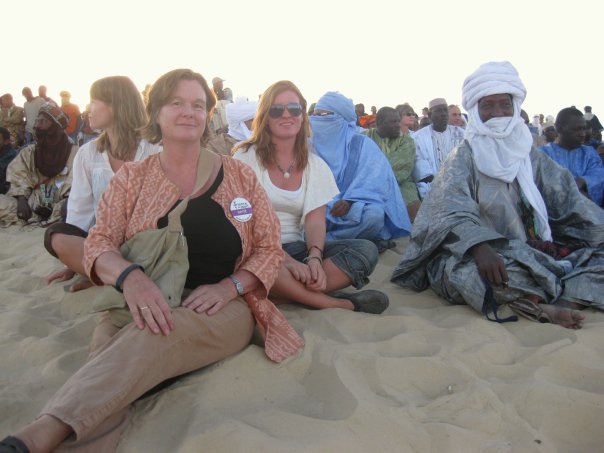
I have a charming niece named Katja Boye. She and her family are currently traveling, working and studying in various parts of West Africa. Katja recently sent my family some of her digital images; I really enjoyed the many scenes and textures and colors of Africa. I also enjoyed the contrast of seeing images of my very light-skinned relatives (they are Norwegian, with their permanent home in Norway) mingling with the many dark-skinned Africans. katja-in-class I asked Katja if she would grant me permission to share some of her photos on this website and she gave the go-ahead. I don't actually know these specific locations within West Africa yet - - perhaps Katja will write a comment and provide some further information. Katja (she stands out in the photo to the right) is the daughter of Alida Jay Boye (my wife's sister), who you can see at the left side of the sand dune photo below. Alida is the co-author of a beautifully written and photographed book describing the people and the ancient manuscripts of Timbuktu, located in the African country of Mali. Yes, Timbuktu is a real place, it is surrounded by sand dunes, and here is an aerial shot of of the city. The title Alida's book is The Hidden Treasures of Timbuktu: Rediscovering Africa's Literary Culture. For many years, Alida has been "commuting" from Norway to Mali work on these manuscripts under the auspices of the United Nations. Here's more information about Alida's work. alida-and-familyI don't claim to be able to read any of these manuscripts, but I do enjoy their physical beauty, which you can see here. Those who can read the manuscripts recognize them to be a vast literary treasure created by Africans and collected by various people and institutions in Timbuktu, which for centuries served as a commercial crossroads in Africa. For more on Timbuktu and its famous manuscripts, consider this informative video. Katja's father Thorvaldt (who works in a diplomatic capacity for the Norwegian government regarding several west African countries) and her sister Ebba (a student) have also spent considerable time working and studying in various parts of Africa. As you can see, the members of this family are quite comfortable traveling far from their cold homeland of Norway to warm Africa. Click on the title to this post for the permalink version, which will allow you to see all 18 images. Katja - thanks for letting me share these photos!

Continue ReadingNiece in Africa

The craving for beer as the cause of civilization

According to archaeologist Patrick McGovern, the craving for beer might have caused people to decide to start farming. Humans turned from hunting and gathering to agriculture because of "our ancestors’ simple urge for alcoholic beverages." He points to evidence that humans were making beer as far back as 9,000 years ago.

Continue ReadingThe craving for beer as the cause of civilization

Avatar

Okay, so I contributed to the James Cameron Self Love Fund and saw AVATAR. Yesterday we went to the 3-D showing (no way I would spend money on the normal view, I can wait for the DVD the way I do with 99% of the movies I see anymore). I’ve had a day to think about it now and I’ve come to some conclusions, which are hardly profound, but I think worth saying. Let me say up front that I wasn’t bored. Visually, this is a stunning achievement. But that’s what everyone is saying. It is, in fact, the best 3-D I’ve ever seen. Often in the past the effect is minimal and the cost in headache high. This was neither. And it fully supported the visuals rather than masking mundane or poor image elements. Pandora, the planet involved, is magnificently realized. Cool stuff. Real gosh wow. The biology is problematic. You have a wide mix of lifeforms analogous to Earth. Some big lumbering critters like hippos or rhinoceri that also have features of a dinosaur, and some small things that are clearly wolves, and one big nasty cat-like thing that’s like a sabertooth tiger. It’s unclear if any of these creatures are mammalian, but it doesn’t matter much. Dinosaur analogs. Most of them apparently four-legged. But the “horses” the natives ride are six-legged, reminiscent of Edgar Rice Burroughs’ thoats. How does that play out in evolutionary terms? Well, maybe that’s a quibble. How then do you evolve humanoids out of this? Well, maybe that’s a quibble, too. This film is not about science on any level, regardless of the few bits of dialogue suggesting there are, you know, scientists, and that there is a studyable cause to any of this. Because the story, basically, is hackneyed, cynical, and cliched. [more . . . ]

Continue ReadingAvatar

FOX commentator struggles to not understand the First Amendment

In this February, 2009 video, FOX commentator Megyn Kelly worked hard to claim that she didn't understand the First Amendment. Michael Newdow, who filed a suit challenging a school that required his child to say the Pledge (including the phrase "one nation under God") showed considerable patience with Kelly, but the outcome was pre-ordained. Kelly showed the same closed tortucan mind as the U.S. Supreme Court which strained mightily to through out his suit on a technicality rather than face the music. Emotions generated by the compulsion to force students to say the pledge has often caused massive distortion to legal logic.

Continue ReadingFOX commentator struggles to not understand the First Amendment