
Tell them what Architecture 2030 says about coal:
Because coal is the only fossil fuel plentiful and supposedly cheap enough to push the planet to 450 parts per million (ppm) of carbon dioxide (CO2) in the atmosphere. Because reaching 450 ppm (or possibly less) triggers potentially irreversible glacial melt and sea level rise.
Because 53% of Americans live in and around coastal cities and towns and, beginning with just one meter of sea level rise, many of these cities and towns will be inundated.
Scientists are forewarning that at approx. 450 ppm CO2 in the atmosphere, we will trigger potentially irreversible glacial melt and sea level rise “out of humanity’s control.” We are currently at 385 ppm, and are increasing atmospheric concentrations of CO2 at approx. 2 ppm annually. At this growth rate, we will reach 450 ppm in 2035 . . .
In the US, there are over 600 existing coal plants and 151 new coal plants in various stages of development.
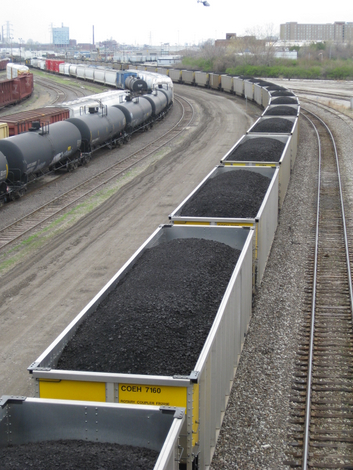
Tell them that there is a smarter and better way. And a cleaner way. Tell them that mining coal is not only ugly, it’s dangerous for miners and everyone else.
Tell them to take a close look into a train car full of coal (as I did yesterday) and to ask themselves if coal looks like the fuel of the future.
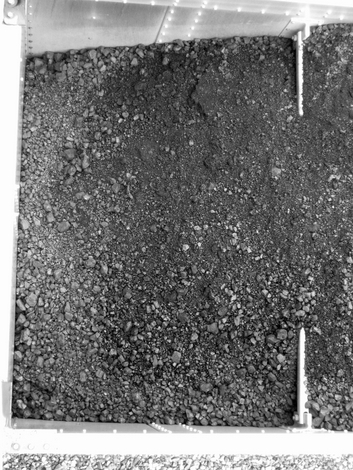
I thought about coal as I noticed a train loaded with coal go by (I took these photos). I thought about how little most people know about coal yet how politicians and their constituents don’t have the dangers of coal on their radar. Some of these dangers are set forth in my earlier post, The Banality of Burning Coal.
I’ve been told by a man who works with the biggest electric company in St. Louis that each coal burning plant eats an entire train full of coal each day. That is confirmed by Wikipedia:
Coal is delivered by highway truck, rail, barge or collier ship. A large coal train called a “unit train” may be two kilometers (over a mile) long, containing 100 cars with 100 tons of coal in each one, for a total load of 10,000 tons. A large plant under full load requires at least one coal delivery this size every day.
Most people I speak with resist serious energy conservation as a matter of principle. Many conservatives belittle conservation, as though it is a matter of weakness. They scoff at conservation. When I bring up global warming, they deny it. When I bring up peak oil, they have no logical response. They resist energy conservation as if they were 3 year olds whining that they don’t want to try a new sort of food that their parents put on their plates. It’s an irrational emotional resistance (not that emotions are always irrational) that is endangering our economy. Conservation is one-half of the solution out of this big mess.
It’s time to raise everyone’s consciousness regarding the dangers of coal (and other fossil fuels) and the beauty and efficiency of energy conservation. Next time someone scoffs at conservation, ask them to explain why conservation is a bad idea. Ask them why Americans shouldn’t immediately take steps to cut our wasteful and dangerous energy usage in half. Ask them why we shouldn’t drive smaller cars (or bicycles) and why we shouldn’t turn out lights we aren’t using and why we shouldn’t dry clothes outside. There are numerous other things you can do, right now.
Dare to take the time to ask your friends who resist conservation why we shouldn’t try to become smart and efficient in our use of energy so that we don’t have to resort to dirty and dangerous carbon-based fuels. All of these things add up to big things like national security and healthy economy. Not being dependent on oil. You’d think that conservatives could understand this.
Tell your friends and acquaintances that there is a better way to create and use energy, but that this way would require the United States to have some sort of energy policy. Tell them that the United States has no energy policy. See if they know what a great deal it is to invest in conservation, including the development of zero-carbon-footprint buildings:
Investment in building energy efficiency is surprisingly effective. A single investment of $21.6 billion would replace 22.3 conventional 500 MW coal-fired power plants, reduce annual CO2 emissions by 86.7 million metric tons, save 204 billion cu. ft. of natural gas and 10.7 million barrels of oil each year, save consumers $8.46 billion in energy bills annually (less than a 3-year simple payback) and create 216,000 permanent new jobs.
Tell them to go here to read more about coal.


I'm all for alternative sources of energy (nuclear power is looking better every day), but until something becomes cheaper and more practical than coal, those power plants are going to continue burning fossil fuels.
I reside in Indiana, and our state produces the most CO2 from coal-burning power plants in the United States. It's going to be expensive to convert plants to handle other energy sources, but we must do it soon, if for no other reason than we will eventually run out of coal!
I've heard that the United States has sufficient coal resources to last another 130 years. Can someone confirm this assumption?
Responding to Roger P., I have also heard that the U.S. has huge coal reserves — at least 100 years, provided, of course, that we don't irrevocably ruin our planet by burning it.
Yes, nuclear is looking better every day. It is the only currently-feasible source that can replace fossil fuels. "Green" sources (solar, wind, hydro, geothermal, etc.) currently lack the energy density that is needed, and will continue to do so for the foreseeable future. Nuclear also has the surprising advantage of releasing *less* nuclear radiation into the environment than coal-fired power plants: turns out radioactive isotopes exist naturally in coal, and these isotopes are released into the atmosphere when the coal is burned; with nuclear power plants, the radiation is contained and sequestered (though many people continue to debate how secure this process will be over time).
Please see our latest report "The 2030 Blueprint: Solving Climate Saves Billions, Good for the Economy, Jobs" for a discussion about nuclear energy, coal, efficiency and climate change at: http://www.architecture2030.org.
"The Obama administration signaled it will reverse course on the Bush administration's refusal to adopt strong limits on mercury emissions from power plants, asking the Supreme Court today to drop the former administration's appeal of a successful lawsuit by Earthjustice and others seeking protective federal mercury emission limits for power plants."
http://www.earthjustice.org/news/press/2009/new-a…
More on the immense danger of burning large amounts of coal to produce electricity:
http://www.huffingtonpost.com/2009/06/12/coal-ash…
I live across the street (less than a block away) from a huge ash pond located within the LG&E facility in Louisville KY. I didn't know the pond existed, much less that it's high hazard, and from the proximity of my home and the embankment that towers over my roofline, I can guess that me and my family would be the loss of life statistic when they say probably lose lives if it breaches. When you think of coal, the lack of regulation, and that we aren't a third world country. How could we have let the lobbyists have the strongest voice? We know this is not right. Coal is dirty and dangerous, when will money stop talking and our conscience win out?
Kaeterina:
I’m so sorry to hear that you are living so very closely to a dangerous dump of toxicity.
Your impassioned writing says it all about the corporate lobbyists. It is a terrible system that allows this sort of thing to happen.
A comment made by Niklaus above made me think. One of the biggest challenges to Nuclear is the sequestration problem: no one wants to store highly radioactive 'spent fuel' anywhere near their home (sensibly enough). So I've often wondered if we are approaching the sequestration problem from the wrong direction.
Instead of concentrating the spent fuel, and attempting to bury it for hugely extended periods, why not dilute it to close to background levels – and incorporate it into natural infrastructure (extremely dilute concentrations into concrete for roads, bridges, foundations, etc.
Many natural rock formations are radioactive (Aberdeen, in Scotland, is build almost entirely of somewhat radioactive granite). I'd need to noodle the math to determine what 'concentrations' would be appropriately safe (How many Bequerels per cubic meter is acceptably safe)
This is probably so wrong on so many levels – it's been a while since I studied any physics – but its so improbable it might actually work.
I do see many potential pitfalls – transportation not least – but these exist already whenever we consider nuclear.
We should also be looking into intermediate technology that lies between the high tech and low tech methods.
Some examples of intermediate technology are the hydraulic ram, sterling cycle engines, and Russian fireplaces.
THe politicians and industrialists may rightly claim that the fossil fuels will last for many years, but when we run out, then what?
There are two enegery inputs into the global ecology: sunlight and tidal strains. There is one output: radiant heat. everything else is just storage.
Tony, I recall a magazine article from severalyears ago that considered the idea of encasing spent nuclear fuel in concrete and with an embedded heat exchanger and using the it as a hot water heat source for use in warming buildings. Your idea may not be so far fetched.
A preeminent group of environmental scientists have volunteered their time to conduct a study concluding that mining coal through mountaintop removal is so dangerous to people that it should be totally banned.
A commentator at Grist notes:
"To me, the most amazing part of all this—and clearly the scientists are amazed as well—is the fact that there’s never been a comprehensive assessment of MTR impacts before. We’re blowing up mountains and we have no idea what the consequences are! The mind boggles. It’s like the whole country is just discovering Appalachia."
http://www.grist.org/article/2010-01-07-science-c…
From TruthOut
The coal ash industry manipulated reports and publications about the dangers of coal combustion waste, reports Public Employees for Environmental Responsibility (PEER). The group stated that the Environmental Protection Agency allowed the multibillon-dollar coal ash industry to have virtually unfettered access to the EPA during the Bush administration and now under President Obama.
As a result of the industry's formal relationship with the EPA, insiders were allowed to edit and ghostwrite publications and official reports on the effects of coal waste. The documents obtained by PEER indicate that the coal ash industry "watered down official reports, brochures and fact-sheets to remove references to potential dangers" of coal ash waste. Additionally, the so-called "environmental benefits" of coal ash were repeatedly aggrandized.
http://www.truthout.org/the-coal-ash-industry-man…