
Check out these identical twins:
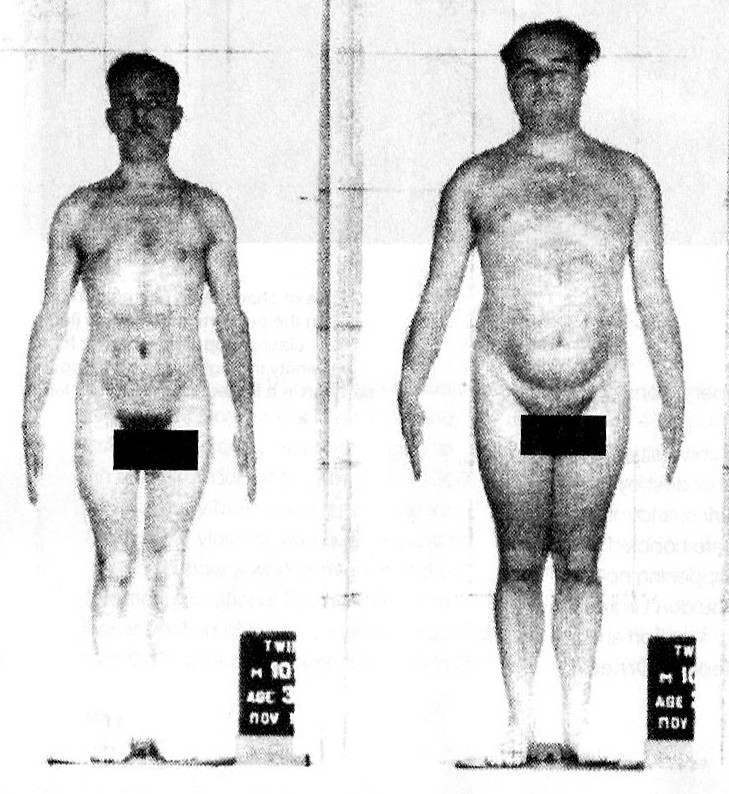
They are really identical twins. This photo is from the November 2006 issue of Discover Magazine. See the related article: “DNA Is Not Destiny The new science of epigenetics rewrites the rules of disease, heredity, and identity.”
Though these two men are genetically identical, they were separated at birth. The man on the left was malnourished for years. Bone structure changes brought about by environmental factors is thus one of many ways (physical and behavioral) in which the environment can dramatically affect the way in which the genes express themselves
As the Discover article points out, the 25,000 genes of our human DNA are widely considered to be an instruction book for our bodies. However, “genes themselves need instructions for what to do, and where and when to do it.” These additional instructions are not in DNA, but
on it, in an array of chemical markers and switches, known collectively as the epigenome, that lie along the length of the double helix. These epigenetic switches and markers in turn help switch on or off the expression of particular genes.
It has long been known that epigenetic switches are critical to the healthy development of organisms. These can be dramatically tweaked by exposure to a vitamin, a toxin or even mothering, altering “the software of our genes in ways that affect an individual’s body and brain for life.” Green tea, for example, has been shown to prevent the growth of cancers.
New research has even suggested that epigenetic signals “can be passed on from one generation to the next, sometimes for several generations, without changing a single gene sequence.” How can this be? Chromosomes are only 50 percent DNA. “The other 50 percent is made up of protein molecules, and these proteins carry the epigenetic marks and information.” Experiments concerning rat exposure to a fungicide (see the article) bear out this conclusion.
Epigenetic markers and patterns are so important that researchers are rallying to begin a project to create an elaborate human epigenome project to map out the entire human epigenome.
Many people assume that DNA pecisely predetermines our body shapes, personalities and diseases. The field of epigenetics, however, is disproving this. “We appear to have a measure of control over our genetic legacy.” We need to substantially revise our idea of genetics. All of the things people eat or smoke “can affect our gene expression and that of future generations. Epigenetics introduces the concept of free will into our idea of genetics.” The ramifications go much further, though, and the stakes are extremely high. The field of epigenetics can serve as a bridge between biology and responsible politics:
Early Child-parent binding is made more difficult by the effects of poverty, dislocation, when social strife. Those factors can certainly affect the cognitive development of the children directly involved. Might they also affect the development of future generations through.? . . . [according to Michael Meany, a biologist from McGill University] early Child-parent binding is made more difficult by the effects of poverty, dislocation and social strife. These factors can certainly affect the cognitive development of the children directly involved. Might they also affect the development of future generations?
Here’s another consequence. Human cloning should no longer be portrayed as it often is in the media. Epigenetics demonstrates that having an identical genome is highly overrated. Genetic cloning cannot really result in identical phenotypic expression. The apple (even if it is a clone) can fall a long way from the tree (the donor). The outcome is highly dependent upon and subject to innumerable environmental factors. I’m not suggesting that cloning is a good idea. Epigenetics demonstrates that cloning will fail to accomplish the egotistic ends that sometimes motivate the desire to clone humans. Further, cloning is ultimate expressing of unbridled egotism.
That genes don’t completely determine the person, should be obvious to the many parents who go to great lengths to have half-clones (babies with one-half each of each parent’s genetic contribution). By the way, this version “half-eugenics” is entirely socially acceptable. Half-clones often disappoint their biological parents, though. The biological offspring of successful parents quite often don’t live up to their parents’ successes. Even more dramatic, consider identical twins, who always have identical genomes, and they really do (always!) develop into unique individuals. Yes, they correlate with each other in many ways. Often they resemble each other, but everyone who knows identical twins knows that they actually look different and they have unique personalities. When you make a phone call to talk to an identical twin, it matters which one of the two answer the phone. Nobody confuses identical twins (or triplets) as the kinds of identical marching robots that a mad scientist might create any science fiction movie. Reproduction of genomes, then, appears to be highly overrated.
The field of epigenetics is further proof that re-creating a complete and exact genetic code cannot duplicate a human individual.
This combination of topics of epigenetics and cloning gives rise to a thought experiment: what if we allowed people to clone babies (I would not allow this currently, because the state of the art process is associated with numerous genetic defects)? But what if we did allow adults to clone their offspring? In light of epigenetics (and in light of studies regarding identical twins), those babies would often turn out substantially different than their parents. Sometimes they would turn out much better than their parent (by whatever scale you choose). That result would brand the parent a “failure” of sorts-why didn’t they do better? What if the cloned offspring turned out much worse than the parent? In that case, the only conclusion would be that the parent got a lot of breaks in life (breaks that the clone did not have). In either case, watching the development of a clone will raise uncomfortable issues regarding whether the parent really “earned” what the parent got in life.
In short, the expanding field of epigenetics will likely result in less opposition to reproductive cloning, not more. In fact, I suspect that if we would allow people to re-create themselves as clones, most people will soon stop cloning voluntarily, for the reasons stated above. Also, as suggested above, society will continue to see reproductive cloning as a crass and simplistic attempt to create a monument to the clone’s parent’s ego, a monument that will too often reflect badly on the parent.
Therefore, almost every baby Einstein will fall short of Einstein. Whenever a cloned Einstein does better than his/her cloner-donor, then the cloner donor could have done better than he/she did. They can’t possibly live duplicate lives. After all, after dad-clone proves E=MC2, offspring-clone won’t get any notoriety for proving it a second time. In any case, reproductive cloning will disappoint the eugenics crowd and disprove the popular perception that genes constitute an “instruction booklet” for meticulously assembling identical human beings who will accomplish equally in the world into which they are brought.


There was a good BBC 2 Horizon documentary on epigenetics called "The Ghost in Your Genes". It originally aired November 3rd, 2005. A complete transcription of the episode can be found here: http://forum.noblerealms.org/viewtopic.php?id=371…
What is epigenetics? Science (29 Feb 2008) has a short article called "Are Epigeneticists ready for Big Science?":
Twenty years ago, most geneticists paid little mind to epigenetics. But cancer and stem cell research have gradually focused attention on these genome modifications. In a still-obscure manner, enzymes, transcription factors, and snippets of RNA converge on particular DNA sequences. They customize the expression of nearby genes, often by adding methyl, acetyl, or phosphorous groups to the DNA or the histone proteins surrounding the DNA. Methylation, for example, can silence a nearby gene and seems to be involved in some cancers. Increasingly, researchers are unearthing links between epigenetics and other diseases.
Here's the link, though it's only accessible by subscribers.
That was really interesting. I have read about twins who got separated by birth and when they met they found out that they were living similar lives, with similar wives, gave their kids the same names, etc. I was never sure though if these stories were really true. These two pictures are truly impressive though.
Even genetically identical E coli have individual "personalities," according to this NYT article by Carl Zimmer:
Yet as plausible as this sounds, it’s far from the truth. A colony of genetically identical E. coli is, in fact, a mob of individuals. Under identical conditions, they will behave in different ways. They have fingerprints of their own.
Here's the full article.
Carl is a smart guy with a lively blog called "The Loom."
This is interesting. I am an identical twin and even thought we have lived our whole life in the same household and have eaten the same food throughout the years, and even though he usually can naturally eat much more than me, I have always been the bigger twin and always weighed more than him. our height has been the same though. I’ve never been more than an inch taller, always even. Today at our adult lives, his average weight is 130 pounds and mine is 150. Looking at this picture I can tell the two brothers have different body types, it is the same case with my “identical” brother and I. I am sort of in doubt weather it has to do with birth separation rather than just genetic.
I have identical twin daughters that are 3 years old. They were the exact same size/weight at birth. The are always together and they eat nearly the same foods. However, one daughter is simply bigger. She is taller and wider than her twin sister. The weird thing is that they weigh the same, even though she is a 1/2 inch taller.
You can tell that they have similar builds, but one is a bigger version of the other. Even her face is fuller. She too eats less than her sister. It’s simply the way her genes interpret the information (in my opinion)