rss

Tag: "Politics"

2
Regulation as a prerequisite to meaningful cooperation

Regulation as a prerequisite to meaningful cooperation

While I was reading up on free market fundamentalism, and I happened across an intriguing article by biologist David Sloan Wilson. As I started reading this article, I was wondering this: Even assuming that a “free market” works wonders in small societies, can societies be scaled up in size guided only by the free market, without formal regulations? D.S. Wilson argues that this is the wrong question. All societies are regulated. The only question is how they are regulated.

D.S. Wilson notes that humans are incredibly cooperative, especially in “small face-to-face groups.” In fact, we regulate each other’s conduct so easily in small groups that “we don’t even notice it.” This gives us the illusion that there is no regulation keeping things in check. All well-functioning groups, large and small, human and non-human, are highly regulated, however. Small groups often seem to work well without formal regulation, but free market fundamentalists (and others) confuse this lack of formal regulation for the total lack of regulation.

This self-organizing ability to function as cooperative groups is “so perfectly natural” because it evolved by a long process of natural selection, in humans no less than bees. By the same token, functioning as large cooperative groups is not natural. Large human groups scarcely existed until the advent of agriculture a mere 10 thousand years ago. This means that new cultural constructions are required that interface with our genetically evolved psychology for human society to function adaptively at a large scale.

Wilson’s approach makes intuitive sense. Throughout the Pleistocene (from about 2 MYA until 10,000 years ago), people lived in small groups. They lacked written language and written laws. They used unwritten techniques (presumably customs, habits, ostracism and various other informal methods of social control and punishment) to coordinate community efforts and punish cheaters. These informal methods worked well enough and long enough that we can now sit here and ponder how well they worked. But just because those ancient forms of regulations weren’t written down doesn’t mean they didn’t exist. And it doesn’t mean that ancient societies weren’t tightly regulated. Just as human households are highly regulated without formal rules, so are small societies. So are non-human societies:

These social preferences go beyond our own species. Cooperation and cheating are behavioral options for all social species, even bacteria, and cooperation survives only to the extent that it is protected against cheating. The eternal conflict between cooperation and cheating even takes place within our own bodies, in the form of genes and cell lineages that manage to game the system at the expense of the organism upon which they depend. We call them diseases, but they are really the failure of a vast system of regulations that enable us to function as organisms as well as we do . . .

What about the eusocial insects, such as ants, wasps and bees? Wilson would argue that a well-functioning hive doesn’t simply happen, and it certainly isn’t driven by something as simplistic as the “self-interest” of individual bees:

[B]ee behavior cannot be reduced to a single principle of self-interest, any more than human behavior. There are solid citizens and cheaters even among the bees, and the cheaters are held at bay only by a regulatory system called “policing” by the biologists who study them.

According to D.S. Wilson, you’ll find regulation (informal or formal) everywhere you find a well-functioning society of living organisms. Further, a human society based merely on individual selfishness can’t self-regulate because we can no longer depend on selfishness to be well-tuned or consistent thanks to Daniel Kahneman’s brilliant destruction of rational choice theory.

Regulation runs a continuum from informal to formal. It is not like regulation itself just showed up for the first time in modern human societies. D.S. Wilson argues that in all large-scale societies, “regulation is required or cooperation will disappear, like water draining from a bathtub.” Without some form of regulation, all societies become rudderless and unproductive. Therefore, there must always be some form of regulation. The question to decide is “What kind of regulation?”

Let there be no more talk of unfettered competition as a moral virtue. Cooperative social life requires regulation. Regulation comes naturally for small human groups but must be engineered for large human groups. Some forms of regulation will work well and others will work poorly. We can argue at length about smart vs. dumb regulation but the concept of no regulation should be forever laid to rest . . . We also need to change the metaphors that guide behavior in everyday life to avoid the disastrous consequences of our current metaphor-guided behaviors. That is why the metaphor of the invisible hand should be declared dead.

I would agree that the “invisible hand” is shorthand for the informal regulations that have been since prehistoric times to facilitate social coordination of small primitive societies. Rather than declaring the “invisible hand” to be dead, though, it might be more accurate to suggest that the “invisible hand” lives on in modern societies, quietly and substantially supplementing our formal regulations. Seen in this way, the “invisible hand,” used in the complete absence of consciously planned social regulations and laws, is not a method for creating or maintaining a complex functioning modern society. Rather, it is the path back to the Pleistocene.

5
Nader in Omaha

Nader in Omaha

Tuesday afternoon, I was privileged to be able to attend a speech by Ralph Nader, followed by a question-and-answer session and a book-signing. He was promoting his new book, Only the Super-rich can save us! If you weren’t aware that he has a new book out, you aren’t alone. In fact, his presence in Omaha wasn’t well-publicized. I managed to see this article in the local paper which alerted me to both the fact that he had a new book out, and that he was in Omaha. I was fortunate enough to be able to arrange for some time off work, and went to the 3:00 session at McFoster’s Natural-Kind Cafe. Unfortunately, I completely forgot my role as a blogger and so I was woefully unprepared to take notes or photos. So rather than direct quotes, I’ll discuss some of the main themes of his speech, as well as the question-and-answer session.

Nader was scheduled to speak at 3:00 p.m., but didn’t actually take the podium until about 3:15, largely due to the enthusiastic crowd gathered around him peppering him with questions and having their books signed. He spoke for about a half-hour, then took questions for roughly another hour. I estimated the crowd to number about 80, and it was standing-room only in the small upstairs room at McFoster’s. His speech stuck pretty closely to the themes of the book, which asks us to re-imagine the last several years. The book begins with the disastrous fumbling of Hurricane Katrina, and a fictionalized Warren Buffet aghast at the apparent inability of a former first-world country to provide relief to its own citizens. Using his vast economic resources, he marshals the needed supplies and delivers them to a devastated New Orleans. The experience haunts him though, and he decides to convene a group of billionaires to solve some of the most pressing crises confronting American democracy. Using untold billions of their own, they are able to finally provide an effective foil against the big-money interests that would continue using the system to unjustly enrich themselves.

0

Newsy.com: where multiple media perspectives are featured

Newsy.com is a website with a nice twist. The site chooses individual stories and then examines them from the perspectives of various news organizations and websites. I’ve watched a few of newsy.com’s featured stories, and I find this approach promising. By featuring a story from the perspectives of multiple news organizations, newsy.com is, in effect, telling us news about news-makers (in addition to telling us the news). Here’s an excerpt from Newsy.com’s about page:

Newsy.com takes a step back to show how the world’s news organizations are reporting a story - providing an unprecedented global and macro point of view. You’ll find CNN right next to Al Jazeera, the BBC right next to ABC. Newsy.com also covers major newspapers, news magazines as well as top blogs from around the world.

Here’s a recent Newsy.com story that asks the question whether FOX News went over the line by promoting a demonstration. Here’s another recent story discussing the new Wikipedia policy that allows only Wikipedia in-house editors to edit articles about living people.

3
Homeland Security seeks to “simplify” color warning system

Homeland Security seeks to “simplify” color warning system

Two weeks ago I briefly pointed out that Janet Napolitano, Secretary for Homeland Security, said that she wanted to reduce the level of fear in this country through improving preparedness for a terrorist attack. Now Homeland Security is seeking to do away with any pretense that we will ever be safe. Their latest proposal is to improve the “public credibility” of the system by”simplifying” the color scheme. If the recommendations are adopted, the new color scheme would consist only of yellow, orange, and red. Or, as Wendy McElroy put it, “the new levels are 1. Be Afraid, 2. Be Very Afraid, 3. Panic!”

While I’m heartened that they at least admit that it’s “institutionally difficult” to lower the threat level, I still don’t believe that the color scheme is an ideal solution. Keeping one’s citizens in a constant state of fear that they will be attacked is, I believe, one way for the government to keep the public’s attention diverted from the causes of terrorist attacks– namely, our governments policies. If we were to stop killing innocent civilians around the world, we may just find that people around the world no longer wish to kill us in retaliation.

6
Brand Obama–now with more awards!

Brand Obama–now with more awards!

Barack Obama’s presidential campaign has again won a major advertising award. A month before winning the presidency, he won Advertising Age’s annual “Marketer of the Year” for 2008. Now, his campaign manager, David Plouffe, has won Brandweek’s “Marketer of the Year” for 2009. What better commentary on the state of contemporary American society could there be? Our president is a master marketer, or more precisely, employs a team of master marketers. In a society that is dedicated to worshiping at the altar of consumerism, perhaps it’s unsurprising that this is the case, but it still is shocking to me. Once I began researching for this article, I really was surprised at the extent to which “Brand Obama” has penetrated our national consciousness.

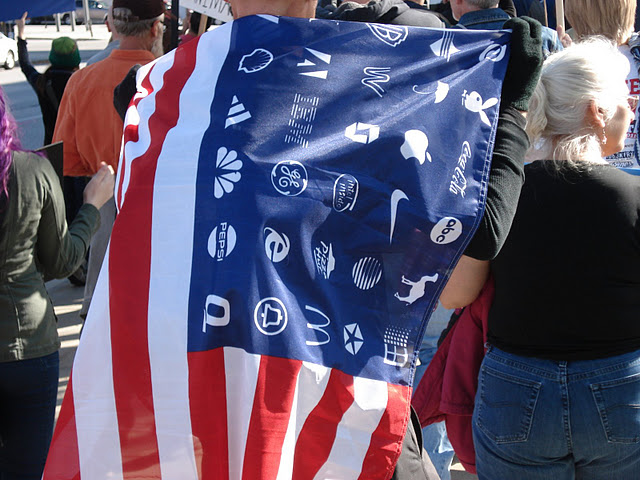
His logo and posters have become iconic. His slogan, “Yes we can” is everywhere– it’s also a marketer’s dream. It’s devoid of any clarity or substance, and yet it makes you feel good, possibly empowered. “Just do it”, anyone? Actually, his campaign beat out the Nike campaign (and even Apple!) for top honors. You can go to mybarackobama.com and sign for immediate updates from Facebook, Myspace, Youtube, Flickr, Twitter, and several other web 2.0 services. You can get Obama on your mobile phone by texting “hope” to 62262– it’s just as easy as voting for the next American Idol! The media is relentlessly focused on what Michelle Obama is wearing next, and there is at least one blog offering daily updates on her clothing choices (”Follow the fashion of Mrs. O.:What and Whom she’s wearing”). For those who are tuned-in, you can even do Ecstasy tablets shaped like Obama. One wonders where does politics end and the cult of personality begin?

5
Dark days and “Green Shoots”

Dark days and “Green Shoots”

“We can have democracy in this country, or we can have great wealth concentrated in the hands of a few, but we can’t have both.” –Supreme Court Justice Lous D. Brandeis

For all the discussion of “green shoots” and an economy on the mend, there’s plenty of data and commentary to the contrary. What’s interesting to me, is that recent developments only highlight the extent to which Main Street economics have become irrelevant to Wall Street.

The administration is claiming that the crisis is largely over, and that it’s time to breathe a sigh of relief. President Obama yesterday argued that “we can be confident that the storms of the past two years are beginning to break.” Treasury Secretary Timothy Geithner discussed last week beginning to wind down some of the programs that were implemented in the heat of the crisis late last year. The value of the Dow Jones Industrial Average has risen from its July low of 8146, and is now trading around 9600. Everything seems well and good in the world of high-finance.

But others see it differently. Nobel-prize winning economist Joseph Stiglitz argued this week that nothing has been done to address the underlying banking problems that created the mess in the first place, adding that “the problems are worse than they were in 2007 before the crisis.” Simon Johnson, former chief economist of the IMF, echoes that sentiment, and points out that the real issues underlying the crisis have not been addressed at all. He lays out 4 areas of concern:

  1. The big banks need to be made to be dramatically smaller.
  2. Executives need to have a great deal of their personal wealth tied up in their banks to prevent a reckless focus on short-term results.
  3. An end to the revolving door between Wall Street and Washington, DC. “There is no way people should be able to go directly (or even overnight) from a failing bank to designing bailout packages to benefit such banks. In any other industry, in any other country, and at any other time in American history, this would have been seen as an unconscionable conflict of interest. “
  4. The financial elite is aware that they are able to exploit the Federal Reserve and use it as a “bailout machine”.
2
On Church and State and Stuff

On Church and State and Stuff

In the USA today, there is a small but highly vocal (some would even say “strident”) movement dedicated to enshrining certain of their religious values in the laws and Constitution of their nation. Many of this movement proclaim that the Constitution and the laws of the United States are already this way; that the law of the land is based on Judeo-Christian principles and that separation of church and state is an illusion, never happened and even if it did happen was never intended by the founders of the nation and is some kind of liberal invention designed to make the US more vulnerable to suitcase bombs, atheist summer camps and movies about Charles Darwin which don’t paint him as the eugenicist spiritual father of Hitler.

This is, of course, in stark contrast to the reality of the situation: the Constitution makes no mention of God, Jesus or the Bible (except for a nameless “Creator”); the Constitution itself proclaims that “no religious test” shall ever be required for a citizen to hold public office and that Congress shall “make no law” either establishing a religion or restricting the right of a citizen to worship as they please (as atheists hadn’t been invented yet, noone thought to include “the right to not be religious”, but it’s assumed, probably safely, that freedom of religion means, or should mean, freedom from it as well). It is also well-recognised that the Founders were framing the establishment of the new nation to be a shiny, free, glorious example of the humanist, rational values of the Enlightenment, the new Age of Reason which was making its presence felt across Europe in the 18th century. Some scholars speculate (compellingly) that Constitution chief architect Thomas Jefferson and many of his ilk, far from being Christians of any flavour, were even deists – but I must point out that their religious beliefs are irrelevant to their democratic intent and rationalist stance, which I suspect was meant to be the whole point.

Many dominionists in the US have argued against this alleged separation, pointing to the “One Nation under God” line in the Pledge of Obedience Allegiance. Leaving aside the odd ritual of swearing fealty to a flag, that little line used to read “One nation, indivisible,” until religious pressure forced the addition of the “under God” bit. How about “In God We Trust”, which appears on US currency? That was added in the 1950s during McCarthyist hysteria as a counter to alleged “godless” communism (a political hysteria peculiar to the US which persists no less strongly today, as evidenced by the bizarre behaviour of the tea-baggers, birthers, deathers and other assorted pithy signwriters who, in textbook Pavlovian manner, protest anything President Obama does, be it being black or making a harmlessly dull “kids, do your homework” speech on TV and who refuse to nail down exactly which particular political evil – fascism, socialism, communism, anarcho–syndicalism - Barry O allegedly wishes to impose on them by trying to make sure they can see a doctor without selling a kidney first, the heartless bastard).

4

Tortured logic, tortured justice

Sometimes, I cannot comprehend how the United States of America has come to occupy the landscape that it has in the year 2009. Growing up, I learned in school about all of the wonderful things that the United States had done for the world. Out of the tyranny that the British Empire had become, our forefathers had the temerity and the moral fortitude to announce to the world that we would be building a new kind of nation– one in which the rights of the individual would trump government power. People were inherently vested with natural rights, inalienable rights. Our First Amendment- the right to speak freely, to worship (or not) as one pleases, free press, who could ask for a better check on governmental power? Can the government force the citizenry to quarter soldiers?

Not here, we’ve got the Constitution! Governments stopping people for no reason, or on trumped-up charges? No way, we’ve got the 4th Amendment! To be sure, there were some stark contradictions, but I didn’t realize those until I was a little older. I mean, it’s a little hard to take seriously those that would lecture on the topic of liberty while being slave-owners, but the overall idea was pretty great.

We were the force for truth and justice and all that is right. We proved it, too. We fought tyranny in World War II, the most recent (winning) war. We saw the evil that was done in the name of National Socialism, Fascism, or whatever label you want to use. We saw the evil in those Nazi bastards and we would have none of it– and rightly so. The indescribable acts of torture and dehumanization were enough to turn anyone’s stomach. I read Night, as well as some other works by holocaust survivor Elie Wiesel, and was moved to tears. I looked at the photographs of the concentration camps and saw the shivering, starving groups of people blankly staring at the camera lens. I saw the piles of bodies- massive piles of them! What kind of people could order (or commit?) these horrible, despicable acts? What kind of person could so callously cause the suffering of their fellow human beings? The Nazi experiment was a singular example of the brutality that one group could inflict on another. There is no crime so heinous that it could compare to the atrocities committed by the Nazis. The scale of the suffering defies understanding– we named it The Holocaust. [More . . . ]

6
On the importance of disagreement

On the importance of disagreement

The beginning of thought is in disagreement - not only with others but also with ourselves. –Eric Hoffer

Honest disagreement is often a good sign of progress. –Mohandas Gandhi

Greetings all! I would like to introduce myself. My name is Brynn, and I’ll be joining the fantastic stable of authors at Dangerous Intersection. I’m flattered that Erich asked me to be a part of what is being built here. Lots of very talented people are contributing their thoughts to the ongoing discussion generated on various topics, and I’m honored to be a part of that.

I’ve been a regular reader of DI for about a year, and I’ve been impressed with the quality posts as well as the engaging discussion that often occurs in the comments following the post. One thing that is never shied away from is disagreement. Nor should disagreement be avoided. There is no party line here, there is no heresy. What is abundant is the type of quality discussion and debate that is the hallmark of a vigorous, open community.

Too often in contemporary American society, honest debate is stifled. Politicians have learned to speak in sound bites. Media commentators have learned to present insipid and truncated stories to a largely passive and apathetic audience. The constraints of time or column inches prevent a lengthy examination of any given issue. Talking points are adopted by the major parties’ respective constituencies as though they were absolute truth. The vehemence with which one holds an opinion has become a substitute for thoughtful reflection on the reasons why one holds an opinion.

This must change. The staggering array of challenges that face us demand a well-informed and engaged citizenry . . .

2

More clarity Needed on Obama healthcare; Something, Anything Needed from Party of “NO!”

I’m concerned about some lack of clarity on health care issues from the Obama administration but, my concern is nothing compared to my disgust for the despicable declarations of “NO!” and nothing from the Republicans in Washington. Chief among the prevaricators is Republican Roy Blunt who reports there will be no GOP alternative to any Democratic plan for the reform of America’s broken healthcare system.

All we’ll hear about is “socialism” and more lies about how you won’t be able to choose your doctors or will lose your current coverage. You can see more about the President’s plan here:

First, “socialism” is government control of the means of production.

Second, no one is proposing that the entire medical “industry” be taken over by the federal government. The current legislation will allow for options to the current system. The current system is one for which I found an apropos description below [the following well-written post was published under the headline of “Still scary…” in the Letters section at the website of the St. Louis Post-Dispatch is reprinted with permission]:

Dear Mr. President: I am writing you today because I am outraged at the notion of involving government in healthcare decisions like they do in other countries. I believe healthcare decisions should be between myself and my doctor.

Well, that is not strictly true. I believe healthcare decisions should be between myself, my doctor, and my insurance company, which provides me a list of which doctors I can see, which specialists I can see, and has a strict policy outlining when I can and can’t see those specialists, for what symptoms, and what tests my doctors can or cannot perform for a given set of symptoms. That seems fair, because the insurance company needs to make a profit; they’re not in the business of just keeping people alive for free.

Oh, and also my employer. My employer decides what health insurance company and plans will be available to me in the first place. If I quit that job and find another, my heath insurance will be different, and I may or may not be able to see the same doctor as I had been seeing before, or receive the same treatments, or obtain the same medicines. So I believe my healthcare decisions should be between myself, the company I work for, my insurance company, and my doctor.

And the separate claims review team that will be looking over my treatment.

My health insurer might have flagged me as someone who needs a lot of healthcare, and who is therefore costing the company money. Needing to use the insurance you paid for is naturally a suspicious activity: that means that a special review team will look over my paperwork, seeing if there is any vaguely plausible reason for the company to be rid of me. They will look for loopholes in my application, irregularities in the paperwork my doctor filled out or any other situations which, like magic, mean that all the money I have paid for health insurance premiums was in fact irrelevant, null and void, and they don’t have to pay a single cent of claims because I defrauded them by neglecting to remember that I had chicken pox in sixth grade, not fifth, or that what I presumed was a bad cold in 1997 was in fact maybe-possibly-bronchitis, and I can’t possibly expect to be covered for any lung-related complaints since then. I suppose I cannot complain too much; after all, this is a crack squadron of employees whose pay is determined by how much they can reduce the healthcare costs incurred by the company. It would be irresponsible for them to not look for such loopholes.

So, Mr. President, I write to you with this demand: we are not a socialist country, one which believes the health of its citizens should come without the proper profit-loss determinations. I believe that my healthcare decisions should be between me, my insurance company plan, my insurance company’s list of approved doctors I am allowed to see and treatments I am allowed to get, my insurance company’s claims department, the insurance company doctors who have never met me, spoken to me or even personally looked at my files, my own preexisting conditions, my insurance company’s crack cost-review and retroactive cancellation and denial squads, my insurance company’s executives and board of directors, my insurance company’s profit requirements, the shareholders, my employer, and my doctor.
Anything else would be insulting.

— The Libtard
1:29 am July 26th, 2009

America needs to take better care of its citizens in critical times of need, like when we are ill. It is not any government scheme to take over the means of production to provide some basic health care for all of us. The status quo is unacceptable. If the Republicans can do no better than “NO,” it’s time for them to get out of the way. People are dying, and we can’t yet all rise from the dead.

5
National traffic safety agency (NHTSA) causes thousands to die by hiding safety data

National traffic safety agency (NHTSA) causes thousands to die by hiding safety data

From a bureaucrat’s perspective, it’s just much easier to hide inconvenient information. That doesn’t make it right to hide important information. Not at all.

Heads should roll for the recently disclosed cover-up by the National Highway Traffic Safety Administration. People died on the highway because of this cover-up, and not just a few people. Back in 2003, federal government researchers estimated that 955 people died and 240,000 accidents occurred in 2002 due to cell phone use. Extrapolate those numbers out to 2009 and we can reasonably assume that 5,000 people needlessly died in highway wrecks because the government didn’t release this shocking cell phone usage data and issue a stern warning that people shouldn’t talk on cell phones while they drive, because it’s as bad as driving while drunk.

This cover-up by the U.S. government means that more people died because of the government’s corrupt ways than the number of people who died in the 9/11 attacks. Shouldn’t we declare “war” on safety officials who cause people to die by intentionally withholding safety information? I would have a commission get to the bottom of this to find out who made this piss poor decision to withhold the date. All the people involved should (but won’t) spend many years in prison for manslaughter.

And let’s connect the dots. Why would Congress get mad because of the release of this accurate data? Let’s see . . . maybe it’s because the telecoms, who contribute massive amounts of money to Congress, would see their profits cut if their customers could run up cell phone minutes while driving. Could that be it? Note: The telephone utilities pour more than $40M annually into lobbying Congress and many millions more into political contributions. These politicians and government employees apparently forget who they work for. Here’s a hint: their top priority should not be the telecoms and other monied contributors. They work for us. If they would have asked themselves this simple question (”Who do I really work for?”), maybe they would have felt compelled to release important safety data, which could have saved thousands of lives.

This recent disclosure is unbelievable and very very sad.

The NYT reports:

The former head of the highway safety agency said he was urged to withhold the research to avoid antagonizing members of Congress who had warned the agency to stick to its mission of gathering safety data but not to lobby states.

Critics say that rationale and the failure of the Transportation Department, which oversees the highway agency, to more vigorously pursue distracted driving has cost lives and allowed to blossom a culture of behind-the-wheel multitasking.

“We’re looking at a problem that could be as bad as drunk driving, and the government has covered it up,” said Clarence Ditlow, director of the Center for Auto Safety.

2
Fixing health care under the table

Fixing health care under the table

At Common Dreams, Bill Moyers and Michael Winslip explain that you won’t see the way the health care debate is being resolved if you only spent time on Capitol Hill. No, it’s much slimier than that:

Katharine Weymouth, the publisher of The Washington Post — one of the most powerful people in DC — invited top officials from the White House, the Cabinet and Congress to her home for an intimate, off-the-record dinner to discuss health care reform with some of her reporters and editors covering the story.

But CEO’s and lobbyists from the health care industry were invited, too, provided they forked over $25,000 a head — or up to a quarter of a million if they want to sponsor a whole series of these cozy get-togethers. And what is the inducement offered? Nothing less, the invitation read, than “an exclusive opportunity to participate in the health-care reform debate among the select few who will get it done.”

If you are not one of the highly-monied invitees or the “select few,” forget about the debate because, politically speaking, you amount to nothing at all. That’s the process. Go tell that to all the grade school students who are being taught lies in their civics classes. They are being taught that this is a democracy, and that our government is ultimately responsible to all of those people who were not invited to that fancy dinner. As the authors, explain, this particular dinner was canceled only after a copy of the invite was leaked to the web site Politico.com. It was, after all, a big misunderstanding.

This peak at how important bills are passed is not an isolated case. It reminds you that when Congress passed the Helping Families Save Their Homes Act, “the select few made sure it no longer contained the cramdown provision that would have allowed judges to readjust mortgages.”

Here’s another example:

Everyone knows the credit ratings agencies were co-conspirators with Wall Street in the shameful wilding that brought on the financial meltdown. But when the Obama administration came up with new reforms to prevent another crisis, the credit ratings agencies were given a pass. They’d been excused by “the select few who actually get it done.”

Shame on us. Shame on our leaders for following big business instead of leading.

4

Mormons Win in California, For Now

Anyone who has been following the 2008/2009 contest of California’s Proposition 8 (constitutional prohibition of marriage between people of the same sexual preference or same sexual identity) knows that it was submitted and promoted by Salt Lake City. The paper trail is clear. Arguably, Salt Lake City isn’t even in California. But that was not the issue, because the Utah money did persuade California voters.

Recently, the California Supreme Court upheld the amendment. But Friendly Atheist Hemant Mehta posted Am I a Bad Person If I Think The Prop 8 Ruling Was Correct?. His point is that this ruling will make it harder for anti-gay activists the next time around.

States are beginning to domino into accepting marriage between those of same gender much like they did for those of different races in the mid 20th century. Conservatives have a valuable role to play; they fear and resist change. They function as a drag anchor to force those who would move ahead to work out iron-clad methods before change is implemented. Our legal system therefore resists implementing anything new from the grass roots direction until it is acceptable to at least half of the voting population. Very frustrating, but a historical necessity. When the process is short-circuited, we get embarrassments such as the 18th and 23rd amendments to our Federal Constitution.