
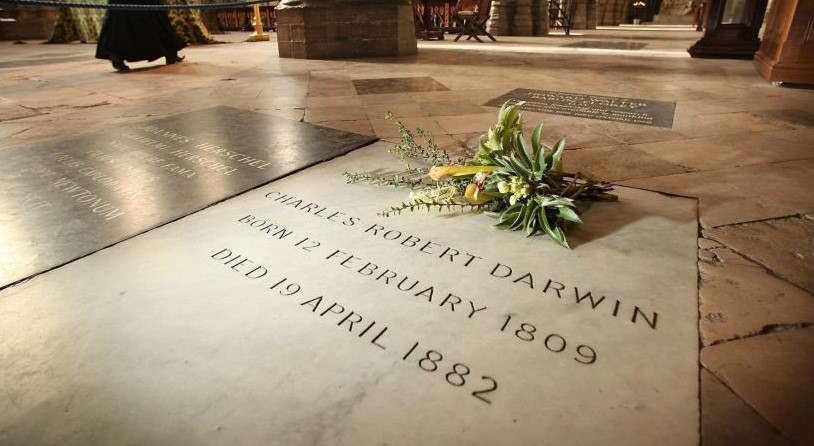
In September, 2005, I traveled to London to attend a conference. While in London, I visited Westminster Abbey.
Bury Darwin: A Deep Dive into the Historical and Political Context

It is hard to imagine a place more rich in history–there was so much to see. But I made sure that I took the time to visit the burial site of Charles Darwin. In comparison with many of the other tombs in the abbey, Darwin’s tomb is simple. I risked the “no photography” rule of the Abbey to take a (non-flash) photo:

While walking and meditating at Westminster Abby, I wondered how it came to pass that Darwin was buried there. Lo and behold, the January/February 2006 edition of Skeptical Inquirer contains an article directly on point: “Why Did They Bury Darwin in Westminster Abbey.” (The article is not available online, but you can see a brief description of it here)
The author of the article, R.G.Weyant, starts out as follows:
Late in the afternoon of Wednesday, April 20 6, 1882, a most improbable event occurred. In a ceremony attended by hundreds of individuals, including members of Parliament, ambassadors from the diplomatic corps, scientific notables, Church of England divines, the Lord Mayor of London, and other assorted dignitaries . . . the earthly remains of Charles Robert Darwin were interred in Westminster Abbey, close to those of such other great English scientists as Sir Isaac Newton.
Some of the information from this article came from a 2002 Darwin biography (Charles Darwin: the Power of Place) written by Janet Browne. She wrote that “Dying was the most political thing Darwin could’ve done. As Huxley and others were aware, to bury him in Westminster Abbey would celebrate both the man and the naturalistic, law governed science that he, and each member of the Darwinian circle, had striven, in his way, to establish.”
Darwin’s Burial and Evolution’s Triumph in 19th Century England
It turns out that the plan to bury Darwin in the Abbey was engineered by Darwin’s cousin, Francis Galton and Darwin’s friend, Thomas Huxley. Through their efforts, a petition persuading church officials to approve the event was signed by various parliamentarians. “For many people, the ceremony in the abbey signaled not only Darwin’s importance to English society but also a kind of reconciliation between science and religion.”
In fact, within a decade after the 1859 publication of origin of species, “most educated Englishman, including many of the clergy, had accepted the fact of evolution. More than a few were uneasy about where the evidence and the reason were taking them, but they went nonetheless.”
As elaborated in the Skeptical Inquirer article, by the time Darwin died, most Englishmen considered evolution to be more than a theory because the evidence in favor of evolution was “simply overwhelming.” At the time Darwin died, his ideas had “become the ideas of his time and culture, and it was convenient for both church and state to recognize that fact.” In fact, by the time Darwin died, evolution had become a source of English national pride.
Times have changed, of course. If Darwin died in the United States today, our government, prodded by fundamentalist churches, would arrange to have his remains unceremoniously thrown in a dumpster somewhere off the beaten path, along with all of those inconvenient fossils documenting the fact that species change over time.


Mike,
I happen to be a consistent honest believer and thinker that doesn't throw out recorded history because I think I know better. Atheists with the assistance of naturalistic science faught for decades to divorce the historical content of the Bible from reality.
Honest non-assumptive archeology has yet to disprove anything recorded in the Bible. Now if you take the findings of natural science with its assumptions left and right you can disprove that a clay tablet with a recorded date on it can't be correct because the radioactive dating says otherwise.
How are you going to believe the historical date or the "scientific" date – this is the crux of the entire matter for me. Science figures out how to adjust its wrong interpretations after it is shown they can't be correct.
This is why I figure that the best recorded historical book is the best place to start with any scientific study. This is why I will not compromise on the human recored history from Genesis Chapter 2 on. I can be flexible up to many thousand years for Genesis 1 but I will not claim there is absolutely no evidence for a Global flood – that is plainly an attempt to discount nearly everything about early history recorded by man.
As you well know, scientists don't let anything stand in the way of their perogative to extraploate and assume anything they darn well decide they want to assume.
I know that this horse is by now just a pile of bones bleaching in the sun, but I must respond too:
That. is. the. point.
Mark,
I don't misunderstand Dan. I know where Dan comes from because it took me many years to come to the fully persuaded position that I hold to tenaciously. It would have been a much easier road to tow intellectually if I swallowed what the university experts told me was true. I didn't want to take that road because I saw their work as biased and every bit as prone to error even though they say its the best we have to go on. I have probably taken more math and science and taught more math and science than Dan has. These are not the issue. I don't teach them as Dan would like so I am obviously a heretic and not to be trusted.
I believe the extent of catastrophism as I view it is not impossible. I happen to believe there was one huge catastrophic exit wound that brought so much crust, mantle and water up from under the ground that you would say that would be totally unbelievable. There were also many smaller releases of water from the mantle and crustal materials all across the continents.
I happen to believe the earth contained a fully functioning and well regulated nuclear fission reactor that was well distrubuted all through the mantle. This entire functioning reactor was destroyed at the Global flood and both water soluble and water insoluble materials were ejected in huge quantities that were then redistributed across the surfaces of the continents. The fountains of the great deep were much more than simply "artesian wells." We will never figure out scientifically the extent of everything that came up from down under during the global flood of Noah.
Mark stated this concerning my point of view:
"Except one thing. And that one thing is conveniently outside all realms of investigation. So you get to have your certainty and be a skeptic at the same time and never be at risk of being proven in error because your certainty is based on something that cannot be directly observed. Very convenient. So you get to lob stink bombs at everyone else and remain smugly certain."
You state this in regards to how I refuse to relent in my opposition to naturalism's "wisdom." Yet, I see those who follow naturalism alone as their trusted point of view as being just as vulnerable and guilty of the same way of thinking and logical errors that you accuse me of.
Let me reword your statement a little so you see where I come from.
So naturalists get to have their certainty and be skeptics at the same time and never be at risk of being proven in error because their certainty is based on something that cannot be directly observed. Very convenient. So naturalists get to lob stink bombs at everyone else and remain smugly certain.
That is how I view the situation.
Karl writes:—"That is how I view the situation."
Actually, I was referring to your basic belief in a Creator and in much, if not all, the baggage that with that.
Naturalists change their minds all the time. Ah, but the extent of those changes don't affect their "faith" in methodology. I see.
Also:—"Atheists with the assistance of naturalistic science faught for decades to divorce the historical content of the Bible from reality."
Firstly, you're assuming again about the Atheists. This all begins to smack of conspiracy theory and Cabbalistic secret powers crap. But mainly, don't feel so picked on. Until Schliemann, all ancient texts were looked upon as no more than stories. Why would the Bible be any different? When Schliemann found Troy, that began to change. And while archaeology has substantively verified many of the details in biblical accounts, they are rarely ever as recorded. But along with those, they have verified many things found in other, non-biblical texts.
Lastly, the one point Dan has made about the radiation levels necessary to make everything appear as it does in such a short time span is not really debatable. The lithosphere would be unable to support life. It would be a dead slurry of half-molten goo. The heat, Karl. The heat. Like so much else in basic science, you can't ignore the heat.
I respect your tenacity, but your science is cock-eyed.
Vicki, If science wasn't blinded by what the philosophy of naturalism tries to expect them to believe they wouldn't have to qualify any of their stated findings as being in need of possible correction.
I see statements like this is textbooks. The rock is clearly 4.5 billion years old. This is extrapolation extrordinaire.
What's wrong with stating from a scientific point of view that those who believe in the philosophy of naturalism and a very old earth believe the rock sample is billions of years old while those who think the extrapolation is a bit questionable wouldn't agree with this as stated scientific fact.
The first presumes fact and could be tested as such on a true and false test by your professor. The second is a more valid scientific statement in my mind because it relates to the methodology used in arriving at a calculated date which could be in error.
Isn't that a scientific and reasonable statement?
Those who believe that the only way to do science is from a naturalistic point of view that is stoic and all based upon numbers are only fooling themselves. Their philosophical point of view is more pernicious than they care to admit to anybody, especially themselves or their peer review process.
That science needs to be corrected means they have deliberately chosen to use their methodology to arrive at calculations that are error prone but the errors aren't going to be even considered until someone forces them otherwise. This is where naturalistic philosophy rules the roast of extrapolated science, and why I don't trust anything that doesn't at least agree with actual recorded human history.
I ask anyone here at DI to tell me a what point and under what criteria they would accept recorded human history as having a bearing upon the findings of modern science.
If it was recorded that such and such a people saw the sun darkened at midday, would that be reliable or a folk tale?
If it was recorded by cave dwellers on a wall that they had killed a dinosaur, would that be reliable or a folk tale?
If it was recorded that an entire city was destroyed in a fire ball inferno, would that be reliable or a folk tale?
If it was recorded that an entire army was destroyed without the need for anyone in a defened city to have to fight, would that be reliable or a folk tale?
If a giant was captured and defeated by pigmies would that be reliable or a folk tale?
If it was recorded that such and such a people killed a dragon would that be reliable or a folk tale?
If it was recorded that there was a flood that lasted for over a year before the survivors got off the boat woukld that be reliable or a folk tale?
Who needs to vouch for the factualness of recorded historical statments before you will consider them reliable?
If you say you have to personally be there to witness it yourself then why do you believe scientists who do their observations and field work and then announce to you their findings?
Here's a news article for linking catastrophism together, this will not sit well with the univeristy geologists.
http://www.latimes.com/news/science/la-sci-extinc…
Karl, let's compare: After high school calculus, I had at least one math course in each of my ten semesters of college (two degrees). Granted, most of them were applied math in engineering and systems analysis rather than bleeding edge theory. But I enjoyed helping classmates with homework and to prep for tests in courses in which I was not enrolled. Chaos theory was new when I was in school, so I had to read about it independently. I've read hundreds of columns and some books by Martin Gardner, and still read the occasional book about math to keep current. A book I'm now reading is A History of Mathematics, showing how math got to where it was in the 20th century from the earliest awareness of numbers, in under 700 pages.
My science background is different. I was raised by an astrophysicist and a horticulturist, surrounded by their books and journals. My father took me along on a couple of field missions for NASA when I was 9 and 10; backstage at Cape Kennedy just before Apollo 13 (I didn't do it)). Our yard was a continuous biology lesson.
I only took the science courses required of University premeds, plus a couple of deeper courses in quantum physics. But I have read over 500 issues of Scientific American, and occasionally Science Magazine, Physics Today, or others.
I have not formally taught either science or math; just silversmithing. But I have applied math and physics working in a radiological dating lab, in industrial robotics design, and occasionally in software design.
Karl writes:—"That science needs to be corrected means they have deliberately chosen to use their methodology to arrive at calculations that are error prone but the errors aren’t going to be even considered until someone forces them otherwise. This is where naturalistic philosophy rules the roast of extrapolated science, and why I don’t trust anything that doesn’t at least agree with actual recorded human history."
I don't know of a single archaeologist or anthropologist who discounts history. That would be ridiculous.
—"I ask anyone here at DI to tell me a what point and under what criteria they would accept recorded human history as having a bearing upon the findings of modern science."
The question seems absurd on its face. Things happened in history which at one time were inexplicable. Some of the explanations offered at the time are often called into question (Zeus did not throw a lightning bolt, the harvest was not destroyed by Quetzelcoatl) but the events themselves are rarely questioned until absolutely no evidence can be found for them (even Atlantic won't go away).
—"If it was recorded that such and such a people saw the sun darkened at midday, would that be reliable or a folk tale?"
Eclipses are known phenomena, why would the recording of one be questioned?
—"If it was recorded by cave dwellers on a wall that they had killed a dinosaur, would that be reliable or a folk tale?"
Since humans and dinosaurs did not coexist, the recording would have to be studied to see what else it could be. I am not familiar with any cave paintings depicting dinosaurs, though.
—"If it was recorded that an entire city was destroyed in a fire ball inferno, would that be reliable or a folk tale?"
We know about meteors, asteroids, boloids. Things fall from the sky. Also, vulcanism accounts for a lot. We would not discount the account as a folktale, only the attribution of the event to divine retribution.
—"If it was recorded that an entire army was destroyed without the need for anyone in a defened city to have to fight, would that be reliable or a folk tale?"
We know of historically recent accounts of armies devastated by plague. But this begins to stretch credulity and we also have accounts of supposed great victories attributed to this or that which we know were other than what was recorded by the victors.
—"If a giant was captured and defeated by pigmies would that be reliable or a folk tale?"
Gigantism is a known phenomena. Again, what's to dispute other than the almost inevitable exaggerations from oral traditions?
—"If it was recorded that such and such a people killed a dragon would that be reliable or a folk tale?"
You wouldn't discount the fact that they killed something, but you would be skeptical about "dragons", for which we have no evidence.
If it was recorded that there was a flood that lasted for over a year before the survivors got off the boat woukld that be reliable or a folk tale?
—"Who needs to vouch for the factualness of recorded historical statments before you will consider them reliable?"
The question is, reliable for what? If you ask me to take the traditionally espoused folk remedies for a serious illness which we can demonstrate to be ineffective rather than rely on modern medicine simply because a bit of recorded "history" claims the remedy worked for king so-n-so, then no, I would not find the historical record reliable. If you ask me to accept that ancient astronomers knew about Halley's Comet and recorded it faithfully when it arrived in the neighborhood, well, sure. But if you ask me to accept that such cometary visitations are reliable predictors of bad times, well, hell no. Yet that was also often part of the "historical account."
—"If you say you have to personally be there to witness it yourself then why do you believe scientists who do their observations and field work and then announce to you their findings?"
I don't believe anyone says that other than in the course of frustrating conversations about things which are otherwise non-issues.
Academia was profoundly skeptical that Troy was anything other than a folk tale. Homer was not an eye-witness, but a poet writing some five to seven hundred years after the event. Oral traditions survived and he wrote the story down. It would seem reasonable to be skeptical. After all, we have fiction writers who make shit up all the time for entertainment! Why assume this is something only Western Civilization since the Renaissance indulged in?
When Schliemann found Troy based on Homer's writings, everyone had to rethink their assumptions—which they did.
But because there was a city there and one level was clearly razed, did that mean there was a horse?
Never to be known. Should we take it as a given that there was? I would see no harm in believing the story, but to claim that it is absolutely true based on the finding of Troy is a stretch.
Was there a great war? Apparently, but we known this now based on findings from other civilizations that were extant at the time, that some massive amount of shit hit the fan at the time the Mycenaeans supposedly beseiged Troy. It would not be unreasonable to assume a major war occurred that damaged trade in the region and precipitated a collapse. (I've noted this in other posts that the collapse of the Hittite Empire, which happened about this time, left a power vacuum in Canaan, which the Israelites took advantage of.)
There are many facets to the picture which support valid readings of ancient historical events, but they have to be carefully weighed to sort out the propaganda from the facts, the hagiography from the biography, the b.s. from the way it happened.
Was there a Trojan War? More than likely, yes. Did it last ten years? Well…. Did the Greeks win it with a horse? Nice colorful touch, but probably not. Conclusion—the war happened, the politics were certainly more complex than those stated in Homer, and the attributes of the various warriors were doubtless entertainingly exaggerated.
On another front, did the Hebrews conquer Canaan? Probably. Did Joshua's request that the sun be stopped so the battle could continue occur? He may have made the request, but the sun didn't stop. We know this because we know what would have happened if that had happened.
Oh! But what about the all-powerful Yahweh's intervention?
Not historical.
I said this wasn't about who has taken or taught more math and science but thanks for sharing a bit about your background, schooling and work experience.
I did not have parents with college degrees. My father was a carpenter and my mother worked outside the home evenings when the children able to look after one another and then she worked full time when the children were all of school age. Our family had three brothers and four sisters. I was raised as a Christian and moderately defended my perspective of the world from the textbooks and National Geographic dogma that sought to discredit biblical recorded history.
After four years of high school sciences and math which also included calculus 1 and 2, I went to Hudson Valley Community College for two years where I received an associate’s degree in Engineering Science. This work included four semesters of calculus based physics, two courses in mechanics, two courses in chemistry, calculus 3, differential equations, abstract algebra, probability and statistics, thermodynamics, two computer courses, electrical circuits, and a couple of engineering science courses. I'm sure I left off something there as well as the other basic education related courses like English and the social sciences. This is where I received the basics of my higher education in math and the sciences. This was back in 1975-1977. I had 77 college credits (semester hours) from this community college.
I transferred into a polytechnic as a junior and considered going into the field of biomedical engineering until the classroom atmosphere there and belligerent deportment of the instructors told me this was not where I wanted to further my education. My biology professor either came to class drunk or with a hangover more often than not and for the first time I ran into the teaching assistants who seemed to care for nothing but doing what was required to keep them in good standing with the department. This was where I first learned the meaning of the long arm of the university gurus of higher education and how science (especially biology) materials had to be taught according to a naturalistic framework. I withdrew within six weeks and considered how I could possibly manage to come to terms with what I had just experienced. Blatant hostility towards my basic world view was not something I handled well to say the least.
The following fall I enrolled in Central Bible College and spent three more years obtaining a B.A. in Christian Education. I accredited and other 110 semester hour credits in courses that helped me better defend what I believed to be true.
From here I went into teaching and received a B.S. degree from Excelsior College and a Master of Science in Education from the College of Saint Rose. These were required to remain state certified to teach in both math and physics. I have taken several post graduate courses in several fields of science including earth science, modern physics and science instruction. I have taught all of the junior and senior high sciences and currently teach AP Physics as well.
I also have read many journals and publications, but I don’t do so with a blind eye to the philosophy of naturalism that pervades most modern perspectives. I have read much, and considered much evidence and still find the evidence in favor of naturalism and macro-evolution to not be overwhelming and as much as matter of faith as my perspective upon the Bible and Creation. I guess the only difference between you and I is that I never submitted to the university mindset that devours most young people these days.
Mark states:
"Lastly, the one point Dan has made about the radiation levels necessary to make everything appear as it does in such a short time span is not really debatable. The lithosphere would be unable to support life. It would be a dead slurry of half-molten goo. The heat, Karl. The heat. Like so much else in basic science, you can’t ignore the heat."
I have considered the heat issues, you assume the only way for improper apparent half lives for radioactive remnants are from the result of concentrated accelerated nuclear decay, I do not.
I have said repeatedly that the appearances of accelerated nuclear decay or miscalculated actual half lives for a sample could all be the result of the transport of soluble radioisotopes either into or out of a sample, or by just a flat out error in the original presummed ratios of radioisotopes in a sample under investigation.
I have no where said that the radiation that is present on and in the lithosphere was the result of a high temperature meltdown. It is far to widely distributed and in such low concentrations that to believe this is preposterous.
I beleive the inner workings of the planet once depended upon water acting as both a moderator and a heat exchange transport fluid. When the water was ejected in large measure during the flood the heat production under the continental plates nearly all but ceased and the heat production under the oceanic plates slowed to a near stand still.
There is much more to this model but I'll only be told I have no evidence for this so its not worth any further consideration.
Since Mark has made classical allusions I will offer this:
Karl writes:—"I have no where said that the radiation that is present on and in the lithosphere was the result of a high temperature meltdown. It is far to widely distributed and in such low concentrations that to believe this is preposterous."
Nor did I say you said that. You have it exactly backwards. And inside out. And….
Dan?
Mark, Karl: Simple radioactive decay produces energy as a nucleus spits out an electron (beta particle) or ionized helium (alpha particle) plus assorted neutrinos. A completely verified, firmly established amount of heat (energy) is produced by each step of decay. Some nuclear batteries make use of this heat of decay using concentrated short-lived isotopes like Co-60 or Pu-238.
If the billions of tons of long-lived radioactive isotopes in our planet were to speed up from half-lives of millions of years (as now measured) to hundreds of years, the results would be dramatic (explosive). The core of the planet is producing about 40 to 60 TW from radioactive processes (source). Multiply this by 10,000 (million divided by hundred), and either the planet explodes or it melts down and glows, depending on how fast you crank up the rate.
If you are assuming that this had happened in the past, and what we see is only a pitiful fraction of the formerly existing isotopes, the Earth would have to have outshone the sun, until the cloud dispersed. Do the arithmetic yourself, if you doubt this.
I can do the math. Please read a simple statement for what it says.
I will say it agian. I did not say that there was a nuclear catastrophy that caused the flood and produced the scattered remants of nuclear isotopes all over the lithosphere.
I am trying to convey to you that pieces of fully functioning, well controlled and widely dispersed nuclear fission reactors were disrupted during the flood. Lets say we had about a bunch of nuclear power plants well distributed but deeply placed inside the earth's crust and/or mantle. Lets say we shut them down quickly and then flush and purged the nuclear cores from the nuclear containment chambers. The materials that were once in the containment vessels where these reactors had been operational for hundreds of years are now empty so that the materials would have to be transported from these positions and then deposited into new positions.
What we examine in so many of our rocks and sediments is what has been transported to these new positions from the once operational reactors.
The bulk of what we have detect in larger quantities are the insoluble lead containing minerals and compounds. The more soluble half-life products are diluted by the water transport mechanism and are not deposited in the expected amount to keep the ratio if radioisotopes meaningful for any dating technique.
The rock that we assume has been undergoing spontaneous decay for millions of years has actually in recent history been part of an ongoing steady nuclear fission process that is not in operation by any extent detectable by present conditions.
The Okloa natural reactor appears to have not gotten destroyed as well as most of these reactors did.
Anyway, there is no need to explain how the earth didn't self destruct due to a massive infusion of heat, but there is a need to account for a drastic reduction in heat when the reactors are shut down, dismembered and dispersed throughout the lithosphere.
This also explains very nicely why we find radioactive isototpes in very unusual quantities in so many fossil remains, not just the sediments the fossils are found in.
If we were describing a localized half-life process we would need less lead around and more uranium to characterize a younger rock. What we find is the remants of the spent nuclear fuel that had alreadychanged into lead with little uranium present because it was much more soluble and therefore carried away and diluted down in concentrations by the chemical solvent liquid water.
Where in this model is there a need for tremendous mind boggling and "star equivalent heat producing engine"?
Karl, we're not talking about fission, nor a flood. You have stated elsewhere that the radiological dates given by measuring decay products trapped in crystalline matrices may be wrong because the decay rates might have been faster in the past. The consequences of this idea are what we've addressed.
No lead nor uranium are involved in most of these age measurements. Isotopes of potassium, rubidium, and samarium are commonly used. There are other ones used for shorter and longer time spans, too.
Decay. Simple decay. Nothing to do with fission.
Also, we are talking about both the crust, where we can most easily measure, and the bulk of the Earth from the bottom of the mantle on down. Techniques are emerging to allow us to "see" decay happening throughout the planet. The core is full of the heavy elements, busily rotting away. Heavy elements have more isotopes with a wider range of half-lives. Also some fission is going on, but this is apparently not the major contributor to the heat we've measured since the 1800's, contrary to what was thought in the 1950's.
Dan writes "Karl, we’re not talking about fission" yet then he later writes in the same comment "Also some fission is going on".
Can we say, "contradiction"?
J.C.
The isotopes he's talking about are not the result of fission. This is not to say there isn't fission going on at some level. Rather than open himself to the charge that he denies that fission occurs closer to the core….
But I suspect you know that.
On all aspects of the topic of radiological dating, we are not talking about fission. But as for the heat in the planet, some of that, much less than previously assumed, comes from fission.
Taken out of context, anyone can seem self-contradictory.
Can radioactive Potassium, Rubidium and Samarium ever be considerd as some of the soluble by-products of the fission that is believed to be occurring deep inside of the earth?
Or, have these isotopes like those in the Uranium 238 disintegration series just always existed since the dawn of the planet in their unstable isotopic forms just waiting around to spontaneously transform from one unstable isotope into the next isotope all the while possessing a possibility of obtaining a stable combination of protons and neutrons which would make them cease their transformations?
If radioactive potassium, rubudium and samarium are even remotely possible by-products of fission I believe a line of reasoning that the earth produces these on a regular basis should be looked into and the entire possibility of how all of these radioisotopes that used to once be deep in the earth ended up in the surface crustal materials.
Karl, Please do some reading about what radiation is, what isotope decay is, and what fission is.
Certainly, it is possible for fission to create almost any smaller isotopes. The issue is, given that these already existed withing a crystal within a rock, how much of each isotope decays to what, and then what and then what, and in how much time for each case?
That more of the initial element could have been (unlikely as it is) produced outside the rock around the crystal is really irrelevant to the issue.
What are suggesting is comparable to: Bank notes decay slowly in a sealed vault (like a crystalline matrix), and therefore the time since the vault was last sealed can be measured by how badly the notes have yellowed. Now these vaults are always found sealed in petrified bank rubble (igneous rock), usually deep under yet more protective layers (other stone of any and all types). Each of these other layers also have vaults of varying types.
You are suggesting that some process might have later created massive amounts of both fresh banknotes as well as yellowed ones (I'll grant this), and that these somehow seep through the encrusting layers, through the petrified banks, and on into the vault, and then leaving no trace of themselves in those outer layers, therefore skewing the age calculated.
Right?
Dan,
I've been saying for quite a while that there is no way of telling exactly when, where or how an igneous rock actually formed, this is all assumptions. This even more so applies to supposed metamorphic and sedimantary rocks which obviously haven't had any of the materials confined in the "bank vault."
Any materials that were once molten and then solidified have to have assumptions made about where, when or how they arrived in the condition we currently find them.
I have also been saying that soluble radioisotopes have been dispersed into lower and lower concentrations throughout the lithosphere, while the insoluble ones have been dispersed to a much lower degree. Just this fact alone needs to be very seriously considered in any dating technique used by by ratio comparisons.
Karl Says:
January 3rd, 2009 at 4:27 pm
….father was a carpenter….
Don't tell me and his name was Jesus! Ha Ha Ha!
……enrolled in Central Bible College and spent three more years obtaining a B.A. in Christian Education.
You enter further study after being indoctrinated and brainwashed as a child. Seriously, if any of this was true would it be necessary to do that.
Just because you study a book (or should I say books) of fiction put together selectively by highly educated but also ignorant men (partly to establish the divine right of kings to rule and partly to keep people in their place) who lived at a time when to challenge the supremacy of the church could mean execution (no one expects the Spanish Inquisition) you think (hmm maybe you can't think. god wants followers not thinkers) this gives you an insight.
You could study all the Harry Potter books from cover to cover and believe Harry Potter was real. You would laugh at that but for a fast growing number of people have opened their eyes and minds and have come to realise that your books of religious dogma have no more merit that a Harry Potter book. What is the worlds fastest growing belief system.? It is the one that realises that men create gods and not the other way round.
The game is up my friend and no amounts of telling people that black is white and vice versa can stop the truth from revealing itself and ignorance being banished back to the dark ages where it belongs.
People are attending places of worship less and less and lie about attending too. In the US 40% claim to attend but survey after survey show only 20% do. In the UK less than 6% of the population (mainly over 60) attend church. The better educated a person the LESS likely they are to believe.
Oh yes the true believers like yourself will promote this rubbish emphatically until the day you die. Even though as an educated man you know it is garbage but you have done it too long now to admit it and would rather continue to be a fool than to admit you were one.
Karl, please at least read the texts from some of the many elementary science courses I keep trying to lead you to. Learn the difference between solubility and melting. Learn the difference between elements and isotopes. Learn the ancient Method of Exhaustion (Eudoxus, Archimedes), or the modern Calculus (Newton) to see how small things inevitably add up to big things, and as a corollary how all big things can be reduced to small. Calculus systematically relates position to jerk, point to space-time, and/or slope to volume over a few orders.
Ideally, take some elementary quantum theory, to see the statistical models that prove how isotopes of elements appear within crystals in which they could not possibly have been incorporated through melting and freezing, nor dissolving and re-crystallizing.
Lightsp33d tell us something true about your personal life so we can make a wise crack about it.
Jesus' human father's name was Joseph not Jesus. If you're going to laugh at somebody's similar stories and overtones get the begats right. Ha! Ha! Ha!
My father's name was Richard, sorry to let you down.
You've entered this discussion after either lurking for months or after stumbling across someone who happens to have a much better trust in something that bears serious consideration one way or the other.
I've never said my perspective and the Bible's is entirely scientifically impeccable. You seem to think yours is. Laugh and use ad hominem attacks that your view of rational discussion, but please try to discruss something besides your spoon fed guarded perspective on life that believes the modern world of scientific authority has it all together and so that makes your philosophy on life superior to mine or anyone else who happens to look into matters from more than your perspective.
I don't look at the Bible through rose colored glasses like you do what the scientists of today tell us.
By the way, what did ever happen to global warming anyway?
Dan would like me to just read and read and read and read what he recommends as the clear think rational man's point of view and stop trying to defend nonsense.
I'm sorry Dan can not see how I can chose to read both sides of these perspectives and not drop my pretentious ideas. How many books have you read and carefully examined the perspectives of the authors and those who support the author in his endeavors.
We are not in a university science class, where the prof gets to issue theory and ideology as dogma. Nor where the majority of highly educated respectable scientists only believe such and such.
If you really read Darwin close you will notice that he used a preponderance of words like, theory, infer, perhaps, might be, could be, hopefully, maybe, the chances, could conclude, belief, some doubt, little doubt, logic, reasoning, affirm, and support. Darwin stated very often that his work was scientific ideology and theory looking for actual evidence to support the rationality of his ideas.
In all of these years there have been people who are not in agreement with others concerning the status of the evidence for "macro-evolution that could bridge from species to species.
No scientist that I know of can bridge the gap from non-material to material or from non-life to life. Sure there is a constant imaginative stir that is often hailed as the latest and geatest proof yet, but they all seem to morph into another form when the matter is looked inot more closely.
Even Richard Dawkins has to go to an extraterrestrial hypothesis to get to life here because the cambrian explosion causes him fits.
As for the existence of matter itself, that is a taken fundamental aspect of reality for naturalists so they don't need to question wence it came or wither it goes.
I'm sorry I do not pay homage to the ideology of Darwin the great buried in Westminster Cathedral (Abbey) He was placed there along side many devout men of faith. He was a man of faith, faith in naturalism to explain what he thought was a more scientifically respectable point of view and philosophical perspective on origins.
I'm sure Hutton and Huxley were glad to see Darwin buried there, and I am as well because it keeps the matter returning to its religious overtones.
Why bury a guy in a place with religious connotations if the things he hoped and believed weren't of a religious nature?
Would it have been more appropriate to have buried him in a place where church and state were more separated? Not to worry, Darwin lives on in the hearts of those inspired to maintain his memory every year through countless observances.
Who gets the Darwin awards this year?
Karl indicates once again that he has not spent any significant time at a university:
The whole point of a university education is to challenge young minds, not to indoctrinate them. When a professor states something as dogma, the correct response is to refute (or possibly support) her position using outside sources and/or direct experimentation. "See for yourself" is the battle cry, not "take my word for it". And I've been to science conferences. They don't all agree, even within one institution.
If Karl had read much actual science at all, he'd notice that all of it uses a "preponderance of words like, theory, infer, perhaps, might be, could be, hopefully, maybe, the chances, could conclude, belief, some doubt, little doubt, logic, reasoning, affirm, and support." It is the modern popularizations of science where those words are more rare. The distinction was fuzzier 150 years ago when Darwin was persuaded to publish publicly, rather than just to his peers.
Dawkins resorted to the "extraterrestrial hypothesis" not because he has any doubts about evolution, but in answer to "did life necessarily originate on the Earth?" Whether it started, crossing space from another planet, extrasolar clouds, undersea, or from moistened crystals, it still evolved.
btw: E=MC<sup>2</sup> "bridges the gap" from material to non-material, from fermions to bosons, from object to field. And it was just a conclusion drawn by applying the principle of relative motion to mid-19th century field theory. Read it aloud: Energy is Matter (modified by a constant conversion factor).
And the biggest barrier between life and non-life is that we don't have a universal definition of the distinction. Draw the line, and then watch as something is observed to cross it. Same goes for "species".
And, Karl, I for one appreciate your attempt to bring the thread back to topic. I agree with your concluding several 'graphs.