
Why did they bury Darwin in Westminster Abbey?
In September, 2005, I traveled to London to attend a conference. While in London, I visited Westminster Abbey.
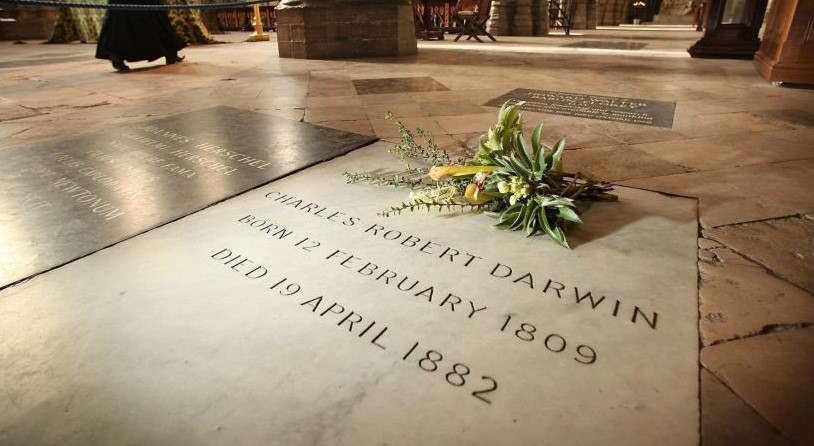
It is hard to imagine a place more rich in history–there was so much to see. But I made sure that I took the time to visit the burial site of Charles Darwin. In comparison with many of the other tombs in the abbey, Darwin’s tomb is simple. I risked the “no photography” rule of the Abbey to take a (non-flash) photo:
While walking and meditating at Westminster Abby, I wondered how it came to pass that Darwin was buried there. Lo and behold, the January/February 2006 edition of Skeptical Inquirer contains an article directly on point: “Why Did They Bury Darwin in Westminster Abbey.” (The article is not available online, but you can see a brief description of it here)
The author of the article, R.G.Weyant, starts out as follows:
Late in the afternoon of Wednesday, April 20 6, 1882, a most improbable event occurred. In a ceremony attended by hundreds of individuals, including members of Parliament, ambassadors from the diplomatic corps, scientific notables, Church of England divines, the Lord Mayor of London, and other assorted dignitaries . . . the earthly remains of Charles Robert Darwin were interred in Westminster Abbey, close to those of such other great English scientists as Sir Isaac Newton.
Some of the information from this article came from a 2002 Darwin biography (Charles Darwin: the Power of Place) written by Janet Browne. She wrote that “Dying was the most political thing Darwin could’ve done. As Huxley and others were aware, to bury him in Westminster Abbey would celebrate both the man and the naturalistic, law governed science that he, and each member of the Darwinian circle, had striven, in his way, to establish.”
It turns out that the plan to bury Darwin in the Abbey was engineered by Darwin’s cousin, Francis Galton and Darwin’s friend, Thomas Huxley. Through their efforts, a petition persuading church officials to approve the event was signed by various parliamentarians. “For many people, the ceremony in the abbey signaled not only Darwin’s importance to English society but also a kind of reconciliation between science and religion.” In fact, within a decade after the 1859 publication of origin of species, “most educated Englishman, including many of the clergy, had accepted the fact of evolution. More than a few were uneasy about where the evidence and the reason were taking them, but they went nonetheless.”
As elaborated in the Skeptical Inquirer article, by the time Darwin died, most Englishmen considered evolution to be more than a theory because the evidence in favor of evolution was “simply overwhelming.” At the time Darwin died, his ideas had “become the ideas of his time and culture, and it was convenient for both church and state to recognize that fact.” In fact, by the time Darwin died, evolution had become a source of English national pride.
Times have changed, of course. If Darwin died in the United States today, our government, prodded by fundamentalist churches, would arrange to have his remains unceremoniously thrown in a dumpster somewhere off the beaten path, along with all of those inconvenient fossils documenting the fact that species change over time.

Related posts:
Since Mark has made classical allusions I will offer this:
Karl writes:—”I have no where said that the radiation that is present on and in the lithosphere was the result of a high temperature meltdown. It is far to widely distributed and in such low concentrations that to believe this is preposterous.”
Nor did I say you said that. You have it exactly backwards. And inside out. And….
Dan?
Mark, Karl: Simple radioactive decay produces energy as a nucleus spits out an electron (beta particle) or ionized helium (alpha particle) plus assorted neutrinos. A completely verified, firmly established amount of heat (energy) is produced by each step of decay. Some nuclear batteries make use of this heat of decay using concentrated short-lived isotopes like Co-60 or Pu-238.
If the billions of tons of long-lived radioactive isotopes in our planet were to speed up from half-lives of millions of years (as now measured) to hundreds of years, the results would be dramatic (explosive). The core of the planet is producing about 40 to 60 TW from radioactive processes (source). Multiply this by 10,000 (million divided by hundred), and either the planet explodes or it melts down and glows, depending on how fast you crank up the rate.
If you are assuming that this had happened in the past, and what we see is only a pitiful fraction of the formerly existing isotopes, the Earth would have to have outshone the sun, until the cloud dispersed. Do the arithmetic yourself, if you doubt this.
I can do the math. Please read a simple statement for what it says.
I will say it agian. I did not say that there was a nuclear catastrophy that caused the flood and produced the scattered remants of nuclear isotopes all over the lithosphere.
I am trying to convey to you that pieces of fully functioning, well controlled and widely dispersed nuclear fission reactors were disrupted during the flood. Lets say we had about a bunch of nuclear power plants well distributed but deeply placed inside the earth’s crust and/or mantle. Lets say we shut them down quickly and then flush and purged the nuclear cores from the nuclear containment chambers. The materials that were once in the containment vessels where these reactors had been operational for hundreds of years are now empty so that the materials would have to be transported from these positions and then deposited into new positions.
What we examine in so many of our rocks and sediments is what has been transported to these new positions from the once operational reactors.
The bulk of what we have detect in larger quantities are the insoluble lead containing minerals and compounds. The more soluble half-life products are diluted by the water transport mechanism and are not deposited in the expected amount to keep the ratio if radioisotopes meaningful for any dating technique.
The rock that we assume has been undergoing spontaneous decay for millions of years has actually in recent history been part of an ongoing steady nuclear fission process that is not in operation by any extent detectable by present conditions.
The Okloa natural reactor appears to have not gotten destroyed as well as most of these reactors did.
Anyway, there is no need to explain how the earth didn’t self destruct due to a massive infusion of heat, but there is a need to account for a drastic reduction in heat when the reactors are shut down, dismembered and dispersed throughout the lithosphere.
This also explains very nicely why we find radioactive isototpes in very unusual quantities in so many fossil remains, not just the sediments the fossils are found in.
If we were describing a localized half-life process we would need less lead around and more uranium to characterize a younger rock. What we find is the remants of the spent nuclear fuel that had alreadychanged into lead with little uranium present because it was much more soluble and therefore carried away and diluted down in concentrations by the chemical solvent liquid water.
Where in this model is there a need for tremendous mind boggling and “star equivalent heat producing engine”?
Karl, we’re not talking about fission, nor a flood. You have stated elsewhere that the radiological dates given by measuring decay products trapped in crystalline matrices may be wrong because the decay rates might have been faster in the past. The consequences of this idea are what we’ve addressed.
No lead nor uranium are involved in most of these age measurements. Isotopes of potassium, rubidium, and samarium are commonly used. There are other ones used for shorter and longer time spans, too.
Decay. Simple decay. Nothing to do with fission.
Also, we are talking about both the crust, where we can most easily measure, and the bulk of the Earth from the bottom of the mantle on down. Techniques are emerging to allow us to “see” decay happening throughout the planet. The core is full of the heavy elements, busily rotting away. Heavy elements have more isotopes with a wider range of half-lives. Also some fission is going on, but this is apparently not the major contributor to the heat we’ve measured since the 1800’s, contrary to what was thought in the 1950’s.
Dan writes “Karl, we’re not talking about fission” yet then he later writes in the same comment “Also some fission is going on”.
Can we say, “contradiction”?
J.C.
The isotopes he’s talking about are not the result of fission. This is not to say there isn’t fission going on at some level. Rather than open himself to the charge that he denies that fission occurs closer to the core….
But I suspect you know that.
On all aspects of the topic of radiological dating, we are not talking about fission. But as for the heat in the planet, some of that, much less than previously assumed, comes from fission.
Taken out of context, anyone can seem self-contradictory.
Can radioactive Potassium, Rubidium and Samarium ever be considerd as some of the soluble by-products of the fission that is believed to be occurring deep inside of the earth?
Or, have these isotopes like those in the Uranium 238 disintegration series just always existed since the dawn of the planet in their unstable isotopic forms just waiting around to spontaneously transform from one unstable isotope into the next isotope all the while possessing a possibility of obtaining a stable combination of protons and neutrons which would make them cease their transformations?
If radioactive potassium, rubudium and samarium are even remotely possible by-products of fission I believe a line of reasoning that the earth produces these on a regular basis should be looked into and the entire possibility of how all of these radioisotopes that used to once be deep in the earth ended up in the surface crustal materials.
Karl, Please do some reading about what radiation is, what isotope decay is, and what fission is.
Certainly, it is possible for fission to create almost any smaller isotopes. The issue is, given that these already existed withing a crystal within a rock, how much of each isotope decays to what, and then what and then what, and in how much time for each case?
That more of the initial element could have been (unlikely as it is) produced outside the rock around the crystal is really irrelevant to the issue.
What are suggesting is comparable to: Bank notes decay slowly in a sealed vault (like a crystalline matrix), and therefore the time since the vault was last sealed can be measured by how badly the notes have yellowed. Now these vaults are always found sealed in petrified bank rubble (igneous rock), usually deep under yet more protective layers (other stone of any and all types). Each of these other layers also have vaults of varying types.
You are suggesting that some process might have later created massive amounts of both fresh banknotes as well as yellowed ones (I’ll grant this), and that these somehow seep through the encrusting layers, through the petrified banks, and on into the vault, and then leaving no trace of themselves in those outer layers, therefore skewing the age calculated.
Right?
Dan,
I’ve been saying for quite a while that there is no way of telling exactly when, where or how an igneous rock actually formed, this is all assumptions. This even more so applies to supposed metamorphic and sedimantary rocks which obviously haven’t had any of the materials confined in the “bank vault.”
Any materials that were once molten and then solidified have to have assumptions made about where, when or how they arrived in the condition we currently find them.
I have also been saying that soluble radioisotopes have been dispersed into lower and lower concentrations throughout the lithosphere, while the insoluble ones have been dispersed to a much lower degree. Just this fact alone needs to be very seriously considered in any dating technique used by by ratio comparisons.
Karl Says:
January 3rd, 2009 at 4:27 pm
….father was a carpenter….
Don’t tell me and his name was Jesus! Ha Ha Ha!
……enrolled in Central Bible College and spent three more years obtaining a B.A. in Christian Education.
You enter further study after being indoctrinated and brainwashed as a child. Seriously, if any of this was true would it be necessary to do that.
Just because you study a book (or should I say books) of fiction put together selectively by highly educated but also ignorant men (partly to establish the divine right of kings to rule and partly to keep people in their place) who lived at a time when to challenge the supremacy of the church could mean execution (no one expects the Spanish Inquisition) you think (hmm maybe you can’t think. god wants followers not thinkers) this gives you an insight.
You could study all the Harry Potter books from cover to cover and believe Harry Potter was real. You would laugh at that but for a fast growing number of people have opened their eyes and minds and have come to realise that your books of religious dogma have no more merit that a Harry Potter book. What is the worlds fastest growing belief system.? It is the one that realises that men create gods and not the other way round.
The game is up my friend and no amounts of telling people that black is white and vice versa can stop the truth from revealing itself and ignorance being banished back to the dark ages where it belongs.
People are attending places of worship less and less and lie about attending too. In the US 40% claim to attend but survey after survey show only 20% do. In the UK less than 6% of the population (mainly over 60) attend church. The better educated a person the LESS likely they are to believe.
Oh yes the true believers like yourself will promote this rubbish emphatically until the day you die. Even though as an educated man you know it is garbage but you have done it too long now to admit it and would rather continue to be a fool than to admit you were one.
Karl, please at least read the texts from some of the many elementary science courses I keep trying to lead you to. Learn the difference between solubility and melting. Learn the difference between elements and isotopes. Learn the ancient Method of Exhaustion (Eudoxus, Archimedes), or the modern Calculus (Newton) to see how small things inevitably add up to big things, and as a corollary how all big things can be reduced to small. Calculus systematically relates position to jerk, point to space-time, and/or slope to volume over a few orders.
Ideally, take some elementary quantum theory, to see the statistical models that prove how isotopes of elements appear within crystals in which they could not possibly have been incorporated through melting and freezing, nor dissolving and re-crystallizing.
Lightsp33d tell us something true about your personal life so we can make a wise crack about it.
Jesus’ human father’s name was Joseph not Jesus. If you’re going to laugh at somebody’s similar stories and overtones get the begats right. Ha! Ha! Ha!
My father’s name was Richard, sorry to let you down.
You’ve entered this discussion after either lurking for months or after stumbling across someone who happens to have a much better trust in something that bears serious consideration one way or the other.
I’ve never said my perspective and the Bible’s is entirely scientifically impeccable. You seem to think yours is. Laugh and use ad hominem attacks that your view of rational discussion, but please try to discruss something besides your spoon fed guarded perspective on life that believes the modern world of scientific authority has it all together and so that makes your philosophy on life superior to mine or anyone else who happens to look into matters from more than your perspective.
I don’t look at the Bible through rose colored glasses like you do what the scientists of today tell us.
By the way, what did ever happen to global warming anyway?
Dan would like me to just read and read and read and read what he recommends as the clear think rational man’s point of view and stop trying to defend nonsense.
I’m sorry Dan can not see how I can chose to read both sides of these perspectives and not drop my pretentious ideas. How many books have you read and carefully examined the perspectives of the authors and those who support the author in his endeavors.
We are not in a university science class, where the prof gets to issue theory and ideology as dogma. Nor where the majority of highly educated respectable scientists only believe such and such.
If you really read Darwin close you will notice that he used a preponderance of words like, theory, infer, perhaps, might be, could be, hopefully, maybe, the chances, could conclude, belief, some doubt, little doubt, logic, reasoning, affirm, and support. Darwin stated very often that his work was scientific ideology and theory looking for actual evidence to support the rationality of his ideas.
In all of these years there have been people who are not in agreement with others concerning the status of the evidence for “macro-evolution that could bridge from species to species.
No scientist that I know of can bridge the gap from non-material to material or from non-life to life. Sure there is a constant imaginative stir that is often hailed as the latest and geatest proof yet, but they all seem to morph into another form when the matter is looked inot more closely.
Even Richard Dawkins has to go to an extraterrestrial hypothesis to get to life here because the cambrian explosion causes him fits.
As for the existence of matter itself, that is a taken fundamental aspect of reality for naturalists so they don’t need to question wence it came or wither it goes.
I’m sorry I do not pay homage to the ideology of Darwin the great buried in Westminster Cathedral (Abbey) He was placed there along side many devout men of faith. He was a man of faith, faith in naturalism to explain what he thought was a more scientifically respectable point of view and philosophical perspective on origins.
I’m sure Hutton and Huxley were glad to see Darwin buried there, and I am as well because it keeps the matter returning to its religious overtones.
Why bury a guy in a place with religious connotations if the things he hoped and believed weren’t of a religious nature?
Would it have been more appropriate to have buried him in a place where church and state were more separated? Not to worry, Darwin lives on in the hearts of those inspired to maintain his memory every year through countless observances.
Who gets the Darwin awards this year?
Karl indicates once again that he has not spent any significant time at a university:
The whole point of a university education is to challenge young minds, not to indoctrinate them. When a professor states something as dogma, the correct response is to refute (or possibly support) her position using outside sources and/or direct experimentation. “See for yourself” is the battle cry, not “take my word for it”. And I’ve been to science conferences. They don’t all agree, even within one institution.
If Karl had read much actual science at all, he’d notice that all of it uses a “preponderance of words like, theory, infer, perhaps, might be, could be, hopefully, maybe, the chances, could conclude, belief, some doubt, little doubt, logic, reasoning, affirm, and support.” It is the modern popularizations of science where those words are more rare. The distinction was fuzzier 150 years ago when Darwin was persuaded to publish publicly, rather than just to his peers.
Dawkins resorted to the “extraterrestrial hypothesis” not because he has any doubts about evolution, but in answer to “did life necessarily originate on the Earth?” Whether it started, crossing space from another planet, extrasolar clouds, undersea, or from moistened crystals, it still evolved.
btw: E=MC2 “bridges the gap” from material to non-material, from fermions to bosons, from object to field. And it was just a conclusion drawn by applying the principle of relative motion to mid-19th century field theory. Read it aloud: Energy is Matter (modified by a constant conversion factor).
And the biggest barrier between life and non-life is that we don’t have a universal definition of the distinction. Draw the line, and then watch as something is observed to cross it. Same goes for “species”.
And, Karl, I for one appreciate your attempt to bring the thread back to topic. I agree with your concluding several ‘graphs.
A closer to home example of parallel but distinct evolution is Australia. Those who know what I’m talking about, know what I’m talking about. Those who don’t ought to look it up.
What does it profit a man to gain the whole world, but lose his own souL?
[...] So here we are, in 2009, and we all do have access to each of these immensely important discoveries. It would seem, then, that there is really no excuse for not taking the time to understand and appreciate the power and elegance of natural selection. After all, we have Darwin’s meticulous and brilliant writings to guide us–if nothing else consider reading an abridged version of “The Origin of Species.” We also have numerous corroborating findings that would’ve made Darwin’s work much easier for him. No excuses, right? That’s what I think whenever I see charts showing the tepid response of Americans to Darwin’s brilliant analysis. Note: Upon his death, Darwin was given the great honor of being buried in Westminster Abby. [...]