The Gymnastics many “News” Providers Do with Verifiable Facts

Journalism is not merely about providing the facts. There are so many ways to manipulate, censor and palter even though one is using verifiable facts. This is an excellent post by Michael Nayna:

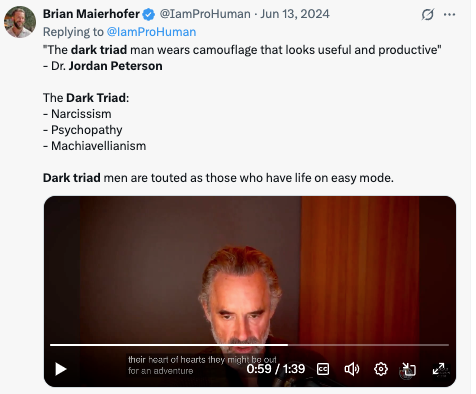
There are three information filters that allow journalists to bend reality using verifiable facts.

#1 – Story selection. Each day offers thousands of stories, and editors typically highlight those that align with an ideological perspective. Politically inconvenient events can be ignored or buried with minimal coverage.

#2 – Fact selection within stories. The amount of details within a particular event is massive, and a journalist needs to choose which ones are relevant. I once worked with a journalist who had been covering a series of attacks on Indian students on public transport. The outlet’s interest was in the racial angle, but an interviewee mentioned other victims. She asked about their nationality, then chose not to pursue those attacks in detail because the victims were Australian. A single vague line made the final cut, and the piece implied racial motive when it couldn’t have been.

#3 – Framing facts with emotive conjugation. For instance, if I’m covering someone I don’t like, he’s cheap; if I’m neutral, he’s frugal; if I like him, he’s thrifty. Someone can be passionate, emotional, or hysterical; careful, hesitant, or cowardly; they can glisten, perspire, or sweat. This is subtle, but once you notice it, you’ll find that even though there’s better and worse news, none of it is purely objective.

Continue ReadingThe Gymnastics many “News” Providers Do with Verifiable Facts

Reverse Engineer Your Mind and Body

In his excellent book, Outlive: The Science and Art of Longevity, Peter Attia stresses the importance of intentionally putting in the time now to safeguard your physical function and independence in later decades. He refers to this as the "Centenarian Decathlon," where individuals reverse-engineer their fitness goals by imagining the physical demands they'll face in their 90s or 100s—such as carrying groceries, playing with grandchildren, hiking, or simply rising from the floor unaided, and then building the necessary strength, stability, and endurance today to make those activities possible and perhaps likely.

Attia warns that without this forward-thinking approach, natural age-related declines (like muscle loss, reduced VO₂ max, and joint instability) erode over time, causing your body to become frail. Instead, you need to treat exercise as the most powerful "drug" for longevity, structured around four pillars: stability (to prevent injury and support safe movement), strength (to build muscle reserve), aerobic efficiency (for cardiovascular health), and anaerobic performance (for high-intensity bursts). An excerpt:

I ask all my patients to sketch out an alternative future for themselves. What do you want to be doing in your later decades? What is your plan for the rest of your life?

Everyone has a slightly different answer--they might want to travel, or continue playing golf or hiking in nature, or simply be able to play with their grandkids and great-grandkids (top of my own list). The point of this exercise is twofold. First, it forces people to focus on their own endgame, which most of us might prefer to avoid thinking about. Economists call this "hyperbolic discounting," the natural tendency for people to choose immediate gratification over potential future gains, especially if those gains entail hard work. Second, it drives home the importance of healthspan. If Becky wants to enjoy a healthy, rewarding life in her later years, and not repeat her mother's fate, she will have to maintain and hopefully improve her physical and cognitive function every decade between now and then. Otherwise, the gravitational pull of aging will do its thing, and she will decline, just as her mother did....

You remain relatively robust until about the fifth decade of life, at which point your cognitive and physical health will likely begin a gradual but steady decline, until you die (healthspan = zero) sometime in your sixties or early seventies. This would have been a not untypical lifespan for someone born into a hunter-gatherer or primitive agrarian tribe, provided they managed to avoid early death thanks to infectious disease or another calamity.

Attia distinguishes lifespan from healthspan:

The important distinction here is that while actual death is inevitable, this deterioration that were talking about is less so. Not everyone who dies in their eighties or nineties passes through the valleys of cognitive, physical, or emotional destruction on the way there. They are preventable--and I believe that they are largely optional, despite their ever-increasing gravitational pull over time. As we will see in later chapters, cognitive, physical, and even emotional deterioration can all be slowed and even reversed in some cases with the application of the proper tactics.

The other key point is that lifespan and healthspan are not independent variables; they are tightly intertwined. If you increase your muscle strength and improve your cardiorespiratory fitness, you have also reduced your risk of dying from all causes by a far greater magnitude than you could achieve by taking any cocktail of medications. The same goes for better cognitive and emotional health. The actions we take to improve our healthspan will almost always result in a longer lifespan. This is why our tactics are largely aimed at improving healthspan first; the lifespan benefits will follow.

[ pp. 40-46] Attia urges that by investing effort today you will "future-proof" your body, preventing decline so your older self remains capable and vibrant. In essence, Attia argues that if you work on these things, you will be giving a gift to your future physical self, enabling a higher quality of life rather than merely extending lifespan.

Why not do something similar to protect your mind? Exerting cognitive load builds up your ability to think. Reading widely (rather than simply following corporate news) will protect you from being manipulated by gaslighting and psyops. Now is the time to protect that version of you that will exist in five or 10 years!

[Supp Oct 3, 2025]

Lack of concern with health and growth, even if done in private, are obvious in public. One's huge belly is a lie detector regarding one's bad diet & and lack of exercise. One's willingness to make ad hominem arguments betrays one's refusal to engage with uncomfortable ideas.

Continue ReadingReverse Engineer Your Mind and Body

Remembering the Good Old Days When Evidence Mattered

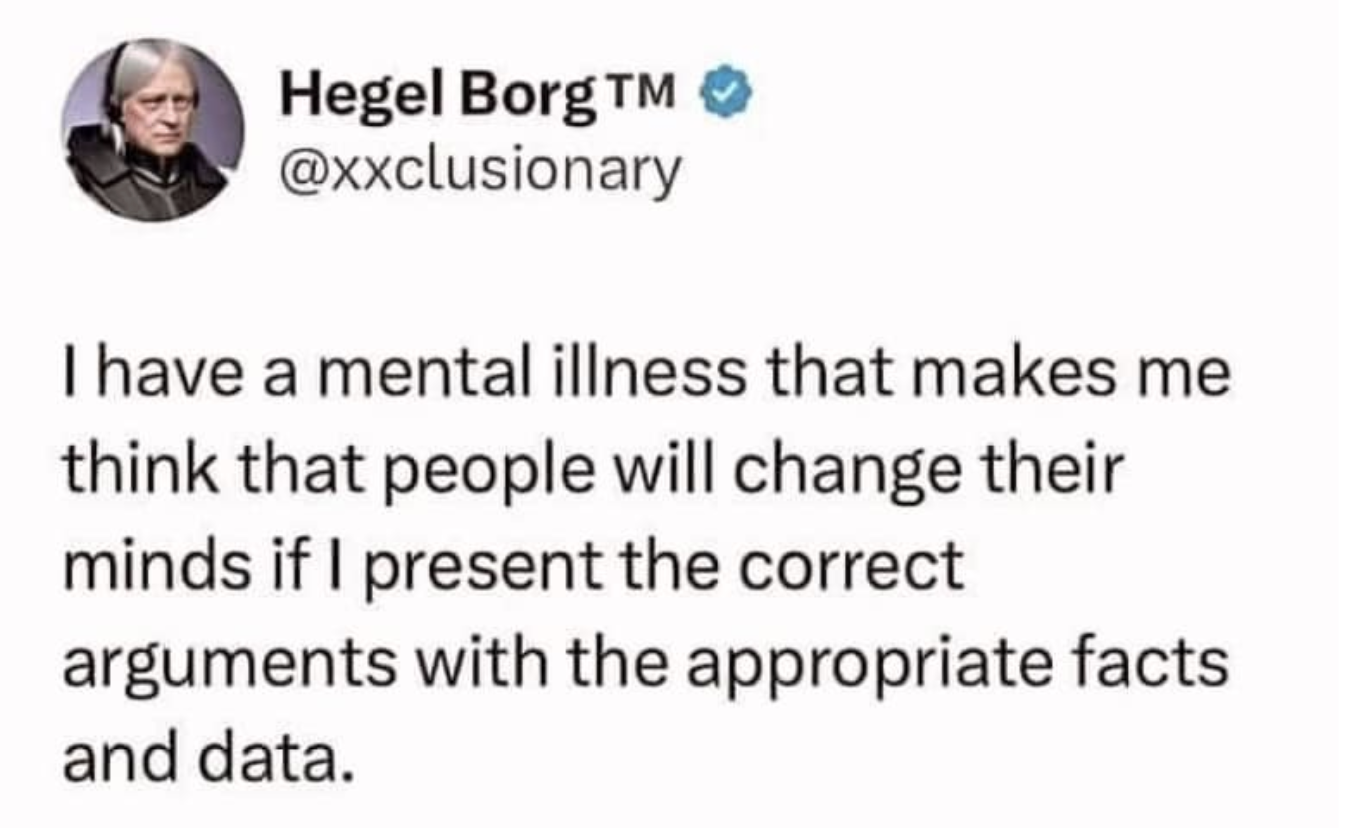
"I have a mental illness that makes me think that people will change their minds if i present the correct arguments with the appropriate facts and data."

And to make things even worse, consider the Boomerang Effect. I turn to Grok:

The boomerang effect (also known as the backfire effect in some psychological literature). Is a persuasion paradox where presenting strong evidence or arguments to debunk a false belief doesn't sway people; instead, it often reinforces their original misconception, making them dig in even deeper. This happens because the challenge feels like a threat to their identity, worldview, or autonomy, triggering defensive reasoning—think of it as the brain "boomeranging" the message right back at you with amplified conviction.Classic examples include political debates (e.g., fact-checking a conspiracy theory that only rallies believers more) or health campaigns (e.g., anti-smoking ads that ironically boost smoking among defiant teens). Studies show it spikes when the persuasion feels too forceful, emotional, or condescending, as people resist perceived control. To counter it, softer approaches like asking open questions or building rapport work better than direct confrontation.It's a frustrating reminder that facts alone don't always win—emotions and ego often steal the show.

Continue ReadingRemembering the Good Old Days When Evidence Mattered

Jeffrey Tucker Describes the Bleak State of the World

Jeffrey Tucker has ambitiously taken the temperature of the political, economic and social world with an article titled: "The Coup, the Calamity, and the Conspiracy." I highly recommend a full read.

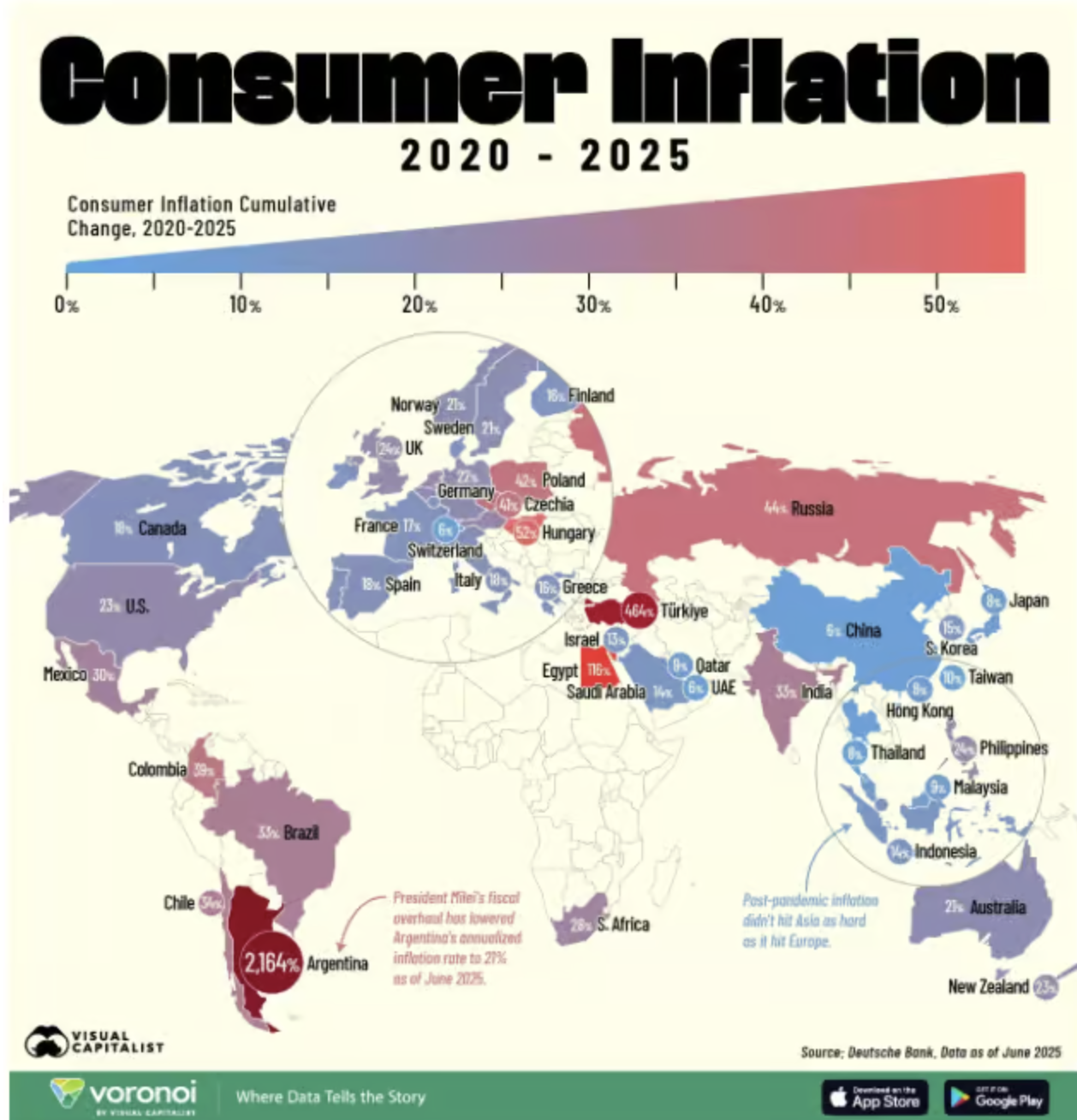
Tucker begins with this graphic:

Here is an excerpt:

[Y]ou could be more realistic and see that this was not a mistake at all. It was entirely intentional, the unfolding of a dark scheme hatched by an indescribably sadistic ruling class. Indeed, if this had all been an accident, we surely would have heard someone apologize by now.

There is also the planning involved. There was Event 201, the lesser-known Crimson Contagion, and many others. They are usually described in the mainstream press as rehearsals for unplanned contingencies, like resiliency training. Absurd. This was plotted far in advance. We have all the receipts. To realize this and connect the dots does not make you a conspiracy theorist. It makes you a person with the capacity to think.

To deny nefarious motives and schemes makes you impossibly naive to the point of sedation. At best, it makes you ill-read in history.

After five years, what can we say was the plan and purpose of this calamity? We all have our views. Certainly within Brownstone ranks, there are many opinions. We argue among ourselves all the time. Coming up with a clean and clear explanation is not easy because there are so many moving parts and so many industrial opportunists who took advantage of the crisis to cash out.

This is such an expansive article that resonated with me over and over.

I have many of the same concerns, but I won't say much here. I will say (as Tucker mentions in the early paragraphs) that I'm sure how well coordinated all of the powerful players are. Just because they are well-entrenched, monied and politically connected doesn't mean that they necessarily agree with each other day to day, much less year to year. But in my mind, there is definitely a hell of a lot of coordination.

The best solution to this horrific anti-Democratic mess is a vigorous, courageous and free press, but the powers-that-be know this deeply and they've got the formerly half-respectable "journalism" industry 95% locked down.

So in the meantime, it's Jeffrey Tucker, independent media and people like you and me doing what we can. It feels like a David and Goliath battle, especially when you see Trump kowtowing to Pfizer, just like Biden did and harris would have

Continue ReadingJeffrey Tucker Describes the Bleak State of the World

About the Dark Triad

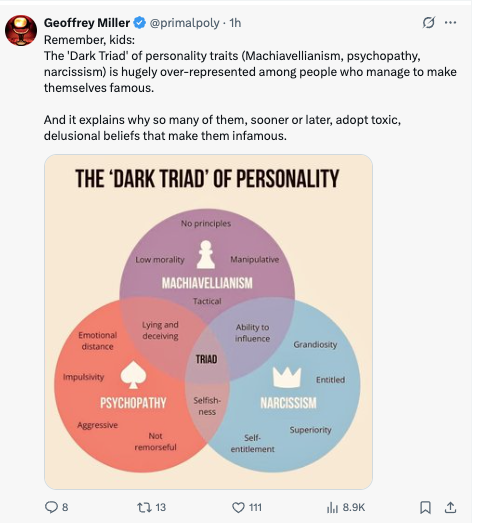
Evolutionary biologist Geoffrey Miller explains the concept:

Remember, kids:

The 'Dark Triad' of personality traits (Machiavellianism, psychopathy, narcissism) is hugely over-represented among people who manage to make themselves famous.

And it explains why so many of them, sooner or later, adopt toxic, delusional beliefs that make them infamous.

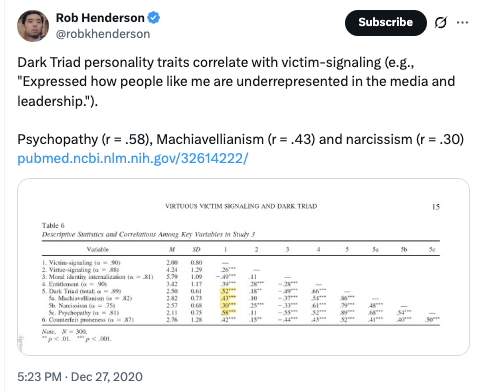
Rob Henderson adds this:

Dark Triad personality traits correlate with victim-signaling (e.g., "Expressed how people like me are underrepresented in the media and leadership.").

Psychopathy (r = .58), Machiavellianism (r = .43) and narcissism (r = .30)

https://pubmed.ncbi.nlm.nih.gov/32614222/

Psychologist Jordan Peterson:

Jordan Peterson:

We're talking about this Machiavellian personality triad, the dark triad, ... Okay, so here's something really interesting. It's the bad boy paradox. They call it that. Young, naive women are attracted to those Machiavellian types, but when they get older and more experienced, they start to be able to see through that. The reason they're attracted to it, as far as I can tell, and I talked about this with bus to see if I was way off on the wrong track, is that those reckless, fearless people mimic real, fearless competence. And young women aren't good at distinguishing between the two, and so they get sucked in by the sort of psychopathic recklessness, because they think it's fearless competence. And of course, the guys who are doing that, they'll prey on that because they're trying to ape competence. But what the women are really after in their heart of hearts, they might be out for an adventure too, because there's that element of it. But they want that fearlessness that does go along with true generosity and competence and also the ability to keep, you know, real darkness away so well.

[Unknown speaker]

A lot of those people who display that kind of, what you call mimicking fearlessness macho, that's they're actually hiding the opposite. They're actually very, very riddled with insecurities. They're not, you know, and they're, they're, they kind of create this sort of bravado and this false front, and they go to an extreme to kind of project this machismo when, in fact, they're riddled with insecurities. And that's their way of dealing with it. With it.

Continue ReadingAbout the Dark Triad