Words Are Not Violence

When I was growing up, we often said "Sticks and stones will break my bones, but words will never hurt me." Last year, I spoke these words at a free speech presentation at a local library and the participants glared at me. I get the same stares when, after I am told that something I said was offensive, I respond by saying "You do you." or "Live and let live" or "To each his own." There are other expressions that don't fare well around the many self-appointed nannies inhabiting American universities, where wokeness still runs amok:

Be yourself

Do your thing

Do your own thing

Be true to yourself

To each their own

Live and let live

I was reminded that it still takes thick skin to say these common sense sorts of things in many places when I spotted this meme:
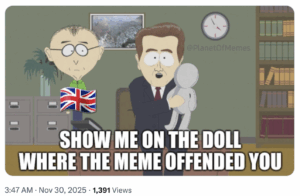
Words are not violence, yet this obvious and useful distinction is being willfully ignored and at great peril to societal flourishing. In his article at Free Press, "Bury the ‘Words Are Violence’ Cliché," Greg Lukianoff comments on this important distinction:

Words are not bullets. Words can’t strike a man from 142 yards away, causing a torrent of blood to erupt from his wound, sending him first to the hospital and then to the morgue. Only bullets can do that.

Upholding that distinction is the North Star of everything I do as president of the Foundation for Individual Rights and Expression (FIRE). For years, I’ve warned that equating words with violence erases the bright line liberal societies drew after centuries of bloodshed. The law draws this line with precision. Advocacy, even vile advocacy, remains protected unless it is intended and likely to produce imminent lawless action. That’s the Brandenburg standard, and it exists because the alternative is to let the powerful decide which ideas are allowed.

Or, as the Supreme Court put it in Texas v. Johnson, “If there is a bedrock principle underlying the First Amendment, it is that the government may not prohibit the expression of an idea simply because society finds the idea itself offensive or disagreeable.” These aren’t lawyerly niceties; they are the safety valves of pluralism. Blur them, and real violence becomes more, not less, likely.

Campus culture has been eroding that line for years. Students are told that offensive ideas are “harm,” that “silence is violence,” and—in a flourish that should now embarrass its users—that speech can be “literally” violence. Jonathan Haidt and I pushed back on that argument almost a decade ago. It’s conceptually wrong and practically dangerous—and has only grown in influence. Teach students that objectionable speech is violence and you invite them to see their own aggression as self-defense. [emphasis added]. This is the bloody fallacy we just witnessed: Accept the premise that rhetoric is a physical attack and you hand extremists a moral permission slip to answer speech with force. We need to bury this trope. Retire it—from classrooms, HR trainings, and editorials—for good.

The numbers show how far the rot has spread. FIRE’s new College Free Speech Rankings, which surveyed nearly 70,000 students across 257 campuses, find a record share now rationalizing coercion. Roughly 34 percent of students say that using violence to stop a campus speech can be acceptable in some circumstances; roughly 70–72 percent say the same about shouting down speakers. In 2021, the violence number was in the low 20s; by last year it was 32 percent. It should be zero. A university that can’t persuade students to reject violence categorically is failing at the first task of liberal education.

Continue ReadingWords Are Not Violence

Short History of Leftist Violence

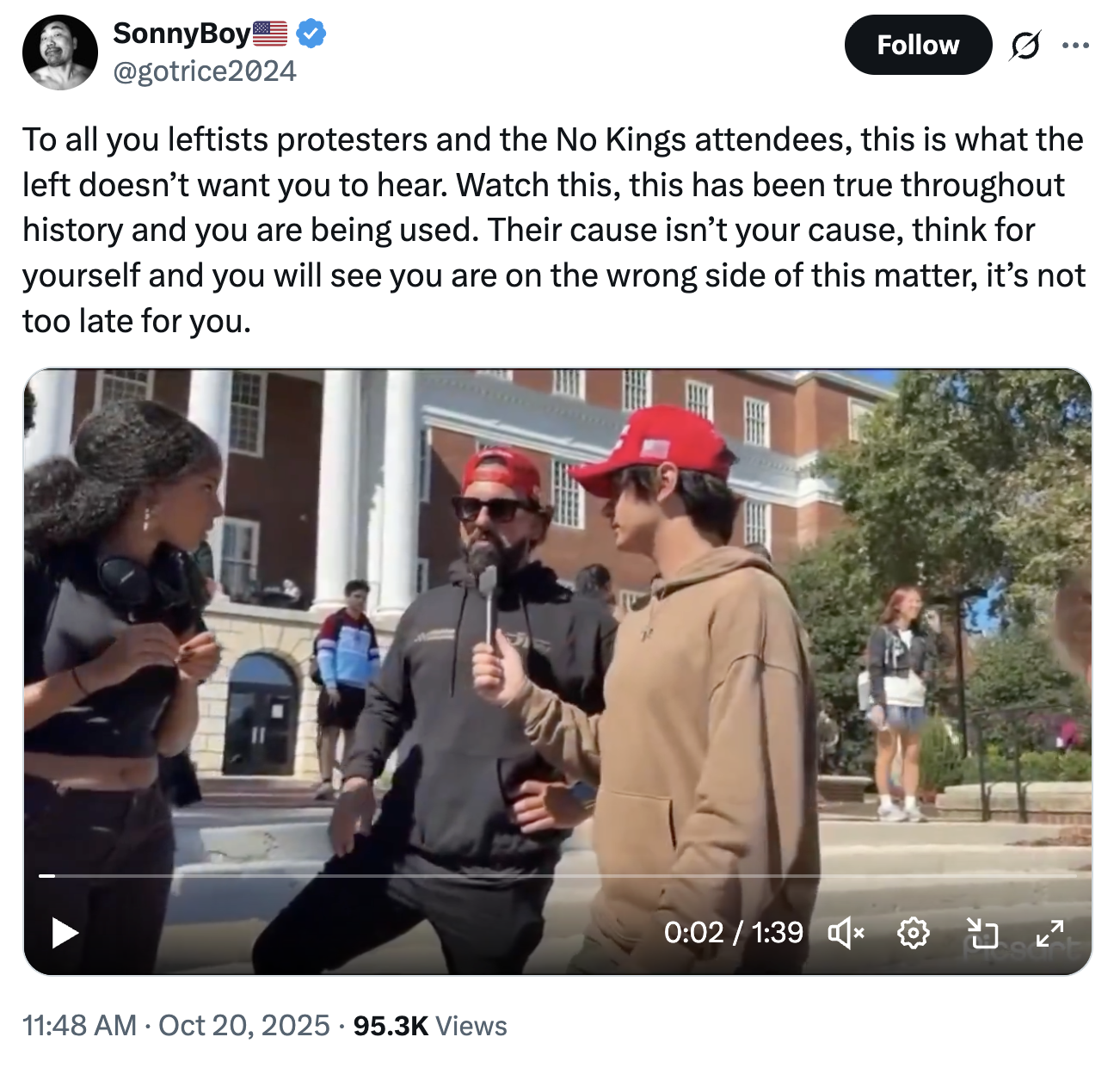
To all you leftists protesters and the No Kings attendees, this is what the left doesn’t want you to hear. Watch this, this has been true throughout history and you are being used. Their cause isn’t your cause, think for yourself and you will see you are on the wrong side of this matter, it’s not too late for you.

Continue ReadingShort History of Leftist Violence

Luxury Beliefs in Chicago

Rob Henderson coined the term "Luxury Beliefs" as follows:

Luxury beliefs are ideas and opinions that confer status on the upper class while inflicting costs on the lower classes.

Here, Rob offers a more expansive discussion:
In addition to my own experiences with social mobility, my luxury beliefs idea stems from Thorstein Veblen’s work, particularly his 1899 book, The Theory of the Leisure Class. Veblen, a sociologist and economist, described how the elites of his era displayed their status through conspicuous consumption, such as wearing delicate, expensive clothing, carrying pocket watches, or attending lavish ballroom events. While material possessions still play a role in signaling status today, I argue that they have become a noisier indicator of wealth. A century ago, one could easily distinguish the rich from the poor based on appearance alone. However, in our wealthier modern society, where access to goods is more widespread, it’s harder to gauge someone’s wealth at a glance.

Instead, status is increasingly expressed through what I call luxury beliefs, which have largely replaced luxury goods. These beliefs reflect what sociologist Pierre Bourdieu termed cultural capital. Elites invest in attending prestigious schools and universities, where they adopt the mannerisms, vocabulary, habits, and fashionable opinions of the upper class. This process enculturates them into the elite and sets them apart from the broader population. For example, while the conventional view might support law enforcement, someone seeking to signal their elite status might advocate for abolishing the police or reimagining law enforcement with ideas like hiring “violence interrupters.” Such unconventional or avant-garde views serve as a way to distinguish oneself from the masses and signal a superior social position.

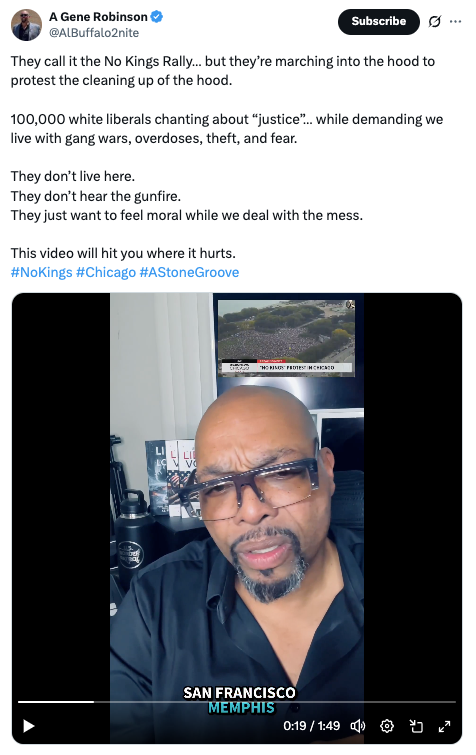
Today, I noticed this post by A Gene Robinson, who doesn't use the term "luxury beliefs," but is angry about non-stop high crime in Chicago contrasted with what he considered the detached cheap signaling of those who participated in the Chicago No Kings Rally:

I asked Grok to compare the economic circumstances of those in Chicago's crime ridden neighborhoods to the circumstances of people who work for corporate media:

Corporate media workers earn 2–5 times more than residents in these Chicago neighborhoods ($60,000+ vs. $25,000–$50,000), enabling comfortable lifestyles with savings, travel, and leisure. They benefit from employer perks like health insurance and flexible time off, contrasting with reliance on public aid in high-crime areas, where poverty rates are 2–3 times higher (40%+ vs. national 12%). Media lifestyles involve professional growth and urban amenities, while these neighborhoods face survival challenges, unemployment-driven desperation, and violence that perpetuates economic stagnation. This disparity highlights broader urban inequalities, where media professionals might even report on these communities from a position of relative privilege.

Then I asked Grok to compare the economic circumstances of those in Chicago's crime-ridden neighborhoods to those who marched in the Chicago no-kings rally:

The economic divide between residents of Chicago's crime-ridden neighborhoods and No Kings rally marchers is stark, highlighting urban inequalities in race, class, and opportunity. Neighborhood residents endure entrenched poverty, with incomes 2–4 times lower than the implied stability of rally participants, who benefit from assets like homes and retirement funds accumulated over decades.

While the former face unemployment, reliance on aid, and violence-linked economic stagnation, marchers—often older, white, and from more affluent backgrounds—enjoy financial security enabling activism without personal economic risk.

This contrast underscores how protests like No Kings may draw from privileged demographics, potentially overlooking the direct economic hardships in the city's most vulnerable areas.

Continue ReadingLuxury Beliefs in Chicago

Jeffrey Tucker Describes the Bleak State of the World

Jeffrey Tucker has ambitiously taken the temperature of the political, economic and social world with an article titled: "The Coup, the Calamity, and the Conspiracy." I highly recommend a full read.

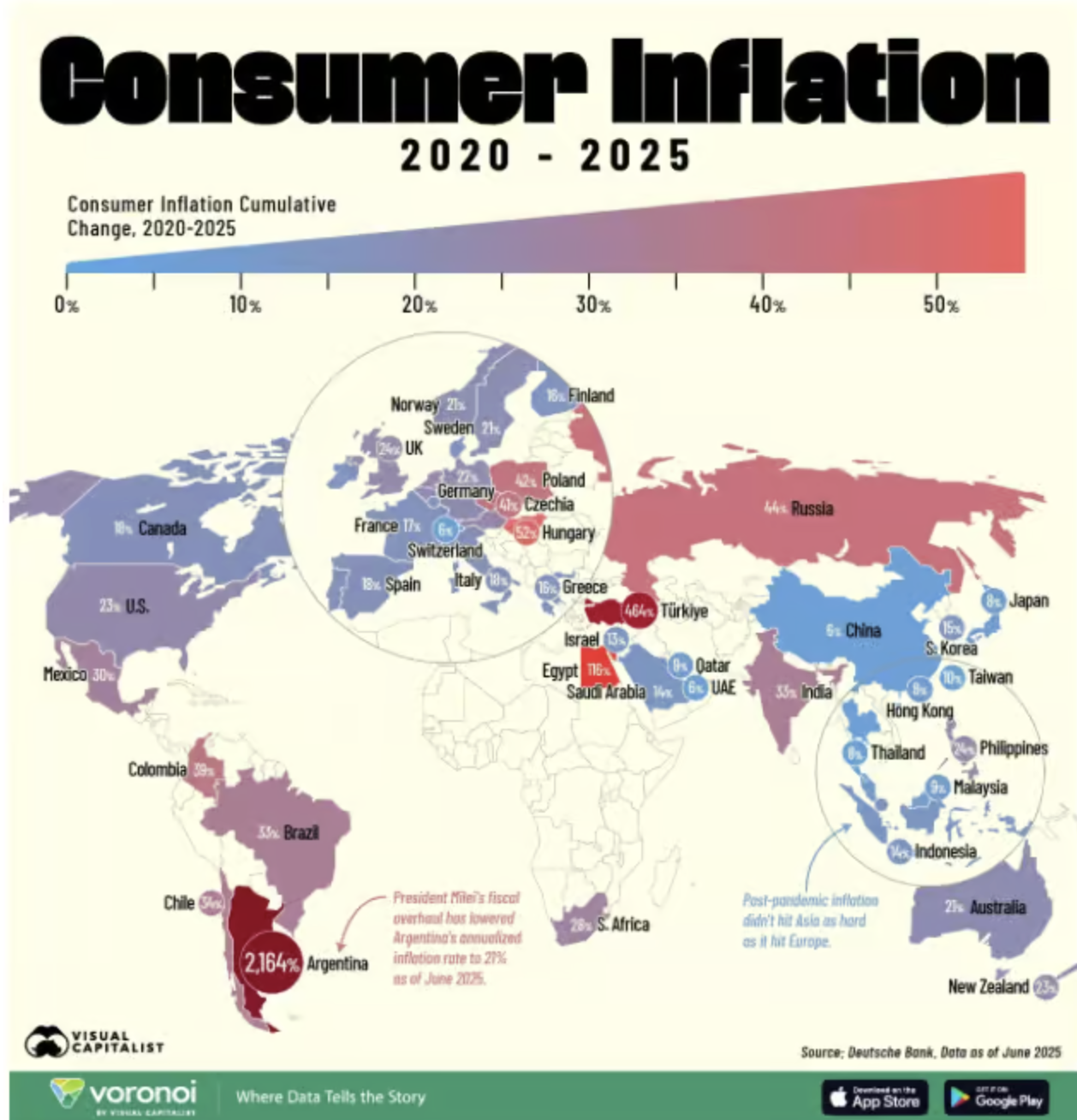
Tucker begins with this graphic:

Here is an excerpt:

[Y]ou could be more realistic and see that this was not a mistake at all. It was entirely intentional, the unfolding of a dark scheme hatched by an indescribably sadistic ruling class. Indeed, if this had all been an accident, we surely would have heard someone apologize by now.

There is also the planning involved. There was Event 201, the lesser-known Crimson Contagion, and many others. They are usually described in the mainstream press as rehearsals for unplanned contingencies, like resiliency training. Absurd. This was plotted far in advance. We have all the receipts. To realize this and connect the dots does not make you a conspiracy theorist. It makes you a person with the capacity to think.

To deny nefarious motives and schemes makes you impossibly naive to the point of sedation. At best, it makes you ill-read in history.

After five years, what can we say was the plan and purpose of this calamity? We all have our views. Certainly within Brownstone ranks, there are many opinions. We argue among ourselves all the time. Coming up with a clean and clear explanation is not easy because there are so many moving parts and so many industrial opportunists who took advantage of the crisis to cash out.

This is such an expansive article that resonated with me over and over.

I have many of the same concerns, but I won't say much here. I will say (as Tucker mentions in the early paragraphs) that I'm sure how well coordinated all of the powerful players are. Just because they are well-entrenched, monied and politically connected doesn't mean that they necessarily agree with each other day to day, much less year to year. But in my mind, there is definitely a hell of a lot of coordination.

The best solution to this horrific anti-Democratic mess is a vigorous, courageous and free press, but the powers-that-be know this deeply and they've got the formerly half-respectable "journalism" industry 95% locked down.

So in the meantime, it's Jeffrey Tucker, independent media and people like you and me doing what we can. It feels like a David and Goliath battle, especially when you see Trump kowtowing to Pfizer, just like Biden did and harris would have

Continue ReadingJeffrey Tucker Describes the Bleak State of the World

Eli Steele Identifies the Hidden Root of Leftist Violence

I'm concerned that Eli Steele has correctly pointed out a problem that has no obvious solution. Certainly no quick fix:

One unique aspect of Leftist-driven violence often goes unnoticed. The recent bloodshed, vandalism, and intimidation that we’ve seen aren’t random but the predictable fallout of a worldview that reduces human complexity to fixed ideological identities. The Left’s obsession with immutable traits -- race, gender, sex -- creates a victimhood hierarchy where dissent feels like an existential threat. When challenged, responses spiral into denial, defensiveness, or even violence from those unable to defend their dogma. This isn’t mere political disagreement, but the grim consequence of a belief system that rejects the Enlightenment’s focus on reason and individuality for rigid orthodoxy.

Recent events expose this pattern. The assassination of Charlie Kirk by Tyler Robinson, radicalized through Leftist politics and his transgender partner’s identity struggles, shows how loyalty to identity can turn lethal when faced with opposing views. School shootings like Audrey Hale’s 2023 Nashville attack and Robin Westman’s 2025 Minneapolis shooting reveal how issues with or challenges to gender identity can ignite rage. Elias Rodriguez’s 2025 murder of two Israeli Embassy employees, accompanied by cries of “shame on Zio-Nazi terror,” reflects a worldview -- shared by many pro-Hamas supporters -- that reduces Jews, Israeli or not, to whites and oppressors. The decade-long wave of Black Lives Matter protests, grounded in claims of systemic racial oppression, fueled riots that caused billions in damages, claimed lives, and pressured countless American institutions into adopting reductive racial identity politics as dogma.

Beyond violence, this ideology breeds intimidation, silencing dissent with threats of job loss or social ostracism. Rooted in identity determinism, this intellectual dead-end leaves no room for nuance or growth, increasing the potential for violence among those trapped in its logic -- a logic now taught to young minds through ethnic studies in K-12 schools.

If we cannot force the Left to retreat from its fixation on identity politics through the ballot box and all legal means, this ideology will only sow ever-increasing division and violence. This challenge is daunting because it demands stripping people of their very identities grounded in immutable characteristics and showing them their worth lies elsewhere -- their character. They will fight with everything they have.

To break this cycle, we must reject the notion that immutable traits dictate moral worth and recommit to reason and individuality. Until the Left abandons its dogma, it will continue to fuel conflict—a stark reminder of what happens when ideological orthodoxy drowns out dialogue.

One way to reject the notion that immutable traits dictate moral worth would be to make sure we remove all financial and social status incentives for enshrining immutable traits. But I am pessimistic that that we can make any headway by engaging in conversation. Where to start?

Continue ReadingEli Steele Identifies the Hidden Root of Leftist Violence