Jeffrey Sachs Discusses U.S. Wars and Lies

Jeffrey Sachs:

Jeffrey Sachs on X:

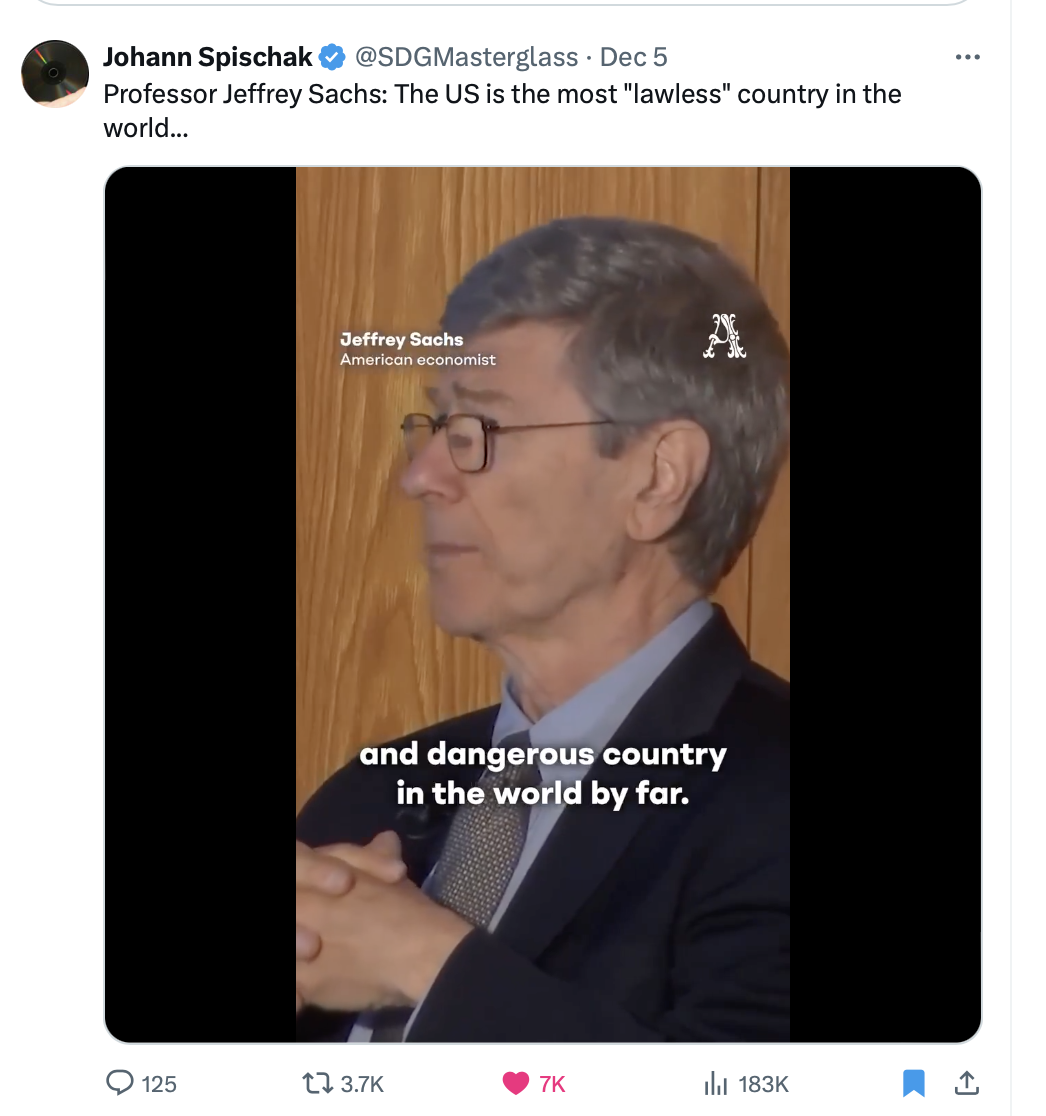
I regard the United States as the most lawless, dangerous country in the world by far. You cannot believe how much misinformation we get every single day. Because I have advised more than 100 governments around the world. I have seen things with my own eyes. I've seen U.S. CIA coups. With my own eyes. Governments lie, but superpowers make super lies. And if you're running the largest war machine in the world, you are going to lie all the time,

The entire Iraq war was not because they thought there were weapons of mass destruction. Weapons of Mass Destruction was the outcome of a focus group inside the Pentagon. How are we going to sell this war to the American people? Who made the decision two days ago that ATACMs can shoot deep inside Russia, another brilliant move. We don't even know if the President of the United States is Compos Mentis. Right now we have a deep state that makes these decisions. Not a word of explanation to the American people. It's all lies, and I've seen it all through my life, because I've been advisers to prime ministers and to presidents and to central bank governors and to some of the wonderful people on this panel, and I've seen a lot.

Continue ReadingJeffrey Sachs Discusses U.S. Wars and Lies

Only 20% of Americans Deny that “Words Can Be Violence”

Remember the old chant many of us said as kids? The website "US Dictionary" indicates it was already considered to be an old adage in 1862 when it appeard in a publication of the African Methodist Episcopal Church. US Dictionary describes this adage further:

The phrase "sticks and stones may break my bones" is a well-known children's rhyme. It is often used as a retort to verbal insults or name-calling, suggesting that physical harm from sticks and stones might injure one, but words will not cause any physical harm.
I remember using this saying when I was a kid into adulthood.

How was this adage used over the years? US Dictionary:

The phrase "sticks and stones may break my bones" is a classic saying that serves as a defense against verbal bullying or insults. It's often completed with the line, "But words will never hurt me." The idea behind the phrase is that physical objects, like sticks and stones, can cause physical harm, but intangible words cannot cause physical pain. This phrase is frequently taught to children as a way of coping with name-calling or verbal bullying, encouraging them not to be hurt by hurtful words.

More about the phrase's meaning:

It's often used to encourage resilience against verbal abuse or insults.

The phrase emphasizes the distinction between physical and emotional harm.

It serves as a reminder that words, while potentially hurtful, cannot inflict physical pain.

It is often used in educational settings to teach children about coping mechanisms for bullying.

Similar phrases include "Words can never hurt me" and "I'm rubber, you're glue."

In other words, the Sticks and Stones saying is time tested wisdom, but then something happened. In a recent poll by FIRE, "SHOCKING: 4 in 5 Americans think ‘words can be violence’"

The poll results:

In a new FIRE poll, 4 in 5 Americans (80%) agree at least slightly with the idea that “words can be violence.”

Democrats and women were most likely to agree words are violence, and Republicans and men were least likely to agree.

Only slightly more than a third of Americans (37%) think citizens should have the right to use profanity when speaking to elected officials.

PHILADELPHIA, Oct. 31, 2024 — In a disturbing new finding from the Foundation for Individual Rights and Expression, 4 in 5 Americans agree to at least some degree with the idea that “words can be violence.”

In the latest edition of the quarterly National Speech Index, FIRE asked 1,000 Americans, “How much, if at all, does the following statement describe your thoughts: ‘Words can be violence.’”

Nearly half of Americans said that statement describes their thoughts either “mostly” (23%) or “completely” (22%).

Around a quarter responded that it describes their thoughts “somewhat” (22%). Another 12% responded that it matches their thoughts “slightly.”

Only a fifth (20%) responded that the statement “does not describe my thoughts at all.”

FIRE's poll results show that women who are democrats are the biggest advocates for this widespread idea that words can be violence.

Based on these results, one might conclude that words can actually be a form of violence. As FIRE explains, however, this is not true:

“Equating words with violence trivializes actual physical harm, shuts down conversations, and even encourages real violence by justifying the use of force against offensive speech,” said FIRE President and CEO Greg Lukianoff. “Free speech isn't violence, it's the best alternative to violence ever invented.”

Similarly, consider this statement on the topic by Lukianoff and Jonathan Haidt:

Lukianoff and Haidt argue that equating stress-causing speech with “violence,” as Feldman Barrett does, isn’t simply an overstatement. Instead, it’s students’ overblown perception of their own fragility — not exposure to the occasional offensive viewpoint — that’s causing widespread mental health problems among today’s college students.

Their prescription is sure to spark discussion in our nation’s college classrooms — and beyond.

“Free speech, properly understood, is not violence. It is a cure for violence.”

The above excerpt comes from an article in the Atlantic: "Why It's a Bad Idea to Tell Students Words Are Violence: A claim increasingly heard on campus will make them more anxious and more willing to justify physical harm." Here is the opening paragraph href="https://www.theatlantic.com/education/archive/2017/07/why-its-a-bad-idea-to-tell-students-words-are-violence/533970/">to that article:

Of all the ideas percolating on college campuses these days, the most dangerous one might be that speech is sometimes violence. We’re not talking about verbal threats of violence, which are used to coerce and intimidate, and which are illegal and not protected by the First Amendment. We’re talking about speech that is deemed by members of an identity group to be critical of the group, or speech that is otherwise upsetting to members of the group. This is the kind of speech that many students today refer to as a form of violence.

Continue ReadingOnly 20% of Americans Deny that “Words Can Be Violence”

Why the U.S. Has Ukrainian Blood on its Hands: Jeffrey Sachs Offers this Primer

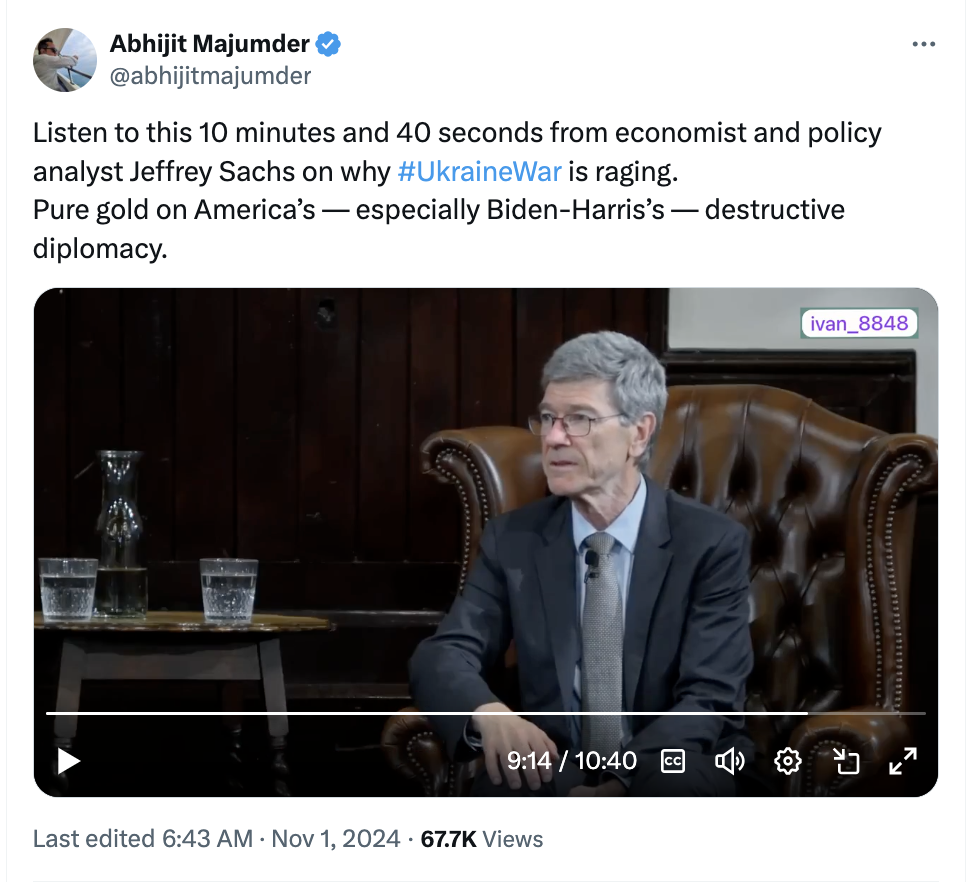
So many people I know proudly ignore the indisputable history of US meddling in Ukraine. Because they are ignorant, they deny that the US is responsible for the needless deaths of 600,000 Ukrainians and 70,000 Russians (and the squandering of the U.S. treasury). The Neocons in the Biden-Harris cabinet (including Biden and Harris) have blood on their hands, but you wouldn't know it because the corporate media has been covering it up and lying to you. The history of Ukraine did not begin in 2022. Please consider listening to Jeffrey Sachs for 10 minutes. These facts are not disputed by anyone who has been paying attention.

Continue ReadingWhy the U.S. Has Ukrainian Blood on its Hands: Jeffrey Sachs Offers this Primer

Censors as Identity Thieves

These censors are insidiously injection-molding your brain. They are existential identity thieves--secretly derailing you, forbidding you from organically becoming the person you were meant to be. In the aggregate, what they are doing is akin to mass murder and the corporate media and the DNC are cheerleading them on. The censorship-industrial complex denies us our unalienable rights to our own Lives, our own Liberty and the Pursuit of our Own happiness. It is all so disgustingly anti-American.

Mike Benz:

I'm standing in front of the global capital of Internet censorship. This is the venture capital arm of the censorship industry. You see, we have a censorship industrial complex, but the heart of it is the industry, the money. That's what makes it work. That's how you get 10s of thousands, hundreds of thousands. Now, at this point, worldwide, full time professional sensors, whose job is to monitor social media, propose censorship solutions, implement censorship techniques, and all of it is funded by this building right here.

And I'm calling on speaker Mike Johnson, as soon as this election passes, should Republicans keep the house. I'm calling on you to set up a special subcommittee for protecting digital speech against government abuse, so that we have an institutionalized Gang of Eight who is capable of taking apart the censorship industry limb by limb, in terms of its government funding. Every single NGO. Every single university. Every single private sector, censorship mercenary firm. Every single fact checker. Every single media organization that's getting money from the National Science Foundation, the Pentagon, the State Department, the Department of Homeland Security, the Justice Department, USAID, the National Endowment for Democracy.

This building has allowed an octopus to grow, and I will tell you for having spoken to innumerable members of Congress who want to do the right thing. There are so many of these programs, and they go by so many different camouflage names. They're not called censorship grants and programs. They'll be called "digital resilience" or "media literacy," or "information integrity" or "countering disinformation."

But it's not countering it by counter-speech. It's censorship. It's remove, reduce, inform. Ban or suspend. Apply friction techniques like shadow ban, search recommendation bans, demonetization, virality circuit breakers or permanent fact check interstitials that are designed to kill virality and feed into the algorithm for deboosting. It's all censorship. It's all funded by the building behind me. And this can all be stopped, but we need eight educated members of Congress to man a panel to do investigations, subpoenas, transcribed interviews and hearings, and we need a brave Speaker of the House who's willing to set that up. Mike Johnson, I'm calling on you.

Continue ReadingCensors as Identity Thieves

About Love Blindness

Biologist Steve Stewart-Williams:

When male fruit flies are courting females and close to mating, they become so fixated on the task at hand that they often fail to spot approaching predators. The phenomenon is known as love blindness.

I can think of some intriguing hypotheticals!

I subscribe to Stewart-Williams and highly recommend it. It is titled the Nature-Nurture-Nietzsche Newsletter.

Here are two more of the tidbits he offers this week:

A large, longitudinal study found no evidence that violent videogames make people more aggressive or less empathetic. Playing violent videogames is correlated with aggression. However, rather than violent videogames making people aggressive, people who are already aggressive gravitate to violent videogames. [Link.]

According to a fascinating new paper, people tend to assume they have all the information they need to reach a conclusion or make a decision. In a preregistered experiment, participants who were given only half the available information were just as confident in their decisions as those who were given all of it. The authors dubbed this the illusion of information adequacy.

Continue ReadingAbout Love Blindness